
UNITED STATES
SECURITIES AND EXCHANGE COMMISSION
Washington, D.C. 20549
FORM 10-K
| ANNUAL REPORT UNDER SECTION 13 OR 15(d) OF THE SECURITIES EXCHANGE ACT OF 1934 | |||||
For the fiscal year ended December 31 , 2024
OR
| TRANSITION REPORT UNDER SECTION 13 OR 15(d) OF SECURITIES EXCHANGE ACT OF 1934 | |||||
Commission File Number 001-35700
(Exact Name of Registrant As Specified in Its Charter)
| (State or Other Jurisdiction of Incorporation or Organization) | (I.R.S. Employer Identification Number) | ||||||||||
| (Address of principal executive offices) | (Zip code) | ||||||||||
(Registrant Telephone Number, Including Area Code): (432 ) 221-7400
| Securities registered pursuant to Section 12(b) of the Act: | |||||||||||||||||
| Title of Each Class | Trading Symbol(s) | Name of Each Exchange on Which Registered | |||||||||||||||
| (NASDAQ Global Select Market) | |||||||||||||||||
| Securities registered pursuant to Section 12(g) of the Act: None | |||||||||||||||||
Indicate by check mark if the registrant is a well-known seasoned issuer, as defined in Rule 405 of the Securities Act. Yes ☒ No ☐
Indicate by check mark if the registrant is not required to file reports pursuant to Section 13 or Section 15(d) of the Act. Yes ☐ No ☒
Indicate by check mark whether the registrant (1) has filed all reports required to be filed by Section 13 or 15(d) of the Securities Exchange Act of 1934 during the preceding 12 months (or for such shorter period that the registrant was required to file such reports), and (2) has been subject to such filing requirements for the past 90 days. Yes ☒ No ☐
Indicate by check mark whether the registrant has submitted electronically every Interactive Data File required to be submitted pursuant to Rule 405 of Regulation S-T (§ 232.405 of this chapter) during the preceding 12 months (or for such shorter period that the registrant was required to submit such files). Yes ☒ No ☐
Indicate by check mark whether the registrant is a large accelerated filer, an accelerated filer, a non-accelerated filer, a smaller reporting company, or an emerging growth company. See the definitions of “large accelerated filer,” “accelerated filer,” “smaller reporting company” and “emerging growth company” in Rule 12b-2 of the Exchange Act:
| ☒ | Accelerated Filer | ☐ | ||||||||||||||||||
| Non-Accelerated Filer | ☐ | Smaller Reporting Company | ||||||||||||||||||
| Emerging Growth Company | ||||||||||||||||||||
If an emerging growth company, indicate by check mark if the registrant has elected not to use the extended transition period for complying with any new or revised financial accounting standards provided pursuant to Section 13(a) of the Exchange Act. ☐
Indicate by check mark whether the registrant has filed a report on and attestation to its management’s assessment of the effectiveness of its internal control over financial reporting under Section 404(b) of the Sarbanes-Oxley Act (15 U.S.C. 7262(b)) by the registered public accounting firm that prepared or issued its audit report. ☒
If securities are registered pursuant to Section 12(b) of the Act, indicate by check mark whether the financial statements of the registrant included in the filing reflect the correction of an error to previously issued financial statements ☐
Indicate by check mark whether any of those error corrections are restatements that required a recovery analysis of incentive-based compensation received by any of the registrant’s executive officers during the relevant recovery period pursuant to §240.10D-1(b) ☐
Indicate by check mark whether the registrant is a shell company (as defined in Rule 12b-2 of the Exchange Act). Yes ☐ No ☒
Aggregate market value of the voting and non-voting common equity held by non-affiliates of registrant as of June 30, 2024 was approximately $35.5 billion.
As of February 21, 2025, 289,440,898 shares of the registrant’s common stock were outstanding.
DOCUMENTS INCORPORATED BY REFERENCE
Portions of Diamondback Energy, Inc.’s Proxy Statement for the 2025 Annual Meeting of Stockholders are incorporated by reference in Items 10, 11, 12, 13 and 14 of Part III of this Form 10-K.
DIAMONDBACK ENERGY, INC.
FORM 10-K
FOR THE YEAR ENDED DECEMBER 31, 2024
TABLE OF CONTENTS
| Page | |||||
i
GLOSSARY OF OIL AND NATURAL GAS TERMS
The following is a glossary of certain oil and natural gas industry terms used in this Annual Report on Form 10-K, which we refer to as this Annual Report or this report:
| 3-D seismic | Geophysical data that depict the subsurface strata in three dimensions. 3-D seismic typically provides a more detailed and accurate interpretation of the subsurface strata than 2-D, or two-dimensional, seismic. | ||||
| Argus WTI Houston | Grade of oil that serves as a benchmark price for oil at Houston, Texas. | ||||
| Argus WTI Midland | Grade of oil that serves as a benchmark price for oil at Midland, Texas. | ||||
| Basin | A large depression on the earth’s surface in which sediments accumulate. | ||||
| Bbl or barrel | One stock tank barrel, or 42 U.S. gallons liquid volume, used in this report in reference to crude oil or other liquid hydrocarbons. | ||||
| BO | One barrel of crude oil. | ||||
| BO/d | One barrel of crude oil per day. | ||||
| BOE | One barrel of crude oil equivalent, with six thousand cubic feet of natural gas being equivalent to one barrel of oil. | ||||
| BOE/d | Barrels of crude oil equivalent per day. | ||||
| Brent | A major trading classification of light sweet oil that serves as a benchmark price for oil worldwide. | ||||
| British Thermal Unit or BTU | The quantity of heat required to raise the temperature of one pound of water by one degree Fahrenheit. | ||||
| Completion | The process of treating a drilled well followed by the installation of permanent equipment for the production of natural gas or oil, or in the case of a dry hole, the reporting of abandonment to the appropriate agency. | ||||
| Condensate | Liquid hydrocarbons associated with the production that is primarily natural gas. | ||||
| Crude oil | Liquid hydrocarbons retrieved from geological structures underground to be refined into fuel sources. | ||||
| Developed acreage | Acreage allocated or assignable to productive wells. | ||||
| Development costs | Capital costs incurred in the acquisition, exploitation and exploration of proved oil and natural gas reserves. | ||||
| Differential | An adjustment to the price of oil or natural gas from an established spot market price to reflect differences in the quality and/or location of oil or natural gas. | ||||
| Dry hole or dry well | A well found to be incapable of producing hydrocarbons in sufficient quantities such that proceeds from the sale of such production exceed production expenses and taxes. | ||||
| Estimated Ultimate Recovery or EUR | Estimated ultimate recovery is the sum of reserves remaining as of a given date and cumulative production as of that date. | ||||
| Exploitation | A development or other project which may target proven or unproven reserves (such as probable or possible reserves), but which generally has a lower risk than that associated with exploration projects. | ||||
| Field | An area consisting of either a single reservoir or multiple reservoirs, all grouped on or related to the same individual geological structural feature and/or stratigraphic condition. | ||||
| Finding and development costs | Capital costs incurred in the acquisition, exploitation and exploration of proved oil and natural gas reserves divided by proved reserve additions and revisions to proved reserves. | ||||
| Fracturing | The process of creating and preserving a fracture or system of fractures in a reservoir rock typically by injecting a fluid under pressure through a wellbore and into the targeted formation. | ||||
| Gross acres or gross wells | The total acres or wells, as the case may be, in which a working interest is owned. | ||||
| Henry Hub | Natural gas gathering point that serves as a benchmark price for natural gas futures on the NYMEX. | ||||
| Horizontal drilling | A drilling technique used in certain formations where a well is drilled vertically to a certain depth and then drilled at a right angle within a specified interval. | ||||
| Horizontal wells | Wells drilled directionally horizontal to allow for development of structures not reachable through traditional vertical drilling mechanisms. | ||||
MBbls | One thousand barrels of crude oil and other liquid hydrocarbons. | ||||
| MBO | One thousand barrels of crude oil. | ||||
| MBO/d | One thousand barrels of crude oil per day. | ||||
| MBOE | One thousand barrels of crude oil equivalent, determined using a ratio of six Mcf of natural gas to one Bbl of crude oil, condensate or natural gas liquids. | ||||
| MBOE/d | One thousand BOE per day. | ||||
| Mcf | One thousand cubic feet of natural gas. | ||||
| Mineral interests | The interests in ownership of the resource and mineral rights, giving an owner the right to profit from the extracted resources. | ||||
| MMBtu | One million British Thermal Units. | ||||
| MMcf | Million cubic feet of natural gas. | ||||
ii
| Net acres or net wells | The sum of the fractional working interest owned in gross acres. | ||||
| Net revenue interest | An owner’s interest in the revenues of a well after deducting proceeds allocated to royalty, overriding interests and other burdens. | ||||
| Net royalty acres | Net mineral acres multiplied by the average lease royalty interest and other burdens. | ||||
| Oil and natural gas properties | Tracts of land consisting of properties to be developed for oil and natural gas resource extraction. | ||||
| Operator | The individual or company responsible for the exploration and/or production of an oil or natural gas well or lease. | ||||
Play or Resource play | A set of discovered or prospective oil and/or natural gas accumulations sharing similar geologic, geographic and temporal properties, such as source rock, reservoir structure, timing, trapping mechanism and hydrocarbon type. | ||||
| Plugging and abandonment | Refers to the sealing off of fluids in the reservoir penetrated by a well so that the fluids from one reservoir will not escape into another or to the surface. Regulations of all states require plugging of abandoned wells. | ||||
| PUD | Proved undeveloped reserves. | ||||
| Productive well | A well that is found to be mechanically capable of producing hydrocarbons in sufficient quantities such that proceeds from the sale of the production exceed production expenses and taxes. | ||||
| Prospect | A specific geographic area which, based on supporting geological, geophysical or other data and also preliminary economic analysis using reasonably anticipated prices and costs, is deemed to have potential for the discovery of commercially recoverable hydrocarbons. | ||||
| Proved developed reserves | Reserves that can be expected to be recovered through existing wells with existing equipment and operating methods. | ||||
| Proved reserves | The estimated quantities of oil, natural gas and natural gas liquids which geological and engineering data demonstrate with reasonable certainty to be commercially recoverable in future years from known reservoirs under existing economic and operating conditions. | ||||
| Proved undeveloped reserves | Proved reserves that are expected to be recovered from new wells on undrilled acreage or from existing wells where a relatively major expenditure is required for recompletion. | ||||
| Recompletion | The process of re-entering an existing wellbore that is either producing or not producing and completing new reservoirs in an attempt to establish or increase existing production. | ||||
| Reserves | Reserves are estimated remaining quantities of oil and natural gas and related substances anticipated to be economically producible, as of a given date, by application of development projects to known accumulations. In addition, there must exist, or there must be a reasonable expectation that there will exist, the legal right to produce or a revenue interest in the production, installed means of delivering oil and natural gas or related substances to the market and all permits and financing required to implement the project. Reserves should not be assigned to adjacent reservoirs isolated by major, potentially sealing, faults until those reservoirs are penetrated and evaluated as economically producible. Reserves should not be assigned to areas that are clearly separated from a known accumulation by a non-productive reservoir (i.e., absence of reservoir, structurally low reservoir or negative test results). Such areas may contain prospective resources (i.e., potentially recoverable resources from undiscovered accumulations). | ||||
| Reservoir | A porous and permeable underground formation containing a natural accumulation of producible natural gas and/or crude oil that is confined by impermeable rock or water barriers and is separate from other reservoirs. | ||||
| Royalty interest | An interest that gives an owner the right to receive a portion of the resources or revenues without having to carry any costs of development, which may be subject to expiration. | ||||
| Spacing | The distance between wells producing from the same reservoir. Spacing is often expressed in terms of acres (e.g., 40-acre spacing) and is often established by regulatory agencies. | ||||
Standardized measure | The present value of estimated future net revenue to be generated from the production of proved reserves, determined in accordance with the rules and regulations of the SEC (using prices and costs in effect as of the date of estimation), less future development, production and income tax expenses, and discounted at 10% per annum to reflect the timing of future net revenue. | ||||
| Tight formation | A formation with low permeability that produces natural gas with very low flow rates for long periods of time. | ||||
| Undeveloped acreage | Lease acreage on which wells have not been drilled or completed to a point that would permit the production of economic quantities of oil and natural gas regardless of whether such acreage contains proved reserves. | ||||
| Waha Hub | Natural gas gathering point that serves as a benchmark price for natural gas at western Texas and New Mexico. | ||||
Wellbore | The hole drilled by the bit that is equipped for oil or natural gas production on a completed well. | ||||
| Working interest | An operating interest that gives the owner the right to drill, produce and conduct operating activities on the property and receive a share of production and requires the owner to pay a share of the costs of drilling and production operations. | ||||
| WTI | West Texas Intermediate, a light sweet blend of oil produced from fields in western Texas and is a grade of oil that serves as a benchmark for oil on the NYMEX. | ||||
| WTI Cushing | Grade of oil that serves as a benchmark price for oil at Cushing, Oklahoma. | ||||
iii
GLOSSARY OF CERTAIN OTHER TERMS
The following is a glossary of certain other terms that are used in this Annual Report:
| ASU | Accounting Standards Update. | ||||
| Company | Diamondback Energy, Inc., a Delaware corporation, together with its subsidiaries. | ||||
| Dodd-Frank Act | Dodd-Frank Wall Street Reform and Consumer Protection Act (HR 4173). | ||||
| EPA | U.S. Environmental Protection Agency. | ||||
| Equity Plan | The Company’s 2021 Amended and Restated Equity Incentive Plan. | ||||
| Exchange Act | The Securities Exchange Act of 1934, as amended. | ||||
| FASB | Financial Accounting Standards Board. | ||||
| FERC | Federal Energy Regulatory Commission. | ||||
| GAAP | Accounting principles generally accepted in the United States. | ||||
| LIBOR | The London interbank offered rate. | ||||
| Nasdaq | The Nasdaq Global Select Market. | ||||
| NYMEX | New York Mercantile Exchange. | ||||
OPEC | Organization of the Petroleum Exporting Countries. | ||||
OSHA | Federal Occupational Safety and Health Act. | ||||
Rattler | Rattler Midstream LP, a Delaware limited partnership and a wholly owned subsidiary of the Company since 2022. | ||||
| Rattler’s GP | Rattler Midstream GP LLC, a Delaware limited liability company; the general partner of Rattler Midstream LP and a wholly owned subsidiary of the Company. | ||||
| Rattler LLC | Rattler Midstream Operating LLC, a Delaware limited liability company and a wholly owned subsidiary of the Company since 2022. | ||||
| Ryder Scott | Ryder Scott Company, L.P. | ||||
S&P 500 | Standard and Poor’s 500 index. | ||||
| SEC | United States Securities and Exchange Commission. | ||||
| SEC Prices | Unweighted arithmetic average oil and natural gas prices as of the first day of the month for the most recent 12 months as of the balance sheet date. | ||||
| Securities Act | The Securities Act of 1933, as amended. | ||||
| Guaranteed Senior Notes | The outstanding senior notes issued by Diamondback Energy, Inc. under indentures where Diamondback E&P is the sole guarantor, consisting of the 3.250% Senior Notes due 2026, 5.200% Senior Notes due 2027, 3.500% Senior Notes due 2029, 5.150% Senior Notes due 2030, 3.125% Senior Notes due 2031, 6.250% Senior Notes due 2033, 5.400% Senior Notes due 2034, 4.400% Senior Notes due 2051, 4.250% Senior Notes due 2052, 6.250% Senior Notes due 2053, 5.750% Senior Notes due 2054 and 5.900% Senior Notes due 2064. | ||||
| SOFR | The secured overnight financing rate. | ||||
| TSR | Total stockholder return of the Company’s common stock. | ||||
| Viper | Viper Energy, Inc. | ||||
| Viper LLC | Viper Energy Partners LLC, a Delaware limited liability company and a subsidiary of Viper. | ||||
Viper Notes | The outstanding senior notes issued by Viper Energy, Inc. under indentures where Viper Energy, Inc. is the sole guarantor, consisting of the 5.375% Senior Notes due 2027 and the 7.375% Senior Notes due 2031. | ||||
XOP | Standard and Poor’s Oil and Gas Exploration and Production industry index. | ||||
iv
CAUTIONARY STATEMENT REGARDING FORWARD-LOOKING STATEMENTS
This Annual Report contains “forward-looking statements” within the meaning of Section 27A of the Securities Act and Section 21E of the Exchange Act, which involve risks, uncertainties, and assumptions. All statements, other than statements of historical fact, including statements regarding our: future performance; business strategy; future operations (including drilling plans and capital plans); estimates and projections of revenues, losses, costs, expenses, returns, cash flow, and financial position; reserve estimates and our ability to replace or increase reserves; anticipated benefits or other effects of strategic transactions (including the recently completed Endeavor Acquisition and the pending Double Eagle Acquisition (in each case, as defined below) discussed in this report and other acquisitions or divestitures, including the pending 2025 Drop Down); and plans and objectives of management (including plans for future cash flow from operations and for executing environmental strategies) are forward-looking statements. When used in this report, the words “aim,” “anticipate,” “believe,” “continue,” “could,” “estimate,” “expect,” “forecast,” “future,” “guidance,” “intend,” “may,” “model,” “outlook,” “plan,” “positioned,” “potential,” “predict,” “project,” “seek,” “should,” “target,” “will,” “would,” and similar expressions (including the negative of such terms) as they relate to the Company are intended to identify forward-looking statements, although not all forward-looking statements contain such identifying words. Although we believe that the expectations and assumptions reflected in our forward-looking statements are reasonable as and when made, they involve risks and uncertainties that are difficult to predict and, in many cases, beyond our control. Accordingly, forward-looking statements are not guarantees of future performance and our actual outcomes could differ materially from what we have expressed in our forward-looking statements.
Factors that could cause our outcomes to differ materially include (but are not limited to) the following:
•changes in supply and demand levels for oil, natural gas, and natural gas liquids, and the resulting impact on the price for those commodities;
•the impact of public health crises, including epidemic or pandemic diseases and any related company or government policies or actions;
•actions taken by the members of OPEC and Russia affecting the production and pricing of oil, as well as other domestic and global political, economic, or diplomatic developments;
•changes in general economic, business or industry conditions, including changes in foreign currency exchange rates interest rates, and inflation rates, instability in the financial sector;
•regional supply and demand factors, including delays, curtailment delays or interruptions of production, or governmental orders, rules or regulations that impose production limits;
•federal and state legislative and regulatory initiatives relating to hydraulic fracturing, including the effect of existing and future laws and governmental regulations;
•physical and transition risks relating to climate change;
•restrictions on the use of water, including limits on the use of produced water and a moratorium on new produced water well permits recently imposed by the Texas Railroad Commission in an effort to control induced seismicity in the Permian Basin;
•significant declines in prices for oil, natural gas, or natural gas liquids, which could (among other things) require recognition of significant impairment charges;
•changes in U.S. energy, environmental, monetary and trade policies;
•conditions in the capital, financial and credit markets, including the availability and pricing of capital for drilling and development operations and our environmental and social responsibility projects;
•challenges with employee retention and an increasingly competitive labor market due;
•changes in availability or cost of rigs, equipment, raw materials, supplies, oilfield services;
•changes in safety, health, environmental, tax, and other regulations or requirements (including those addressing air emissions, water management, or the impact of global climate change);
•security threats, including cybersecurity threats and disruptions to our business and operations from breaches of our information technology systems, or from breaches of information technology systems of third parties with whom we transact business;
•lack of, or disruption in, access to adequate and reliable transportation, processing, storage and other facilities for our oil, natural gas, and natural gas liquids;
v
•failures or delays in achieving expected reserve or production levels from existing and future oil and natural gas developments, including due to operating hazards, drilling risks, or the inherent uncertainties in predicting reserve and reservoir performance;
•difficulty in obtaining necessary approvals and permits;
•severe weather conditions and natural disasters;
•acts of war or terrorist acts and the governmental or military response thereto;
•changes in the financial strength of counterparties to our credit agreement and hedging contracts;
•changes in our credit rating;
•risks related to the recently completed Endeavor Acquisition, the pending Double Eagle Acquisition and the pending 2025 Drop Down; and
•the other risk and factors discussed in this report.
In light of these factors, the events anticipated by our forward-looking statements may not occur at the time anticipated or at all. Moreover, we operate in a very competitive and rapidly changing environment and new risks emerge from time to time. We cannot predict all risks, nor can we assess the impact of all factors on our business or the extent to which any factor, or combination of factors, may cause actual results to differ materially from those anticipated by any forward-looking statements we may make. Accordingly, you should not place undue reliance on any forward-looking statements made in this report. All forward-looking statements speak only as of the date of this report or, if earlier, as of the date they were made. We do not intend to, and disclaim any obligation to, update or revise any forward-looking statements unless required by applicable law.
vi
PART I
Except as noted, in this Annual Report on Form 10-K, we refer to Diamondback, together with its consolidated subsidiaries, as “we,” “us,” “our,” or “the Company”. This Annual Report includes certain terms commonly used in the oil and natural gas industry, which are defined above in the “Glossary of Oil and Natural Gas Terms.”
ITEMS 1 and 2. BUSINESS AND PROPERTIES
Overview
We are an independent oil and natural gas company focused on the acquisition, development, exploration and exploitation of unconventional, onshore oil and natural gas reserves primarily in the Permian Basin in West Texas. This basin, which is one of the major producing basins in the United States, is characterized by an extensive production history, a favorable operating environment, mature infrastructure, long reserve life, multiple producing horizons, enhanced recovery potential and a large number of operators. We report operations in one reportable segment, the upstream segment.
Our activities are primarily focused on horizontal development of the Spraberry and Wolfcamp formations of the Midland Basin and the Wolfcamp and Bone Spring formations of the Delaware Basin, both of which are part of the larger Permian Basin in West Texas and New Mexico. These formations are characterized by a high concentration of oil and liquids rich natural gas, multiple vertical and horizontal target horizons, extensive production history, long-lived reserves and high drilling success rates.
At December 31, 2024, our total acreage position in the Permian Basin was approximately 1,077,697 gross (860,719 net) acres, which consisted primarily of 910,991 gross (737,181 net) acres in the Midland Basin and 161,981 gross (123,218 net) acres in the Delaware Basin.
In addition, our publicly traded subsidiary Viper Energy, Inc., which we refer to as Viper, owns mineral interests primarily in the Permian Basin. At December 31, 2024, we owned approximately 45% of Viper’s outstanding shares of common stock.
As of December 31, 2024, our estimated proved oil and natural gas reserves were 3,557,416 MBOE (which includes estimated reserves of 195,873 MBOE attributable to the mineral interests owned by Viper). As of December 31, 2024, approximately 67% are classified as proved developed producing. Proved undeveloped, or PUD, reserves included in this estimate are from 1,381 gross (1,258 net) horizontal well locations in which we have a working interest. As of December 31, 2024, our estimated proved reserves were approximately 50% oil, 23% natural gas and 27% natural gas liquids.
Significant Acquisitions and Divestitures
Diamondback Acquisition and Divestiture
Endeavor Acquisition
On September 10, 2024, we completed our acquisition of Endeavor Parent, LLC (“Endeavor”) (the “Endeavor Acquisition”) for consideration consisting of $7.3 billion in cash, subject to certain customary post-closing adjustments, and approximately 117.27 million shares of our common stock. The Endeavor Acquisition included approximately 500,849 gross (361,927 net) acres, which are primarily located in the Permian Basin. See Note 5—Endeavor Energy Resources, LP Acquisition in Item 8. Financial Statements and Supplementary Data of this report for additional discussion of the Endeavor Acquisition.
Pending Double Eagle Acquisition
On February 14, 2025, we entered into a definitive securities purchase agreement with Double Eagle IV Midco, LCC (“Double Eagle”), to acquire all of the issued and outstanding interests of DE Permian, LLC, DE IV Combo, LLC, and DE IV Operating, LLC, each of which are wholly owned subsidiaries of Double Eagle (the “Double Eagle Acquisition”) for consideration consisting of $3.0 billion in cash and approximately 6.9 million shares of our common stock, subject to customary adjustments. The pending Double Eagle Acquisition consists of approximately 67,700 gross (40,000 net) acres, which are primarily located in the Midland Basin, and approximately 407 gross (342 net) horizontal locations in primary development targets. The pending Double Eagle Acquisition is expected to close in the second quarter of 2025, subject to the satisfaction of customary closing conditions and regulatory approval.
1
Pending 2025 Drop Down Transaction
On January 30, 2025, Endeavor Energy Resources, LP (“EER LP”) and 1979 Royalties, LP and 1979 Royalties GP, LLC (collectively, the “Endeavor Subsidiaries”), each of which is our subsidiary, entered into a definitive equity purchase agreement with Viper and Viper LLC to divest the Endeavor Subsidiaries from EER LP to Viper in exchange for consideration consisting of (i) $1.0 billion in cash and (ii) the issuance of 69.63 million Viper LLC units and an equal number of shares of Viper’s Class B common stock, in each case subject to customary closing adjustments, including, among other things, for net title benefits (such transaction, the “pending 2025 Drop Down”). The pending 2025 Drop Down is expected to close in the second quarter of 2025, subject to certain conditions.
See Note 17—Subsequent Events in Item 8. Financial Statements and Supplementary Data of this report for further discussion of the pending Double Eagle Acquisition and the pending 2025 Drop Down.
Viper Acquisitions
Viper Tumbleweed Acquisitions
In September and October of 2024, Viper completed a series of related acquisitions including the Viper TWR Acquisition, the Viper Q Acquisition and the Viper M Acquisition, collectively the (“Viper Tumbleweed Acquisitions”) as defined and discussed below.
On October 1, 2024 Viper acquired all of the issued and outstanding equity interests in TWR IV, LLC and TWR IV SellCo, LLC from Tumbleweed Royalty IV, LLC (“TWR IV”) and TWR IV SellCo Parent, LLC (the “Viper TWR Acquisition”). The Viper TWR Acquisition consideration consisted of approximately (i) $464 million in cash, (ii) 10.09 million Viper LLC units, including transaction costs and certain customary post-closing adjustments, (iii) an option for TWR IV to acquire up to 10.09 million shares of Viper’s Class B Common Stock (the “TWR Class B Option”), and (iv) contingent cash consideration of up to $41 million, payable in January of 2026. The mineral and royalty interests acquired in the Viper TWR Acquisition represent approximately 3,067 net royalty acres located primarily in the Permian Basin.
On September 3, 2024 Viper acquired all of the issued and outstanding equity interests in (i) Tumbleweed-Q Royalties, LLC (the “Viper Q Acquisition”) for a purchase price of $114 million in cash, including transaction costs and certain customary post-closing adjustments, and contingent cash consideration of up to $5 million payable in January of 2026, and (ii) MC TWR Royalties, LP and MC TWR Intermediate, LLC (the “Viper M Acquisition” and together with the Viper Q Acquisition, the ”Viper Q & M Acquisitions”) for a purchase price of $76 million in cash, including transaction costs and certain customary post-closing adjustments, and contingent cash consideration of up to $4 million payable in January of 2026. The mineral and royalty interests acquired in the Viper Q & M Acquisitions represent approximately 406 and 267 net royalty acres located primarily in the Permian Basin, respectively.
See Note 4—Acquisitions and Divestitures in Item 8. Financial Statements and Supplementary Data of this report for additional discussion of our acquisitions and divestitures during 2024.
Our Business Strategy
Our business strategy includes the following:
•Exercise Capital Discipline. During 2024, we continued building on our execution track record, generating free cash flow while keeping capital costs under control. Our efficiency gains, particularly in the Midland Basin drilling and completion programs, enabled us to mitigate certain inflationary pressures on variable well costs, which led to a total capital expenditure amount of $2.9 billion, consistent with our guidance presented in November 2024. We expect to continue to exercise capital discipline, with a focus on capital efficiency over volume growth, and after giving effect to the pending Double Eagle Acquisition, plan to spend between $3.80 billion and $4.20 billion in 2025.
•Focus on low cost development strategy and continuous improvement in operational, capital allocation and cost efficiencies. Our acreage position is generally in contiguous blocks which allows us to develop this acreage efficiently with a “manufacturing” strategy that takes advantage of economies of scale and uses centralized production and fluid handling facilities. We are the operator of approximately 92% of our acreage, which allows us to efficiently manage our operating costs, pace of development activities and the gathering and marketing of our production. Our average 80% working interest in our acreage allows us to realize the majority of the benefits of these activities and cost efficiencies.
2
•Continue to deliver on our enhanced capital return program. We expect to be in a position to continue to deliver on our enhanced capital return program, through which we intend to return at least 50% of our quarterly free cash flow to our stockholders. Our capital return program is currently focused on our sustainable base dividend and a combination of stock repurchases and variable dividends.
•Leverage our experience operating in the Permian Basin. Our executive team, which has significant experience in the Permian Basin, intends to continue to seek ways to maximize hydrocarbon recovery by optimizing and enhancing our drilling and completion techniques. Our focus on efficient drilling and completion techniques is an important part of the continuous drilling program we have planned for our significant inventory of identified potential drilling locations. We believe that the experience of our executive team in deviated and horizontal drilling and completions has helped reduce the execution risk normally associated with these complex well paths. In addition, our completion techniques are continually evolving as we evaluate and implement hydraulic fracturing practices that have and are expected to continue to increase recovery and reduce completion costs. Our executive team regularly evaluates our operating results against those of other top operators in the area in an effort to benchmark our performance and adopt best practices compared to our peers. The successful execution of the Endeavor Acquisition has further strengthened our existing operating experience and has begun to deliver operational synergies ahead of schedule, and we expect to enhance our existing inventory and achieve additional synergies from our pending Double Eagle Acquisition.
•Pursue strategic acquisitions with substantial resource potential. We have a proven history of acquiring leasehold positions in the Permian Basin that have substantial oil-weighted resource potential. We believe our executive team, with its extensive experience in the Permian Basin, has a competitive advantage in identifying acquisition targets and a proven ability to evaluate resource potential. We regularly review acquisition opportunities and intend to pursue acquisitions that meet our strategic and financial targets, as evidenced by our recently completed Endeavor Acquisition and the pending Double Eagle Acquisition.
•Maintain financial flexibility. We seek to maintain a conservative financial position. As of December 31, 2024, Diamondback had $134 million of standalone cash and cash equivalents and our borrowing base was set at $2.5 billion, which was fully available for future borrowings. As of December 31, 2024, Viper had $27 million of cash and cash equivalents, $261 million in outstanding borrowings and approximately $1.0 billion available for future borrowings under its revolving credit facility. Additionally, we have a near-term target of reducing our net debt (which we define as total debt, excluding debt issuance costs, discounts, premiums and unamortized basis adjustments, less cash and cash equivalents) to $10 billion and a long-term target of maintaining our net debt between $6 billion and $8 billion, and, to that end, have announced our commitment to sell at least $1.5 billion of our non-core assets to accelerate debt reduction and maintain a strong balance sheet.
•Deliver on our commitment to environmental, social and governance (“ESG”) performance. We are committed to the safe and responsible development of our resources in the Permian Basin. Our approach to ESG is evidenced through our commitment to people, safety, environmental responsibility, community and sound governance practices.
Our Strengths
We believe the following strengths will help us achieve our business goals:
•Oil rich resource base in one of North America’s leading resource plays. Substantially all of our leasehold acreage is located in one of the most prolific oil plays in North America, the Permian Basin in West Texas. The majority of our current properties are well positioned in the core of the Permian Basin.
•Multi-year drilling inventory in one of North America’s leading oil resource plays. We have identified a multi-year inventory of potential drilling locations for our oil-weighted reserves that we believe provides attractive growth and return opportunities. At an assumed economic price of approximately $50.00 per Bbl WTI, we currently have approximately 9,188 gross (7,130 net) identified potential horizontal drilling locations on our acreage, based on our evaluation of applicable geologic and engineering data. These gross identified economic potential horizontal locations have an average lateral length of approximately 10,215 feet, with the actual length depending on lease geometry and other considerations. These locations exist across most of our acreage blocks and in multiple horizons. The ultimate inter-well spacing at these locations may vary due to different factors, which would result in a higher or lower location count. In addition, we have approximately 16,557 square miles of licensed 3-D seismic data covering our acreage. This data facilitates the evaluation of
3
our existing drilling inventory and provides insight into future development activity, including additional horizontal drilling opportunities and strategic leasehold acquisitions. We expect that this multi-year inventory will be further enhanced through our pending Double Eagle Acquisition once completed.
•Experienced, incentivized and proven management team. Our executive team has a proven track record of executing on multi-rig development drilling programs and extensive experience in the Permian Basin. Our executive team has significant experience with both drilling and completing horizontal wells in addition to horizontal well reservoir and geologic expertise.
•Favorable operating environment. We have focused our drilling and development operations in the Permian Basin, one of the longest operating hydrocarbon basins in the United States, with a long and well-established production history and developed infrastructure. We believe that the geological and regulatory environment of the Permian Basin is stable and predictable and that we are faced with less operational risks in the Permian Basin when compared to other emerging hydrocarbon basins.
•High degree of operational control. We are the operator of approximately 92% of our Permian Basin acreage. This operating control allows us to better execute on our strategies of enhancing returns through operational and cost efficiencies and increasing ultimate hydrocarbon recovery by seeking to continually improve our drilling techniques, completion methodologies and reservoir evaluation processes. We retain the ability to increase or decrease our capital expenditure program based on commodity price outlooks. This operating control also enables us to obtain data needed for efficient exploration of horizontal prospects.
Our Properties
Location and Land
The Permian Basin area covers a significant portion of western Texas and eastern New Mexico and is considered one of the major producing basins in the United States. As of December 31, 2024, our total acreage position in the Permian Basin was approximately 1,077,697 gross (860,719 net) acres, which consisted primarily of 910,991 gross (737,181 net) acres in the Midland Basin and 161,981 gross (123,218 net) acres in the Delaware Basin. In addition, as of December 31, 2024, our publicly traded subsidiary, Viper, owned mineral interests underlying approximately 987,861 gross acres (35,671 net) royalty acres in the Permian Basin. Approximately 52% of these net royalty acres are operated by us.
We have been developing multiple pay intervals primarily in the Permian Basin through horizontal drilling and believe that there are opportunities to target additional intervals throughout the stratigraphic column. We believe our significant experience drilling, completing and operating horizontal wells will allow us to efficiently develop our remaining inventory and ultimately target other horizons that have limited development to date. The following table presents horizontal producing wells in which we have a working interest as of December 31, 2024:
| Basin | Number of Horizontal Wells | ||||
| Midland | 5,304 | ||||
| Delaware | 919 | ||||
| Other | 367 | ||||
Total(1) | 6,590 | ||||
(1) Of these 6,590 total horizontal producing wells, we are the operator of 4,723 wells and have a non-operated working interest in 1,867 additional wells.
4
The following table presents the average number of days in which we were able to drill our horizontal wells to total depth specified below during the year ended December 31, 2024:
| Average Days to Total Depth | |||||
| Midland Basin | |||||
| 7,500 foot lateral | 8 | ||||
| 10,000 foot lateral | 9 | ||||
| 13,000 foot lateral | 10 | ||||
| 15,000 foot lateral | 10 | ||||
18,000 foot lateral | 13 | ||||
| Delaware Basin | |||||
| 10,000 foot lateral | 16 | ||||
| 13,000 foot lateral | 16 | ||||
| 15,000 foot lateral | 20 | ||||
Further advances in drilling and completion technology may result in economic development of zones that are not currently viable.
Area History
Our proved reserves are located in the Permian Basin of West Texas, in particular in the Clearfork, Spraberry, Bone Spring, Wolfcamp, Strawn, Atoka, Barnett and Woodford formations. The Spraberry play was initiated with production from several new field discoveries in the late 1940s and early 1950s. It was eventually recognized that a regional productive trend was present, as fields were extended and coalesced over a broad area in the central Midland Basin. Development in the Spraberry play was sporadic over the next several decades due to typically low productive rate wells, with economics being dependent on oil prices and drilling costs.
The Wolfcamp formation is a long-established reservoir in West Texas, first found in the 1950s as wells aiming for deeper targets occasionally intersected slump blocks or debris flows with good reservoir properties. Exploration using 2-D seismic data located additional fields, but it was not until the use of 3-D seismic data in the 1990s that the greater extent of the Wolfcamp formation was revealed. The additional potential of the shales within this formation as reservoir rather than just source rocks was not recognized until very recently.
By mid-2010, approximately half of the rigs active in the Permian Basin were drilling wells in the Permian Spraberry, Dean and Wolfcamp formations, which we collectively refer to as the Wolfberry play. Since then, we and most other operators are almost exclusively drilling horizontal wells in the development of unconventional reservoirs in the Permian Basin. As of December 31, 2024, we held working interests in 10,277 gross (7,891 net) producing wells and only royalty interests in 20,651 additional wells.
Geology
The greater Permian Basin formed as an area of rapid Pennsylvanian-Permian subsidence in response to dynamic structural influence of the Marathon Uplift and Ancestral Rockies. It is one of the most productive sedimentary basins in the U.S., with established oil and natural gas production from several stacked reservoirs of varying age ranges, most notably Permian aged sediments. In particular, the Permian aged Wolfcamp, Spraberry and Bone Spring Formations have been heavily targeted for several decades. First, through vertical commingling of these zones and, more recently, through horizontal exploitation of each individual horizon. Prior to deposition of the Wolfcamp, Spraberry and Bone Spring Formations, the area of the present-day Permian Basin was a continuous sedimentary feature called the Tabosa Basin. During this time, Ordovician, Silurian, Devonian and Mississippian sediments were laid down in a primarily open marine, shelf setting. However, some time frames saw more restrictive settings that lead to deposits of organically rich mudstone such as the Devonian Woodford and Mississippian Barnett. These formations are important sources and, more recently, reservoirs within the present-day Greater Permian Basin.
The Spraberry and Bone Spring Formations were deposited as siliciclastic and carbonate turbidites and debris flows along with pelagic mudstones in a deep-water, basinal environment, while the Wolfcamp reservoirs consist of debris-flow, grain-flow and fine-grained pelagic sediments, which were also deposited in a basinal setting. The best carbonate reservoirs within the Wolfcamp, Spraberry and Bone Spring are generally found in close proximity to the Central Basin Platform, while mudstone reservoirs thicken basin-ward, away from the Central Basin Platform. The mudstone within these reservoirs is
5
organically rich, which when buried to sufficient depth for thermal maturation, became the source of the hydrocarbons found both within the mudstones themselves and in the interbedded conventional clastic and carbonate reservoirs. Due to this complexity, the Wolfcamp, Spraberry and Bone Spring intervals are a hybrid reservoir system that contains characteristics of both unconventional and conventional reservoirs.
We have successfully developed several hybrid reservoir intervals within the Clearfork, Spraberry/Bone Spring, Wolfcamp, Barnett and Woodford formations since we began horizontal drilling in 2012. The mudstones and some clastics exhibit low permeabilities which necessitate the need for hydraulic fracture stimulation to unlock the vast storage of hydrocarbons in these targets.
We possess, or are in the process of acquiring, 3-D seismic data over substantially all of our major asset areas. Our extensive geophysical database currently includes approximately 16,557 square miles of 3-D data, a significant portion of which is attributable to the Endeavor Acquisition. This data will continue to be utilized in the development of our horizontal drilling program and identification of additional resources to be exploited.
Recent and Future Activity
During 2025, we expect to drill an estimated 446 to 471 gross (406 to 428 net) operated horizontal wells and complete an estimated 557 to 592 gross (526 to 560 net) operated horizontal wells on our acreage. We currently estimate that our capital expenditures in 2025, which gives effect to the pending Double Eagle Acquisition, will be between $3.80 billion and $4.20 billion, consisting of $3.13 billion to $3.44 billion for horizontal drilling and completions, $280 million to $320 million non-operated activity and capital workovers and $390 million to $440 million for infrastructure, midstream and environmental capital expenditures. During the year ended December 31, 2024, we drilled 372 gross (351 net) and completed 410 gross (386 net) operated horizontal wells and incurred capital expenditures for drilling, completing and equipping wells, infrastructure and midstream additions to oil and natural gas properties of $2.9 billion.
We were operating 19 drilling rigs and four completion crews at December 31, 2024 and currently intend to operate between 13 and 19 rigs and four and six completion crews on average in 2025. We will continue monitoring the ongoing commodity price environment and expect to retain the financial flexibility to adjust our drilling and completion plans in response to market conditions.
Oil and Natural Gas Data
Proved Reserves
Evaluation and Review of Reserves
The estimated reserves as of December 31, 2024, 2023 and 2022 are based on reserve estimates prepared by our internal reservoir engineers and audited by Ryder Scott, an independent petroleum engineering firm. The internal and external technical persons responsible for preparing or auditing our proved reserve estimates meet the requirements with regards to qualifications, independence, objectivity and confidentiality set forth in the Standards Pertaining to the Estimating and Auditing of Oil and Gas Reserves Information promulgated by the Society of Petroleum Engineers. Ryder Scott is a third-party engineering firm and does not own an interest in any of our properties and is not employed by us on a contingent basis. The purpose of Ryder Scott’s audits was to provide additional assurance on the reasonableness of internally prepared reserve estimates and covered 100% of our total proved reserves for 2024, 2023 and 2022.
Under SEC rules, proved reserves are those quantities of oil and natural gas that, by analysis of geoscience and engineering data, can be estimated with reasonable certainty to be economically producible from a given date forward, from known reservoirs and under existing economic conditions, operating methods and government regulations prior to the time at which contracts providing the right to operate expire, unless evidence indicates that renewal is reasonably certain, regardless of whether deterministic or probabilistic methods are used for the estimation. If deterministic methods are used, the SEC has defined reasonable certainty for proved reserves as a “high degree of confidence that the quantities will be recovered.” All of our proved reserves as of December 31, 2024 were estimated using a deterministic method.
The estimation of reserves involves two distinct determinations. The first determination results in the estimation of the quantities of recoverable oil and natural gas and the second determination results in the estimation of the uncertainty associated with those estimated quantities in accordance with the definitions established under SEC rules. The process of estimating the quantities of recoverable oil and natural gas reserves relies on the use of certain generally accepted analytical procedures. These analytical procedures fall into three broad categories or methods: (i) performance-based methods, (ii) volumetric-based methods and (iii) analogy. These methods may be used singularly or in combination by the reserve
6
evaluator in the process of estimating the quantities of reserves. In general, our proved producing reserves attributable to producing wells were estimated by performance methods. These performance methods include, but may not be limited to, decline curve analysis, which utilized extrapolations of available historical production and pressure data. In certain cases where there was inadequate historical performance data to establish a definitive trend and where the use of production performance data as a basis for the estimates was considered to be inappropriate, the proved producing reserves were estimated by analogy, or a combination of performance and analogy methods. The analogy method was used where there was inadequate historical performance data to establish a definitive trend and where the use of production performance data as a basis for the reserve estimates was considered to be inappropriate. All proved undeveloped reserves were estimated by the analogy method.
To estimate economically recoverable proved reserves and related future net cash flows, we considered many factors and assumptions, including the use of reservoir parameters derived from geological, geophysical and engineering data which cannot be measured directly, economic criteria based on current costs and the SEC pricing requirements and forecasts of future production rates. To establish reasonable certainty with respect to our estimated proved reserves, the technologies and economic data used included production and well test data, downhole completion information, geologic data, electrical logs, radioactivity logs, core analyses, available seismic data and historical well cost and operating expense data.
The process of estimating oil, natural gas and natural gas liquids reserves is complex and requires significant judgment, as discussed in Item 1A. Risk Factors and Item 7. Management Discussion and Analysis—Critical Accounting Estimates of this report. As a result, we maintain an internal staff of petroleum engineers and geoscience professionals that have an internal control process to ensure the integrity, accuracy and timeliness of the data used to calculate our proved reserves. Our internal technical staff met with our independent reserve auditor periodically during their audit of the period covered by the reserve reports to discuss the assumptions and methods used in our proved reserve estimation process. As part of the audit process, we provide historical information to the independent reserve engineers for our properties such as ownership interest, oil and natural gas production, well test data, commodity prices and operating and development costs.
The Executive Vice President and Chief Engineer is primarily responsible for overseeing the preparation of all our reserve estimates and overseeing communications with our independent reserve auditor. The Executive Vice President and Chief Engineer is a petroleum engineer with over 21 years of reservoir and operations experience and our geoscience staff has an average of approximately 16 years of industry experience per person. Our technical staff uses historical information for our properties such as ownership interest, oil and natural gas production, well test data, commodity prices and operating and development costs. Ryder Scott performed an independent analysis during its audit of our estimated reserves for 2024 and any differences were reviewed with our Executive Vice President and Chief Engineer. For 2024, our reserve auditor’s estimates of our proved reserves did not materially differ from our estimates by more than the established audit tolerance guidelines of ten percent.
The internal control procedures utilized in the preparation of our proved reserve estimates are intended to ensure reliability of reserve estimations, and include the following:
•review and verification of historical production data, which is based on actual production as reported by us;
•preparation of reserve estimates by the primary reserve engineers or under their direct supervision;
•review by the primary reserve engineers of all of our reported proved reserves at the close of each quarter, including the review of all significant reserve changes and all new proved undeveloped reserves additions;
•review of historical realized commodity prices and differentials from index prices compared to the differentials used in the reserves database;
•direct reporting responsibilities by our Executive Vice President and Chief Engineer to our Executive Vice President—Operations;
•prior to finalizing the reserve report, a review of our preliminary proved reserve estimates by our Chief Executive Officer, President and Chief Financial Officer, Executive Vice President and Chief Operating Officer, Executive Vice President and Chief Engineer and our primary reserves engineers takes place on an annual basis;
•review of our proved reserve estimates by our Audit Committee with our executive team and Ryder Scott on an annual basis;
•verification of property ownership by our land department; and
•no employee’s compensation is tied to the amount of reserves booked.
7
For estimates and further discussion of our proved developed and proved undeveloped reserves, see Note 19—Supplemental Information on Oil and Natural Gas Operations in Item 8. Financial Statements and Supplementary Data of this report.
Potential Drilling Locations
We have identified a multi-year inventory of potential drilling locations for our oil-weighted reserves that we believe provides attractive growth and return opportunities. At an assumed price of approximately $50.00 per Bbl WTI, we currently have approximately 9,188 gross (7,130 net) identified economic potential horizontal drilling locations on our acreage based on our evaluation of applicable geologic and engineering data.
The following table presents the number of gross identified economic potential horizontal drilling locations by basin:
| Number of Identified Economic Potential Horizontal Drilling Locations | |||||
| Midland Basin | |||||
Lower Spraberry(1) | 1,226 | ||||
Middle Spraberry(1) | 1,512 | ||||
Wolfcamp A(2) | 1,091 | ||||
Wolfcamp B(2) | 1,338 | ||||
Wolfcamp D(3) | 1,182 | ||||
| Other | 1,639 | ||||
| Total Midland Basin | 7,988 | ||||
| Delaware Basin | |||||
2nd Bone Springs(3) | 376 | ||||
3rd Bone Springs(3) | 363 | ||||
Wolfcamp A(3) | 141 | ||||
Wolfcamp B(3) | 302 | ||||
| Other | 18 | ||||
| Total Delaware Basin | 1,200 | ||||
| Total | 9,188 | ||||
(1)Our current location count is based on 660 foot to 880 foot spacing in Midland, Martin and northeast Andrews counties, depending on the prospect area and 880 foot spacing in all other counties.
(2)Our current location count is based on 660 foot to 880 foot spacing in Midland and Howard counties, depending on the prospect area and 880 foot spacing in all other counties.
(3)Our current location count is based on 880 foot to 1,320 foot spacing.
8
Oil and Natural Gas Production and Price History
The following tables set forth information regarding our net production of oil, natural gas and natural gas liquids by basin for the fields containing 15% or more along with other production from fields containing less than 15% of our total proved reserves:
| Midland Basin | Delaware Basin | Other | Total | ||||||||||||||||||||
| Production Data: | |||||||||||||||||||||||
| Year Ended December 31, 2024 | |||||||||||||||||||||||
| Oil (MBbls) | 104,875 | 18,325 | 125 | 123,325 | |||||||||||||||||||
| Natural gas (MMcf) | 222,574 | 52,349 | 757 | 275,680 | |||||||||||||||||||
| Natural gas liquids (MBbls) | 41,559 | 8,084 | 57 | 49,700 | |||||||||||||||||||
| Total (MBOE) | 183,530 | 35,134 | 308 | 218,972 | |||||||||||||||||||
| Year Ended December 31, 2023 | |||||||||||||||||||||||
| Oil (MBbls) | 75,859 | 20,246 | 71 | 96,176 | |||||||||||||||||||
| Natural gas (MMcf) | 140,721 | 57,129 | 267 | 198,117 | |||||||||||||||||||
| Natural gas liquids (MBbls) | 25,899 | 8,296 | 22 | 34,217 | |||||||||||||||||||
| Total (MBOE) | 125,212 | 38,064 | 138 | 163,413 | |||||||||||||||||||
| Year Ended December 31, 2022 | |||||||||||||||||||||||
| Oil (MBbls) | 58,803 | 22,681 | 132 | 81,616 | |||||||||||||||||||
| Natural gas (MMcf) | 116,579 | 59,338 | 459 | 176,376 | |||||||||||||||||||
| Natural gas liquids (MBbls) | 20,800 | 9,016 | 64 | 29,880 | |||||||||||||||||||
| Total (MBOE) | 99,033 | 41,587 | 273 | 140,892 | |||||||||||||||||||
The following table sets forth certain price and cost information for each of the periods indicated:
| Year Ended December 31, | |||||||||||||||||
| 2024 | 2023 | 2022 | |||||||||||||||
| Average Prices: | |||||||||||||||||
| Oil ($ per Bbl) | $ | 73.52 | $ | 75.68 | $ | 93.85 | |||||||||||
| Natural gas ($ per Mcf) | $ | 0.32 | $ | 1.32 | $ | 4.86 | |||||||||||
| Natural gas liquids ($ per Bbl) | $ | 18.99 | $ | 20.08 | $ | 35.07 | |||||||||||
| Combined ($ per BOE) | $ | 46.12 | $ | 50.35 | $ | 67.90 | |||||||||||
Oil, hedged ($ per Bbl)(1) | $ | 72.68 | $ | 74.72 | $ | 86.76 | |||||||||||
Natural gas, hedged ($ per Mcf)(1) | $ | 0.91 | $ | 1.48 | $ | 4.12 | |||||||||||
Natural gas liquids, hedged ($ per Bbl)(1) | $ | 18.99 | $ | 20.08 | $ | 35.07 | |||||||||||
Average price, hedged ($ per BOE)(1) | $ | 46.38 | $ | 49.98 | $ | 62.85 | |||||||||||
| Average Costs per BOE: | |||||||||||||||||
| Lease operating expenses | $ | 5.87 | $ | 5.34 | $ | 4.63 | |||||||||||
| Production and ad valorem taxes | 2.91 | 3.21 | 4.34 | ||||||||||||||
| Gathering, processing and transportation expense | 1.63 | 1.76 | 1.83 | ||||||||||||||
| General and administrative - cash component | 0.68 | 0.59 | 0.63 | ||||||||||||||
| Total operating expense - cash | $ | 11.09 | $ | 10.90 | $ | 11.43 | |||||||||||
| General and administrative - non-cash component | $ | 0.30 | $ | 0.33 | $ | 0.39 | |||||||||||
| Depreciation, depletion, amortization and accretion | 13.02 | 10.68 | 9.54 | ||||||||||||||
| Interest expense, net | 0.62 | 0.97 | 1.09 | ||||||||||||||
| Merger and integration expense | 1.38 | 0.07 | 0.10 | ||||||||||||||
| Total operating expense - non-cash | $ | 15.32 | $ | 12.05 | $ | 11.12 | |||||||||||
Production Costs(2) | $ | 7.50 | $ | 7.10 | $ | 6.46 | |||||||||||
9
(1)Hedged prices reflect the effect of our commodity derivative transactions on our average sales prices and include gains and losses on cash settlements for matured commodity derivatives, which we do not designate for hedge accounting. Hedged prices exclude gains or losses resulting from the early settlement of commodity derivative contracts.
(2)Average production costs is comprised of lease operating expenses and gathering, processing and transportation expense.
Wells Drilled and Completed in 2024
The following table sets forth the total number of operated horizontal wells drilled and completed during the year ended December 31, 2024:
| Drilled | Completed | ||||||||||||||||||||||
| Area: | Gross | Net | Gross | Net | |||||||||||||||||||
| Midland Basin | 342 | 325 | 391 | 369 | |||||||||||||||||||
| Delaware Basin | 30 | 26 | 19 | 17 | |||||||||||||||||||
| Total | 372 | 351 | 410 | 386 | |||||||||||||||||||
As of December 31, 2024, we operated the following wells:
| Vertical Wells | Horizontal Wells | Total | |||||||||||||||||||||||||||||||||
| Area: | Gross | Net | Gross | Net | Gross | Net | |||||||||||||||||||||||||||||
| Midland Basin | 3,066 | 2,902 | 4,102 | 3,850 | 7,168 | 6,752 | |||||||||||||||||||||||||||||
| Delaware Basin | 153 | 136 | 621 | 575 | 774 | 711 | |||||||||||||||||||||||||||||
| Total | 3,219 | 3,038 | 4,723 | 4,425 | 7,942 | 7,463 | |||||||||||||||||||||||||||||
Productive Wells
As of December 31, 2024, we owned an interest in a total of 30,928 gross productive wells with an average unweighted 77% working interest in 10,277 gross (7,891 net) wells and an average 2.1% royalty interest in 20,651 additional wells. Through our subsidiary, Viper, we own an average 2.7% net revenue interest in 14,707 of the total 30,928 gross productive wells. Productive wells consist of producing wells and wells capable of production, including natural gas wells awaiting pipeline connections to commence deliveries and oil wells awaiting connection to production facilities. Gross wells are the total number of producing wells in which we have an interest, and net wells are the sum of our fractional working interests owned in gross wells.
The following table sets forth information regarding productive wells by basin as of December 31, 2024:
| Gross Wells | Net Wells | ||||||||||||||||||||||||||||||||||
| Oil | Natural Gas | Total | Oil | Natural Gas | Total | ||||||||||||||||||||||||||||||
| Midland Basin | 23,841 | 134 | 23,975 | 7,074 | 25 | 7,099 | |||||||||||||||||||||||||||||
| Delaware Basin | 4,487 | 953 | 5,440 | 626 | 118 | 744 | |||||||||||||||||||||||||||||
| Midcon Basin | 202 | 237 | 439 | 1 | 2 | 3 | |||||||||||||||||||||||||||||
| Williston Basin | 446 | 1 | 447 | 5 | — | 5 | |||||||||||||||||||||||||||||
| Other | 225 | 402 | 627 | 17 | 23 | 40 | |||||||||||||||||||||||||||||
| Total productive wells | 29,201 | 1,727 | 30,928 | 7,723 | 168 | 7,891 | |||||||||||||||||||||||||||||
10
Drilling Results
The following tables set forth information with respect to the number of wells drilled during the periods indicated by basin. Each of these wells was drilled in the Permian Basin of West Texas. The information should not be considered indicative of future performance, nor should it be assumed that there is necessarily any correlation between the number of productive wells drilled, quantities of reserves found or economic value. Productive wells are those that produce commercial quantities of hydrocarbons, whether or not they produce a reasonable rate of return.
| Year Ended December 31, 2024 | |||||||||||||||||||||||||||||||||||
| Midland Basin | Delaware Basin | Total | |||||||||||||||||||||||||||||||||
| Gross | Net | Gross | Net | Gross | Net | ||||||||||||||||||||||||||||||
| Development: | |||||||||||||||||||||||||||||||||||
| Productive | 322 | 308 | 30 | 26 | 352 | 334 | |||||||||||||||||||||||||||||
| Dry | — | — | — | — | — | — | |||||||||||||||||||||||||||||
| Exploratory: | |||||||||||||||||||||||||||||||||||
| Productive | 20 | 17 | — | — | 20 | 17 | |||||||||||||||||||||||||||||
| Dry | — | — | — | — | — | — | |||||||||||||||||||||||||||||
| Total: | |||||||||||||||||||||||||||||||||||
| Productive | 342 | 325 | 30 | 26 | 372 | 351 | |||||||||||||||||||||||||||||
| Dry | — | — | — | — | — | — | |||||||||||||||||||||||||||||
| Year Ended December 31, 2023 | |||||||||||||||||||||||||||||||||||
| Midland Basin | Delaware Basin | Total | |||||||||||||||||||||||||||||||||
| Gross | Net | Gross | Net | Gross | Net | ||||||||||||||||||||||||||||||
| Development: | |||||||||||||||||||||||||||||||||||
| Productive | 192 | 179 | 29 | 25 | 221 | 204 | |||||||||||||||||||||||||||||
| Dry | — | — | — | — | — | — | |||||||||||||||||||||||||||||
| Exploratory: | |||||||||||||||||||||||||||||||||||
| Productive | 123 | 106 | 6 | 5 | 129 | 111 | |||||||||||||||||||||||||||||
| Dry | — | — | — | — | — | — | |||||||||||||||||||||||||||||
| Total: | |||||||||||||||||||||||||||||||||||
| Productive | 315 | 285 | 35 | 30 | 350 | 315 | |||||||||||||||||||||||||||||
| Dry | — | — | — | — | — | — | |||||||||||||||||||||||||||||
| Year Ended December 31, 2022 | |||||||||||||||||||||||||||||||||||
| Midland Basin | Delaware Basin | Total | |||||||||||||||||||||||||||||||||
| Gross | Net | Gross | Net | Gross | Net | ||||||||||||||||||||||||||||||
| Development: | |||||||||||||||||||||||||||||||||||
| Productive | 59 | 54 | 16 | 15 | 75 | 69 | |||||||||||||||||||||||||||||
| Dry | — | — | — | — | — | — | |||||||||||||||||||||||||||||
| Exploratory: | |||||||||||||||||||||||||||||||||||
| Productive | 138 | 129 | 27 | 25 | 165 | 154 | |||||||||||||||||||||||||||||
| Dry | — | — | — | — | — | — | |||||||||||||||||||||||||||||
| Total: | |||||||||||||||||||||||||||||||||||
| Productive | 197 | 183 | 43 | 40 | 240 | 223 | |||||||||||||||||||||||||||||
| Dry | — | — | — | — | — | — | |||||||||||||||||||||||||||||
As of December 31, 2024, we had 49 gross (47 net) operated wells in the process of drilling and 358 gross (336 net) wells in the process of completion or waiting on completion.
11
Acreage
The following table sets forth information as of December 31, 2024 relating to our leasehold acreage:
Developed Acreage(1) | Undeveloped Acreage | Total Acreage(2) | |||||||||||||||||||||||||||||||||
| Basin | Gross | Net | Gross | Net | Gross | Net | |||||||||||||||||||||||||||||
| Midland | 469,088 | 359,564 | 441,903 | 377,617 | 910,991 | 737,181 | |||||||||||||||||||||||||||||
| Delaware | 113,952 | 67,820 | 48,029 | 55,398 | 161,981 | 123,218 | |||||||||||||||||||||||||||||
| Other | — | — | 4,725 | 320 | 4,725 | 320 | |||||||||||||||||||||||||||||
| Total | 583,040 | 427,384 | 494,657 | 433,335 | 1,077,697 | 860,719 | |||||||||||||||||||||||||||||
(1)Does not include undrilled acreage held by production under the terms of the lease. Large portions of the acreage that are considered developed under SEC guidelines are developed with vertical wells or horizontal wells that are in a single horizon. We believe much of this acreage has significant remaining development potential in one or more intervals with horizontal wells.
(2)Does not include Viper’s mineral interests but does include leasehold acres that we own underlying our mineral interests.
Undeveloped Acreage Expirations
As of December 31, 2024, the following gross and net undeveloped acres are set to expire over the next five years based on their contractual lease maturities unless (i) production is established within the spacing units covering the acreage or (ii) the lease is renewed or extended under continuous drilling provisions prior to the contractual expiration dates.
| Acres Expiring | |||||||||||||||||||||||||||||||||||
| Midland | Delaware | Total | |||||||||||||||||||||||||||||||||
| Gross | Net | Gross | Net | Gross | Net | ||||||||||||||||||||||||||||||
| 2025 | 5,515 | 4,290 | — | — | 5,515 | 4,290 | |||||||||||||||||||||||||||||
| 2026 | 8,159 | 6,459 | 302 | 249 | 8,461 | 6,708 | |||||||||||||||||||||||||||||
| 2027 | 9,171 | 6,921 | 276 | 227 | 9,447 | 7,148 | |||||||||||||||||||||||||||||
| 2028 | 6,004 | 4,918 | — | — | 6,004 | 4,918 | |||||||||||||||||||||||||||||
| 2029 | 337 | 245 | — | — | 337 | 245 | |||||||||||||||||||||||||||||
| Total | 29,186 | 22,833 | 578 | 476 | 29,764 | 23,309 | |||||||||||||||||||||||||||||
Title to Properties
Prior to the drilling of an oil or natural gas well, it is the normal practice in our industry for the person or company acting as the operator of the well to obtain a preliminary title review to ensure there are no obvious defects in title to the well. To the extent title opinions or other investigations reflect title defects impacting the development or operation of a producing property, we are typically responsible for curing any title defects at our expense. We generally will not commence drilling operations on a property until we have cured any material title defects. We have obtained title opinions on substantially all of our producing properties and believe that we have satisfactory title to our producing properties in accordance with standards generally accepted in the oil and natural gas industry. Prior to completing an acquisition of producing oil and natural gas leases, we perform title reviews on the most significant leases and, depending on the materiality of properties, we may obtain a title opinion, an updated title review, or review previously obtained title opinions. Our oil and natural gas properties are subject to customary royalty and other interests, liens for current taxes and other burdens which we believe do not materially interfere with the use of or affect our carrying value of the properties.
Marketing and Customers
We typically sell production to a relatively small number of customers, as is customary in the exploration, development and production business. For the years ended December 31, 2024 and 2023, four purchasers each accounted for more than 10% of our revenue. For the year ended December 31, 2022, two purchasers each accounted for more than 10% of our revenue. We do not require collateral and do not believe the loss of any single purchaser would materially impact our operating results, as crude oil and natural gas are fungible products with well-established markets and numerous purchasers. For additional information regarding our customer concentrations, see Note 3—Revenue from Contracts with Customers in Item 8. Financial Statements and Supplementary Data of this report.
12
Delivery Commitments
Certain of our firm sales agreements include delivery commitments that specify the delivery of a fixed and determinable quantity of oil. We expect our production and reserves will continue to be the primary means of fulfilling our future commitments. However, these contracts provide the options of delivering third-party volumes or paying a monetary shortfall penalty if production is inadequate to satisfy our commitment. In 2023, we began purchasing third-party volumes to fulfill a certain delivery commitment to a pipeline in the Permian Basin. For additional information regarding commitments, see Note 16—Commitments and Contingencies in Item 8. Financial Statements and Supplementary Data of this report.
Competition
The oil and natural gas industry is intensely competitive, and we compete with other companies that may have greater resources. Many of these companies not only explore for and produce oil and natural gas, but also carry on midstream and refining operations and market petroleum and other products on a regional, national or worldwide basis. These companies may be able to pay more for productive oil and natural gas properties and exploratory prospects or to define, evaluate, bid for and purchase a greater number of properties and prospects than our financial or human resources permit. In addition, these companies may have a greater ability to continue exploration activities during periods of low oil and natural gas market prices. Our larger or more integrated competitors may be able to absorb the burden of existing, and any changes to, federal, state and local laws and regulations more easily than we can, which would adversely affect our competitive position. Further, oil and natural gas compete with other forms of energy available to customers, primarily based on price. These alternate forms of energy include electricity, coal and fuel oils.
Oil and Natural Gas Leases
The typical oil and natural gas lease agreement covering our properties provides for the payment of royalties to the mineral owner for all oil and natural gas produced from any wells drilled on the leased premises. The lessor royalties and other leasehold burdens on our properties generally range from 15% to 35%, resulting in a net revenue interest to us generally ranging from 65% to 85%.
Seasonal Nature of Business
Generally, demand for oil increases during the summer months and decreases during the winter months while natural gas decreases during the summer months and increases during the winter months. Certain natural gas buyers utilize natural gas storage facilities and purchase some of their anticipated winter requirements during the summer, which can lessen seasonal demand fluctuations. In our exploration and production business, seasonal weather conditions, and lease stipulations can limit our drilling and producing activities and other oil and natural gas operations in a portion of our operating areas. These seasonal anomalies can pose challenges for meeting our well drilling objectives and can increase competition for equipment, supplies and personnel during the spring and summer months, which could lead to shortages and increase costs or delay operations.
Regulation
Oil and natural gas operations such as ours are subject to various types of legislation, regulation and other legal requirements. Legislation and regulation affecting the oil and natural gas industry is under constant review for amendment or expansion. Some of these requirements carry substantial penalties for failure to comply. The regulatory burden on the oil and natural gas industry increases our cost of doing business and, consequently, affects our profitability.
Environmental Matters. Our oil and natural gas exploration, development and production operations are subject to stringent laws and regulations governing the discharge of materials into the environment or otherwise relating to environmental protection. Numerous federal, state and local governmental agencies, such as the EPA, issue regulations that often require difficult and costly compliance measures that carry substantial administrative, civil and criminal penalties and may result in injunctive obligations for non-compliance. These laws and regulations may require the acquisition of a permit before drilling commences; restrict the types, quantities and concentrations of various substances that can be released into the environment in connection with drilling and production activities; limit or prohibit construction or drilling activities on certain lands lying within wilderness, wetlands, ecologically or seismically sensitive areas, and other protected areas; require action to prevent or remediate pollution from current or former operations, such as plugging abandoned wells or closing pits; result in the suspension or revocation of necessary permits, licenses and authorizations; require that additional pollution controls be installed; and impose substantial liabilities for pollution resulting from our operations or related to our owned or operated facilities. Liability under such laws and regulations is often strict (i.e., no showing of “fault” is required) and can be joint and several. Moreover, it is not uncommon for neighboring landowners and other third parties to file claims for personal
13
injury and property damage allegedly caused by the release of hazardous substances, hydrocarbons or other waste products into the environment. Changes in environmental laws and regulations occur frequently, and any changes that result in more stringent and costly pollution control or waste handling, storage, transport, disposal or cleanup requirements could materially and adversely affect our operations and financial position, as well as the oil and natural gas industry in general. Our management believes that we are in substantial compliance with applicable environmental laws and regulations and we have not experienced any material adverse effect from compliance with these environmental requirements. This trend, however, may not continue in the future.
Waste Handling. The Resource Conservation and Recovery Act, or the RCRA, as amended, and comparable state statutes and regulations promulgated thereunder, affect oil and natural gas exploration, development and production activities by imposing requirements regarding the generation, transportation, treatment, storage, disposal and cleanup of hazardous and non-hazardous wastes. With federal approval, the individual states administer some or all of the provisions of the RCRA, sometimes in conjunction with their own, more stringent requirements. Although most wastes associated with the exploration, development and production of crude oil and natural gas are exempt from regulation as hazardous wastes under the RCRA, such wastes may constitute “solid wastes” that are subject to the less stringent non-hazardous waste requirements. Moreover, the EPA or state or local governments may adopt more stringent requirements for the handling of non-hazardous wastes or categorize some non-hazardous wastes as hazardous for future regulation. Indeed, legislation has been proposed from time to time in the U.S. Congress to re-categorize certain oil and natural gas exploration, development and production wastes as “hazardous wastes.” Also, in December 2016, the EPA agreed in a consent decree to review its regulation of oil and natural gas waste. However, in April 2019, the EPA concluded that revisions to the federal regulations for the management of oil and natural gas waste were not necessary at that time. Any changes in such laws and regulations could have a material adverse effect on our capital expenditures and operating expenses.
Administrative, civil and criminal penalties can be imposed for failure to comply with waste handling requirements. We believe that we are in substantial compliance with applicable requirements related to waste handling, and that we hold all necessary and up-to-date permits, registrations and other authorizations to the extent that our operations require them under such laws and regulations. Although we do not believe the current costs of managing our wastes, as presently classified, to be significant, any legislative or regulatory reclassification of oil and natural gas exploration and production wastes could increase our costs to manage and dispose of such wastes.
Remediation of Hazardous Substances. The Comprehensive Environmental Response, Compensation and Liability Act, as amended, which we refer to as CERCLA or the “Superfund” law, and analogous state laws, generally impose liability, without regard to fault or legality of the original conduct, on classes of persons who are considered to be responsible for the release of a “hazardous substance” into the environment. These persons include the current owner or operator of a contaminated facility, a former owner or operator of the facility at the time of contamination, and those persons that disposed or arranged for the disposal of the hazardous substance at the facility. Under CERCLA and comparable state statutes, persons deemed “responsible parties” are subject to strict liability that, in some circumstances, may be joint and several for the costs of removing or remediating previously disposed wastes (including wastes disposed of or released by prior owners or operators) or property contamination (including groundwater contamination), for damages to natural resources and for the costs of certain health studies. In addition, it is not uncommon for neighboring landowners and other third parties to file claims for personal injury and property damage allegedly caused by the hazardous substances released into the environment. In the course of our operations, we use materials that, if released, would be subject to CERCLA and comparable state statutes. Therefore, governmental agencies or third parties may seek to hold us responsible under CERCLA and comparable state statutes for all or part of the costs to clean up sites at which such “hazardous substances” have been released.
Water Discharges. The Federal Water Pollution Control Act of 1972, as amended, also known as the “Clean Water Act,” or the CWA, the Safe Drinking Water Act, the Oil Pollution Act, or the OPA, and analogous state laws and regulations promulgated thereunder impose restrictions and strict controls regarding the unauthorized discharge of pollutants, including produced waters and other gas and oil wastes, into navigable waters of the United States, as well as state waters. The discharge of pollutants into regulated waters is prohibited, except in accordance with the terms of a permit issued by the EPA or the state. Spill prevention, control and countermeasure plan requirements under federal law require appropriate containment berms and similar structures to help prevent the contamination of navigable waters in the event of a petroleum hydrocarbon tank spill, rupture or leak. The CWA and regulations implemented thereunder also prohibit the discharge of dredge and fill material into regulated waters, including jurisdictional wetlands, unless authorized by an appropriately issued permit.
The scope of waters regulated under the CWA has fluctuated in recent years. On January 18, 2023, the EPA and the U.S. Army Corps of Engineers, or the Corps, jointly promulgated final rules expanding the scope of waters protected under the CWA. However, on May 25, 2023, the United States Supreme Court issued an opinion substantially narrowing the scope of “waters of the United States” protected by the CWA. On September 8, 2023, the EPA and the Corps published a final rule
14
conforming their regulations to the decision. These recent actions have provided some clarity. However, to the extent the EPA and the Corps broadly interpret their jurisdiction and expand the range of properties subject to the CWA’s jurisdiction, we or third-party operators could face increased costs and delays with respect to obtaining permits for dredge and fill activities in wetland areas.
The EPA has also adopted regulations requiring certain oil and natural gas exploration and production facilities to obtain individual permits or coverage under general permits for storm water discharges. In addition, on June 28, 2016, the EPA published a final rule prohibiting the discharge of wastewater from onshore unconventional oil and natural gas extraction facilities to publicly owned wastewater treatment plants, which regulations are discussed in more detail below under the caption “—Regulation of Hydraulic Fracturing.” Costs may be associated with the treatment of wastewater or developing and implementing storm water pollution prevention plans, as well as for monitoring and sampling the storm water runoff from certain of our facilities. Some states also maintain groundwater protection programs that require permits for discharges or operations that may impact groundwater conditions.
The OPA is the primary federal law for oil spill liability. The OPA contains numerous requirements relating to the prevention of and response to petroleum releases into waters of the United States, including the requirement that operators of offshore facilities and certain onshore facilities near or crossing waterways must develop and maintain facility response contingency plans and maintain certain significant levels of financial assurance to cover potential environmental cleanup and restoration costs. The OPA subjects owners of facilities to strict liability that, in some circumstances, may be joint and several for all containment and cleanup costs and certain other damages arising from a release, including, but not limited to, the costs of responding to a release of oil to surface waters.
Non-compliance with the CWA or the OPA may result in substantial administrative, civil and criminal penalties, as well as injunctive obligations. We believe we are in material compliance with the requirements of each of these laws.
Air Emissions. The federal Clean Air Act, or the CAA, as amended, and comparable state laws and regulations, regulate emissions of various air pollutants through the issuance of permits and the imposition of other requirements. The EPA has developed, and continues to develop, stringent regulations governing emissions of air pollutants at specified sources. New facilities may be required to obtain permits before work can begin, and existing facilities may be required to obtain additional permits and incur capital costs in order to remain in compliance. For example, on August 16, 2012, the EPA published final regulations under the federal CAA that establish new emission controls for oil and natural gas production and processing operations, which are discussed in more detail below in “—Regulation of Hydraulic Fracturing.” Also, on May 12, 2016, the EPA issued a final rule regarding the criteria for aggregating multiple small surface sites into a single source for air-quality permitting purposes applicable to the oil and natural gas industry. This rule could cause small facilities, on an aggregate basis, to be deemed a major source, thereby triggering more stringent air permitting processes and requirements. These laws and regulations may increase the costs of compliance for some facilities we own or operate, and federal and state regulatory agencies can impose administrative, civil and criminal penalties for non-compliance with air permits or other requirements of the federal CAA and associated state laws and regulations. We believe that we are in substantial compliance with all applicable air emissions regulations and that we hold all necessary and valid construction and operating permits for our operations. Obtaining or renewing permits has the potential to delay the development of oil and natural gas projects.
Climate Change. In recent years, federal, state and local governments have taken steps to reduce emissions of greenhouse gases. For example, the Infrastructure Investment and Jobs Act of 2021 and the Inflation Reduction Act of 2022, or the IRA, include billions of dollars in incentives for the development of renewable energy, clean hydrogen, clean fuels, electric vehicles, investments in advanced biofuels and supporting infrastructure and carbon capture and sequestration. Also, in March 2024, the EPA finalized ambitious rules to reduce harmful air pollutant emissions, including greenhouse gases, from light-, medium-, and heavy-duty vehicles beginning in model year 2027. These incentives and regulations could accelerate the transition of the economy away from the use of fossil fuels toward lower- or zero-carbon emissions alternatives, which could decrease demand for, and in turn the prices of, the oil and natural gas that we produce and sell and adversely impact our business. In addition, the IRA imposes the first ever federal fee on the emission of greenhouse gases through a methane emissions charge. The IRA amends the CAA to impose a fee on the emission of methane that exceeds an applicable waste emissions threshold from sources required to report their greenhouse gas emissions to the EPA, including those sources in offshore and onshore petroleum and natural gas production and gathering and boosting source categories. However, on January 20, 2025, President Trump signed multiple executive orders seeking to reverse many of these climate rules and incentives, including pausing the disbursement of funds under the IRA and eliminating the “electric vehicle mandate.” Despite this shift, numerous proposals have been made and are likely to continue to be made at the international, regional and state levels of government that are intended to limit emissions of greenhouse gases by enforceable requirements and voluntary measures.
15
On November 18, 2024, the EPA published a final rule on the methane emissions charge, which became effective on January 17, 2025. The methane emissions charge must be paid no later than August 31 of the year following the reporting period and starts at $900 per ton of methane in 2024, increases to $1,200 in 2025 and will be set at $1,500 for 2026 and each year after. Calculation of the fee is based on methane emissions that exceed certain thresholds established in the IRA. The methane emissions charge could increase our operating costs, which could adversely impact our business, financial condition and cash flows.
The EPA has also finalized a series of greenhouse gas monitoring, reporting and emissions control rules for the oil and natural gas industry, and almost one-half of the states have taken measures to reduce emissions of greenhouse gases primarily through the development of greenhouse gas emission inventories and/or regional greenhouse gas cap-and-trade programs. In addition, states have imposed increasingly stringent requirements related to the venting or flaring of gas during oil and natural gas operations. For example, on November 4, 2020, the Texas Railroad Commission adopted new guidance on when flaring is permissible, requiring operators to submit more specific information to justify the need to flare or vent gas.
At the international level, in December 2015, the United States participated in the 21st Conference of the Parties of the United Nations Framework Convention on Climate Change in Paris, France. The resulting Paris Agreement calls for the parties to undertake “ambitious efforts” to limit the average global temperature, and to conserve and enhance sinks and reservoirs of greenhouse gases. The Paris Agreement went into effect on November 4, 2016. On April 21, 2021, the United States announced that it was setting an economy-wide target of reducing its greenhouse gas emissions by 50-52 percent below 2005 levels in 2030. In November 2021, in connection with the 26th Conference of the Parties in Glasgow, Scotland, the United States and other world leaders made further commitments to reduce greenhouse gas emissions, including reducing global methane emissions by at least 30% by 2030 from 2020 levels. More than 150 countries have now signed on to this pledge. At the 28th Conference of the Parties in the United Arab Emirates, world leaders agreed to transition away from fossil fuels in a just, orderly and equitable manner and to triple renewables and double energy efficiency globally by 2030. Additionally, the Biden Administration announced a new climate target for the United States on December 19, 2024, which includes a 61 to 66 percent reduction in economy-wide net greenhouse gas emissions by 2035, as compared to 2005 levels. Furthermore, many state and local leaders have stated their intent to intensify efforts to support the international climate commitments. However, on January 20, 2025, President Trump issued an executive order directing the United States Ambassador to the United Nations to immediately withdraw from the Paris Agreement, and on January 27, 2025, the United States’ Acting Ambassador to the United Nations submitted a notification of withdrawal from the Paris Agreement, which is set to become effective one year after notification on January 27, 2026.
Restrictions on emissions of methane or carbon dioxide that may be imposed could adversely impact the demand for, price of, and value of our products and reserves. As our operations also emit greenhouse gases directly, current and future laws or regulations limiting such emissions could increase our own costs. At this time, it is not possible to accurately estimate how potential future laws or regulations addressing greenhouse gas emissions would impact our business.
Regulation of Hydraulic Fracturing. Hydraulic fracturing is an important common practice that is used to stimulate production of hydrocarbons from tight formations, including shales. The process, which involves the injection of water, sand and chemicals under pressure into formations to fracture the surrounding rock and stimulate production, is typically regulated by state oil and natural gas commissions. However, legislation has been proposed in recent sessions of the U.S. Congress to amend the Safe Drinking Water Act to repeal the exemption for hydraulic fracturing from the definition of “underground injection,” to require federal permitting and regulatory control of hydraulic fracturing, and to require disclosure of the chemical constituents of the fluids used in the fracturing process. Furthermore, several federal agencies have asserted regulatory authority over certain aspects of the process. For example, the EPA has taken the position that hydraulic fracturing with fluids containing diesel fuel is subject to regulation under the Underground Injection Control program, specifically as “Class II” Underground Injection Control wells under the Safe Drinking Water Act.
On June 28, 2016, the EPA published a final rule prohibiting the discharge of wastewater from onshore unconventional oil and natural gas extraction facilities to publicly owned wastewater treatment plants. The EPA is also conducting a study of private wastewater treatment facilities (also known as centralized waste treatment, or CWT, facilities) accepting oil and natural gas extraction wastewater. The EPA is collecting data and information related to the extent to which CWT facilities accept such wastewater, available treatment technologies (and their associated costs), discharge characteristics, financial characteristics of CWT facilities, and the environmental impacts of discharges from CWT facilities.
On August 16, 2012, the EPA published final regulations under the federal CAA that establish new air emission controls for oil and natural gas production and natural gas processing operations. Specifically, the EPA’s rule package includes New Source Performance standards to address emissions of sulfur dioxide and volatile organic compounds and a separate set of emission standards to address hazardous air pollutants frequently associated with oil and natural gas production and processing activities. The final rules seek to achieve a 95% reduction in volatile organic compounds emitted
16
by requiring the use of reduced emission completions or “green completions” on all hydraulically-fractured wells constructed or refractured after January 1, 2015. The rules also establish specific new requirements regarding emissions from compressors, controllers, dehydrators, storage tanks and other production equipment. The EPA received numerous requests for reconsideration of these rules from both industry and the environmental community, and court challenges to the rules were also filed. In response, the EPA has issued, and will likely continue to issue, revised rules responsive to some of the requests for reconsideration. In particular, on May 12, 2016, the EPA amended its regulations to impose new standards for methane and volatile organic compounds emissions for certain new, modified, and reconstructed equipment, processes, and activities across the oil and natural gas sector. However, on August 13, 2020, in response to an executive order by President Trump to review and revise unduly burdensome regulations, the EPA amended the 2012 and 2016 New Source Performance standards to ease regulatory burdens, including rescinding standards applicable to transmission or storage segments and eliminating methane requirements altogether. On June 30, 2021, President Biden signed into law a joint resolution of the U.S. Congress disapproving the 2020 amendments (with the exception of some technical changes) thereby reinstating the 2012 and 2016 New Source Performance standards. The EPA expects owners and operators of regulated sources to take “immediate steps” to comply with these standards. Additionally, on March 8, 2024, the EPA published a final rule to expand and strengthen emission reduction requirements for both new and existing sources in the oil and natural gas industry by requiring increased monitoring of fugitive emissions, imposing new requirements for pneumatic controllers and tank batteries, and prohibiting venting of natural gas in certain situations. These new standards, to the extent implemented, as well as any future laws and their implementing regulations, may require us to obtain pre-approval for the expansion or modification of existing facilities or the construction of new facilities expected to produce air emissions, impose stringent air permit requirements, or mandate the use of specific equipment or technologies to control emissions, which may increase our compliance or operating costs.
Furthermore, there are certain governmental reviews either underway or being proposed that focus on environmental aspects of hydraulic fracturing practices. On December 13, 2016, the EPA released a study examining the potential for hydraulic fracturing activities to impact drinking water resources, finding that, under some circumstances, the use of water in hydraulic fracturing activities can impact drinking water resources. Also, on February 6, 2015, the EPA released a report with findings and recommendations related to public concern about induced seismic activity from disposal wells. The report recommends strategies for managing and minimizing the potential for significant injection-induced seismic events. Other governmental agencies, including the U.S. Department of Energy and the Department of the Interior have evaluated or are evaluating various other aspects of hydraulic fracturing. These ongoing or proposed studies could spur initiatives to further regulate hydraulic fracturing, and could ultimately make it more difficult or costly for us to perform fracturing and increase our costs of compliance and doing business.
Several states, including Texas, and local jurisdictions, have adopted, or are considering adopting, regulations that could restrict or prohibit hydraulic fracturing in certain circumstances, impose more stringent operating standards and/or require the disclosure of the composition of hydraulic fracturing fluids. The Texas Legislature adopted legislation, effective September 1, 2011, requiring oil and natural gas operators to publicly disclose the chemicals used in the hydraulic fracturing process. The Texas Railroad Commission adopted rules and regulations implementing this legislation that apply to all wells for which the Texas Railroad Commission issues an initial drilling permit after February 1, 2012. The law requires that the well operator disclose the list of chemical ingredients subject to the requirements of OSHA for disclosure on an internet website and also file the list of chemicals with the Texas Railroad Commission with the well completion report. The total volume of water used to hydraulically fracture a well must also be disclosed to the public and filed with the Texas Railroad Commission. Also, in May 2013, the Texas Railroad Commission adopted rules governing well casing, cementing and other standards for ensuring that hydraulic fracturing operations do not contaminate nearby water resources. The rules took effect in January 2014. Additionally, on October 28, 2014, the Texas Railroad Commission adopted disposal well rule amendments designed, among other things, to require applicants for new disposal wells that will receive non-hazardous produced water and hydraulic fracturing flowback fluid to conduct seismic activity searches utilizing the U.S. Geological Survey. The searches are intended to determine the potential for earthquakes within a circular area of 100 square miles around a proposed new disposal well. The disposal well rule amendments, which became effective on November 17, 2014, also clarify the Texas Railroad Commission’s authority to modify, suspend or terminate a disposal well permit if scientific data indicates a disposal well is likely to contribute to seismic activity. The Texas Railroad Commission has used this authority to deny permits and temporarily suspend operations for waste disposal wells. For example, in September 2021, the Texas Railroad Commission curtailed the amount of water companies were permitted to inject into some wells near Midland and Odessa in the Permian Basin, and has subsequently suspended some permits there and expanded the restrictions to other areas. In addition, the Texas Railroad Commission has imposed monitoring and reporting requirements for any new disposal well permitted in the Permian Basin. These restrictions on use of produced water, a moratorium on new produced water disposal wells, and additional monitoring and reporting requirements could result in increased operating costs, requiring us or our service providers to truck produced water, recycle it or pump it through the pipeline network or other means, all of which could be costly. We or our service providers may also need to limit disposal well volumes, disposal rates and pressures or locations, or require us or our service providers to shut down or curtail the injection of produced water into disposal wells. These factors may make drilling
17
and completion activity in the affected parts of the Permian Basin less economical and adversely impact our business, results of operations and financial condition.
There has been increasing public controversy regarding hydraulic fracturing with regard to the use of fracturing fluids, induced seismic activity, impacts on drinking water supplies, use of water and the potential for impacts to surface water, groundwater and the environment generally. A number of lawsuits and enforcement actions have been initiated across the country implicating hydraulic fracturing practices. If new laws or regulations that significantly restrict hydraulic fracturing are adopted, such laws could make it more difficult or costly for us to perform fracturing to stimulate production from tight formations as well as make it easier for third parties opposing the hydraulic fracturing process to initiate legal proceedings based on allegations that specific chemicals used in the fracturing process could adversely affect groundwater. In addition, if hydraulic fracturing is further regulated at the federal, state or local level, our fracturing activities could become subject to additional permitting and financial assurance requirements, more stringent construction specifications, increased monitoring, reporting and recordkeeping obligations, plugging and abandonment requirements and also to permitting delays and potential increases in costs. Such changes could cause us to incur substantial compliance costs, and compliance or the consequences of any failure to comply by us could have a material adverse effect on our financial condition and results of operations. At this time, it is not possible to estimate the impact on our business of newly enacted or potential federal, state or local laws governing hydraulic fracturing.
Endangered Species. The federal Endangered Species Act, or ESA, and analogous state laws restrict activities that may affect listed endangered or threatened species or their habitats. If endangered species, such as the recently listed lesser prairie chicken or dunes sagebrush lizard, are located in areas where we operate, our operations or any work performed related to them could be prohibited or delayed or expensive mitigation may be required. While some of our operations may be located in areas that are designated as habitats for endangered or threatened species, we believe that we are in compliance with the ESA. However, the designation of previously unprotected species in areas where we operate as threatened or endangered could result in the imposition of restrictions on our operations and consequently have a material adverse effect on our business.
Other Regulation of the Oil and Natural Gas Industry. The oil and natural gas industry is extensively regulated by numerous federal, state and local authorities. Legislation affecting the oil and natural gas industry is under constant review for amendment or expansion, frequently increasing the regulatory burden. Also, numerous departments and agencies, both federal and state, are authorized by statute to issue rules and regulations that are binding on the oil and natural gas industry and its individual members, some of which carry substantial penalties for failure to comply. Although the regulatory burden on the oil and natural gas industry increases our cost of doing business and, consequently, affects our profitability, these burdens generally do not affect us any differently or to any greater or lesser extent than they affect other companies in the industry with similar types, quantities and locations of production.
The availability, terms and cost of transportation significantly affect sales of oil and natural gas. The interstate transportation and sale for resale of oil and natural gas is subject to federal regulation, including regulation of the terms, conditions and rates for interstate transportation, storage and various other matters, primarily by FERC. Federal and state regulations govern the price and terms for access to oil and natural gas pipeline transportation. FERC’s regulations for interstate oil and natural gas transmission in some circumstances may also affect the intrastate transportation of oil and natural gas.
Although oil and natural gas prices are currently unregulated, the U.S. Congress historically has been active in the area of oil and natural gas regulation. We cannot predict whether new legislation to regulate oil and natural gas might be proposed, what proposals, if any, might actually be enacted by the U.S. Congress or the various state legislatures, and what effect, if any, the proposals might have on our operations. Sales of condensate and oil and natural gas liquids are not currently regulated and are made at market prices.
Drilling and Production. Our operations are subject to various types of regulation at the federal, state and local level. These types of regulation include requiring permits for the drilling of wells, drilling bonds and reports concerning operations. The state, and some counties and municipalities, in which we operate also regulate one or more of the following; the location of wells; the method of drilling and casing wells; the timing of construction or drilling activities, including seasonal wildlife closures; the rates of production or “allowables”; the surface use and restoration of properties upon which wells are drilled; the plugging and abandoning of wells; and notice to, and consultation with, surface owners and other third parties.
State laws regulate the size and shape of drilling and spacing units or proration units governing the pooling of oil and natural gas properties. Some states allow forced pooling or integration of tracts to facilitate exploration while other states rely on voluntary pooling of lands and leases. In some instances, forced pooling or unitization may be implemented by third
18
parties and may reduce our interest in the unitized properties. In addition, state conservation laws establish maximum rates of production from oil and natural gas wells, generally prohibit the venting or flaring of natural gas and impose requirements regarding the ratability of production. These laws and regulations may limit the amount of oil and natural gas we can produce from our wells or limit the number of wells or the locations at which we can drill. Moreover, each state generally imposes a production or severance tax with respect to the production and sale of oil, natural gas and natural gas liquids within its jurisdiction. States do not regulate wellhead prices or engage in other similar direct regulation, but we cannot assure you that they will not do so in the future. The effect of such future regulations may be to limit the amounts of oil and natural gas that may be produced from our wells, negatively affect the economics of production from these wells or to limit the number of locations we can drill.
Federal, state and local regulations provide detailed requirements for the plugging and abandonment of wells, closure or decommissioning of production facilities and pipelines and for site restoration in areas where we operate. Although the Corps does not require bonds or other financial assurances, some state agencies and municipalities do have such requirements.
Natural Gas Sales. Historically, federal legislation and regulatory controls have affected the price of the natural gas we produce and the manner in which we market our production. FERC has jurisdiction over the transportation and sale for resale of natural gas in interstate commerce by natural gas companies under the Natural Gas Act of 1938 and the Natural Gas Policy Act of 1978. Since 1978, various federal laws have been enacted which have resulted in the complete removal of all price and non-price controls for sales of domestic natural gas sold in “first sales,” which include all of our sales of our own production. Under the Energy Policy Act of 2005, FERC has substantial enforcement authority to prohibit the manipulation of natural gas markets and enforce its rules and orders, including the ability to assess substantial civil penalties.
Oil Sales and Transportation. Sales of crude oil, condensate and natural gas liquids are not currently regulated and are made at negotiated prices. Nevertheless, the U.S. Congress could reenact price controls in the future.
Our crude oil sales are affected by the availability, terms and cost of transportation. The transportation of oil in common carrier pipelines is also subject to rate regulation. FERC regulates interstate oil pipeline transportation rates under the Interstate Commerce Act, and we have a tariff on file with FERC to perform oil gathering service in interstate commerce. Intrastate oil pipeline transportation rates are subject to regulation by state regulatory commissions. The basis for intrastate oil pipeline regulation, and the degree of regulatory oversight and scrutiny given to intrastate oil pipeline rates, varies from state to state. Insofar as effective interstate and intrastate rates are equally applicable to all comparable shippers, we believe that the regulation of oil transportation rates will not affect our operations in any materially different way than such regulation will affect the operations of our competitors.
Further, interstate and intrastate common carrier oil pipelines, including us, must provide service on a non-discriminatory basis. Under this open access standard, common carriers must offer service to all shippers requesting service on the same terms and under the same rates. When oil pipelines operate at full capacity, access is governed by prorationing provisions set forth in the pipelines’ published tariffs. Accordingly, we believe that access to oil pipeline transportation services generally will be available to us to the same extent as to our competitors.
Safety and Maintenance Regulation. In our midstream operations, we are subject to regulation by the U.S. Department of Transportation, or DOT, under the Hazardous Liquids Pipeline Safety Act of 1979, or HLPSA, and comparable state statutes with respect to design, installation, testing, construction, operation, replacement and management of pipeline facilities. HLPSA covers petroleum and petroleum products, including natural gas liquids and condensate, and requires any entity that owns or operates pipeline facilities to comply with such regulations, to permit access to and copying of records and to file certain reports and provide information as required by the United States Secretary of Transportation. These regulations include potential fines and penalties for violations. We believe that we are in compliance in all material respects with these HLPSA regulations.
We are also subject to the Pipeline Safety Improvement Act of 2002. The Pipeline Safety Improvement Act establishes mandatory inspections for all United States crude oil and natural gas transportation pipelines and some gathering pipelines in high-consequence areas within ten years. DOT, through the Pipeline and Hazardous Materials Safety Administration, or PHMSA, has developed regulations implementing the Pipeline Safety Improvement Act that requires pipeline operators to implement integrity management programs, including more frequent inspections and other safety protections in areas where the consequences of potential pipeline accidents pose the greatest risk to people and their property.
The Pipeline Safety and Job Creation Act, enacted in 2011, and the Protecting our Infrastructure of Pipelines and Enhancing Safety Act of 2016, also known as the PIPES Act, enacted in 2016, amended the HLPSA and increased safety regulation. The Pipeline Safety and Job Creation Act doubles the maximum administrative fines for safety violations from
19
$100,000 to $200,000 for a single violation and from $1.0 million to $2.0 million for a related series of violations (now increased for inflation to $272,926 and $2,729,245, respectively), and provides that these maximum penalty caps do not apply to civil enforcement actions, establishes additional safety requirements for newly constructed pipelines, and requires studies of certain safety issues that could result in the adoption of new regulatory requirements for existing pipelines, including the expansion of integrity management, use of automatic and remote-controlled shut-off valves, leak detection systems, sufficiency of existing regulation of gathering pipelines, use of excess flow valves, verification of maximum allowable operating pressure, incident notification, and other pipeline-safety related requirements. The PIPES Act ensures that the PHMSA completes the Pipeline Safety and Job Creation Act requirements; reforms PHMSA to be a more dynamic, data-driven regulator; and closes gaps in federal standards.
PHMSA has undertaken rulemakings to address many areas of this legislation. For example, on October 1, 2019, PHMSA published final rules to expand its integrity management requirements and impose new pressure testing requirements on regulated pipelines, including certain segments outside High Consequence Areas. Also, on November 15, 2021, PHMSA published a final rule extending reporting requirements to all onshore gas gathering operators and establishing a set of minimum safety requirements for certain gas gathering pipelines with large diameters and high operating pressures, and, on August 24, 2022, PHMSA published a final rule strengthening integrity management requirements for onshore gas transmission lines, bolstering corrosion control standards and repair criteria, and imposing new requirements for inspections after extreme weather events. Further, on January 17, 2025, PHMSA issued a final rule to reduce methane emissions from new and existing gas pipelines, underground natural gas storage facilities and liquefied natural gas facilities. However, pursuant to an executive order issued on January 20, 2025, the rule (and other rules that have been issued but not yet published in the Federal Register) has been withdrawn and is subject to further review and approval. These requirements and related rule making proceedings, could require us to install new or modified safety controls, pursue additional capital projects or conduct maintenance programs on an accelerated basis, any or all of which tasks could result in our incurring increased operating costs that could have a material adverse effect on our results of operations or financial position. In addition, any material penalties or fines issued to us under these or other statutes, rules, regulations or orders could have an adverse impact on our business, financial condition, results of operation and cash flow.
States are largely preempted by federal law from regulating pipeline safety but may assume responsibility for enforcing intrastate pipeline regulations at least as stringent as the federal standards, and many states have undertaken responsibility to enforce the federal standards. For example, on December 17, 2019, the Texas Railroad Commission adopted rules requiring that operators of gathering lines take 'appropriate' actions to fix safety hazards. We do not anticipate any significant problems in complying with applicable federal and state laws and regulations in Texas. Our gathering pipelines have ongoing inspection and compliance programs designed to keep the facilities in compliance with pipeline safety and pollution control requirements.
In addition, we are subject to the requirements of the federal Occupational Safety and Health Act, or OSHA, and comparable state statutes, whose purpose is to protect the health and safety of workers. Moreover, the OSHA hazard communication standard, the EPA community right-to-know regulations under Title III of the federal Superfund Amendment and Reauthorization Act and comparable state statutes require that information be maintained concerning hazardous materials used or produced in our operations and that this information be provided to employees, state and local government authorities and citizens. Rattler LLC and the entities in which it owns an interest are also subject to OSHA Process Safety Management regulations, which are designed to prevent or minimize the consequences of catastrophic releases of toxic, reactive, flammable or explosive chemicals. These regulations apply to any process which involves a chemical at or above specified thresholds, or any process which involves flammable liquid or gas, pressurized tanks, caverns and wells in excess of 10,000 pounds at various locations. Flammable liquids stored in atmospheric tanks below their normal boiling point without the benefit of chilling or refrigeration are exempt from these standards. Also, the Department of Homeland Security and other agencies such as the EPA continue to develop regulations concerning the security of industrial facilities, including crude oil and natural gas facilities. We are subject to a number of requirements and must prepare Federal Response Plans to comply. We must also prepare Risk Management Plans under the regulations promulgated by the EPA to implement the requirements under the CAA to prevent the accidental release of extremely hazardous substances. We have an internal program of inspection designed to monitor and enforce compliance with safeguard and security requirements. We believe that we are in compliance in all material respects with all applicable laws and regulations relating to safety and security.
State Regulation. Texas regulates the drilling for, and the production, gathering and sale of, oil and natural gas, including imposing severance taxes and requirements for obtaining drilling permits. Texas currently imposes a 4.6% severance tax on oil production and a 7.5% severance tax on natural gas production. States also regulate the method of developing new fields, the spacing and operation of wells and the prevention of waste of oil and natural gas resources. States may regulate rates of production and may establish maximum daily production allowables from oil and natural gas wells based on market demand or resource conservation, or both. States do not regulate wellhead prices or engage in other similar direct economic regulation, but we cannot assure you that they will not do so in the future. The effect of these regulations
20
may be to limit the amount of oil and natural gas that may be produced from our wells and to limit the number of wells or locations we can drill.
The petroleum industry is also subject to compliance with various other federal, state and local regulations and laws. Some of those laws relate to resource conservation and equal employment opportunity. We do not believe that compliance with these laws will have a material adverse effect on us.
Operational Hazards and Insurance
The oil and natural gas industry involves a variety of operating risks, including the risk of fire, explosions, blow outs, pipe failures and, in some cases, abnormally high pressure formations which could lead to environmental hazards such as oil spills, natural gas leaks and the discharge of toxic gases. If any of these should occur, we could incur legal defense costs and could be required to pay amounts due to injury, loss of life, damage or destruction to property, natural resources and equipment, pollution or environmental damage, regulatory investigation and penalties and suspension of operations.
In accordance with what we believe to be industry practice, we maintain insurance against some, but not all, of the operating risks to which our business is exposed. We currently have insurance policies for onshore property (oil lease property/production equipment) for selected locations, control of well protection for all wells, comprehensive general liability, commercial automobile, workers compensation, pollution liability (claims made coverage with a policy retroactive date and occurrence-based coverage for sudden, accidental releases), excess umbrella liability and other coverage.
Our insurance is subject to certain exclusions and limitations, and there is no assurance that such coverage will fully or adequately protect us against liability from all potential consequences, damages and losses. Any of these operational hazards could cause a significant disruption to our business. A loss not fully covered by insurance could have a material adverse effect on our financial position, results of operations and cash flows. See Item 1A. Risk Factors of this report for additional information regarding operating hazard and uninsured risks.
We reevaluate the purchase of insurance, policy terms and limits annually. Future insurance coverage for our industry could increase in cost and may include higher deductibles or retentions. In addition, some forms of insurance may become unavailable in the future or unavailable on terms that we believe are economically acceptable. No assurance can be given that we will be able to maintain insurance in the future at rates that we consider reasonable and we may elect to maintain minimal or no insurance coverage. We may not be able to secure additional insurance or bonding that might be required by new governmental regulations. This may cause us to restrict our operations, which might severely impact our financial position. The occurrence of a significant event, not fully insured against, could have a material adverse effect on our financial condition and results of operations.
Generally, we also require our third-party vendors to sign master service agreements in which they agree to indemnify us for property damage and injuries and deaths of the service provider’s employees as well as contractors and subcontractors hired by the service provider.
Human Capital
We have developed a culture grounded upon the solid foundation of our core values—leadership, integrity, excellence, people and teamwork—that are adhered to throughout our company. We set a high bar for all of our employees in terms of how they operate and interact, both within the office and out in the field. We challenge them to identify new ways to foster a better future for themselves and for us. Our board of directors, through its Safety, Sustainability and Corporate Responsibility Committee, which we refer to as the SS&CR Committee, provides an important oversight of our human capital management strategy, including diversity, equity and inclusion. The SS&CR Committee receives regular updates from our executive leadership, senior management and third-party consultants on human capital trends and other key human capital matters impacting our business.
As of December 31, 2024, we had 1,983 full time employees. None of our employees are represented by labor unions or covered by any collective bargaining agreements. We also utilize independent contractors and consultants involved in land, technical, regulatory and other disciplines to assist our full-time employees.
Equal Opportunity, Recruiting and Retention
Equal employment opportunity is one of our core tenets and, as such, our employment decisions are based on merit, qualifications, competencies and contributions. We actively seek to attract and retain top talent and continue to cultivate our respectful work environment. We value the perspectives, experiences and ideas contributed by our employees from a diverse range of ethnic, cultural and ideological backgrounds. Over 24% of our employees are women and over 42% of our
21
employees self-identify as ethnic minorities as of December 31, 2024. We disclosed our 2023 Equal Employment Opportunity (EEO-1) data as of December 31, 2023 in our 2024 Corporate Sustainability Report in an effort to provide transparency into the Company’s workforce demographics.
In 2024, we took various actions to expand our recruitment efforts, particularly in our college recruitment and internship programs. We collaborated with several student organizations to reinforce this inclusive initiative, which will continue in the future. In addition, we have focused on recruiting experienced hires to target and retain top industry talent. We have historically had a low annual attrition rate, representing approximately 15% in 2024, despite the challenging labor market and increased competition for talent. We believe that our low attrition rate is in part a result of our corporate culture focused on diversity and inclusion, teamwork and commitment to employee development and career advancement discussed in more detail below.
Health and Safety
Protecting employees, the public and the environment is a top priority in our operations and in the way we manage our assets. We are focused on minimizing the risk of workplace incidents and preparing for emergencies as an ingrained element of our corporate responsibility. We also strive to comply with all applicable health, safety and environmental standards, laws and regulations.
We have committed to reduce injuries and fatalities in our business and are focused on safety culture improvements, safety leadership actions and human performance principles. We are requiring our operational employees and independent contractors and their employees to go through orientation and training aligned with the International Association of Oil and Gas Producers Life Saving Rules, a program that also meets the operational safety requirements adopted by the American Petroleum Institute. We also involve employees from all operational levels in our safety program to provide input and suggested improvements to the overall safety program, recommend preventative measures based on reviewing vehicle and personnel incidents, safety and environmental audits at operational locations and participate in the audit and oversight of the Diamondback Hazard Communication Program.
Since inception, we have had no employee work-related fatalities. Our employee OSHA recordable cases, comprising work-related injuries and illnesses that require medical treatment beyond first aid, totaled 11 in 2024, up from three in 2023. Our employee total recordable incident rate (TRIR) was 0.88 in 2024 up from 0.30 in 2023, and lost-time incident rate (LTIR) was 0.40 in 2024 up from 0.10 in 2023. At December 31, 2024, we have a short term goal of maintaining an employee TRIR of 0.25 or less.
Training and Development
We support employees in pursuing training opportunities to expand their professional skills. Our internal course offerings in 2024 included a wide array of topics in addition to extensive safety and other compliance training sessions. Additionally, our people undergo training and education each year on regulatory compliance, industry standards and innovative opportunities to effectively manage the challenges of developing our resources. We have also implemented development programs that are designed to build leadership capabilities at all levels.
Our Facilities
Our corporate headquarters is located at the Fasken Center in Midland, Texas. We also lease additional office space in Midland, Texas, Dallas, Texas and Oklahoma City, Oklahoma.
Availability of Company Reports
Our annual reports on Form 10-K, quarterly reports on Form 10-Q, current reports on Form 8-K, and all amendments to those reports are available free of charge on the Investor Relations page of our website at www.diamondbackenergy.com as soon as reasonably practicable after such material is electronically filed with, or furnished to, the SEC. Information contained on, or connected to, our website is not incorporated by reference into this Annual Report and should not be considered part of this or any other report that we file with or furnish to the SEC. Reports filed or furnished with the SEC are also made available on its website at www.sec.gov.
22
ITEM 1A. RISK FACTORS
The nature of our business activities subjects us to certain hazards and risks. The following is a summary of some of the material risks relating to our business activities. Other risks are described in Items 1 and 2. “Business and Properties,” Item 7. “Management’s Discussion and Analysis of Financial Condition and Results of Operations” and Item 7A. “Quantitative and Qualitative Disclosures About Market Risk.” These risks are not the only risks we face. We could also face additional risks and uncertainties not currently known to us or that we currently deem to be immaterial. If any of these risks actually occurs, it could materially harm our business, financial condition or results of operations and the trading price of our shares could decline.
The following is a summary of the principal risks that could adversely affect our business, operations and financial results:
Risks Related to the Oil and Natural Gas Industry and Our Business
•Market conditions and particularly volatility in prices for oil and natural gas may adversely affect our revenue, cash flows, profitability, growth, production and the present value of our estimated reserves.
•Our commodity price derivatives could result in financial losses, may fail to protect us from declines in commodity prices, prevent us from fully benefiting from commodity price increases and may expose us to other risks, including counterparty credit risk.
•The IRA and other risks relating to climate change could accelerate the transition to a low carbon economy and could impose new costs on our operations that may have a material and adverse effect on us.
•Climate change-related regulations, policies and initiatives may have other adverse effects, such as a greater potential for governmental investigations or litigation.
•We may be unable to obtain needed capital or financing on satisfactory terms or at all to fund our acquisitions or development activities, which could lead to a loss of properties and a decline in our oil and natural gas reserves and future production.
•Our failure to successfully identify, complete and integrate pending and future acquisitions of properties or businesses could reduce our earnings, and title defects in the properties in which we invest may lead to losses.
•Our identified potential drilling locations are susceptible to uncertainties that could materially alter the occurrence or timing of their drilling.
•If production from our Permian Basin acreage decreases, we may fail to meet our obligations to deliver specified quantities of oil under our oil purchase contract, which may adversely affect our operations.
•The inability of one or more of our customers to meet their obligations, or loss of one or more of our significant purchasers, may adversely affect our financial results.
•Our method of accounting for investments in oil and natural gas properties may result in impairment of asset value.
•Any material inaccuracies in reserve estimates or underlying assumptions will materially affect the quantities and present value of our reserves.
•We are vulnerable to risks associated with our primary operations concentrated in a single geographic area.
•If transportation or other facilities, certain of which we do not control, or rigs, equipment, raw materials, oil services or personnel are unavailable, our operations could be interrupted and our revenues reduced.
•Our operations are subject to various governmental laws and regulations which require compliance that can be burdensome and expensive and may impose restrictions on our operations.
•U.S. tax legislation, including recently adopted IRA, may negatively affect our business, results of operations, financial condition and cash flow.
•Drilling for and producing oil and natural gas are high-risk activities with many uncertainties that may result in a total loss of investment and adversely affect our business, financial condition or results of operations.
•We rely on a few key employees whose absence or loss could adversely affect our business.
•A terrorist attack or armed conflict could harm our business and could adversely affect our business.
•A cyber incident could result in information theft, data corruption, operational disruption and/or financial loss.
•Following the closing of the Endeavor Acquisition, the Endeavor equityholders have the ability to significantly influence our business, and their interest in our business may be different from that of other stockholders.
Risks Related to Our Indebtedness
•Our substantial level of indebtedness could adversely affect our financial condition and prevent us from fulfilling our obligations under our indebtedness, and we and our subsidiaries may be able to incur substantial additional indebtedness in the future.
•The significant additional indebtedness incurred in connection with the Endeavor Acquisition may limit our operating or financial flexibility relative to our current position and make it difficult to satisfy our obligations with respect to our other indebtedness.
23
•Implementing our capital programs may require, under some circumstances, an increase in our total leverage through additional debt issuances, and any significant reduction in availability under our revolving credit facility or inability to otherwise obtain financing for our capital programs could require us to curtail our capital expenditures.
•Restrictive covenants in certain of our existing and future debt instruments may limit our ability to respond to changes in market conditions or pursue business opportunities.
•We depend on our subsidiaries for dividends and other payments.
•If we experience liquidity concerns, we could face a downgrade in our debt ratings which could restrict our access to, and negatively impact the terms of, current or future financings or trade credit.
•Borrowings under our and Viper LLC’s revolving credit facilities expose us to interest rate risk.
Risks Related to Our Common Stock
•The declaration of dividends and any repurchases of our common stock are each within the discretion of our board of directors, and there is no guarantee that we will pay any dividends on or repurchases of our common stock in the future or at levels anticipated by our stockholders.
•The market value of our common stock could decline if large amounts of our common stock are sold following the Endeavor Acquisition.
•A change of control could limit our use of net operating losses.
•We may issue preferred stock whose terms could adversely affect the voting power or value of our common stock.
•Provisions in our certificate of incorporation and bylaws and Delaware law make it more difficult to effect a change in control of the company, which could adversely affect the price of our common stock.
Risks Related to the Oil and Natural Gas Industry and Our Business
Market conditions for oil and natural gas, and particularly volatility in prices for oil and natural gas, have in the past adversely affected, and may in the future adversely affect, our revenue, cash flows, profitability, growth, production and the present value of our estimated reserves.
Our revenues, operating results, profitability, future rate of growth and the carrying value of our oil and natural gas properties depend significantly upon the prevailing prices for oil and natural gas. Historically, oil and natural gas prices have been volatile and are subject to fluctuations in response to changes in supply and demand, market uncertainty and a variety of additional factors that are beyond our control, including the domestic and foreign supply of oil and natural gas; the level of prices and expectations about future prices of oil and natural gas; the level of global oil and natural gas exploration and production; the cost of exploring for, developing, producing and delivering oil and natural gas; the price and quantity of foreign imports; political and economic conditions in oil producing countries, including the Middle East, Africa, South America and Russia; the potential impact of the war in Ukraine, the Israel-Hamas War and other conflicts in the Middle East on the global energy markets and macroeconomic conditions; the continued threat of terrorism and the impact of military and other action, including U.S. military operations in the Middle East; the ability of members of the OPEC+ to agree to and maintain oil price and production controls; speculative trading in crude oil and natural gas derivative contracts; the level of consumer product demand; extreme weather conditions and other natural disasters; risks associated with operating drilling rigs; technological advances affecting energy consumption; the price and availability of alternative fuels; domestic and foreign governmental regulations and taxes, including the new administration’s energy and environmental policies; global or national health concerns, including the outbreak of pandemic or contagious disease; the proximity, cost, availability and capacity of oil and natural gas pipelines and other transportation facilities; and overall domestic and global economic conditions. Our results of operations may also be adversely impacted by any future government rule, regulation or order that may impose production limits, as well as pipeline capacity and storage constraints, in the Permian Basin where we operate.
These factors and the volatility of the energy markets make it extremely difficult to predict future oil and natural gas price movements with any certainty. From the beginning of 2022 through the end of 2024, NYMEX WTI prices ranged from $65.75 to $123.70 per Bbl and the NYMEX Henry Hub price of natural gas ranged from $1.58 to $9.68 per MMBtu. If the prices of oil and natural gas decline, our operations, financial condition and level of expenditures for the development of our oil and natural gas reserves may be materially and adversely affected.
Primarily as a result of our Endeavor Acquisition, the Viper Tumbleweed Acquisitions, and the pending Double Eagle Acquisition, if consummated, we expect to increase our fourth quarter 2024 production levels in 2025. We cannot reasonably predict whether production levels will remain at current levels or the full extent of the impact of the events above and any subsequent recovery may have on our industry and our business.
24
If commodity prices fall below current levels, we may be required to record impairments in future periods and such impairments could be material. Further, if commodity prices decrease, our production, proved reserves and cash flows will be adversely impacted. Reductions in our reserves could also negatively impact the borrowing base under our revolving credit facility, which could limit our liquidity and ability to conduct additional exploration and development activities.
Our commodity price derivatives could result in financial losses, may fail to protect us from declines in commodity prices, prevent us from fully benefiting from commodity price increases and may expose us to other risks, including counterparty credit risk.
We use commodity price derivatives, which have historically included swaps, basis swaps, swaptions, roll hedges, costless collars, puts and basis puts, to reduce price volatility associated with certain of our oil, natural gas liquids and natural gas sales. Currently, we have hedged a portion of our estimated 2025 and 2026 production. To the extent that the prices of oil, natural gas liquids and natural gas remain at current levels or decline further, we may not be able to economically hedge additional future production at the same level as our current commodity price derivatives, and our results of operations and financial condition may be negatively impacted. While these commodity price derivatives are intended to mitigate risk from commodity price volatility, we may be prevented from fully realizing the benefits of increases in the prices of oil, natural gas liquids and natural gas above the price levels of the commodity price derivatives used to manage price risk.
At settlement, market prices for commodities may exceed the contract prices in our commodity price derivatives agreements, resulting in our need to make significant cash payments to our counterparties. Further, by using commodity derivative instruments, we expose ourselves to credit risk if we are in a positive position at contract settlement and the counterparty fails to perform under the terms of the derivative contract. We do not require collateral from our counterparties.
For additional information regarding our outstanding derivative contracts as of December 31, 2024, see Note 13—Derivatives in Item 8. Financial Statements and Supplementary Data, Item 7. Management’s Discussion and Analysis of Financial Condition and Results of Operations and Item 7A. Quantitative and Qualitative Disclosures About Market Risk—Commodity Price Risk of this report.
The IRA and other risks relating to climate change could accelerate the transition to a low carbon economy and could impose new costs on our operations that may have a material and adverse effect on us.
Governmental and regulatory bodies, investors, consumers, industry and other stakeholders have been increasingly focused on climate change matters in recent years. This focus, together with changes in consumer and industrial/commercial behavior, preferences and attitudes with respect to the generation and consumption of energy, the use of hydrocarbons, and the use of products manufactured with, or powered by, hydrocarbons, may result in; (i) the enactment of climate change-related regulations, policies and initiatives by governments, investors, and other companies, including alternative energy or “zero carbon” requirements and fuel or energy conservation measures; (ii) technological advances with respect to the generation, transmission, storage and consumption of energy (including advances in wind, solar and hydrogen power, as well as battery technology); (iii) increased availability of, and increased demand from consumers and industry for, energy sources other than oil and natural gas (including wind, solar, nuclear, and geothermal sources as well as electric vehicles); and (iv) development of, and increased demand from consumers and industry for, lower-emission products and services (including electric vehicles and renewable residential and commercial power supplies) as well as more efficient products and services.
Any of these developments may reduce the demand for products manufactured with (or powered by) hydrocarbons and the demand for, and in turn the prices of, the oil and natural gas that we produce and sell, which would likely have a material adverse impact on us.
If any of these developments reduce the desirability of participating in the oilfield services, midstream or downstream portions of the oil and gas industry, then these developments may also reduce the availability to us of necessary third-party services and facilities that we rely on, which could increase our operational costs and adversely affect our ability to explore for, produce, transport and process oil and natural gas and successfully carry out our business and financial strategy. The enactment of climate change-related regulations, policies and initiatives may also result in increases in our compliance costs and other operating costs and have other adverse effects, such as a greater potential for governmental investigations or litigation.
In recent years, federal, state and local governments have taken steps to reduce emissions of greenhouse gases. For example, the Infrastructure Investment and Jobs Act and the IRA include billions of dollars in incentives for the development of renewable energy, clean hydrogen, clean fuels, electric vehicles, investments in advanced biofuels and supporting infrastructure and carbon capture and sequestration. Also, in March 2024, the EPA finalized ambitious rules to reduce harmful air pollutant emissions, including greenhouse gases, from light-, medium-, and heavy-duty vehicles beginning in
25
model year 2027. These incentives and regulations could accelerate the transition of the economy away from the use of fossil fuels towards lower- or zero-carbon emissions alternatives, which could decrease demand for, and in turn the prices of, the oil and natural gas that we produce and sell and adversely impact our business. In addition, the IRA imposes the first ever federal fee on the emission of greenhouse gases through a methane emissions charge, which could increase our operating costs and thereby adversely impact our business, financial condition and cash flows. On January 20, 2025, President Trump signed multiple executive orders seeking to reverse these climate incentives, including pausing the disbursement of funds under the IRA. The same day, President Trump also issued executive orders to encourage fossil fuel production and exploration on federal lands and waters, while moving away from incentivizing renewable energy and electric vehicles. It is unclear what effect those actions will have.
In addition to potentially reducing demand for our oil and natural gas and potentially reducing the availability of oilfield services and midstream and downstream customers, any further regulatory or other climate change incentives, to the extent they continue, may create reputational risks associated with the exploration for, and production of, hydrocarbons, which may adversely affect the availability and cost to us of capital. For example, in recent years, certain stakeholders and capital providers sought to restrict or seek more stringent conditions with respect to their investment in or financing of certain carbon intensive sectors. If financial institutions and other investors refuse to invest in or provide capital to the oil and gas sector in the future because of these reputational risks, that could result in capital being unavailable to us, or only at significantly increased costs.
For further discussion regarding the risks to us of climate change-related regulations, policies and initiatives, please see the section entitled Items 1 and 2. Business and Properties—Regulation—Climate Change of this report.
Changing political and social perspectives on climate change and other environmental, social and governance factors may create risks and uncertainties impacting our business.
In recent years, increased attention to global climate change resulted in increased investor attention and an increased risk of public and private litigation. Further, shareholders have sought to effect changes to public companies’ businesses or governance to deal with climate change-related issues through shareholder proposals, public campaigns, proxy solicitations or other actions. Any such future actions may result in significant management distraction and potentially significant expense.
Additionally, cities, counties, and other governmental entities in several states in the U.S. have filed lawsuits against energy companies seeking damages allegedly associated with climate change. Similar lawsuits may be filed in other jurisdictions. If any such lawsuits were to be filed against us, whether due to our activities or the activities of the acquired entities or operations prior to their acquisition by us, we could incur substantial legal defense costs and, if any such litigation were adversely determined, we could incur substantial damages.
Any of these climate change-related litigation risks could result in unexpected costs, negative sentiments about our company, disruptions in our operations, and increases to our operating expenses, which in turn could have an adverse effect on our business, financial condition and results of operations.
Our targets related to sustainability and emissions reduction initiatives, including our public statements and disclosures regarding them, may expose us to numerous risks.
We have developed, and will continue to develop, targets related to our environmental, social and governance (“ESG”) initiatives, including our emissions reduction targets and strategy. Statements in this and other reports we file with the SEC and other public statements related to these initiatives reflect our current plans and expectations and are not a guarantee the targets will be achieved or achieved on the currently anticipated timeline. Our ability to achieve our ESG targets, including emissions reductions, is subject to numerous factors and conditions, some of which are outside of our control, and failure to achieve our announced targets or comply with ethical, environmental or other standards, including reporting standards, may expose us to government enforcement actions or private litigation and adversely impact our business. Further, our continuing efforts to research, establish, accomplish and accurately report on these targets may create additional operational risks and expenses and expose us to reputational, legal and other risks.
ESG expectations, including both the matters in focus and the management of such matters, as well as perspectives on the efficacy of ESG considerations, continue to evolve, and we cannot currently predict how regulators’, investors’ and other stakeholders’ views on ESG matters may affect the regulatory and investment landscape and affect our business, financial condition, and results of operations. Further, in response to the evolving regulatory environment and investor expectations, or due to our acquisitions of other companies or assets, we may, periodically, make adjustments to our environmental targets or goals. If we do not, or are perceived to not, adapt or comply with investor or stakeholder expectations and standards on ESG matters, we may suffer from reputational damage and our business, financial condition
26
and results of operations could be materially and adversely affected. Any reputational damage associated with ESG factors may also adversely impact our ability to recruit and retain employees and customers.
The SEC published final rules on March 28, 2024, relating to the disclosure of a range of climate-related risks and other information. Several lawsuits have been filed challenging the rules. In April 2024, the SEC agreed to pause the rules to facilitate an orderly judicial resolution. To the extent the rules are implemented, we and/or our customers could incur increased costs related to the assessment and disclosure of climate-related information.
It is unclear what effect recent executive orders by President Trump will have on investor and other stakeholders’ near-term and long-term ESG expectations for companies involved in fossil fuel exploration and production.
Conservation measures and technological advances could reduce demand for oil and natural gas.
Fuel conservation measures, alternative fuel requirements, increasing consumer demand for alternatives to oil and natural gas, technological advances in fuel economy and energy generation devices could reduce demand for oil and natural gas. The impact of the changing demand for oil and natural gas services and products may have a material adverse effect on our business, financial condition, results of operations and cash flows.
A significant portion of our net leasehold acreage is undeveloped, and that acreage may not ultimately be developed or become commercially productive, which could cause us to lose rights under our leases as well as have a material adverse effect on our oil and natural gas reserves and future production and, therefore, our future cash flow and income.
A significant portion of our net leasehold acreage is undeveloped, or acreage on which wells have not been drilled or completed to a point that would permit the production of commercial quantities of oil and natural gas regardless of whether such acreage contains proved reserves. In addition, many of our oil and natural gas leases require us to drill wells that are commercially productive and to maintain the production in paying quantities, and if we are unsuccessful in drilling such wells and maintaining such production, we could lose our rights under such leases. Our future oil and natural gas reserves and production and, therefore, our future cash flow and income are highly dependent on successfully developing our undeveloped leasehold acreage.
Leases on oil and natural gas properties typically have a term of three to five years, after which they expire unless, prior to expiration, production in paying quantities is established within the spacing units covering the undeveloped acres. The cost to renew such leases may increase significantly, and we may not be able to renew such leases on commercially reasonable terms or at all. Any reduction in our current drilling program, either through a reduction in capital expenditures or the unavailability of drilling rigs, could result in the loss of acreage through lease expirations. Any non-renewal or other loss of leases could materially and adversely affect the growth of our asset basis, cash flows and results of operations.
Our development and exploration operations and our ability to complete acquisitions require substantial capital and we may be unable to obtain needed capital or financing on satisfactory terms or at all, which could lead to a loss of properties and a decline in our oil and natural gas reserves.
The oil and natural gas industry is capital intensive. We make and expect to continue to make substantial capital expenditures in our business and operations for the exploration for and development, production and acquisition of oil and natural gas reserves. In 2024, our total capital expenditures, including expenditures for drilling, completion, infrastructure and additions to midstream assets, were approximately $2.9 billion. Our 2025 capital budget, which gives effect to the pending Double Eagle Acquisition, for drilling, completion, infrastructure and midstream, including investments in water disposal infrastructure and gathering line projects, is currently estimated to be approximately $3.80 billion to $4.20 billion, representing an increase of 40% from our 2024 capital expenditures. Since completing our initial public offering in October 2012, we have financed capital expenditures primarily with borrowings under our revolving credit facility, cash generated by operations, the net proceeds from public offerings of our common stock and our senior notes and sales of non-core assets.
We intend to finance our future capital expenditures with cash flow from operations, while future acquisitions may also be funded from operations as well as proceeds from offerings of our debt and equity securities and borrowings under our revolving credit facility. Our cash flow from operations and access to capital are subject to a number of variables, including our proved reserves; the volume of oil and natural gas we are able to produce from existing wells; the prices at which our oil and natural gas are sold; our ability to acquire, locate and produce economically new reserves; and our ability to borrow under our credit facility.
We cannot assure you that our operations and other capital resources will provide cash in sufficient amounts to maintain planned or future levels of capital expenditures. Further, our actual capital expenditures in 2025 could exceed our
27
capital expenditure budget. In the event our capital expenditure requirements at any time are greater than the amount of capital we have available, we could be required to seek additional sources of capital, which may include traditional reserve base borrowings, debt financing, joint venture partnerships, sales of assets, offerings of debt or equity securities or other means. We cannot assure you that we will be able to obtain debt or equity financing on terms favorable to us, or at all.
If we are unable to fund our capital requirements or our costs of capital increase, we may be required to curtail our operations relating to the exploration and development of our prospects, which in turn could lead to a possible loss of properties and a decline in our oil and natural gas reserves, or we may be otherwise unable to implement our development plan, complete acquisitions or take advantage of business opportunities or respond to competitive pressures, any of which could have a material adverse effect on our production, revenues and results of operations. In addition, a delay in or the failure to complete proposed or future infrastructure projects could delay or eliminate potential efficiencies and related cost savings.
Our success depends on finding, developing or acquiring additional reserves.
Our future success depends upon our ability to find, develop or acquire additional oil and natural gas reserves that are economically recoverable. Our proved reserves will generally decline as reserves are depleted, except to the extent that we conduct successful exploration or development activities or acquire properties containing proved reserves, or both. To increase reserves and production, we undertake development, exploration and other replacement activities or use third parties to accomplish these activities. If we are unable to replace our current production, the value of our reserves will decrease, and our business, financial condition and results of operations would be adversely affected. Furthermore, although our revenues may increase if prevailing oil and natural gas prices increase significantly, our finding and development costs for additional reserves could also increase.
Our failure to successfully identify, complete and integrate pending and future acquisitions of properties or businesses could reduce our earnings and slow our growth.
There is intense competition for acquisition opportunities in our industry. The successful acquisition of producing properties requires an assessment of several factors, including recoverable reserves, future oil and natural gas prices and their applicable differentials, operating costs, and potential environmental and other liabilities.
The accuracy of these assessments is inherently uncertain, and we may not be able to identify attractive acquisition opportunities. In connection with these assessments, we perform a review of the subject properties that we believe to be generally consistent with industry practices. Our review will not reveal all existing or potential problems, including title defects or environmental issues, nor will it permit us to become sufficiently familiar with the properties to assess fully their deficiencies and capabilities. Inspections may not always be performed on every well, and environmental problems, such as groundwater contamination, are not necessarily observable even when an inspection is undertaken. Environmental or other regulatory issues may arise with respect to acquired entities or operations years after the acquisitions. Even when problems are identified, the seller may be unwilling or unable to provide effective contractual protection against all or part of the problems. Even if we do identify attractive acquisition opportunities, we may not be able to complete the acquisition or do so on commercially acceptable terms.
Competition for acquisitions may increase the cost of, or cause us to refrain from, completing acquisitions. Our ability to complete acquisitions is dependent upon, among other things, our ability to obtain debt and equity financing and, in some cases, regulatory approvals. If these acquisitions include geographic regions in which we do not currently operate, we could be subject to unforeseen operating difficulties and difficulties in coordinating geographically dispersed operations, personnel and facilities. In addition, if we enter into new geographic markets, we may be subject to additional and unfamiliar legal and regulatory requirements. Compliance with regulatory requirements may impose substantial additional obligations on us and our management, cause us to expend additional time and resources in compliance activities and increase our exposure to penalties or fines for non-compliance with such additional legal requirements. Further, the success of any completed acquisition will depend on our ability to integrate effectively the acquired business into our existing operations. The process of integrating acquired businesses may involve unforeseen difficulties and may require a disproportionate amount of our managerial and financial resources. In addition, possible future acquisitions may be larger and for purchase prices significantly higher than those paid for earlier acquisitions.
Any of these factors could have a material adverse effect on our financial condition and results of operations. Our financial position and results of operations may also fluctuate significantly from period to period, based on whether or not significant acquisitions are completed in particular periods.
28
Our identified potential drilling locations, which are part of our anticipated future drilling plans, are susceptible to uncertainties that could materially alter the occurrence or timing of their drilling.
Drilling for oil and natural gas often involves unprofitable efforts, not only from dry wells but also from wells that are productive but do not produce sufficient oil or natural gas to return a profit at then realized prices after deducting drilling, operating and other costs.
As of December 31, 2024, we have approximately 9,188 gross (7,130 net) identified economic potential horizontal drilling locations in multiple horizons on our acreage at an assumed price of approximately $50.00 per Bbl WTI. As of December 31, 2024, only 1,381 of our gross identified economic potential horizontal drilling locations in which we have a working interest were attributed to proved reserves. These drilling locations, including those without proved undeveloped reserves, represent a significant part of our growth strategy. Our ability to drill and develop these locations depends on a number of uncertainties, including the availability of capital, construction of infrastructure, unusual or unexpected geological formations, title problems, facility or equipment malfunctions, unexpected operational events, inclement weather, environmental and other regulatory requirements and approvals, oil and natural gas prices, costs, drilling results and the availability of water. Further, our identified potential drilling locations are in various stages of evaluation, ranging from locations that are ready to drill to locations that will require substantial additional interpretation. In addition, as of December 31, 2024, we have identified approximately 1,657 horizontal drilling locations in intervals in which we have drilled very few or no wells, which are necessarily more speculative and based on results from other operators whose acreage may not be consistent with ours. We cannot predict in advance of drilling and testing whether any particular drilling location will yield oil or natural gas in sufficient quantities to recover drilling or completion costs or to be economically viable. The use of technologies and the study of producing fields in the same area will not enable us to know conclusively prior to drilling whether oil or natural gas will be present or, if present, whether oil or natural gas will be present in sufficient quantities to be economically viable. Even if sufficient amounts of oil or natural gas exist, we may damage the potentially productive hydrocarbon bearing formation or experience mechanical difficulties while drilling or completing the well, possibly resulting in a reduction in production from the well or abandonment of the well. If we drill additional wells that we identify as dry holes in our current and future drilling locations, our drilling success rate may decline and materially harm our business. Through December 31, 2024, we are the operator of, have participated in, or have acquired working interest in a total of 6,590 horizontal producing wells completed on our acreage. We cannot assure you that the analogies we draw from available data from these or other wells, more fully explored locations or producing fields will be applicable to our drilling locations. Further, initial production rates reported by us or other operators in the Permian Basin may not be indicative of future or long-term production rates. Because of these uncertainties, we do not know if the potential drilling locations we have identified will ever be drilled or if we will be able to produce oil or natural gas from these or any other potential drilling locations. As such, our actual drilling activities may materially differ from those presently identified, which could adversely affect our business.
If production from our Permian Basin acreage decreases due to decreased developmental activities, production related difficulties or otherwise, we may fail to meet our obligations to deliver specified quantities of oil under our oil purchase contracts, which will result in deficiency payments to the counterparty and may have an adverse effect on our operations.
We are a party to long-term crude oil agreements under which, subject to certain terms and conditions, we are obligated to deliver specified quantities of oil to our counterparties. Our maximum delivery obligation under these agreements varies for different periods and depends in some cases upon certain conditions beyond our control. If production from our Permian Basin acreage decreases due to reduced developmental activities, as a result of the low commodity price environment, production related difficulties or otherwise, we may be unable to meet our obligations under our oil purchase agreements, which may result in deficiency payments to certain counterparties or a default under such agreements and may have an adverse effect on our company.
The inability of one or more of our customers to meet their obligations may adversely affect our financial results.
In addition to credit risk related to receivables from commodity derivative contracts, our principal exposure to credit risk is through receivables from joint interest owners on properties we operate and receivables from purchasers of our oil and natural gas production. Joint interest receivables arise from billing entities that own partial interests in the wells we operate. These entities participate in our wells primarily based on their ownership in leases on which we wish to drill. We are generally unable to control which co-owners participate in our wells.
We are also subject to credit risk due to the concentration of our oil and natural gas receivables with several significant customers. See Items 1 and 2. Business and Properties—Marketing and Customers of this report for additional information regarding these customers. This concentration of customers may impact our overall credit risk in that these entities may be similarly affected by any adverse changes in economic and other conditions. We do not require our customers
29
to post collateral. Under certain circumstances, the revenue due to them can be offset by any unpaid receivables. The inability or failure of our significant customers or joint working interest owners to meet their obligations to us or their insolvency or liquidation may materially adversely affect our financial results.
Our method of accounting for investments in oil and natural gas properties may result in impairment of asset value.
We account for our oil and natural gas producing activities using the full cost method of accounting. Accordingly, all costs incurred in the acquisition, exploration and development of proved oil and natural gas properties, including the costs of abandoned properties, dry holes, geophysical costs and annual lease rentals are capitalized. We also capitalize direct operating costs for services performed with internally owned drilling and well servicing equipment.
The net capitalized costs of proved oil and natural gas properties are subject to a full cost ceiling limitation in which the costs are not allowed to exceed their related estimated future net revenues discounted at 10%. To the extent capitalized costs of evaluated oil and natural gas properties, net of accumulated depreciation, depletion, amortization and impairment, exceed the discounted future net revenues of proved oil and natural gas reserves, the excess capitalized costs are charged to expense. We use the unweighted arithmetic average first day of the month price for oil and natural gas for the 12-month period preceding the calculation date in estimating discounted future net revenues.
No impairments were recorded on our proved oil and natural gas properties for the years ended December 31, 2024, 2023 and 2022. See Item 7. Management’s Discussion and Analysis of Financial Condition and Results of Operations—Critical Accounting Estimates—Oil and Natural Gas Accounting and Reserves of this report. If the prices of oil and natural gas decline, we may be required to further write-down the value of our oil and natural gas properties in the future, which could negatively affect our results of operations.
Our estimated reserves and EURs are based on many assumptions that may turn out to be inaccurate. Any material inaccuracies in these reserve estimates or underlying assumptions will materially affect the quantities and present value of our reserves.
Oil and natural gas reserve engineering is not an exact science and requires subjective estimates of underground accumulations of oil and natural gas and assumptions concerning future oil and natural gas prices, production levels, ultimate recoveries and operating and development costs. As a result, estimated quantities of proved reserves, projections of future production rates and the timing of development expenditures may be incorrect. The EURs for our horizontal wells are based on management’s internal estimates. Over time, we may make material changes to reserve estimates taking into account the results of actual drilling, testing and production. Also, certain assumptions regarding future oil and natural gas prices, production levels and operating and development costs may prove incorrect. Any significant variance from these assumptions to actual figures could greatly affect our estimates of reserves, the economically recoverable quantities of oil and natural gas attributable to any particular group of properties, the classifications of reserves based on risk of recovery and estimates of future net cash flows. A substantial portion of our reserve estimates are made without the benefit of a lengthy production history, which are less reliable than estimates based on a lengthy production history. Numerous changes over time to the assumptions on which our reserve estimates are based, as described above, often result in the actual quantities of oil and natural gas that we ultimately recover being different from our reserve estimates. Reserve estimates do not include any value for probable or possible reserves that may exist, nor do they include any value for unproved undeveloped acreage. The reserve estimates represent our net revenue interest in our properties.
The timing of both our production and our incurrence of costs in connection with the development and production of oil and natural gas properties will affect the timing of actual future net cash flows from proved reserves.
The standardized measure of our estimated proved reserves is not necessarily the same as the current market value of our estimated proved oil reserves.
The present value of future net cash flows from our proved reserves, or standardized measure may not represent the current market value of our estimated proved oil reserves. Actual future prices and costs may differ materially from those used in the net present value estimate, and future net present value estimates using then current prices and costs may be significantly less than current estimates. In addition, the 10% discount factor we use when calculating discounted future net cash flow for reporting requirements in compliance with the Financial Accounting Standard Board Codification 932, “Extractive Activities—Oil and Gas,” may not be the most appropriate discount factor based on interest rates in effect from time to time and risks associated with us or the oil and natural gas industry in general.
30
The development of our proved undeveloped reserves may take longer and may require higher levels of capital expenditures than we currently anticipate.
Approximately 33% of our total estimated proved reserves as of December 31, 2024, were proved undeveloped reserves and may not be ultimately developed or produced. Recovery of proved undeveloped reserves requires significant capital expenditures and successful drilling and completion operations. The reserve data included in the reserve reports of our independent petroleum engineers assume that substantial capital expenditures are required to develop such reserves. We cannot be certain that the estimated costs of the development of these reserves are accurate, that development will occur as scheduled or that the results of such development will be as estimated. Delays in the development of our reserves, increases in costs to drill and develop such reserves, or further decreases in commodity prices will reduce the future net revenues of our estimated proved undeveloped reserves and may result in some projects becoming uneconomical. In addition, delays in the development of reserves could force us to reclassify certain of our proved reserves as unproved reserves.
Our producing properties are located in the Permian Basin of West Texas, making us vulnerable to risks (including weather-related risks) associated with operating in a single geographic area. In addition, we have a large amount of proved reserves attributable to a small number of producing horizons within this area.
Our producing properties are currently geographically concentrated in the Permian Basin of West Texas. As a result, we may be disproportionately exposed to the impact of regional supply and demand factors, delays or interruptions of production from wells in this area caused by governmental regulation, processing or transportation capacity constraints, availability of equipment, facilities, personnel or services market limitations or interruption of the processing or transportation of crude oil, natural gas or natural gas liquids, and extreme weather conditions and their adverse impact on production volumes, availability of electrical power, road accessibility and transportation facilities.
Extreme regional weather events may occur that can affect our suppliers or customers, which could adversely affect us. For example, a significant hurricane or similar weather event could damage refining and other oil and natural gas-related facilities on the Gulf Coast of Texas and Louisiana, which (if significant enough) could limit the availability of gathering and transportation facilities across Texas and could then cause production in the Permian Basin (including potentially our production) to be curtailed or shut in or (in the case of natural gas) flared. Climate change may also increase the frequency and severity of significant weather events over time. Further, any increase in flaring of our natural gas production due to weather-related events or otherwise could make it difficult for us to achieve our publicly-announced sustainability and emissions reduction targets, which could expose us to reputational risks and adversely impact our contractual and other business relationships. Any of the above-referenced events could have a material adverse effect on us and our production volumes (and therefore on our financial condition and results of operations).
In addition, the effect of fluctuations on supply and demand may become more pronounced within specific geographic oil and natural gas producing areas such as the Permian Basin, which may cause these conditions to occur with greater frequency or magnify the effects of these conditions. Due to the concentrated nature of our portfolio of properties, a number of our properties could experience any of the same conditions at the same time, resulting in a relatively greater impact on our results of operations than they might have on other companies that have a more diversified portfolio of properties. Such delays or interruptions could have a material adverse effect on our financial condition and results of operations.
In addition to the geographic concentration of our producing properties described above, as of December 31, 2024, most of our proved reserves are concentrated in the Wolfberry play in the Midland Basin. This concentration of assets within a small number of producing horizons exposes us to additional risks, such as changes in field-wide rules and regulations that could cause us to permanently or temporarily shut-in all of our wells within a field.
We depend upon several significant purchasers for the sale of most of our oil and natural gas production. The loss of one or more of these purchasers could, among other factors, limit our access to suitable markets for the oil and natural gas we produce.
The availability of a ready market for any oil and/or natural gas we produce depends on numerous factors beyond the control of our management, including those discussed. We cannot assure you that we will continue to have ready access to suitable markets for our future oil and natural gas production. In addition, we depend upon several significant purchasers for the sale of most of our oil and natural gas production. See Items 1 and 2. Business and Properties—Marketing and Customers of this report for additional information regarding these customers. The loss of one or more of these customers, and our inability to sell our production to other customers on terms we consider acceptable, could materially and adversely affect our business, financial condition, results of operations and cash flow.
31
The unavailability, high cost or shortages of rigs, equipment, raw materials, supplies, oilfield services or personnel may restrict our operations.
The oil and natural gas industry is cyclical, which can result in shortages of drilling rigs, equipment, raw materials (particularly sand and other proppants), supplies and personnel. When shortages occur, the costs and delivery times of rigs, equipment and supplies increase and demand for, and wage rates of, qualified drilling rig crews also rise with increases in demand. We cannot predict whether these conditions will exist in the future and, if so, what their timing and duration will be. In accordance with customary industry practice, we rely on independent third-party service providers to provide most of the services necessary to drill new wells. If we are unable to secure a sufficient number of drilling rigs at reasonable costs, our financial condition and results of operations could suffer, and we may not be able to drill all of our acreage before our leases expire. In addition, we do not have long-term contracts securing the use of our existing rigs, and the operators of those rigs may choose to cease providing services to us. Shortages of any of the items referenced above could delay or restrict our exploration and development operations, which in turn could impair our financial condition and results of operations.
Our operations are substantially dependent on the availability of water. Restrictions on our ability to obtain water may have an adverse effect on our financial condition, results of operations and cash flows.
Water is an essential component of deep shale oil and natural gas production during both the drilling and hydraulic fracturing processes. Historically, we have been able to purchase water from local land owners for use in our operations. Over the past several years, Texas has experienced extreme drought conditions. As a result of this severe drought, some local water districts have begun restricting the use of water subject to their jurisdiction for hydraulic fracturing to protect local water supply. Also, in 2021, the Texas Legislature directed the Texas Railroad Commission to adopt rules encouraging fluid oil and gas waste recycling. On January 3, 2025, the Commission published final amendments to its water protection rules to, among other things, encourage waste recycling. The revised rules will go into effect on July 1, 2025. If we are unable to obtain water to use in our operations from local sources, or we are unable to effectively utilize flowback water, we may be unable to economically drill for or produce oil and natural gas, which could have an adverse effect on our financial condition, results of operations and cash flows.
Recent regulatory restrictions on the disposal of produced water and additional monitoring and reporting requirements related to existing and new produced water disposal wells in the Permian Basin to stem rising seismic activity and earthquakes could increase our operating costs and adversely impact our business, results of operations and financial condition.
In September 2021, the Texas Railroad Commission curtailed the amount of produced water companies were permitted to inject into some wells near Midland and Odessa in the Permian Basin, and has since indefinitely suspended some permits there and expanded the restrictions to other areas. These actions were taken in an effort to control induced seismic activity and recent increases in earthquakes in the Permian Basin, which have been linked by the U.S. and local seismologists to wastewater disposal in oil fields. The Texas Railroad Commission has since adopted rules governing the permitting or re-permitting of wells used to dispose of produced water and other fluids resulting from the production of oil and gas in order to address these seismic activity concerns within the state. Among other things, these rules require companies seeking permits for disposal wells to provide seismic activity data in permit applications, provide for more frequent monitoring and reporting for certain wells and allow the state to modify, suspend or terminate permits on grounds that a disposal well is likely to be, or determined to be, causing seismic activity. These restrictions and additional monitoring and reporting requirements related to existing and new produced water and produced water disposal wells could result in increased operating costs, requiring us or our service providers to truck produced water, recycle it or dispose of it by other means, all of which could be costly. We or our service providers may also need to limit disposal well volumes, disposal rates and pressures or locations, or require us or our service providers to shut down or curtail the injection of produced water into disposal wells. These factors may make drilling activity in the affected parts of the Permian Basin less economical and adversely impact our business, results of operations and financial condition.
Part of our strategy involves drilling in existing or emerging shale plays using the latest available horizontal drilling and completion techniques; therefore, the results of our planned exploratory drilling in these plays are subject to risks associated with drilling and completion techniques and drilling results may not meet our expectations for reserves or production.
Our operations involve developing and utilizing the latest drilling and completion techniques. Risks that we face while drilling include, but are not limited to, spacing of wells to maximize economic return; landing our well bore in the desired drilling zone; staying in the desired drilling zone while drilling horizontally through the formation; running our casing the entire length of the well bore; and being able to run tools and other equipment consistently through the horizontal well bore.
32
Risks that we face while completing our wells include, but are not limited to, being able to fracture stimulate the planned number of stages; run tools the entire length of the well bore during completion operations; successfully clean out the well bore after completion of the final fracture stimulation stage; and prevent unintentional communication with other wells.
Furthermore, certain of the new techniques we are adopting, such as infill drilling and multi-well pad drilling, may cause irregularities or interruptions in production due to, in the case of infill drilling, offset wells being shut in and, in the case of multi-well pad drilling, the time required to drill and complete multiple wells before any such wells begin producing. The results of our drilling in new or emerging formations are more uncertain initially than drilling results in areas that are more developed and have a longer history of established production. Newer or emerging formations and areas often have limited or no production history and consequently we are less able to predict future drilling results in these areas.
Ultimately, the success of these drilling and completion techniques can only be evaluated as more wells are drilled and production profiles are established over a sufficiently long time period. If our drilling results are less than anticipated or we are unable to execute our drilling program because of capital constraints, lease expirations, access to gathering systems, and/or declines in natural gas and oil prices, the return on our investment in these areas may not be as attractive as we anticipate. Further, as a result of any of these developments we could incur material write-downs of our oil and natural gas properties and the value of our undeveloped acreage could decline in the future.
The marketability of our production is dependent upon transportation and other facilities, certain of which we do not control. If these facilities are unavailable, our operations could be interrupted and our revenues reduced.
The marketability of our oil and natural gas production depends in part upon the availability, proximity and capacity of transportation facilities owned by third parties. We do not control third-party transportation facilities and our access to them may be limited or denied. Insufficient production from our wells to support the construction of pipeline facilities by our purchasers or a significant disruption in the availability of our or third-party transportation facilities or other production facilities could adversely impact our ability to deliver to market or produce our oil and natural gas and thereby cause a significant interruption in our operations. For example, on certain occasions we have experienced high line pressure at our tank batteries with occasional flaring due to the inability of the gas gathering systems in the areas in which we operate to support the increased production of natural gas in the Permian Basin. If, in the future, we are unable, for any sustained period, to implement acceptable delivery or transportation arrangements or encounter production related difficulties, we may be required to shut in or curtail production. In addition, the amount of oil and natural gas that can be produced and sold may be subject to curtailment in certain other circumstances outside of our control, such as pipeline interruptions due to maintenance, excessive pressure, ability of downstream processing facilities to accept unprocessed gas, physical damage to the gathering or transportation system or lack of contracted capacity on such systems. The curtailments arising from these and similar circumstances may last from a few days to several months, and in many cases, we are provided with limited, if any, notice as to when these circumstances will arise and their duration. Any such shut in or curtailment, or an inability to obtain favorable terms for delivery of the oil and natural gas produced from our fields, would adversely affect our financial condition and results of operations.
Our operations are subject to various governmental laws and regulations which require compliance that can be burdensome and expensive.
Our oil and natural gas operations are subject to various federal, state and local governmental regulations that may be changed from time to time in response to economic and political conditions. Matters subject to regulation include discharge permits for drilling operations, drilling bonds, reports concerning operations, the spacing of wells, unitization and pooling of properties and taxation. From time to time, regulatory agencies have imposed price controls and limitations on production by restricting the rate of flow of oil and natural gas wells below actual production capacity to conserve supplies of oil and natural gas. In addition, the production, handling, storage, transportation, remediation, emission and disposal of oil and natural gas, by-products thereof and other substances and materials produced or used in connection with oil and natural gas operations are subject to regulation under federal, state and local laws and regulations primarily relating to protection of human health and the environment. Failure to comply with these laws and regulations may result in the assessment of sanctions, including administrative, civil or criminal penalties, permit revocations, requirements for additional pollution controls and injunctions limiting or prohibiting some or all of our operations. Further, these laws and regulations imposed strict requirements for water and air pollution control and solid waste management. Significant expenditures may be required to comply with governmental laws and regulations applicable to us. In addition, federal and state legislation and regulatory initiatives relating to hydraulic fracturing could result in increased costs and additional operating restrictions or delays. Even if federal regulatory burdens temporarily ease, the historic trend of more expansive and stricter environmental legislation and regulations may continue in the long-term, and at the state and local levels. See Items 1 and 2. Business and Properties—Regulation of this report for a detailed description of certain laws and regulations that affect us.
33
Restrictions on drilling activities intended to protect certain species of wildlife may adversely affect our ability to conduct drilling activities in some of the areas where we operate.
Oil and natural gas operations in our operating areas can be adversely affected by seasonal or permanent restrictions on drilling activities designed to protect various wildlife. Seasonal restrictions may limit our ability to operate in protected areas and can intensify competition for drilling rigs, oilfield equipment, services, supplies and qualified personnel, which may lead to periodic shortages when drilling is allowed. These constraints and the resulting shortages or high costs could delay our operations and materially increase our operating and capital costs. Permanent restrictions imposed to protect threatened or endangered species could prohibit drilling in certain areas or require the implementation of expensive mitigation measures. The designation of previously unprotected species in areas where we operate as threatened or endangered, such as the recent designation of lesser prairie chickens in southwestern Texas and the dunes sagebrush lizard in southeast New Mexico and west Texas as endangered, could cause us to incur increased costs arising from species protection measures or could result in limitations on our exploration and production activities that could have an adverse impact on our ability to develop and produce our reserves.
Derivatives reform legislation and related regulations could have an adverse effect on our ability to hedge risks associated with our business.
The Dodd-Frank Act established federal oversight of the over-the-counter derivatives market and entities, including us, that participate in that market. The Dodd-Frank Act required the Commodity Futures Trading Commission (CFTC), the SEC, and certain federal regulators of financial institutions (Prudential Regulators), to adopt rules or regulations implementing the Dodd-Frank Act. The Dodd-Frank Act established margin requirements and requires clearing and trade execution practices for certain market participants and may result in certain market participants needing to curtail or cease their derivatives activities. Although some of the rules necessary to implement the Dodd-Frank Act remain to be adopted, the CFTC, the SEC and the Prudential Regulators have issued a number of rules, including rules requiring clearing of certain swaps through registered clearing facilities (Mandatory Clearing Rule), requiring the posting of collateral for uncleared swaps (Margin Rule) and imposing position limits (Position Limit Rule). There are exceptions, subject to meeting certain filing, recordkeeping and reporting requirements, to the Mandatory Clearing Rule, the Margin Rule and the Position Limit Rule.
We qualify for the “end user” exception to the Mandatory Clearing Rule and the “non-financial end user” exception to the Margin Rule and we believe that the majority, if not all, of our hedging activities qualify for the “bona fide hedging transaction or position” exception to the Position Limit Rule. We intend to satisfy the applicable filing, recordkeeping and reporting requirements to use these exceptions, so we do not expect to be directly affected by any of such rules. However, most if not all of our swap counterparties will be subject to mandatory clearing and collateral requirements in connection with their hedging activities with other counterparties that do not qualify for exceptions to these rules, which could significantly increase the cost of our derivative contracts or reduce the availability of derivatives to us that we have historically used to protect against risks that we encounter in our business.
In addition, the European Union and other non-U.S. jurisdictions have enacted laws and regulations (collectively, Foreign Regulations), which may apply to our transactions with counterparties subject to such Foreign Regulations (Foreign Counterparties). The Foreign Regulations, the Dodd-Frank Act, the rules which have been adopted and not vacated and other regulations could significantly increase the cost of our derivative contracts, materially alter the terms of our derivative contracts, reduce the availability of derivatives to us that we have historically used to protect against risks that we encounter in our business, reduce our ability to monetize or restructure our existing derivative contracts and increase our exposure to less creditworthy counterparties. If we reduce our use of derivatives as a result of the Dodd-Frank Act, the Foreign Regulations or other regulations, our results of operations and cash flows may become more volatile and less predictable, which could adversely affect our ability to plan for and fund capital expenditures. Finally, the Dodd-Frank Act was intended, in part, to reduce the volatility of oil and natural gas prices, which some legislators attributed to speculative trading in derivatives and commodity contracts related to oil and natural gas. Our revenues could therefore be adversely affected if a consequence of the Dodd-Frank Act and regulations is to lower commodity prices. Any of these consequences could have a material adverse effect on us, our financial condition and our results of operations.
U.S. tax legislation may adversely affect our business, results of operations, financial condition and cash flow.
From time to time, legislation has been proposed that, if enacted into law, would make significant changes to U.S. federal and state income tax laws affecting the oil and natural gas industry, including (i) eliminating the immediate deduction for intangible drilling and development costs, (ii) the repeal of the percentage depletion allowance for oil and natural gas properties, and (iii) an extension of the amortization period for certain geological and geophysical expenditures. No accurate prediction can be made as to whether any such legislative changes will be proposed or enacted in the future or, if enacted,
34
what the specific provisions or the effective date of any such legislation would be. These proposed changes in the U.S. tax law, if adopted, or other similar changes that would impose additional tax on our activities or reduce or eliminate deductions currently available with respect to natural gas and oil exploration, development or similar activities, could adversely affect our business, results of operations, financial condition and cash flow.
On August 16, 2022, President Biden signed into law the IRA, which, among other changes, imposes a 15% corporate alternative minimum tax (“CAMT”) on the “adjusted financial statement income” of certain large corporations (generally, corporations reporting more than $1 billion average adjusted pre-tax net income on their consolidated financial statements) for tax years beginning after December 31, 2022. While we are subject to CAMT, we did not incur a CAMT liability for 2024.
The IRA also imposes an excise tax of 1% on the fair market value of certain public company stock repurchases occurring on or after January 1, 2023. The excise tax is imposed on the repurchasing corporation, and the amount of the excise tax is generally 1% of the aggregate fair market value of the stock repurchased during the taxable year. However, for purposes of calculating the excise tax, repurchasing corporations are permitted to net the fair market value of certain new stock issuances against the fair market value of stock repurchases during the same taxable year. To the extent the 1% excise tax applies to repurchases of shares under our common stock repurchase program, the number of shares we repurchase and our cash flow may be affected.
The U.S. Treasury Department, the Internal Revenue Service and other standard-setting bodies are expected to issue additional guidance on how CAMT, stock buyback excise tax and other provisions of the IRA will be applied or otherwise administered that may differ from our interpretations. We continue to evaluate the IRA and its effect on our financial results and operating cash flow.
We operate in areas of high industry activity, which may affect our ability to hire, train or retain qualified personnel needed to manage and operate our assets.
Our operations and drilling activity are concentrated in the Permian Basin in West Texas, an area in which industry activity has increased rapidly. As a result, demand for qualified personnel in this area, and the cost to attract and retain such personnel, has increased over the past few years due to competition and may increase substantially in the future. Moreover, our competitors may be able to offer better compensation packages to attract and retain qualified personnel than we are able to offer.
Any delay or inability to secure the personnel necessary for us to continue or complete our current and planned development activities could lead to a reduction in production volumes. Any such negative effect on production volumes, or significant increases in costs, could have a material adverse effect on our business, financial condition and results of operations.
We rely on a few key employees whose absence or loss could adversely affect our business.
Many key responsibilities within our business have been assigned to a small number of employees. The loss of their services could adversely affect our business. In particular, the loss of the services of one or more members of our executive team could disrupt our operations. We do not have employment agreements with our executives and may not be able to assure their retention. Further, we do not maintain “key person” life insurance policies on any of our employees. As a result, we are not insured against any losses resulting from the death of our key employees.
Operating hazards and uninsured risks may result in substantial losses and could prevent us from realizing profits.
Our operations are subject to all of the hazards and operating risks associated with drilling for and production of oil and natural gas, including the risk of fire, explosions, blowouts, surface cratering, uncontrollable flows of natural gas, oil and formation water, pipe or pipeline failures, abnormally pressured formations, casing collapses and environmental hazards such as oil spills, gas leaks and ruptures or discharges of toxic gases. In addition, our operations are subject to risks associated with hydraulic fracturing, including any mishandling, surface spillage or potential underground migration of fracturing fluids, including chemical additives. The occurrence of any of these events could result in substantial losses to us due to injury or loss of life, severe damage to or destruction of property, natural resources and equipment, pollution or other environmental damage, clean-up responsibilities, regulatory investigations and penalties, suspension of operations and repairs required to resume operations.
35
We endeavor to contractually allocate potential liabilities and risks between us and the parties that provide us with services and goods, which include pressure pumping and hydraulic fracturing, drilling and cementing services and tubular goods for surface, intermediate and production casing. Under our agreements with our vendors, to the extent responsibility for environmental liability is allocated between the parties, (i) our vendors generally assume all responsibility for control and removal of pollution or contamination which originates above the surface of the land and is directly associated with such vendors’ equipment while in their control and (ii) we generally assume the responsibility for control and removal of all other pollution or contamination which may occur during our operations, including pre-existing pollution and pollution which may result from fire, blowout, cratering, seepage or any other uncontrolled flow of oil, gas or other substances, as well as the use or disposition of all drilling fluids. In addition, we generally agree to indemnify our vendors for loss or destruction of vendor-owned property that occurs in the well hole (except for damage that occurs when a vendor is performing work on a footage, rather than day work, basis) or as a result of the use of equipment, certain corrosive fluids, additives, chemicals or proppants. However, despite this general allocation of risk, we might not succeed in enforcing such contractual allocation, might incur an unforeseen liability falling outside the scope of such allocation or may be required to enter into contractual arrangements with terms that vary from the above allocations of risk. As a result, we may incur substantial losses which could materially and adversely affect our financial condition and results of operations.
In accordance with what we believe to be customary industry practice, we historically have maintained insurance against some, but not all, of our business risks. Our insurance may not be adequate to cover any losses or liabilities we may suffer. Also, insurance may no longer be available to us or, if it is, its availability may be at premium levels that do not justify its purchase. The occurrence of a significant uninsured claim, a claim in excess of the insurance coverage limits maintained by us or a claim at a time when we are not able to obtain liability insurance could have a material adverse effect on our ability to conduct normal business operations and on our financial condition, results of operations or cash flow. In addition, we may not be able to secure additional insurance or bonding that might be required by new governmental regulations. This may cause us to restrict our operations, which might severely impact our financial position. We may also be liable for environmental damage caused by previous owners of properties purchased by us, which liabilities may not be covered by insurance.
Since hydraulic fracturing activities are part of our operations, we maintain insurance to protect against claims made for bodily injury and property damage, and that insurance includes coverage for clean-up costs stemming from a sudden and accidental pollution event. However, we may not have coverage if we are unaware of the pollution event and unable to report the “occurrence” to our insurance company within the time frame required under our insurance policy. We have limited coverage for gradual, long-term pollution events. In addition, these policies do not provide coverage for all liabilities, and we cannot assure you that the insurance coverage will be adequate to cover claims that may arise, or that we will be able to maintain adequate insurance at rates we consider reasonable. A loss not fully covered by insurance could have a material adverse effect on our financial position, results of operations and cash flows.
Our use of 2-D and 3-D seismic data is subject to interpretation and may not accurately identify the presence of oil and natural gas, which could adversely affect the results of our drilling operations.
Even when properly used and interpreted, 2-D and 3-D seismic data and visualization techniques are only tools used to assist geoscientists in identifying subsurface structures and hydrocarbon indicators and do not enable the interpreter to know whether hydrocarbons are, in fact, present in those structures. In addition, the use of 3-D seismic and other advanced technologies requires greater predrilling expenditures than traditional drilling strategies, and we could incur losses as a result of such expenditures. As a result, our drilling activities may not be successful or economical.
We own interests in certain pipeline projects and other joint ventures, and we may in the future enter into additional joint ventures, and our control of such entities is limited by provisions of the governing documents of such entities and by our percentage ownership in such entities.
We have ownership interests in several joint ventures, and we may enter into other similar arrangements in the future. While we own equity interests and have certain voting rights with respect to our ownership interest, we do not control our joint ventures. We have limited ability to influence the business decisions of these entities, and it may therefore be difficult or impossible for us to cause the joint venture to take actions that we believe would be in our or the relevant joint venture’s best interests. Moreover, joint venture arrangements involve various risks and uncertainties, such as committing us to fund operating and/or capital expenditures, the timing and amount of which we may not control. In addition, our joint venture partners may not satisfy their financial obligations to the joint venture and may have economic, business or legal interests or goals that are inconsistent with ours, or those of the joint venture.
We are also unable to control the amount of cash we receive from the operation of these entities. Further, certain of these joint ventures have incurred substantial debt and servicing such debt or complying with debt covenants may limit the
36
ability of the joint ventures to make distributions to us and the other joint venture partners. These joint ventures also have internal control environments independent of our oversight and review. If our joint venture partners have control deficiencies in their accounting or financial reporting environments, it may result in inaccuracies in the reporting for our percentage of the financial results of the joint venture.
We may not be able to keep pace with technological developments in our industry.
The oil and natural gas industry is characterized by rapid and significant technological advancements and introductions of new products and services using new technologies. As others use or develop new technologies, we may be placed at a competitive disadvantage or may be forced by competitive pressures to implement those new technologies at substantial costs. In addition, other oil and natural gas companies may have greater financial, technical and personnel resources that allow them to enjoy technological advantages and that may in the future allow them to implement new technologies before we can. We may not be able to respond to these competitive pressures or implement new technologies on a timely basis or at an acceptable cost. If one or more of the technologies we use now or in the future were to become obsolete, our business, financial condition or results of operations could be materially and adversely affected.
A terrorist attack or armed conflict could harm our business.
Terrorist activities, anti-terrorist efforts and other armed conflicts involving the United States or other countries may adversely affect the United States and global economies and could prevent us from meeting our financial and other obligations. If any of these events occur, the resulting political instability and societal disruption could reduce overall demand for oil and natural gas causing a reduction in our revenues. Oil and natural gas related facilities could be direct targets of terrorist attacks, and our operations could be adversely impacted if infrastructure integral to our customers’ operations is destroyed or damaged. Costs for insurance and other security may increase as a result of these threats, and some insurance coverage may become more difficult to obtain, if available at all.
Our operations depend heavily on electrical power, internet and telecommunication infrastructure and information and computer systems. If any of these systems are compromised or unavailable, our business could be adversely affected.
We are heavily dependent on electrical power, internet and telecommunications infrastructure and our information systems and computer-based programs, including our well operations information, seismic data, electronic data processing and accounting data. If any of such infrastructure, systems or programs were to fail or become unavailable or compromised, or create erroneous information in our hardware or software network infrastructure, our ability to safely and effectively operate our business will be limited and any such consequence could have a material adverse effect on our business.
We are subject to cybersecurity risks. A cyber incident could occur and result in information theft, data corruption, operational disruption and/or financial loss.
As an exploration and production company, we rely extensively on information technology systems, including internally developed software, data hosting platforms, real-time data acquisition systems, third-party software, cloud services and other internally or externally hosted hardware and software platforms, to (i) estimate our oil and natural gas reserves, (ii) process and record financial and operating data, (iii) process and analyze all stages of our business operations, including exploration, drilling, completions, production, transportation, pipelines and other related activities and (iv) communicate with our employees and vendors, suppliers and other third parties. Further, our reliance on technology has increased due to the increased use of personal devices, remote communications and work-from-home or hybrid work practices that evolved in response to the COVID-19 pandemic and became a common business practice thereafter.
Risks from cybersecurity threats have not materially affected, and are not currently anticipated to materially affect our company, including our business strategy, results of operations and financial condition. However, our systems and networks, and those of our vendors, service providers and other third-party providers, may become the target of cybersecurity attacks, including, without limitation, denial-of-service attacks; malicious software; data privacy breaches by employees, insiders or others with authorized access; cyber or phishing-attacks; ransomware; attempts to gain unauthorized access to our data and systems; and other electronic security breaches. Security incidents can also occur as a result of non-technical issues, such as physical theft. More recently, advancements in artificial intelligence (“AI”) may pose serious risks for many of the traditional tools used to identify individuals, including voice recognition (whether by machine or the human ear), facial recognition or screening questions to confirm identities. In addition, generative AI systems may also be used by malicious actors to create more sophisticated cyber-attacks (i.e., more realistic phishing or other attacks). The advancements in AI could lead to an increase in the frequency of identity fraud or cyberattacks (whether successful or unsuccessful), which could cause us to incur increasing costs, including costs to deploy additional personnel, protection technologies and policies and procedures, train employees, and engage third-party experts and consultants. If any of these security breaches were to occur,
37
we could suffer disruptions to our normal operations, including our exploration, completion, production and corporate functions, which could materially and adversely affect us in a variety of ways, including, but not limited to, unauthorized access to, and release of, our business data, reserves information, strategic information or other sensitive or proprietary information, which could have a material and adverse effect on our ability to compete for oil and gas resources, or reduce our competitive advantage over other companies; data corruption, communication interruption, or other operational disruptions during our drilling activities, which could result in our failure to reach the intended target or a drilling incident; data corruption or operational disruptions of our production-related infrastructure, which could result in loss of production or accidental discharges; unauthorized access to, and release of, personal information of our employees, vendors, service providers, royalty and working interest owners, or other third parties, which could expose us to allegations that we did not sufficiently protect such information; a cybersecurity attack on a vendor, service provider or other business partner, which could result in supply chain disruptions and could delay or halt our operations; a cybersecurity attack on third-party gathering, transportation, processing, fractionation, refining or other facilities, which could result in reduced demand for our production or delay or prevent us from transporting and marketing our production, in either case resulting in a loss of revenues; a cybersecurity attack involving commodities exchanges or financial institutions could slow or halt commodities trading, thus preventing us from marketing our production or engaging in hedging activities, resulting in a loss of revenues; a deliberate corruption of our financial or operating data could result in events of non-compliance which could then lead to regulatory enforcement actions, fines or penalties; a cybersecurity attack on a communications network or power grid, which could cause operational disruptions resulting in a loss of revenues; and a cybersecurity attack on our automated and surveillance systems, which could cause a loss of production and potential environmental hazards.
We have implemented and invested in, and will continue to implement and invest in, controls, procedures and protections (including internal and external personnel) that are designed to protect our systems, identify and remediate on a regular basis vulnerabilities in our systems and related infrastructure and monitor and mitigate the risk of data loss and other cybersecurity threat. We have engaged third-party consultants to conduct penetration testing and risk assessments. Our cybersecurity governance program is informed by the National Institute of Standards and Technology (“NIST”) Cybersecurity Framework and measured by the Maturity and Risk Assessment Ratings associated with the NIST Cybersecurity Framework and the Capability Maturity Model Integration. Such measures, however, cannot entirely eliminate cybersecurity threats and the controls, procedures and protections we have implemented and invested in may prove to be ineffective. We maintain specialized insurance for possible liability resulting from a cyberattack on our assets, however, we cannot assure you that the insurance coverage will be adequate to cover claims that may arise, or that we will be able to maintain adequate insurance at rates we consider reasonable. A loss not fully covered by insurance could have a material adverse effect on our financial position, results of operations and cash flows.
Evolving privacy-related laws could give rise to liabilities, which could adversely impact our business, results of operations or financial condition.
A variety of U.S. federal, state and international laws and regulations govern the collection, use, retention, sharing and security of personal data. All 50 states have enacted legislation on data breach notification requirements and many states continue to enact laws on matters of privacy, data protection and cybersecurity. The existing privacy-related laws and regulations are evolving and subject to potentially differing interpretations. In addition, various U.S. federal, state and foreign legislative and regulatory bodies continue to enact new laws regarding privacy and data protection, as well as expand the scope of existing laws. For example, Texas recently passed the Texas Data Privacy and Security Act, which establishes new laws for collecting, storing, processing, and selling consumer information. Several other states, such as California, Utah, Colorado, Virginia, Connecticut, Michigan, Ohio, Pennsylvania, and New Jersey, among others, have proposed or passed legislation regarding data privacy and use. We cannot predict the impact of any such evolving privacy-related laws on our business, operations or financial condition, but may find it necessary to enhance our existing systems and procedures, which may involve substantial expense or distraction from other aspects of our business. In addition, any violations of applicable privacy-related laws or regulations may require us to address legal claims, sustain monetary penalties or incur other liabilities, as well as cause reputational damage, any of which could adversely impact our business, results of operations or financial condition.
Following the closing of the Endeavor Acquisition, the Endeavor equityholders have the ability to significantly influence our business, and their interest in our business may be different from that of other stockholders.
As of December 31, 2024, Endeavor’s equityholders held approximately 36% of our common stock. Pursuant to an agreement with the Endeavor equityholders (the “Stockholders Agreement), the Company appointed three additional directors to our board of directors of the Company at closing of the Endeavor Acquisition. We will not be permitted to take certain actions without the consent of the holders of a majority of the shares of our common stock held by the Endeavor equityholders. The Endeavor equityholders’ level of ownership and influence may make some transactions (such as those involving mergers, material share issuances or changes in control) more difficult or impossible, which in turn could adversely
38
affect the market price of our shares of common stock or prevent our shareholders from realizing a premium over the market price for their shares of our common stock. The interests of the Endeavor equityholders may conflict with the interests of other stockholders.
Risks Related to Our Indebtedness
References in this section to “us, “we” or “our” shall mean Diamondback Energy, Inc. and Diamondback E&P LLC, collectively, unless otherwise specified.
Servicing our indebtedness requires a significant amount of cash, and we may not have sufficient cash flow from our business to pay our substantial indebtedness.
Our ability to make scheduled payments of the principal, to pay interest on or to refinance our indebtedness, including our senior notes, depends on our future performance, which is subject to economic, financial, competitive and other factors beyond our control. If we are unable to generate sufficient cash flow to service our debt, we may be required to adopt one or more alternatives, such as reducing or delaying capital expenditures, selling assets, restructuring debt or obtaining additional equity capital on terms that may be onerous or highly dilutive. However, we cannot assure you that undertaking alternative financing plans, if necessary, would allow us to meet our debt obligations. In the absence of such cash flows, we could have substantial liquidity problems and might be required to sell material assets or operations to attempt to meet our debt service and other obligations. We may not be able to consummate those asset sales to raise capital or sell assets at prices that we believe are fair, and proceeds that we do receive may not be adequate to meet any debt service obligations then due. Our ability to refinance our indebtedness will depend on the capital markets and our financial condition at the time. We may not be able to engage in any of these activities or engage in these activities on desirable terms, which could result in a default on our debt obligations and have an adverse effect on our financial condition.
The significant additional indebtedness incurred in connection with the Endeavor Acquisition, as well as additional indebtedness that may be incurred in connection with future acquisitions, may limit our operating or financial flexibility and make it difficult to satisfy our obligations with respect to our other indebtedness.
We incurred a substantial amount of debt to finance the cash consideration of the Endeavor Acquisition and to repay certain existing indebtedness of Endeavor. Additionally, from time to time we may incur additional indebtedness in connection with other acquisitions in the future. Our increased level of debt could have negative consequences on us, including, among other things, (i) requiring us to dedicate a larger portion of cash flow from operations to servicing and repayment of the debt, (ii) reducing funds available for strategic initiatives and opportunities, working capital and other general corporate needs, (iii) limiting our ability to incur additional indebtedness, which could restrict our flexibility to react to changes in our business, our industry and economic conditions and (iv) placing us at a competitive disadvantage compared to our competitors that have less debt.
We and our subsidiaries may still be able to incur substantial additional indebtedness in the future, which could further exacerbate the risks that we and our subsidiaries face.
We and our subsidiaries may be able to incur substantial additional indebtedness in the future. The terms of our and our subsidiaries’ revolving credit facilities and the indentures restrict, but in each case do not completely prohibit, us from doing so. Further, the indentures governing our and our subsidiaries’ notes allow us to issue additional notes, incur certain other additional debt and to have subsidiaries that do not guarantee the senior notes and which may incur additional debt, which would be structurally senior to the senior notes. In addition, the indentures governing the senior notes do not prevent us from incurring other liabilities that do not constitute indebtedness. If we or a guarantor incur any additional indebtedness that ranks equally with the senior notes (or with the guarantees thereof), including additional unsecured indebtedness or trade payables, the holders of that indebtedness will be entitled to share ratably with holders of the senior notes in any proceeds distributed in connection with any insolvency, liquidation, reorganization, dissolution or other winding-up of us or a guarantor. If new debt or other liabilities are added to our current debt levels, the related risks that we and our subsidiaries now face could intensify.
Implementing our capital programs may require, under some circumstances, an increase in our total leverage through additional debt issuances, and any significant reduction in availability under our revolving credit facility or inability to otherwise obtain financing for our capital programs could require us to curtail our capital expenditures.
We have historically relied on availability under our revolving credit facility to fund a portion of our capital expenditures. We expect that we will continue to fund a portion of our capital expenditures with borrowings under the revolving credit facility, cash flow from operations and the proceeds from debt and equity offerings. In the past, we have
39
created availability under the revolving credit facility by repaying outstanding borrowings with the proceeds from debt or equity offerings. We cannot assure you that we will choose to or be able to access the capital markets to repay any such future borrowings. Instead, we may be required or choose to finance our capital expenditures through additional debt issuances, which would increase our total amount of debt outstanding. If the availability under the revolving credit facility were reduced, and we were otherwise unable to secure other sources of financing, we may be required to curtail our capital expenditures, which could limit our ability to fund our drilling activities and acquisitions or otherwise finance the capital expenditures necessary to replace our reserves.
Restrictive covenants in certain of our existing and future debt instruments may limit our ability to respond to changes in market conditions or pursue business opportunities.
Certain of our debt instruments contain, and the terms of any future indebtedness may contain, restrictive covenants that limit our ability to, among other things: incur or guarantee additional indebtedness; make certain investments; create liens; sell or transfer assets; issue preferred stock; merge or consolidate with another entity; pay dividends or make other distributions; create unrestricted subsidiaries; and engage in transactions with affiliates. A breach of any of these restrictive covenants could result in default under the applicable debt instrument.
We and our subsidiaries may be prevented from taking advantage of business opportunities that arise because of the limitations imposed on us by the restrictive covenants and financial covenants contained in our and our subsidiaries’ debt instruments. As an example, our revolving credit facility requires us to maintain a total net debt to capitalization ratio. The requirement that we and our subsidiaries comply with these provisions may materially adversely affect our and our subsidiaries ability to react to changes in market conditions, take advantage of business opportunities we believe to be desirable, obtain future financing, fund needed capital expenditures or withstand a continuing or future downturn in our business.
If a default occurs under our revolving credit facility, the lenders thereunder may elect to declare all borrowings outstanding, together with accrued interest and other fees, to be immediately due and payable, which would result in an event of default under the indentures governing our senior notes. The lenders will also have the right in these circumstances to terminate any commitments they have to provide further borrowings. If the indebtedness under our revolving credit facility and our senior notes were to be accelerated, we cannot assure you that our assets would be sufficient to repay in full that indebtedness.
We depend on our subsidiaries for dividends and other payments.
As a holding company, we depend on our subsidiaries for dividends and other payments. We are a legal entity separate and distinct from our operating subsidiaries. There are statutory and regulatory limitations on the payment of dividends. If our subsidiaries are unable to make dividend payments to us and sufficient cash or liquidity is not otherwise available, we may not be able to make dividend payments to our stockholders or principal and interest payments on our outstanding indebtedness.
If we experience liquidity concerns, we could face a downgrade in our debt ratings which could restrict our access to, and negatively impact the terms of, current or future financings or trade credit.
Our ability to obtain financings and trade credit and the terms of any financings or trade credit is, in part, dependent on the credit ratings assigned to our debt by independent credit rating agencies. We cannot provide assurance that any of our current ratings will remain in effect for any given period of time or that a rating will not be lowered or withdrawn entirely by a rating agency if, in its judgment, circumstances so warrant. Factors that may impact our credit ratings include debt levels, planned asset purchases or sales and near-term and long-term production growth opportunities, liquidity, asset quality, cost structure, product mix and commodity pricing levels. A ratings downgrade could adversely impact our ability to access financings or trade credit and increase our borrowing costs.
Borrowings under our and Viper LLC’s revolving credit facilities expose us to interest rate risk.
Our earnings are exposed to interest rate risk associated with borrowings under our and Viper LLC’s revolving credit facilities. The terms of our and Viper LLC’s revolving credit facilities provide for interest on borrowings at a floating rate equal to an alternate base rate tied to the secured overnight financing rate (“SOFR”). SOFR tends to fluctuate based on multiple factors, including general short-term interest rates, rates set by the U.S. Federal Reserve and other central banks and general economic conditions. From time to time, we use interest rate swaps to reduce interest rate exposure with respect to our fixed and/or floating rate debt. The weighted average interest rate on borrowings under our revolving credit facility was 6.33% during the year ended December 31, 2024. Viper LLC’s weighted average interest rate on borrowings from its
40
revolving credit facility was 7.34% during the year ended December 31, 2024. If interest rates increase, so will our interest costs, which may have a material adverse effect on our results of operations and financial condition.
Risks Related to Our Common Stock
The declaration of base and variable dividends and any repurchases of our common stock are each within the discretion of our board of directors based upon a review of relevant considerations, and there is no guarantee that we will pay any dividends on or repurchase shares of our common stock in the future or at levels anticipated by our stockholders.
The decision to pay any future base and variable dividends is solely within the discretion of, and subject to approval by, our board of directors. Our board of directors’ determination with respect to any such dividends, including the record date, the payment date and the actual amount of the dividend, will depend upon our profitability and financial condition, contractual restrictions, restrictions imposed by applicable law and other factors that the board deems relevant at the time of such determination. Based on its evaluation of these factors, the board of directors may determine not to declare a dividend, whether base or variable, or declare dividends at rates that are less than currently anticipated, either of which could reduce returns to our stockholders.
In September 2024, our board of directors approved an increase in our common stock repurchase program to acquire up to $6.0 billion. We may be limited in our ability to repurchase shares of our common stock by various governmental laws, rules and regulations which prevent us from purchasing our common stock during periods when we are in possession of material non-public information. Through December 31, 2024, approximately $3.3 billion has been repurchased through the repurchase program. Even though this program is in place, we may not repurchase any shares through the program and any such repurchases are completely within the discretion of our board of directors. In addition, the stock repurchase program has no time limit and may be suspended, modified, or discontinued by the board of directors at any time. Any elimination of, or reduction in, the Company’s base or variable dividend or common stock repurchase program could adversely affect the total return of an investment in and have a material adverse effect on the market price of our common stock.
Beginning in the first quarter of 2024, our board of directors approved a reduction to our return of capital commitment to at least 50% (down from 75%) of free cash flow to be distributed quarterly to our stockholders in the primary form of a base dividend with additional return of capital expected to be in the form of a variable dividend and through our stock repurchase program. The amount of cash available to return to our stockholders, if any, can vary significantly from quarter to quarter for a number of reasons, including commodity prices, liquidity, debt levels, capital resources and other factors. The price of our common stock may deteriorate if we are unable to meet investor expectations with respect to the timing and amount of our return of capital commitment to our shareholders, and such deterioration may be material.
The market value of our common stock could decline if large amounts of our common stock are sold following the Endeavor Acquisition and the pending Double Eagle Acquisition.
At closing, we entered into the Stockholders Agreement with the Endeavor equityholders that, among other things, provided the Endeavor equityholders with certain shelf, demand and piggyback registration rights. While the Endeavor equityholders are subject to a lock-up with respect to 90% of the shares of our common stock issued in the Endeavor Acquisition, the lock-up will apply to 66.6% and 33.3% of the shares issued in the Endeavor Acquisition following March 10, 2025 and September 10, 2025, respectively, and will terminate following March 10, 2026. Additionally, if the pending Double Eagle Acquisition is consummated, we will issue approximately 6.9 million shares of our common stock to the seller. Endeavor equityholders and Double Eagle equityholders may decide not to hold shares of our common stock that they received in the Endeavor Acquisition and Double Eagle Acquisitions, respectively, and may decide to reduce their investment in us. Such sales of our common stock or the perception that these sales may occur, could have the effect of depressing the market price for our common stock.
A change of control could limit our use of net operating losses and certain other tax attributes.
Under Section 382 of the Internal Revenue Code of 1986, as amended (the “Code”), a corporation that experiences an “ownership change” (as defined in the Code) may be subject to limitations on its ability to offset taxable income arising after the ownership change with net operating losses (“NOLs”) or tax credits generated prior to the ownership change. In general, an ownership change occurs if there is a cumulative increase in the ownership of a corporation’s stock totaling more than 50 percentage points by one or more “5% shareholders” (as defined in the Code) at any time during a rolling three-year period. An ownership change would establish an annual limitation on the amount of a corporation’s pre-change NOLs or tax credits that could be utilized to offset taxable income in any future taxable year. The amount of the limitation is generally equal to the value of the corporation’s stock immediately prior to the ownership change multiplied by an interest rate, referred
41
to as the long-term tax-exempt rate, periodically promulgated by the IRS. This limitation, however, may be significantly increased if there is “net unrealized built-in gain” in the assets of the corporation undergoing the ownership change.
As of December 31, 2024, we had an NOL carryforward of approximately $538 million and tax credits of $4 million for U.S. federal income tax purposes, principally consisting of tax attributes acquired from QEP Resources, Inc. (“QEP”) and Rattler. As a result of ownership changes for Diamondback Energy, Inc., QEP and Rattler, which occurred in connection with the acquisition of QEP and the Rattler Merger, our NOLs and other carryforwards, including those acquired from QEP and Rattler, are subject to an annual limitation under Section 382 of the Code. However, we have determined that our fair market value and our net unrealized built-in gain position resulted in a significant increase in our Section 382 limits. Accordingly, we believe that the application of Section 382 of the Code as a result of these ownership changes will not have a material adverse effect on our ability to utilize our NOLs and credits.
Future changes in our stock ownership, however, could result in an additional ownership change under Section 382 of the Code. Any such ownership change may limit our ability to offset taxable income arising after such an ownership change with NOLs or other tax attributes generated prior to such an ownership change, possibly substantially.
We may issue preferred stock whose terms could adversely affect the voting power or value of our common stock.
Our certificate of incorporation authorizes us to issue, without the approval of our stockholders, one or more classes or series of preferred stock having such designations, preferences, limitations and relative rights, including preferences over our common stock respecting dividends and distributions, as our board of directors may determine. The terms of one or more classes or series of preferred stock could adversely impact the voting power or value of our common stock. For example, we might grant holders of preferred stock the right to elect some number of our directors in all events or on the happening of specified events or the right to veto specified transactions. Similarly, the repurchase or redemption rights or liquidation preferences we might assign to holders of preferred stock could affect the residual value of the common stock.
Provisions in our certificate of incorporation and bylaws and Delaware law make it more difficult to effect a change in control of our company, which could adversely affect the price of our common stock.
The existence of some provisions in our certificate of incorporation and bylaws and Delaware corporate law could delay or prevent a change in control of our company, even if that change would be beneficial to our stockholders. Our certificate of incorporation and bylaws contain provisions that may make acquiring control of our company difficult, including provisions regulating the ability of our stockholders to nominate directors for election or to bring matters for action at annual meetings of our stockholders; limitations on the ability of our stockholders to call a special meeting and act by written consent; the ability of our board of directors to adopt, amend or repeal bylaws, and the requirement that the affirmative vote of holders representing at least 66 2/3% of the voting power of all outstanding shares of capital stock be obtained for stockholders to amend our bylaws; the requirement that the affirmative vote of holders representing at least 66 2/3% of the voting power of all outstanding shares of capital stock be obtained to remove directors; the requirement that the affirmative vote of holders representing at least 66 2/3% of the voting power of all outstanding shares of capital stock be obtained to amend our certificate of incorporation; and the authorization given to our board of directors to issue and set the terms of preferred stock without the approval of our stockholders.
These provisions also could discourage proxy contests and make it more difficult for our stockholders to elect directors and take other corporate actions. As a result, these provisions could make it more difficult for a third party to acquire us, even if doing so would benefit our stockholders, which may limit the price that investors are willing to pay in the future for shares of our common stock.
ITEM 1B. UNRESOLVED STAFF COMMENTS
None.
ITEM 1C. CYBERSECURITY
Cybersecurity Risk Management Strategy
We have implemented and invested in, and will continue to implement and invest in, controls, procedures and protections (including internal and external personnel) that are designed to protect our systems, identify and remediate on a regular basis vulnerabilities in our systems and related infrastructure and monitor and mitigate the risk of data loss and other cybersecurity threats. We have engaged third-party consultants to conduct penetration testing and risk assessments. Our cybersecurity program is informed by the National Institute of Standards and Technology (“NIST”) Cybersecurity
42
Framework and measured by the Maturity and Risk Assessment Ratings associated with the NIST Cybersecurity Framework and the Capability Maturity Model Integration.
Our cybersecurity risk management program includes:
•risk assessments designed to help identify material cybersecurity risks to our critical systems, information, products, services, and our broader enterprise IT and operational technology, or OT, environments;
•a security team principally responsible for managing (i) our cybersecurity risk assessment processes, (ii) our security controls, and (iii) our response to cybersecurity incidents;
•the use of external service providers, where appropriate, to assess, test, train or otherwise assist with aspects of our security controls;
•security tools deployed in the IT and OT environments for protection against and monitoring for suspicious activity;
•cybersecurity awareness training of our employees, including incident response personnel and senior management;
•cybersecurity tabletop exercises for members of our cybersecurity incident response team and legal department;
•a cybersecurity incident response plan that includes procedures for responding to cybersecurity incidents; and
•a third-party risk management process for service providers, suppliers and vendors.
Cybersecurity Governance
43
ITEM 3. LEGAL PROCEEDINGS
Diamondback has elected to use a $1 million threshold for disclosing certain environmental proceedings to which a federal, state or local governmental authority is a party.
We are a party to various routine legal proceedings, disputes and claims arising in the ordinary course of our business, including those that arise from interpretation of federal and state laws and regulations affecting the natural gas and crude oil industry, personal injury claims, title disputes, royalty disputes, contract claims, employment claims, claims alleging violations of antitrust laws, contamination claims relating to oil and natural gas exploration and development and environmental claims, including claims involving assets previously sold to third parties and no longer part of our current operations. While the ultimate outcome of the pending proceedings, disputes or claims, and any resulting impact on us, cannot be predicted with certainty, we believe that none of these matters, if ultimately decided adversely, will have a material adverse effect on our financial condition, results of operations or cash flows. For additional information regarding environmental matters, see Note 16—Commitments and Contingencies in Item 8. Financial Statements and Supplementary Data of this report.
ITEM 4. MINE SAFETY DISCLOSURES
Not applicable.
44
PART II
ITEM 5. MARKET FOR REGISTRANT’S COMMON EQUITY, RELATED STOCKHOLDER MATTERS AND ISSUER PURCHASES OF EQUITY SECURITIES
Listing and Holders of Record
Our common stock is listed on the Nasdaq Global Select Market under the symbol “FANG”. There were 4,721 holders of record of our common stock on February 21, 2025.
Dividend Policy
Future base and variable dividends are at the discretion of our board of directors, and the board of directors may change the dividend amount from time to time based on the Company's outlook for commodity prices, liquidity, debt levels, capital resources, free cash flow and other factors. Beginning in the first quarter of 2024, our board of directors has approved a reduction in our return of capital commitment to our shareholders to at least 50% (down from 75%) of our quarterly free cash flow through repurchases under our share repurchase program, base dividends and variable dividends to facilitate the repayment of indebtedness incurred in connection with the Endeavor Acquisition. Our board of directors intends to continue the payment of dividends to the holders of the Company’s common stock in the future; however, the Company can provide no assurance that dividends will be authorized or declared in the future or as to the amount or type of any future dividends. Our board of directors’ determination with respect to any such dividends, whether base or variable, including the record date, the payment date and the actual amount of the dividend, will depend upon our profitability and financial condition, contractual restrictions, restrictions imposed by applicable law and other factors that the board deems relevant at the time of such determination.
Recent Sales of Unregistered Securities
None.
Issuer Repurchases of Equity Securities
Our common stock repurchase activity for the three months ended December 31, 2024 was as follows:
| Period | Total Number of Shares Purchased(1) | Average Price Paid Per Share(2)(4) | Total Number of Shares Purchased as Part of Publicly Announced Plan | Approximate Dollar Value of Shares that May Yet Be Purchased Under the Plan(3)(4) | ||||||||||||||||||||||
| ($ In millions, except per share amounts, shares in thousands) | ||||||||||||||||||||||||||
| October 1, 2024 - October 31, 2024 | 951 | $ | 180.35 | 944 | $ | 2,907 | ||||||||||||||||||||
| November 1, 2024 - November 30, 2024 | 443 | $ | 177.79 | 443 | $ | 2,828 | ||||||||||||||||||||
| December 1, 2024 - December 31, 2024 | 939 | $ | 163.06 | 939 | $ | 2,675 | ||||||||||||||||||||
| Total | 2,333 | $ | 172.90 | 2,326 | ||||||||||||||||||||||
(1)Includes 6,454 shares of common stock repurchased from executives in order to satisfy tax withholding requirements. Such shares are cancelled and retired immediately upon repurchase.
(2)The average price paid per share includes any commissions paid to repurchase stock.
(3)On September 18, 2024, our board of directors approved an increase in our common stock repurchase program from $4.0 billion to $6.0 billion, excluding excise tax. The stock repurchase program has no time limit and may be suspended, modified, or discontinued by the board of directors at any time.
(4)The Inflation Reduction Act of 2022, which was enacted into law on August 16, 2022, imposed a nondeductible 1% excise tax on the net value of certain stock repurchases made after December 31, 2022. All dollar amounts presented exclude such excise taxes, as applicable.
45
Stock Performance Graph
The following performance graph includes a comparison of our cumulative total stockholder return over a five-year period with the cumulative total returns of the Standard & Poor’s 500 Stock Index, or the S&P 500 Index, and the SPDR S&P Oil & Gas Exploration and Production ETF, or XOP Index. The graph assumes an investment of $100 on December 31, 2019, and that all dividends were reinvested.
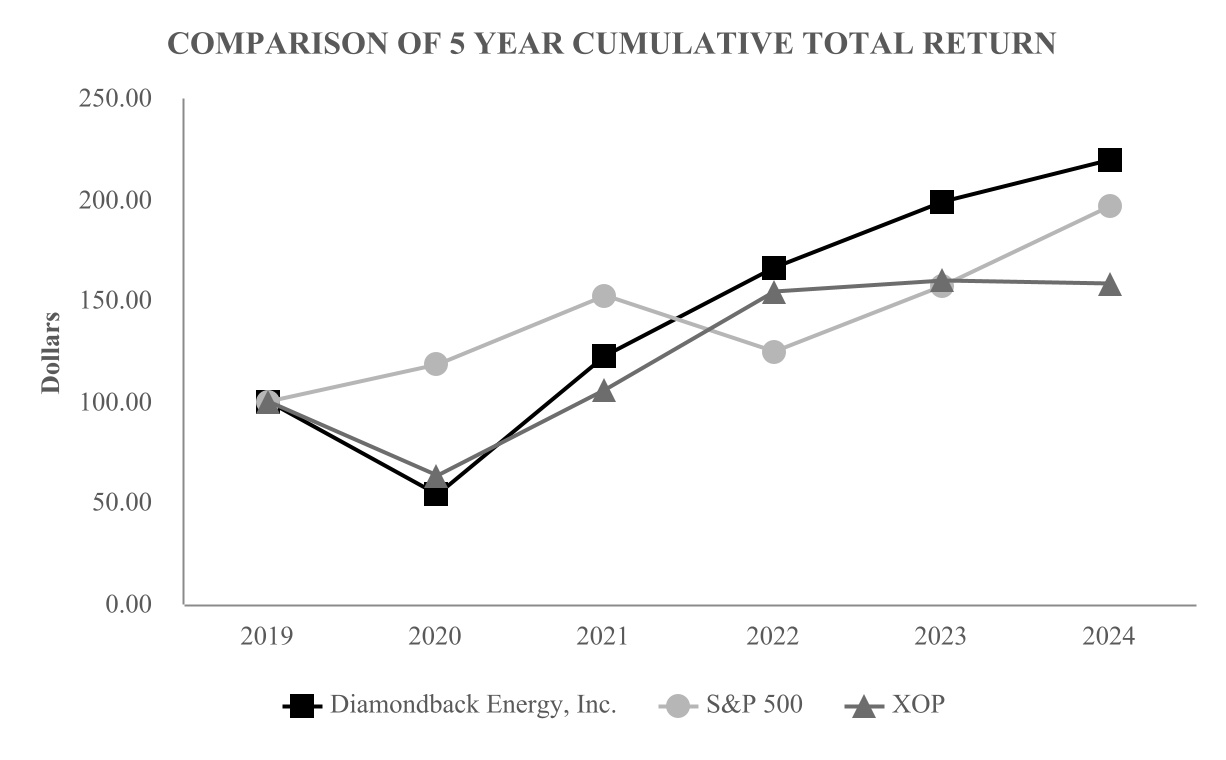
| As of December 31, | |||||||||||||||||||||||||||||||||||
| Calculated Values | 2019 | 2020 | 2021 | 2022 | 2023 | 2024 | |||||||||||||||||||||||||||||
| Diamondback Energy, Inc. | $100.00 | $54.00 | $122.81 | $166.41 | $199.06 | $219.68 | |||||||||||||||||||||||||||||
| S&P 500 | $100.00 | $118.39 | $152.34 | $124.73 | $157.48 | $196.85 | |||||||||||||||||||||||||||||
| XOP | $100.00 | $63.69 | $106.21 | $154.35 | $159.83 | $158.18 | |||||||||||||||||||||||||||||
ITEM 6. [RESERVED.]
46
ITEM 7. MANAGEMENT’S DISCUSSION AND ANALYSIS OF FINANCIAL CONDITION AND RESULTS OF OPERATIONS
The following discussion and analysis should be read in conjunction with our consolidated financial statements and notes thereto in Item 8. Financial Statements and Supplementary Data of this report. The following discussion contains “forward-looking statements” that reflect our future plans, estimates, beliefs, and expected performance. Actual results and the timing of events may differ materially from those contained in these forward-looking statements due to a number of factors discussed further in Item 1A. Risk Factors and Cautionary Statement Regarding Forward-Looking Statements of this report.
Overview
We are an independent oil and natural gas company focused on the acquisition, development, exploration and exploitation of unconventional, onshore oil and natural gas reserves primarily in the Permian Basin in West Texas. As of December 31, 2024, we have one reportable segment, the upstream segment. See Note 1—Description of the Business and Basis of Presentation and Note 18—Segment Information in Item 8. Financial Statements and Supplementary Data of this report for further discussion.
2024 Financial and Operating Highlights
•We recorded net income of $3.3 billion.
•Increased our annual base dividend to $4.00 per share of common stock in the fourth quarter of 2024, paid dividends to stockholders of $1.6 billion during 2024 and declared a base cash dividend payable in the first quarter of 2025 of $1.00 per share of common stock.
•Increased our common stock repurchase program authorization to $6.0 billion, excluding excise taxes, and repurchased $959 million of our common stock, leaving approximately $2.7 billion available for future purchases under our common stock repurchase program at December 31, 2024.
•Our cash operating costs were $11.09 per BOE, including lease operating expenses of $5.87 per BOE, cash general and administrative expenses of $0.68 per BOE and production and ad valorem taxes and gathering, processing and transportation expenses of $4.54 per BOE.
•Issued the April 2024 Notes for an aggregate of $5.5 billion in proceeds and incurred $1.0 billion in initial borrowings under the Tranche A Loans (as defined below in “—Transactions and Recent Developments”) to fund a portion of the cash consideration for the Endeavor Acquisition.
•Our average production was 598,284 MBOE/d.
•Drilled 372 gross horizontal wells (including 342 in the Midland Basin and 30 in the Delaware Basin).
•Turned 410 gross operated horizontal wells (including 391 in the Midland Basin and 19 in the Delaware Basin) to production.
•As of December 31, 2024, we had approximately 860,719 net acres, which primarily consisted of 737,181 net acres in the Midland Basin and 123,218 net acres in the Delaware Basin. As of December 31, 2024, we had an estimated 9,188 gross horizontal locations that we believe to be economic at $50.00 per Bbl WTI. In addition, our publicly traded subsidiary, Viper, owns mineral interests underlying approximately 987,861 gross acres and 35,671 net royalty acres in the Permian Basin. We operate approximately 52% of these net royalty acres.
•Incurred capital expenditures, excluding acquisitions, of $2.9 billion.
Transactions and Recent Developments
2025 Transactions
Pending Double Eagle Acquisition
On February 14, 2025, we entered into a definitive securities purchase agreement with Double Eagle to effect the pending Double Eagle Acquisition for consideration of $3.0 billion in cash and approximately 6.9 million shares of our common stock, subject to customary adjustments. The pending Double Eagle Acquisition consists of approximately 67,700 gross (40,000 net) acres, which are primarily located in the Midland Basin, and approximately 407 gross (342 net) horizontal locations in primary development targets. We intend to fund the cash portion of the pending Double Eagle Acquisition through a combination of cash on hand, borrowings under our credit facility or proceeds from term loans and senior notes offerings. The pending Double Eagle Acquisition is expected to close in the second quarter of 2025, subject to the satisfaction of customary closing conditions and regulatory approval.
47
Viper 2025 Equity Offering
On February 3, 2025, Viper completed an underwritten public offering of approximately 28.34 million shares of its Class A common stock (the “Viper 2025 Equity Offering”), which included 3.70 million shares issued pursuant to an option to purchase additional shares of its Class A common stock granted to the underwriters at a price to the public of $44.50 per share. Viper received total net proceeds for the Viper 2025 Equity Offering of approximately $1.2 billion after the underwriters’ discount and estimated transaction costs.
Pending 2025 Drop Down Transaction
On January 30, 2025, EER LP and the Endeavor Subsidiaries, each of which is our subsidiary, entered into a definitive equity purchase agreement with Viper and Viper LLC to divest the Endeavor Subsidiaries to Viper in exchange for consideration consisting of (i) $1.0 billion in cash and (ii) the issuance of 69.63 million Viper LLC units and an equal number of shares of Viper’s Class B common stock (which securities are exchangeable for an equal number of Viper’s Class A common stock), in each case subject to customary closing adjustments, including for net title benefits. The pending 2025 Drop Down is expected to close in the second quarter of 2025, subject to the approval by Viper’s stockholders, regulatory clearance and the satisfaction or waiver of other closing conditions. Viper intends to fund the cash consideration for the pending 2025 Drop Down with the net proceeds from the Viper 2025 Equity Offering discussed above. The mineral and royalty interests owned by the Endeavor Subsidiaries being divested in the pending 2025 Drop Down represent approximately 22,847 net royalty acres located primarily in the Permian Basin. The Endeavor Subsidiaries being sold in the pending 2025 Drop Down were acquired by us in the recently completed Endeavor Acquisition.
See Note 17—Subsequent Events in Item 8. Financial Statements and Supplementary Data of this report for further discussion of the pending Double Eagle Acquisition, the Viper 2025 Equity Offering and the pending 2025 Drop Down.
2024 Diamondback Acquisitions and Divestitures
Endeavor Acquisition
On September 10, 2024, we completed the Endeavor Acquisition for consideration consisting of $7.3 billion in cash, subject to certain customary post-closing adjustments, and approximately 117.27 million shares of our common stock. The Endeavor Acquisition included approximately 500,849 gross (361,927 net) acres, which are primarily located in the Permian Basin. The cash consideration for the Endeavor Acquisition was funded through a combination of cash on hand, the net proceeds of the Company’s $5.5 billion April 2024 Senior Notes offering and $1.0 billion in borrowings under the Tranche A Loans (as defined and discussed below). See Note 5—Endeavor Energy Resources, LP Acquisition in Item 8. Financial Statements and Supplementary Data of this report for further discussion of the Endeavor Acquisition.
TRP Energy, LLC Asset Exchange
On December 20, 2024, we completed an exchange agreement with TRP Energy, LLC (“TRP”), in which we exchanged approximately 47,034 gross (35,673 net) acres located in the Delaware Basin and $325 million in cash, subject to customary post-closing adjustments, for certain of TRP’s assets consisting of approximately 21,582 gross (15,421 net) acres located in the Midland Basin (the “TRP Exchange”). The TRP Exchange was valued at approximately $1.4 billion.
WTG Midstream Transaction
On July 15, 2024, Remuda Midstream Holdings LLC, (the “WTG joint venture”) sold its WTG Midstream LLC subsidiary (the “WTG Midstream Transaction”), resulting in proceeds to us of 10.1 million common units of Energy Transfer LP and $190 million in cash, subject to customary closing adjustments. At the closing of the WTG Midstream Transaction, the value attributable to us for the 10.1 million common units was approximately $135 million, of which we received approximately $81 million with the remaining $54 million held in escrow pursuant to an escrow agreement entered into by the WTG joint venture. A gain of approximately $74 million was recognized for the WTG Transaction in the third quarter of 2024.
48
2024 Viper Acquisitions
Viper Tumbleweed Acquisitions
On October 1, 2024, Viper and Viper LLC completed the Viper TWR Acquisition, for which the consideration consisted of approximately (i) $464 million in cash, (ii) 10.09 million Viper LLC units, including transaction costs and certain customary post-closing adjustments, (iii) the TWR Class B Option, and (iv) contingent cash consideration of up to $41 million payable in January of 2026. The mineral and royalty interests acquired in the Viper TWR Acquisition represent approximately 3,067 net royalty acres located primarily in the Permian Basin.
On September 3, 2024 Viper and Viper LLC acquired all of the issued and outstanding equity interests in Tumbleweed-Q Royalties, LLC (i) the Viper Q Acquisition for a purchase price of approximately $114 million in cash, including transaction costs and certain customary post-closing adjustments, and a contingent cash consideration of up to $5 million payable in January of 2026, and (ii) MC TWR Royalties, LP and MC TWR Intermediate, LLC the Viper M Acquisition for a purchase price of approximately $76 million in cash, including transaction costs and certain customary post-closing adjustments, and a contingent cash consideration of up to $4 million payable in January of 2026. The mineral and royalty interests acquired in the Viper Q & M Acquisitions, represent approximately 406 and 267 net royalty acres located primarily in the Permian Basin, respectively.
See Note 4—Acquisitions and Divestitures in Item 8. Financial Statements and Supplementary Data of this report for further discussion of the TRP Exchange, the Viper Tumbleweed Acquisitions and the WTG Midstream Transaction.
2024 Capital Transactions
Viper 2024 Equity Offering
On September 13, 2024, Viper completed an underwritten public offering of approximately 11.5 million shares of its Class A common stock at a price to the public of $42.50 per share for total net proceeds to Viper of approximately $476 million (the “Viper 2024 Equity Offering”).
See Note 10—Stockholders' Equity and Earnings (Loss) Per Share in Item 8. Financial Statements and Supplementary Data of this report for further discussion of the Viper 2024 Equity Offering.
April 2024 Notes Offering
On April 18, 2024, we issued an aggregate of $5.5 billion in senior notes, consisting of (i) $850 million aggregate principal amount of 5.200% Senior Notes due April 18, 2027 (the “2027 Notes”), (ii) $850 million aggregate principal amount of 5.150% Senior Notes due January 30, 2030 (the “2030 Notes”), (iii) $1.3 billion aggregate principal amount of 5.400% Senior Notes due April 18, 2034 (the “2034 Notes”), (iv) $1.5 billion aggregate principal amount of 5.750% Senior Notes due April 18, 2054 (the “2054 Notes”), and (v) $1.0 billion aggregate principal amount of 5.900% Senior Notes due April 18, 2064 (the “2064 Notes” and together with the 2027 Notes, the 2030 Notes the 2034 Notes and the 2054 Notes, the “April 2024 Notes”).
Term Loan Agreement
In connection with the Endeavor Acquisition, we entered into a Term Loan Credit Agreement with Citibank, N.A. on February 29, 2024 (the “Term Loan Agreement”). The Term Loan Agreement provided the Company with the ability to borrow up to $1.5 billion, which was comprised of $1.0 billion of Tranche A Loans (the “Tranche A Loans”) and $500 million of Tranche B Loans (the “Tranche B Loans”). On August 2, 2024, we terminated our undrawn Tranche B Loans. Initial borrowings of $1.0 billion under the Tranche A Loans were used to fund a portion of the cash consideration for the Endeavor Acquisition.
Commodity Prices
Prices for oil, natural gas and natural gas liquids are determined primarily by prevailing market conditions. Regional and worldwide economic activity, extreme weather conditions and other substantially variable factors, influence market conditions for these products. These factors are beyond our control and are difficult to predict. During 2024, 2023 and 2022 the NYMEX WTI prices averaged $75.76, $77.60 and $94.33 per Bbl, respectively, and the NYMEX Henry Hub prices averaged $2.41, $2.66 and $6.54 per MMBtu, respectively.
49
For additional information around risks related to commodity prices, see Part II. Item 7A. Quantitative and Qualitative Disclosures About Market Risk—Commodity Price Risk.
Outlook
During 2024, we had total capital expenditures of $2.9 billion, which was consistent with our guidance presented in November 2024. In 2025, we expect production and capital expenditures to increase as a result of the Endeavor Acquisition the Viper Tumbleweed Acquisitions, and the pending Double Eagle Acquisition, if consummated. Giving effect to the pending Double Eagle Acquisition, we have currently budgeted 2025 total capital spend of $3.80 billion to $4.20 billion, which at the midpoint is an increase of 36% year over year. Given the volatile current macro environment for oil prices and near-term global oil supply and demand dynamics, we have made the capital allocation decision to focus on free cash flow (as defined in “— Capital Requirements”) generation and capital efficiency over volume growth in 2025.
As part of the agreement with Double Eagle, we have also agreed to accelerate development on a portion of our non-core southern Midland Basin acreage. This acceleration is expected to bring forward net asset value to us by developing our lower quality acreage at a faster pace than current expectations. As a result, we expect significant free cash flow growth in 2026 and beyond with minimal capital deployment through this accelerated development plan.
Beginning in the first quarter of 2024, our board of directors approved a reduction to our return of capital commitment to our shareholders to at least 50% (down from 75%) of our quarterly free cash flow. Because we added debt to fund the cash portion of the Endeavor Acquisition and expect to add additional debt upon completion of the pending Double Eagle Acquisition, we are allocating more free cash flow to pay down our debt, with a near-term goal to reduce net debt to $10 billion. Our long-term target is to maintain our net debt between $6 billion and $8 billion through free cash flow generation and potential non-core asset sales as demonstrated by our recently announced commitment to sell at least $1.5 billion of non-core assets to help accelerate debt reduction and maintain a strong balance sheet. We also remain focused on our long-term priority to return cash to our stockholders.
In the Midland Basin, we continued to have positive results across our core development areas located within Midland, Martin, Ector, Glasscock, Reagan, Andrews and Howard counties, where development has primarily focused on drilling long-lateral, multi-well pads targeting the Spraberry and Wolfcamp formations.
In the Delaware Basin, we continued to target the Wolfcamp and Bone Spring formations across our primary development areas located in Pecos, Reeves and Ward counties. Collectively, the Delaware Basin accounted for approximately 5% of our total development in 2024, and we expect a similar portion of our total development to be focused in these areas in 2025.
As of December 31, 2024, we were operating 19 drilling rigs and four completion crews and currently intend to operate between 13 and 19 drilling rigs and between four and six completion crews in 2025 on average across our current acreage position in the Midland and Delaware Basins.
50
2025 Guidance
The following table presents our current estimates, which give effect to the estimated contribution related to the pending Double Eagle Acquisition, of certain financial and operating results for the full year of 2025, as well as production and cash tax guidance for the first quarter of 2025:
2025 Guidance | |||||
| Net production - MBOE/d | 883 - 909 | ||||
| Oil production - MBO/d | 485 - 498 | ||||
Q1 2025 oil production - MBO/d (total - MBOE/d) | 470 - 475 (860 - 875) | ||||
(Unit costs $/BOE): | |||||
| Lease operating expenses, including workovers | $5.90 - $6.30 | ||||
General and administrative expenses - cash | $0.60 - $0.75 | ||||
Non-cash stock-based compensation | $0.25 - $0.35 | ||||
Depreciation, depletion, amortization and accretion | $14.00 - $15.00 | ||||
| Interest expense (net of interest income) | $0.25 - $0.50 | ||||
Gathering, processing and transportation | $1.20 - $1.40 | ||||
Production and ad valorem taxes (% of revenue) | ~7% | ||||
| Corporate tax rate (% of pre-tax income) | 23% | ||||
| Cash tax rate (% of pre-tax income) | 17% - 20% | ||||
Q1 2025 cash taxes (in millions) | $280 - $340 | ||||
51
Results of Operations
Comparison of the Years Ended December 31, 2024 and 2023
For a discussion of the results of operations for the year ended December 31, 2023 as compared to the year ended December 31, 2022, please refer to Part II, Item 7. Management's Discussion and Analysis of Financial Condition and Results of Operations in our Annual Report on Form 10-K for the year ended December 31, 2023 (filed with the SEC on February 22, 2024), which is incorporated in this report by reference from such prior report on Form 10-K.
The following table sets forth selected historical operating data for the periods indicated:
| Year Ended December 31, | |||||||||||
| 2024 | 2023 | ||||||||||
| Revenues (in millions): | |||||||||||
| Oil sales | $ | 9,067 | $ | 7,279 | |||||||
| Natural gas sales | 89 | 262 | |||||||||
| Natural gas liquid sales | 944 | 687 | |||||||||
| Total oil, natural gas and natural gas liquid revenues | $ | 10,100 | $ | 8,228 | |||||||
| Production Data: | |||||||||||
| Oil (MBbls) | 123,325 | 96,176 | |||||||||
| Natural gas (MMcf) | 275,680 | 198,117 | |||||||||
| Natural gas liquids (MBbls) | 49,700 | 34,217 | |||||||||
Combined volumes (MBOE)(1) | 218,972 | 163,413 | |||||||||
| Daily oil volumes (BO/d) | 336,954 | 263,496 | |||||||||
Daily combined volumes (BOE/d) | 598,284 | 447,707 | |||||||||
| Average Prices: | |||||||||||
| Oil ($ per Bbl) | $ | 73.52 | $ | 75.68 | |||||||
| Natural gas ($ per Mcf) | $ | 0.32 | $ | 1.32 | |||||||
| Natural gas liquids ($ per Bbl) | $ | 18.99 | $ | 20.08 | |||||||
| Combined ($ per BOE) | $ | 46.12 | $ | 50.35 | |||||||
Oil, hedged ($/Bbl)(2) | $ | 72.68 | $ | 74.72 | |||||||
Natural gas, hedged ($/Mcf)(2) | $ | 0.91 | $ | 1.48 | |||||||
Natural gas liquids, hedged ($/Bbl)(2) | $ | 18.99 | $ | 20.08 | |||||||
Average price, hedged ($/BOE)(2) | $ | 46.38 | $ | 49.98 | |||||||
(1)Bbl equivalents are calculated using a conversion rate of six Mcf per Bbl.
(2)Hedged prices reflect the effect of our commodity derivative transactions on our average sales prices and include gains and losses on cash settlements for matured commodity derivatives, which we do not designate for hedge accounting. Hedged prices exclude gains or losses resulting from the early settlement of commodity derivative contracts.
52
Production Data. Substantially all of our revenues are generated through the sale of oil, natural gas and natural gas liquids production. The following table provides information on the mix of our production for the years ended December 31, 2024 and 2023:
| Year Ended December 31, | |||||||||||
| 2024 | 2023 | ||||||||||
| Oil (MBbls) | 56 | % | 59 | % | |||||||
| Natural gas (MMcf) | 21 | % | 20 | % | |||||||
| Natural gas liquids (MBbls) | 23 | % | 21 | % | |||||||
| 100 | % | 100 | % | ||||||||
See Items 1 and 2. Business and Properties—Oil and Natural Gas Data—Oil and Natural Gas Production and Price History of this report for further discussion of production by basin.
Oil, Natural Gas and Natural Gas Liquids Revenues. Our revenues are a function of oil, natural gas and natural gas liquids production volumes sold and average sales prices received for those volumes.
Our oil, natural gas and natural gas liquids revenues increased by approximately $1.9 billion, or 23%, to $10.1 billion in 2024 compared to $8.2 billion in 2023. This net increase consisted of an additional $2.5 billion attributable to the 34% growth in our combined production volumes, and a reduction of $596 million attributable to lower average prices received for our oil, natural gas and natural gas liquids production.
Approximately 72% of the increase in combined production volumes is attributable to the Endeavor Acquisition, 4% is attributable to Viper’s GRP Acquisition and 1% is attributable to Viper’s Tumbleweed Acquisitions. The remainder of the change is attributable to new wells drilled on previously existing acreage.
See Note 4—Acquisitions and Divestitures and Note 5—Endeavor Energy Resources, LP Acquisition in Item 8. Financial Statements and Supplementary Data of this report for further definition and discussion of Viper’s GRP Acquisition, the Viper Tumbleweed Acquisitions and the Endeavor Acquisition.
Net Sales of Purchased Oil. Beginning in the third quarter of 2023, we entered into purchase transactions with third parties and separate sale transactions with third parties to satisfy certain of our unused oil pipeline capacity commitments.
The following table presents the net sales of purchased oil from third parties for the year ended December 31, 2024 and 2023:
| Year Ended December 31, | |||||||||||
| (In millions) | 2024 | 2023 | |||||||||
| Sales of purchased oil | $ | 923 | $ | 111 | |||||||
| Purchased oil expense | 921 | 111 | |||||||||
| Net sales of purchased oil | $ | 2 | $ | — | |||||||
Other Revenues. The following table shows the other revenues for the year ended December 31, 2024 and 2023:
| Year Ended December 31, | |||||||||||
| (In millions) | 2024 | 2023 | |||||||||
| Other operating income | $ | 43 | $ | 73 | |||||||
Other operating income decreased by $30 million in 2024 compared to 2023 primarily due to (i) a $37 million reduction in midstream service revenues following the sale of the Deep Blue Water Assets in the third quarter of 2023, (ii) a $5 million increase in midstream service revenues resulting from the Endeavor Acquisition and (iii) other individually insignificant changes.
53
Lease Operating Expenses. The following table shows lease operating expenses for the years ended December 31, 2024 and 2023:
| Year Ended December 31, | |||||||||||||||||||||||
| 2024 | 2023 | ||||||||||||||||||||||
| (In millions, except per BOE amounts) | Amount | Per BOE | Amount | Per BOE | |||||||||||||||||||
| Lease operating expenses | $ | 1,286 | $ | 5.87 | $ | 872 | $ | 5.34 | |||||||||||||||
Lease operating expenses increased by $414 million, or $0.53 per BOE in 2024 as compared to 2023. The increase primarily consists of (i) $220 million in lease operating expenses related to the Endeavor Acquisition, (ii) $66 million in additional costs incurred for water services as a result of divesting the Deep Blue Water Assets in the third quarter of 2023, (iii) $65 million due to an increase in legacy production volumes, (iv) $48 million due to an increase in workover expense, (v) $12 million due to an increase in electrical generation costs, and (vi) other individually insignificant changes.
Production and Ad Valorem Tax Expense. The following table shows production and ad valorem tax expense for the years ended December 31, 2024 and 2023:
| Year Ended December 31, | |||||||||||||||||||||||||||||||||||
| 2024 | 2023 | ||||||||||||||||||||||||||||||||||
| (In millions, except per BOE amounts) | Amount | Per BOE | Percentage of oil, natural gas and natural gas liquids revenue | Amount | Per BOE | Percentage of oil, natural gas and natural gas liquids revenue | |||||||||||||||||||||||||||||
| Production taxes | $ | 462 | $ | 2.11 | 4.6 | % | $ | 380 | $ | 2.32 | 4.6 | % | |||||||||||||||||||||||
| Ad valorem taxes | 176 | 0.80 | 1.7 | 145 | 0.89 | 1.8 | |||||||||||||||||||||||||||||
| Total production and ad valorem expense | $ | 638 | $ | 2.91 | 6.3 | % | $ | 525 | $ | 3.21 | 6.4 | % | |||||||||||||||||||||||
In general, production taxes are directly related to production revenues and are based upon current year commodity prices. Production taxes as a percentage of oil, natural gas and natural gas liquids revenues remained consistent during 2024 compared to 2023.
Ad valorem taxes are based, among other factors, on property values driven by prior year commodity prices. Ad valorem taxes increased by $31 million in 2024 compared to 2023 primarily due to $28 million of ad valorem taxes accrued on properties acquired as part of the Endeavor Acquisition and other individually insignificant changes.
Gathering, Processing and Transportation Expense. The following table shows gathering, processing and transportation expense for the years ended December 31, 2024 and 2023:
| Year Ended December 31, | |||||||||||||||||||||||
| 2024 | 2023 | ||||||||||||||||||||||
| (In millions, except per BOE amounts) | Amount | Per BOE | Amount | Per BOE | |||||||||||||||||||
| Gathering, processing and transportation | $ | 356 | $ | 1.63 | $ | 287 | $ | 1.76 | |||||||||||||||
Gathering, processing and transportation expense increased by $69 million in 2024 compared to 2023 primarily due to an increase in our production from legacy wells as well as an increase in our contractual rates throughout the year. The decrease in the overall rate per BOE between 2024 and 2023 is due to recording gathering, processing and transportation charges for production from the Endeavor Acquisition as a reduction to revenue in accordance with the terms of the acquired contracts.
54
Depreciation, Depletion, Amortization and Accretion. The following table shows the components of our depreciation, depletion and amortization expense for the years ended December 31, 2024 and 2023:
| Year Ended December 31, | |||||||||||
| (In millions, except BOE amounts) | 2024 | 2023 | |||||||||
| Depletion of proved oil and natural gas properties | $ | 2,759 | $ | 1,669 | |||||||
| Depreciation of other property and equipment | 61 | 56 | |||||||||
| Other amortization | 8 | 6 | |||||||||
| Asset retirement obligation accretion | 22 | 15 | |||||||||
| Depreciation, depletion, amortization and accretion expense | $ | 2,850 | $ | 1,746 | |||||||
| Oil and natural gas properties depletion rate per BOE | $ | 12.60 | $ | 10.21 | |||||||
| Depreciation, depletion, amortization and accretion per BOE | $ | 13.02 | $ | 10.68 | |||||||
The increase in depletion of proved oil and natural gas properties of $1.1 billion in 2024 as compared to 2023 consists of an additional (i) $567 million from the growth in production volumes, and (ii) $523 million due to applying a higher depletion rate in 2024. The increase in depletion rate was primarily due to the addition of higher value leasehold costs and proved reserves from the Endeavor Acquisition and Viper’s Tumbleweed Acquisitions into the depletable base in 2024.
General and Administrative Expenses. The following table shows general and administrative expenses for the years ended December 31, 2024 and 2023:
| Year Ended December 31, | |||||||||||||||||||||||
| 2024 | 2023 | ||||||||||||||||||||||
| (In millions, except per BOE amounts) | Amount | Per BOE | Amount | Per BOE | |||||||||||||||||||
| General and administrative expenses | $ | 148 | $ | 0.68 | $ | 96 | $ | 0.59 | |||||||||||||||
| Non-cash stock-based compensation | 65 | 0.30 | 54 | 0.33 | |||||||||||||||||||
| Total general and administrative expenses | $ | 213 | $ | 0.98 | $ | 150 | $ | 0.92 | |||||||||||||||
The increase in general and administrative expenses of $52 million in 2024 compared to 2023 was primarily due to (i) a $41 million increase in employee compensation and benefit costs related to additional headcount largely from the Endeavor Acquisition and annual compensation adjustments, (ii) a $12 million increase in software costs, and (iii) offsetting changes in other individually insignificant items.
Other Operating Costs and Expenses. The following table shows the other operating costs and expenses for the year ended December 31, 2024 and 2023:
| Year Ended December 31, | |||||||||||
| (In millions) | 2024 | 2023 | |||||||||
| Merger and integration expenses | $ | 303 | $ | 11 | |||||||
| Other operating expenses | $ | 103 | $ | 140 | |||||||
Merger and integration expenses in 2024 include costs incurred in connection with the Endeavor Acquisition primarily for severance and accelerated incentive compensation payments to former Endeavor employees as well as investment banking and legal costs. See Note 5—Endeavor Energy Resources, LP Acquisition in Item 8. Financial Statements and Supplementary Data of this report for further details regarding expenses incurred the Endeavor Acquisition.
Other operating expenses decreased by $37 million in 2024 compared to 2023 primarily due to a $77 million reduction in midstream services costs as a result of the sale of the Deep Blue Water Assets in the third quarter of 2023. This reduction was partially offset by increases of (i) $25 million in midstream services costs following the Endeavor Acquisition, (ii) $8 million in net losses on the sale of property, plant and equipment in 2024, (iii) $7 million primarily attributable to the write off of certain saltwater disposal assets during 2024, and (iv) other individually insignificant changes.
55
Derivative Instruments. The following table shows the net gain (loss) on derivative instruments and the net cash received (paid) on settlements of derivative instruments for the years ended December 31, 2024 and 2023:
| Year Ended December 31, | |||||||||||
| (In millions) | 2024 | 2023 | |||||||||
Gain (loss) on derivative instruments, net | $ | 137 | $ | (259) | |||||||
Net cash received (paid) on settlements(1) | $ | (51) | $ | (110) | |||||||
(1)The year ended December 31, 2024 includes cash paid on interest rate swaps terminated prior to their contractual maturity of $37 million and cash paid for the early settlement of treasury lock contracts of $25 million
The change from a loss to a gain on derivative instruments in 2024 compared to 2023 primarily reflects (i) a $374 million increase in the value of our unsettled natural gas contracts due to a decrease in market prices for natural gas compared to our contract prices, (ii) a $129 million increase in cash received on the settlement of natural gas contracts, and (iii) a $10 million increase in the value of our interest rate swap contracts primarily due to a decline in expected future interest rates. These increases were partially offset by (i) a $60 million increase in cash paid on the settlement of interest rate derivatives (ii) a $43 million decrease in the value of our unsettled oil contracts due to an increase in market prices for oil compared to our contract prices, (iii) an $11 million increase in cash paid for the settlement of oil contracts, and (iv) other individually insignificant changes.
See Note 13—Derivatives in Item 8. Financial Statements and Supplementary Data of this report for further details regarding our derivative instruments and interest rate swaps.
Other Income (Expense). The following table shows other income and expenses for the years ended December 31, 2024 and 2023:
| Year Ended December 31, | |||||||||||
| (In millions) | 2024 | 2023 | |||||||||
| Interest expense, net | $ | (135) | $ | (159) | |||||||
| Other income (expense), net | $ | 80 | $ | 52 | |||||||
| Gain (loss) on extinguishment of debt | $ | 2 | $ | (4) | |||||||
| Income (loss) from equity investments, net | $ | 21 | $ | 48 | |||||||
Interest expense, net decreased $24 million in 2024 compared to 2023 primarily due to (i) an additional $165 million in capitalized interest costs, which reduce interest expense, (ii) an increase in interest income of $138 million due to holding proceeds from the April 2024 Notes in short-term interest bearing accounts until the close of the Endeavor Acquisition, and (iii) a $12 million decrease in interest expense on our revolving credit facility due to lower average borrowings outstanding in 2024. These reductions were largely offset by (i) an increase of $233 million in interest expense on senior notes related primarily to the issuance of the April 2024 Notes and Viper’s 7.375% Senior Notes due 2031 which were issued in the fourth quarter of 2023, (ii) an increase of $39 million in amortization of debt issuance costs primarily related to our terminated Bridge Facility, Tranche A Loans and April 2024 Notes, and (iii) a $19 million increase in interest expense incurred in connection with the Tranche A Loans.
See Note 9—Debt in Item 8. Financial Statements and Supplementary Data of this report for further details regarding outstanding borrowing, interest expense and gain (loss) on extinguishment of debt.
Other income (expense), net for 2024 includes a gain recorded on the WTG Midstream Transaction of approximately $74 million compared to 2023 including a $53 million gain on the sale of our equity method investment in Gray Oak Pipeline, LLC (“Gray Oak”), partially offset by various other insignificant activity.
The decrease in income from our equity investments primarily reflects reductions of (i) $17 million due to the sale of our interest in OMOG JV LLC in the third quarter of 2023, (ii) $11 million due to the WTG Midstream Transaction, and (ii) other individually insignificant activity.
See Note 8—Equity Method Investments and Related Party Transactions in Item 8. Financial Statements and Supplementary Data of this report for further discussion.
56
Provision for (Benefit from) Income Taxes. The following table shows the provision for (benefit from) income taxes for the years ended December 31, 2024 and 2023:
| Year Ended December 31, | |||||||||||
| (In millions) | 2024 | 2023 | |||||||||
| Provision for (benefit from) income taxes | $ | 800 | $ | 912 | |||||||
The change in our income tax provision for 2024 compared to 2023 was primarily due to a lower effective annual tax rate following the release of Viper’s $156 million valuation allowance in the fourth quarter of 2024. See Note 12—Income Taxes in Item 8. Financial Statements and Supplementary Data of this report for further discussion of our income tax expense.
Liquidity and Capital Resources
Overview of Sources and Uses of Cash
Historically, our primary sources of liquidity have included cash flows from operations, proceeds from our public equity offerings, issuances of common stock in connection with acquisitions, borrowings under our revolving credit facility, proceeds from the issuance of senior notes and sales of non-core assets. Our primary uses of capital have been for the acquisition, development and exploration of oil and natural gas properties and repayment of debt and returning capital to stockholders. At December 31, 2024, we had approximately $2.6 billion of liquidity consisting of $134 million in standalone cash and cash equivalents and $2.5 billion available under our credit facility. As discussed below, our capital budget for 2025, which gives effect to the pending Double Eagle Acquisition, is $3.80 billion to $4.20 billion. As of December 31, 2024, we have approximately $900 million of Tranche A Loans maturing in September 2025.
Future cash flows are subject to a number of variables, including the level of our oil and natural gas production and the volatility of commodity prices. Further, significant additional capital expenditures will be required to more fully develop our properties. Prices for our commodities are determined primarily by prevailing market conditions, regional and worldwide economic activity, weather and other substantially variable factors. These factors are beyond our control and are difficult to predict. See Item 1A. Risk Factors of this report above. In order to mitigate this volatility, we enter into derivative contracts with a number of financial institutions, all of which are participants in our credit facility, to economically hedge a portion of our estimated future crude oil and natural gas production as discussed further in Note 13—Derivatives in Item 8. Financial Statements and Supplementary Data and Item 7A. Quantitative and Qualitative Disclosures About Market Risk—Commodity Price Risk of this report. The level of our hedging activity and duration of the financial instruments employed depend on our desired cash flow protection, available hedge prices, the magnitude of our capital program and our operating strategy.
Cash Flow
Our cash flows for the years ended December 31, 2024 and 2023 are presented below:
| Year Ended December 31, | |||||||||||
| 2024 | 2023 | ||||||||||
| (In millions) | |||||||||||
| Net cash provided by (used in) operating activities | $ | 6,413 | $ | 5,920 | |||||||
| Net cash provided by (used in) investing activities | (11,221) | (3,323) | |||||||||
| Net cash provided by (used in) financing activities | 4,387 | (2,176) | |||||||||
| Net change in cash | $ | (421) | $ | 421 | |||||||
Operating Activities
Our operating cash flow is sensitive to many variables, the most significant of which is the volatility of prices for the oil and natural gas we produce.
The increase in operating cash flows for the year ended December 31, 2024 compared to the same period in 2023 primarily resulted from (i) an increase of $1.8 billion in total revenue, excluding sales of purchased oil, (ii) an additional $138 million in interest income, and (iii) a reduction of $59 million in cash paid on settlements of derivatives. These cash inflows were partially offset by an increase in our cash operating expenses, excluding purchased oil expense, of
57
approximately $903 million related primarily to merger and integration costs incurred in connection with the Endeavor Acquisition and additional lease operating expenses, (ii) an increase of $253 million in cash paid for taxes, (iii) an increase of $123 million in cash paid for interest, net of capitalized amounts, and (iv) fluctuations in other working capital balances due primarily to the timing of when collections were made on accounts receivable and payments were made on accounts payable. See “—Results of Operations” for discussion of significant changes in our revenues and expenses.
Investing Activities
The majority of our net cash used for investing activities during the year ended December 31, 2024 and 2023 was for drilling and completion costs in conjunction with our development program as well as the purchase of oil and gas properties including the Endeavor Acquisition and Viper’s Tumbleweed Acquisitions in 2024 and the Lario Acquisition and Viper’s GRP Acquisition in 2023. These cash outflows were partially offset by proceeds received from the divestitures of various oil and gas properties and other assets, which are discussed further in Note 4—Acquisitions and Divestitures in Item 8. Financial Statements and Supplementary Data of this report.
Capital Expenditure Activities
Our capital expenditures excluding acquisitions and equity method investments (on a cash basis) were as follows for the specified period:
| Year Ended December 31, | |||||||||||
| 2024 | 2023 | ||||||||||
| (In millions) | |||||||||||
| Drilling, completions and non-operated additions to oil and natural gas properties | $ | 2,632 | $ | 2,429 | |||||||
| Infrastructure additions to oil and natural gas properties | 221 | 153 | |||||||||
| Additions to midstream assets | 14 | 119 | |||||||||
| Total | $ | 2,867 | $ | 2,701 | |||||||
For further discussion regarding our development program, please see Items 1 and 2. Business and Properties—Oil and Natural Gas Data—Wells Drilled and Completed in 2024 of this report.
Financing Activities
During the year ended December 31, 2024, net cash used in financing activities was primarily attributable to $5.5 billion of proceeds from the issuance of the April 2024 Notes, $900 million in borrowings on our Tranche A Loans, net of repayments, $476 million in proceeds from the Viper 2024 Equity Offering, $451 million in proceeds from the sale of our shares of Viper’s Class A common stock and $2 million in borrowings on our credit facilities, net of repayments. These cash inflows were partially offset by (i) $1.6 billion of dividends paid to stockholders, (ii) $959 million of repurchases as part of the share repurchase program, (iii) $227 million in dividends to non-controlling interest, (iv) $99 million of debt issuance costs primarily associated with the April 2024 Notes, Term Loan Agreement and Bridge Facility, and (vi) $39 million in cash paid for tax withholdings on vested employee stock awards.
Net cash used in financing activities for the year ended December 31, 2023 was primarily attributable to (i) $1.4 billion of dividends paid to stockholders, (ii) $935 million of repurchases as part of the Diamondback and Viper share repurchase programs, (iii) $134 million paid for the retirement of outstanding principal on certain senior notes, and (iv) $129 million in distributions to non-controlling interest. The cash outflows were partially offset by (i) $394 million in net proceeds from the issuance of the Viper 2031 Notes and an additional $111 million in borrowings under credit facilities, net of repayments.
Capital Resources
Our working capital requirements are supported by our cash and cash equivalents and available borrowings under our revolving credit facility. We may draw on our revolving credit facility to meet short-term cash requirements, or issue debt or equity securities as part of our longer-term liquidity and capital management program and to finance the pending Double Eagle Acquisition. Because of the alternatives available to us, we believe that our short-term and long-term liquidity are adequate to fund not only our current operations, but also our near-term and long-term capital requirements.
58
As we pursue our business and financial strategy, we regularly consider which capital resources, including cash flow and/or equity and debt financings, are available to meet our future financial obligations, planned capital expenditure activities and liquidity requirements. Our future ability to grow proved reserves and production will be highly dependent on the capital resources available to us. Any prolonged volatility in the capital, financial and/or credit markets and/or adverse macroeconomic conditions may limit our access to, or increase our cost of, capital or make capital unavailable on terms acceptable to us or at all.
Revolving Credit Facilities and Other Debt Instruments
As of December 31, 2024, our debt, including the debt of Viper, consisted of approximately $12.0 billion in aggregate outstanding principal amount of senior notes, $900 million in aggregate outstanding short-term borrowings under the Tranche A Loans and $261 million in aggregate outstanding borrowings under revolving credit facilities.
As of December 31, 2024, the maximum credit amount available under our credit agreement was $2.5 billion, which may be increased to a total maximum commitment amount of $2.6 billion, with no outstanding borrowings and $2.5 billion available for future borrowings. Our credit agreement matures on June 2, 2029.
Viper LLC’s Credit Agreement
The Viper LLC credit agreement, as amended to date, matures on September 22, 2028 and provides for a revolving credit facility in the maximum credit amount of $2.0 billion, with a borrowing base and elected commitment amount of $1.3 billion. At December 31, 2024, there were $261 million of outstanding borrowings and $1.0 billion available for future borrowings under the Viper LLC credit agreement.
For additional discussion of our outstanding debt as of December 31, 2024, see Note 9—Debt in Item 8. Financial Statements and Supplementary Data of this report.
Debt Ratings
We receive debt ratings from the major ratings agencies in the U.S which impact the interest rates we receive on our variable rate debt and interest rate swaps. In determining our debt ratings, the agencies consider a number of qualitative and quantitative items including, but not limited to, commodity pricing levels, our liquidity, asset quality, reserve mix, debt levels, cost structure, planned asset sales and production growth opportunities. In September, we received an upgrade from two of the three major ratings agencies in the U.S., Standard and Poor’s Global Ratings Services and Fitch Investor Services. Currently, our credit ratings from the three main credit rating agencies are as follows:
•Standard and Poor’s Global Ratings Services (BBB);
•Fitch Investor Services (BBB+); and
•Moody’s Investor Services (Baa2).
Any rating downgrades may result in additional letters of credit or cash collateral being posted under certain contractual arrangements.
Capital Requirements
In addition to future operating expenses and working capital commitments discussed in “—Outlook”, our primary short and long-term liquidity requirements consist primarily of (i) capital expenditures, (ii) payments of principal and interest on our revolving credit agreements, Tranche A Loans and senior notes, (iii) payments of other contractual obligations, (iv) cash commitments for dividends and repurchases of securities, and the pending Double Eagle Acquisition.
2025 Capital Spending Plan
We currently estimate that our 2025 capital budget, which gives effect to the pending Double Eagle Acquisition, will be $3.80 billion to $4.20 billion, including $3.13 billion to $3.44 billion for horizontal drilling and completions, $280 million to $320 million for non-operated activity and capital workovers and $390 million to $440 million spent on infrastructure, midstream and environmental capital expenditures. We currently expect to drill approximately 446 to 471 gross (406 to 428 net) horizontal wells and complete approximately 557 to 592 gross (526 to 560 net) horizontal wells across our operated and non-operated leasehold acreage in the Northern Midland and Southern Delaware Basins, with an average lateral length of approximately 11,500 feet.
59
The amount and timing of our capital expenditures are largely discretionary and within our control. We could choose to defer a portion of these planned capital expenditures depending on a variety of factors, including but not limited to the success of our drilling activities, prevailing and anticipated prices for oil and natural gas, the availability of necessary equipment, infrastructure and capital, the receipt and timing of required regulatory permits and approvals, seasonal conditions, drilling and acquisition costs and the level of participation by other interest owners. We will continue monitoring commodity prices and overall market conditions and can adjust our rig cadence and our capital expenditure budget up or down in response to changes in commodity prices and overall market conditions.
Payments of Principal and Interest on Senior Notes and Tranche A Loans
At December 31, 2024, we have total principal payments due on our outstanding senior notes, including those of Viper, of $764 million in 2026, $1.3 billion in 2027, $73 million in 2028, $915 million in 2029 and $9.0 billion thereafter. Additionally, we expect to incur future cash interest costs on these senior notes of approximately $612 million in 2025, $1.2 billion cumulatively in the years from 2026 through 2027, $1.0 billion cumulatively in the years from 2028 and 2029, and $7.1 billion cumulatively between 2030 and 2064.
In addition to the senior notes, we have $900 million in aggregate outstanding borrowings under the Tranche A Loans due in 2025. See Note 9—Debt in Item 8. Financial Statements and Supplementary Data of this report for further discussion on the Tranche A Loans.
Other Contractual Obligations and Commitments
At December 31, 2024, our other significant contractual obligations consist primarily of (i) minimum transportation commitments totaling $2.8 billion, (ii) electrical power purchase commitments totaling $365 million (iii) asset retirement obligations totaling $592 million, (iv) electric fracturing fleet and related power generation services commitments totaling $199 million and (v) minimum purchase commitments for quantities of sand used in our drilling operations totaling $66 million. We expect to make aggregate payments of approximately $442 million for these commitments during 2025. See Note 7—Asset Retirement Obligations and Note 16—Commitments and Contingencies in Item 8. Financial Statements and Supplementary Data of this report for further discussion of these and other contractual obligations and commitments.
We and Five Point Energy LLC currently anticipate collectively contributing $500 million in follow-on capital to fund future growth in our Deep Blue Midland Basin LLC joint venture projects and acquisitions.
Return of Capital Commitment
Beginning in the first quarter of 2024, our board of directors approved a return of capital commitment of at least 50% (down from 75%) of our quarterly free cash flow to our stockholders through repurchases under our share repurchase program, base dividends and variable dividends. The remainder of our free cash flow will be used primarily to reduce debt. On February 21, 2025, our board of directors declared a base cash dividend for the fourth quarter of 2024 of $1.00 per share of common stock.
Free cash flow is a non-GAAP financial measure. As used by us, free cash flow is defined as cash flow from operating activities before changes in working capital in excess of cash capital expenditures and other adjustments as determined by us. We believe that free cash flow is useful to investors as it provides a measure to compare both cash flow from operating activities and additions to oil and natural gas properties across periods on a consistent basis.
Future base and variable dividends are at the discretion of our board of directors, and the board of directors may change the dividend amount from time to time based on our outlook for commodity prices, liquidity, debt levels, capital resources, free cash flow and other factors. We can provide no assurance that dividends will be authorized or declared in the future or as to the amount and type of any future dividends. Any future dividends, whether base or variable, if declared and paid, will by their nature fluctuate based on our free cash flow, which will depend on a number of factors beyond our control, including commodity prices.
On September 18, 2024, our board of directors approved an increase in our common stock repurchase program from $4.0 billion to $6.0 billion, excluding excise tax. Since the inception of the stock repurchase program, we have repurchased an aggregate 25.84 million shares of our common stock for a total cost of $3.5 billion, excluding excise tax, as of February 21, 2025. Subject to regulatory restrictions and other factors discussed elsewhere in this report, we intend to continue opportunistically purchasing shares under this repurchase program primarily with funds from cash flow from operations and liquidity events such as the sale of assets while maintaining sufficient liquidity to fund our capital expenditure
60
programs. See Note 10—Stockholders' Equity and Earnings (Loss) Per Share in Item 8. Financial Statements and Supplementary Data of this report for further discussion of the repurchase program.
Guarantor Financial Information
Diamondback E&P is the sole guarantor under the indentures governing the outstanding Guaranteed Senior Notes.
Guarantees are “full and unconditional,” as that term is used in Regulation S-X, Rule 3-10(b)(3), except that such guarantees will be released or terminated in certain circumstances set forth in the indentures governing the Guaranteed Senior Notes, such as, with certain exceptions, (i) in the event Diamondback E&P (or all or substantially all of its assets) is sold or disposed of, (ii) in the event Diamondback E&P ceases to be a guarantor of or otherwise be an obligor under certain other indebtedness, and (iii) in connection with any covenant defeasance, legal defeasance or satisfaction and discharge of the relevant indenture.
Diamondback E&P’s guarantees of the Guaranteed Senior Notes are senior unsecured obligations and rank senior in right of payment to any of its future subordinated indebtedness, equal in right of payment with all of its existing and future senior indebtedness, including its obligations under its revolving credit facility, and effectively subordinated to any of its existing and future secured indebtedness, to the extent of the value of the collateral securing such indebtedness.
The rights of holders of the Guaranteed Senior Notes against Diamondback E&P may be limited under the U.S. Bankruptcy Code or state fraudulent transfer or conveyance law. Each guarantee contains a provision intended to limit Diamondback E&P’s liability to the maximum amount that it could incur without causing the incurrence of obligations under its guarantee to be a fraudulent conveyance. However, there can be no assurance as to what standard a court will apply in making a determination of the maximum liability of Diamondback E&P. Moreover, this provision may not be effective to protect the guarantee from being voided under fraudulent conveyance laws. There is a possibility that the entire guarantee may be set aside, in which case the entire liability may be extinguished.
The following tables present summarized financial information for Diamondback Energy, Inc., as the parent, and Diamondback E&P, as the guarantor subsidiary, on a combined basis after elimination of (i) intercompany transactions and balances between the parent and the guarantor subsidiary, and (ii) equity in earnings from and investments in any subsidiary that is a non-guarantor. The information is presented in accordance with the requirements of Rule 13-01 under the SEC’s Regulation S-X. The financial information may not necessarily be indicative of results of operations or financial position had the guarantor subsidiary operated as an independent entity.
| December 31, 2024 | |||||
| Summarized Balance Sheets: | (In millions) | ||||
| Assets: | |||||
| Current assets | $ | 933 | |||
| Property and equipment, net | $ | 21,795 | |||
| Other noncurrent assets | $ | 32 | |||
| Liabilities: | |||||
| Current liabilities | $ | 2,943 | |||
| Intercompany accounts payable, non-guarantor subsidiary | $ | 3,381 | |||
| Long-term debt | $ | 10,978 | |||
| Other noncurrent liabilities | $ | 2,979 | |||
| Year Ended December 31, 2024 | |||||
| Summarized Statement of Operations: | (In millions) | ||||
| Revenues | $ | 7,022 | |||
| Income (loss) from operations | $ | 2,319 | |||
| Net income (loss) | $ | 1,631 | |||
61
Critical Accounting Estimates
The discussion and analysis of our financial condition and results of operations is based upon our consolidated financial statements, which have been prepared in accordance with accounting principles generally accepted in the United States.
Certain amounts included in or affecting our consolidated financial statements and related disclosures must be estimated by our management, requiring certain assumptions to be made with respect to values or conditions that cannot be known with certainty at the time the consolidated financial statements are prepared. These estimates and assumptions affect the amounts we report for assets and liabilities and our disclosure of contingent assets and liabilities at the date of the consolidated financial statements and the reported amounts of revenues and expenses during the reporting period. We evaluate our estimates and assumptions on a regular basis. Critical accounting estimates are those estimates made in accordance with generally accepted accounting principles that involve a significant level of estimation uncertainty and have had or are reasonably likely to have a material impact on the financial condition or results of operations of the registrant. Any effects on our business, financial position or results of operations resulting from revisions to these estimates are recorded in the period in which the facts that give rise to the revision become known.
We consider the following to be our most critical accounting estimates and have reviewed these critical accounting estimates with the Audit Committee of our board of directors.
Oil and Natural Gas Accounting and Reserves
We account for our oil and natural gas producing activities using the full cost method of accounting, which is dependent on the estimation of proved reserves to determine the rate at which we record depletion on our oil and natural gas properties and whether the value of our evaluated oil and natural gas properties is permanently impaired based on the quarterly full cost ceiling impairment test. Further, we utilize estimated proved reserves to assign fair value to acquired proved oil and natural gas properties including mineral and royalty interests. As such, we consider the estimation of proved reserves to be a critical accounting estimate.
Oil and natural gas reserve engineering is a subjective process of estimating underground accumulations of oil and natural gas that cannot be precisely measured and the accuracy of any reserve estimate is a function of the quality of available data and of engineering and geological interpretation and judgment. Proved oil and natural gas reserve estimates and their associated future net cash flows were prepared by our internal reservoir engineers and audited by Ryder Scott Company, L.P., independent petroleum engineers as of December 31, 2024, 2023 and 2022. The process of estimating oil and natural gas reserves is complex, requiring significant decisions in the evaluation of available geological, geophysical, engineering and economic data. Significant inputs included in the calculation of future net cash flows include our estimate of operating and development costs, anticipated production of proved reserves and other relevant data. The data for a given property may also change substantially over time as a result of numerous factors, including additional development activity, evolving production history and a continual reassessment of the viability of production under changing economic conditions. As a result, material revisions to existing reserve estimates occur from time to time, and reserve estimates are often different from the quantities of oil and natural gas that are ultimately recovered. Although every reasonable effort is made to ensure that reported reserve estimates represent the most accurate assessments possible, the subjective decisions and variances in available data for various properties increase the likelihood of significant changes in these estimates. If such changes are material, they could significantly affect future depletion of capitalized costs and result in impairment of assets that may be material. Revisions of previous reserve estimates accounted for approximately $2.0 billion, or 16% of the change in the standardized measure of our total reserves from December 31, 2023 to December 31, 2024. No impairments were recorded for our proved oil and gas properties during the years ended December 31, 2024, 2023 and 2022. Based on the historical 12-month average trailing SEC prices for oil and natural gas throughout 2024 and into 2025, we are not currently projecting a full cost ceiling impairment in the first quarter of 2025.
Additionally, costs associated with unevaluated properties are excluded from the full cost pool until we have made a determination as to the existence of proved reserves. We assess all items classified as unevaluated property (on an individual basis or as a group if properties are individually insignificant) at least annually for possible impairment. This assessment is subjective and includes consideration of the following factors, among others: (i) intent to drill, (ii) remaining lease term, (iii) geological and geophysical evaluations, (iv) drilling results and activity, (v) the assignment of proved reserves, and (vi) the economic viability of development if proved reserves are assigned. At December 31, 2024, our unevaluated properties totaled $22.7 billion, which consisted of 433,335 net undeveloped leasehold acres with approximately 4,290 net acres set to expire in 2025. We did not record any impairment on our unevaluated properties during the year ended December 31, 2024, but any such future impairment could potentially be material to our consolidated financial statements.
62
Business Combinations
We account for business combinations in which it has been determined we are the acquirer using the acquisition method of accounting. Accordingly, identifiable assets acquired and liabilities assumed are recognized at the date of acquisition at their respective estimated fair values.
We make various assumptions in estimating the fair values of assets acquired and liabilities assumed. Fair value estimates are determined based on information that existed at the time of the acquisition, utilizing expectations and assumptions that would be available to and made by a market participant. When market-observable prices are not available to value assets and liabilities, the Company may use the cost, income, or market valuation approaches depending on the quality of information available to support management’s assumptions.
The most significant assumptions relate to the estimated fair values assigned to proved and unproved oil and natural gas properties. The assumptions made in performing these valuations include future production volumes, future commodity prices and costs, future operating and development activities, projections of oil and gas reserves and a weighted average cost of capital rate. The market-based weighted average cost of capital rate is subjected to additional project-specific risking factors. In addition, when appropriate, we review comparable purchases and sales of natural gas and oil properties within the same regions, and use that data as a proxy for fair market value; for example, the amount a willing buyer and seller would enter into in exchange for such properties. Changes in key assumptions may cause the acquisition accounting to be revised, including the recognition of goodwill or discount on an acquisition. There is no assurance the underlying assumptions or estimates associated with the valuation will occur as initially expected. See Note 4—Acquisitions and Divestitures and Note 5—Endeavor Energy Resources, LP Acquisition in Item 8. Financial Statements and Supplementary Data of this report for further discussion of the estimated fair value of assets acquired and liabilities assumed in business combinations including any significant changes in these estimates from the date of acquisition.
Estimated fair values assigned to assets acquired can have a significant effect on results of operations in the future. In addition, differences between the future commodity prices when acquiring assets and the historical 12-month average trailing price to calculate ceiling test impairments of upstream assets may impact net earnings.
Income Taxes
The amount of income taxes we record requires interpretations of complex rules and regulations of federal, state, and local tax jurisdictions. We use the asset and liability method of accounting for income taxes, under which deferred tax assets and liabilities are recognized for the future tax consequences of (1) temporary differences between the financial statement carrying amounts and the tax bases of existing assets and liabilities and (2) operating loss and tax credit carryforwards. Deferred income tax assets and liabilities are based on enacted tax rates applicable to the future period when those temporary differences are expected to be recovered or settled. The effect of a change in tax rates on deferred tax assets and liabilities is recognized in income in the period the rate change is enacted. A valuation allowance is provided for deferred tax assets when it is more likely than not the deferred tax assets will not be realized after considering all positive and negative evidence available concerning the realizability of our deferred tax assets. Positive evidence may include forecasts of future taxable income, assessment of future business assumptions and any applicable tax planning strategies available to the Company. Negative evidence may include losses in recent years, if any, or the projection of losses in future periods. The assessment of the realizability of our deferred tax assets, including the assessment of whether a valuation allowance is required, entails that we make estimates of, and assumptions about, future events, including the pattern of reversal of taxable temporary differences and our future income from operations. Estimating future taxable income requires numerous judgments and assumptions, including projections of future operating conditions which may be impacted by volatile future prices for our oil, natural gas and natural gas production, the expected timing and quantity of future production volumes, and the impact of our commodity derivative instruments on our income.
In 2024, management’s assessment of all available evidence, both positive and negative, supporting realizability of Viper’s deferred tax assets as required by applicable accounting standards, resulted in the full release of Viper’s remaining valuation allowance of $156 million. The positive evidence assessed included recent cumulative income due in part to commodity prices remaining consistently high, acquisitions of additional oil and gas properties, and an expectation of future taxable income based upon recent actual and forecasted production volumes and prices. As of December 31, 2024, Viper had a deferred tax asset of $185 million. Any changes in the positive or negative evidence evaluated when determining if Viper’s deferred tax assets will be realized, including projected future income, could result in a material change to our consolidated financial statements. As of December 31, 2024, our balance of taxable temporary differences anticipated to reverse within the carryforward period provides significant positive evidence for the determination that our remaining deferred tax assets are more likely than not to be realized.
63
The accruals for deferred tax assets and liabilities are often based on unclear tax positions and assumptions that are subject to a significant amount of judgment by management. These assumptions and judgments are reviewed and adjusted as facts and circumstances change. At December 31, 2024, we had no uncertain tax positions, however, material changes to our income tax accruals may occur in the future based on the progress of ongoing audits, changes in legislation or resolution of pending matters.
Recent Accounting Pronouncements
See Note 2—Summary of Significant Accounting Policies in Item 8. Financial Statements and Supplementary Data of this report for recent accounting pronouncements not yet adopted, if any.
Off-Balance Sheet Arrangements
See Note 16—Commitments and Contingencies in Item 8. Financial Statements and Supplementary Data of this report for a discussion of our significant commitments and contingencies, some of which are not recognized in the consolidated balance sheets under GAAP.
ITEM 7A. QUANTITATIVE AND QUALITATIVE DISCLOSURES ABOUT MARKET RISK
Commodity Price Risk
Our major market risk exposure in our exploration and production business is in the pricing applicable to our oil and natural gas production. Realized pricing is primarily driven by the prevailing worldwide price for crude oil and spot market prices applicable to our natural gas production. Pricing for oil and natural gas production can be volatile and unpredictable. We cannot predict events, including the outcome of the war in Ukraine and the Israel-Hamas war, along with other conflicts in the Middle East, changes in interest rates and inflation and global supply chain disruptions, that may lead to future price volatility. We cannot predict events that may lead to future price volatility and the near-term energy outlook remains subject to heightened levels of uncertainty. Further, the prices we receive for production depend on many other factors outside of our control.
We use derivatives, including swaps, basis swaps, roll swaps, costless collars, puts and basis puts, to reduce price volatility associated with certain of our oil and natural gas sales. At December 31, 2024, we had a net asset of $145 million related to our commodity price risk derivatives. Utilizing actual contractual volumes under our commodity price derivatives as of December 31, 2024, a 10% increase in forward curves associated with the underlying commodity would have decreased the net asset position by $15 million to $130 million, while a 10% decrease in forward curves associated with the underlying commodity would have increased the net asset derivative position by $36 million to $181 million. However, any cash derivative gain or loss may be substantially offset by a decrease or increase, respectively, in the actual sales value of production covered by the derivative instrument.
For additional information on our open commodity derivative instruments at December 31, 2024, see Note 13—Derivatives in Item 8. Financial Statements and Supplementary Data of this report.
Counterparty and Customer Credit Risk
Our principal exposures to credit risk are due to the concentration of receivables from the sale of our oil and natural gas production (approximately $1.4 billion at December 31, 2024), and to a lesser extent, receivables resulting from joint interest receivables (approximately $188 million at December 31, 2024). Joint interest receivables arise from billings to entities that own partial interests in wells we operate. These entities participate in our wells primarily based on their ownership in leases on which we intend to drill. We have little ability to control whether these entities will participate in our wells. We do not require our customers to post collateral, and the failure or inability of our significant customers to meet their obligations to us due to their liquidity issues, bankruptcy, insolvency or liquidation may adversely affect our financial results.
64
Interest Rate Risk
We are subject to market risk exposure related to changes in interest rates on our indebtedness under our revolving credit facilities, Tranche A Loans and changes in the fair value of our fixed rate debt. Outstanding borrowings under the credit agreement bear interest at a per annum rate elected by Diamondback E&P. At December 31, 2024, the applicable margin ranges from 0.125% to 1.000% per annum in the case of the alternate base rate, and from 1.125% to 2.000% per annum in the case of Adjusted Term SOFR, in each case based on the pricing level for both our revolving credit facilities and Tranche A Loans. The pricing level depends on certain rating agencies’ ratings of our long-term senior unsecured debt. We are obligated to pay a quarterly commitment fee ranging from 0.125% to 0.325% per year on the unused portion of the commitment for our revolving credit facilities. For our Tranche A Loans, we are obligated to pay a quarterly commitment fee equal to 0.125% per year on the aggregate principal amount of the commitments. We believe significant interest rate changes would not have a material near-term impact on our future earnings or cash flows. For additional information on our variable interest rate debt at December 31, 2024, see Note 9—Debt in Item 8. Financial Statements and Supplementary Data of this report.
Historically, we have at times used interest rates swaps to manage our exposure to (i) interest rate changes on our floating-rate date, and (ii) fair value changes on our fixed rate debt. At December 31, 2024, we have interest rate swap agreements for a notional amount of $900 million to manage the impact of changes to the fair value of our fixed rate senior notes due to changes in market interest rates through December 2029. We pay an average variable rate of interest for these swaps based on three-month SOFR plus 2.1865% and receive a fixed interest rate of 3.50% from our counterparties. At December 31, 2024, our receive-fixed, pay-variable interest rate swaps were in a net liability position of $124 million, and the weighted average variable rate was 6.43%. For additional information on our interest rate swaps, see Note 13—Derivatives in Item 8. Financial Statements and Supplementary Data of this report.
65
ITEM 8. FINANCIAL STATEMENTS AND SUPPLEMENTARY DATA
| (a) | Documents included in this report: | |||||||
| 1. Financial Statements | ||||||||
| 2. Financial Statement Schedules | ||||||||
| Financial statement schedules have been omitted because they are either not required, not applicable or the information required to be presented is included in the Company’s consolidated financial statements and related notes. | ||||||||
66
REPORT OF INDEPENDENT REGISTERED PUBLIC ACCOUNTING FIRM
Board of Directors and Stockholders
Diamondback Energy, Inc.
Opinion on the financial statements
We have audited the accompanying consolidated balance sheets of Diamondback Energy, Inc. (a Delaware corporation) and subsidiaries (the “Company”) as of December 31, 2024 and 2023, the related consolidated statements of operations and comprehensive income, stockholders’ equity, and cash flows for each of the three years in the period ended December 31, 2024, and the related notes (collectively referred to as the “consolidated financial statements”). In our opinion, the consolidated financial statements present fairly, in all material respects, the financial position of the Company as of December 31, 2024 and 2023, and the results of its operations and its cash flows for each of the three years in the period ended December 31, 2024, in conformity with accounting principles generally accepted in the United States of America.
We also have audited, in accordance with the standards of the Public Company Accounting Oversight Board (United States) (“PCAOB”), the Company’s internal control over financial reporting as of December 31, 2024, based on criteria established in the 2013 Internal Control—Integrated Framework issued by the Committee of Sponsoring Organizations of the Treadway Commission (“COSO”), and our report dated February 26, 2025 expressed an unqualified opinion.
Basis for opinion
These consolidated financial statements are the responsibility of the Company’s management. Our responsibility is to express an opinion on the Company’s consolidated financial statements based on our audits. We are a public accounting firm registered with the PCAOB and are required to be independent with respect to the Company in accordance with the U.S. federal securities laws and the applicable rules and regulations of the Securities and Exchange Commission and the PCAOB.
We conducted our audits in accordance with the standards of the PCAOB. Those standards require that we plan and perform the audit to obtain reasonable assurance about whether the financial statements are free of material misstatement, whether due to error or fraud. Our audits included performing procedures to assess the risks of material misstatement of the financial statements, whether due to error or fraud, and performing procedures that respond to those risks. Such procedures included examining, on a test basis, evidence regarding the amounts and disclosures in the financial statements. Our audits also included evaluating the accounting principles used and significant estimates made by management, as well as evaluating the overall presentation of the financial statements. We believe that our audits provide a reasonable basis for our opinion.
Critical audit matter
The critical audit matter communicated below is a matter arising from the current period audit of the financial statements that was communicated or required to be communicated to the audit committee and that: (1) relates to accounts or disclosures that are material to the financial statements and (2) involved our especially challenging, subjective, or complex judgments. The communication of critical audit matters does not alter in any way our opinion on the financial statements, taken as a whole, and we are not, by communicating the critical audit matter below, providing a separate opinion on the critical audit matter or on the accounts or disclosures to which it relates.
Estimation of proved reserves as it relates to the calculation and recognition of depletion expense and the valuation of acquired reserves in connection with the acquisition of Endeavor’s oil and natural gas properties and proved reserves in connection with the Viper Tumbleweed Acquisitions of mineral and royalty interests
As described further in Note 2 to the consolidated financial statements, the Company accounts for its oil and natural gas properties using the full cost method of accounting, which requires management to make estimates of proved reserve volumes and future revenues to record depletion expense. Additionally, as described in Notes 4 and 5 to the consolidated financial statements, the Company acquired significant oil and natural gas properties and mineral and royalty interests during the year through the Endeavor and Viper Tumbleweed Acquisitions, respectively. To estimate the volume of reserves and future revenues, management makes significant estimates and assumptions, including forecasting the timing and volumetric amounts of production and corresponding decline rate of producing properties associated with the Company’s development plan. In addition, the estimation of reserves is impacted by management’s judgments and estimates regarding the financial performance of wells to determine if wells are expected, with reasonable certainty, to be economical under the appropriate pricing assumptions. For acquired reserves, management utilizes an estimated fair value pricing model in determining the corresponding value of reserves. We identified the estimation of reserves attributable to oil and natural gas properties,
67
including acquired proved and unproved reserves in the Endeavor Acquisition and acquired proved reserves in the Viper Tumbleweed Acquisitions, due to its impact on depletion expense and acquisition accounting, as a critical audit matter.
The principal consideration for our determination that the estimation of reserves is a critical audit matter is that changes in certain inputs and assumptions, which require a high degree of subjectivity, necessary to estimate the volume and future revenues of the Company’s reserves, could have a significant impact on the measurement of depletion expense and the fair value of acquired oil and natural gas properties including mineral and royalty interests. In turn, auditing those inputs and assumptions required subjective and complex auditor judgment.
Our audit procedures related to the estimation of reserves included the following, among others.
•We tested the design and operating effectiveness of key controls relating to management’s estimation of reserves for the purpose of calculating depletion expense and management’s estimation of the fair value of the acquired oil and natural gas properties in the Endeavor and Viper Tumbleweed Acquisitions.
•We evaluated the level of knowledge, skill, and ability of the Company’s reservoir engineering specialists and independent petroleum engineering specialists, made inquiries of those reservoir engineers regarding the process followed and judgments made to estimate the Company’s reserve volumes, and read the report of the Company’s independent petroleum engineering specialists.
•Identified inputs and assumptions that were significant to the period end determination of proved reserve volumes and tested management’s process of determining the significant inputs and assumptions, as follows:
◦Compared the estimated pricing and pricing differentials used in the reserve report to realized prices related to revenue transactions recorded in the current year for the pricing differentials;
◦Assessed the reasonableness of forecasted capital expenditures by comparing drilling forecasts applied in the reserve report to recent drilling costs;
◦Vouched, on a sample basis, the working and net revenue interests used in the reserve report to underlying land and division order records;
◦Assessed forecasted production estimates by (i) comparing prior year forecasted production amounts to current year actual results and (ii) comparing forecasted production amounts in the current year reserve report to the actual historical production amounts in the current year, in total and for a sample of individual wells;
◦Obtained evidence supporting the amount of development of proved undeveloped properties reflected in the reserve report and compared future development plans to historical conversion rates to evaluate the likelihood of development related to the proved undeveloped properties; and
◦Applied analytical procedures on inputs to the reserve report by comparing to historical actual results and to the prior year reserve report.
•Identified inputs and assumptions that were significant to the estimated fair value of the acquired oil and natural gas properties in the Endeavor and Viper Tumbleweed Acquisitions and tested management’s process of determining the significant inputs and assumptions, as follows:
◦Evaluated the appropriateness of fair value pricing, including pricing differentials, used in the fair value reserve reports by comparing the pricing forecast to published product pricing as of the acquisition closing dates and pricing differentials to actual historical realized pricing of the acquired properties;
◦Evaluated the level of knowledge, skill and ability of specialists utilized by the Company to assist in the preparation of the estimates of fair value of oil and natural gas properties acquired;
◦Utilized a valuation specialist to evaluate the reasonableness of the Company’s valuation methodology of the Endeavor Acquisition, including testing key inputs and assumptions by understanding and assessing the process used to develop the estimate or through development of an independent expectation;
68
◦Evaluated the appropriateness of the discount rate used in the Tumbleweed Acquisitions fair value reserve reports of proved reserves by comparing to Viper’s actual weighted average cost of capital;
◦Evaluated the appropriateness of the future operating cost and capital expenditure assumptions used in the Endeavor Acquisition fair value reserve report by comparing forecasted amounts to historical operating costs and to recent drilling costs;
◦Compared, on a sample basis, the working interest, as applicable, and net revenue interests used in the fair value reserve reports to the purchase and sale agreements or historical reserve reports;
◦Tested the accuracy of forecasted production estimates in the fair value reserve reports by comparing forecasted production amounts to the actual historical production amounts and to the forecasted production in the year-end reserve report for a sample of individual wells;
◦Applied analytical procedures on the fair value reserve reports’ forecasted production by comparing to the prior year reserve reports’ forecasted production and to the year-end reserve reports’ forecasted production of the acquired proved properties; and
◦Compared the unproved acreage value allocated to other recent acquisitions in the same or similar locations.
/s/ GRANT THORNTON LLP
We have served as the Company’s auditor since 2009.
February 26, 2025
69
| December 31, | |||||||||||
| 2024 | 2023 | ||||||||||
| (In millions, except par value and share amounts) | |||||||||||
| Assets | |||||||||||
| Current assets: | |||||||||||
Cash and cash equivalents ($ | $ | $ | |||||||||
| Restricted cash | |||||||||||
| Accounts receivable: | |||||||||||
| Joint interest and other, net | |||||||||||
Oil and natural gas sales, net ($ | |||||||||||
| Inventories | |||||||||||
| Derivative instruments | |||||||||||
| Prepaid expenses and other current assets | |||||||||||
| Total current assets | |||||||||||
| Property and equipment: | |||||||||||
Oil and natural gas properties, full cost method of accounting ($ | |||||||||||
| Other property, equipment and land | |||||||||||
Accumulated depletion, depreciation, amortization and impairment ($ | ( | ( | |||||||||
| Property and equipment, net | |||||||||||
| Funds held in escrow | |||||||||||
| Equity method investments | |||||||||||
| Derivative instruments | |||||||||||
Deferred income taxes, net ($ | |||||||||||
| Other assets | |||||||||||
| Total assets | $ | $ | |||||||||
| Liabilities and Stockholders’ Equity | |||||||||||
| Current liabilities: | |||||||||||
| Accounts payable - trade | $ | $ | |||||||||
| Accrued capital expenditures | |||||||||||
| Current maturities of debt | |||||||||||
| Other accrued liabilities | |||||||||||
| Revenues and royalties payable | |||||||||||
| Derivative instruments | |||||||||||
| Income taxes payable | |||||||||||
| Total current liabilities | |||||||||||
Long-term debt ($ | |||||||||||
| Derivative instruments | |||||||||||
| Asset retirement obligations | |||||||||||
| Deferred income taxes | |||||||||||
| Other long-term liabilities | |||||||||||
| Total liabilities | |||||||||||
Commitments and contingencies (Note 16) | |||||||||||
| Stockholders’ equity: | |||||||||||
Common stock, $ | |||||||||||
| Additional paid-in capital | |||||||||||
| Retained earnings (accumulated deficit) | |||||||||||
| Accumulated other comprehensive income (loss) | ( | ( | |||||||||
| Total Diamondback Energy, Inc. stockholders’ equity | |||||||||||
| Non-controlling interest | |||||||||||
| Total equity | |||||||||||
| Total liabilities and stockholders' equity | $ | $ | |||||||||
See accompanying notes to consolidated financial statements.
70
Diamondback Energy, Inc. and Subsidiaries
Consolidated Statements of Operations and Comprehensive Income
| Year Ended December 31, | |||||||||||||||||
| 2024 | 2023 | 2022 | |||||||||||||||
| (In millions, except per share amounts, shares in thousands) | |||||||||||||||||
| Revenues: | |||||||||||||||||
| Oil sales | $ | $ | $ | ||||||||||||||
| Natural gas sales | |||||||||||||||||
| Natural gas liquid sales | |||||||||||||||||
| Sales of purchased oil | |||||||||||||||||
| Other operating income | |||||||||||||||||
| Total revenues | |||||||||||||||||
| Costs and expenses: | |||||||||||||||||
| Lease operating expenses | |||||||||||||||||
| Production and ad valorem taxes | |||||||||||||||||
| Gathering, processing and transportation | |||||||||||||||||
| Purchased oil expense | |||||||||||||||||
| Depreciation, depletion, amortization and accretion | |||||||||||||||||
| General and administrative expenses | |||||||||||||||||
| Merger and integration expenses | |||||||||||||||||
| Other operating expenses | |||||||||||||||||
| Total costs and expenses | |||||||||||||||||
| Income (loss) from operations | |||||||||||||||||
| Other income (expense): | |||||||||||||||||
| Interest expense, net | ( | ( | ( | ||||||||||||||
| Other income (expense), net | ( | ||||||||||||||||
| Gain (loss) on derivative instruments, net | ( | ( | |||||||||||||||
| Gain (loss) on extinguishment of debt | ( | ( | |||||||||||||||
| Income (loss) from equity investments, net | |||||||||||||||||
| Total other income (expense), net | ( | ( | |||||||||||||||
| Income (loss) before income taxes | |||||||||||||||||
| Provision for (benefit from) income taxes | |||||||||||||||||
| Net income (loss) | |||||||||||||||||
| Net income (loss) attributable to non-controlling interest | |||||||||||||||||
| Net income (loss) attributable to Diamondback Energy, Inc. | $ | $ | $ | ||||||||||||||
| Earnings (loss) per common share: | |||||||||||||||||
| Basic | $ | $ | $ | ||||||||||||||
| Diluted | $ | $ | $ | ||||||||||||||
| Weighted average common shares outstanding: | |||||||||||||||||
| Basic | |||||||||||||||||
| Diluted | |||||||||||||||||
| Comprehensive income (loss): | |||||||||||||||||
| Net income (loss) attributable to Diamondback Energy, Inc. | $ | $ | $ | ||||||||||||||
| Other comprehensive income (loss), net of tax: | |||||||||||||||||
| Pension and postretirement benefit plans | ( | ( | |||||||||||||||
| Comprehensive income (loss) attributable to Diamondback Energy, Inc | $ | $ | $ | ||||||||||||||
See accompanying notes to consolidated financial statements.
71
Diamondback Energy, Inc. and Subsidiaries
Consolidated Statements of Stockholders’ Equity
| Common Stock | Additional Paid-in Capital | Retained Earnings (Accumulated Deficit) | Accumulated Other Comprehensive Income (Loss) | Non-Controlling Interest | |||||||||||||||||||||||||||||||||||||
| Shares | Amount | Total | |||||||||||||||||||||||||||||||||||||||
| ($ in millions, shares in thousands) | |||||||||||||||||||||||||||||||||||||||||
| Balance at December 31, 2021 | $ | $ | $ | ( | $ | $ | $ | ||||||||||||||||||||||||||||||||||
| Unit-based compensation | — | — | — | — | — | ||||||||||||||||||||||||||||||||||||
| Distribution equivalent rights payments | — | — | — | ( | — | ( | ( | ||||||||||||||||||||||||||||||||||
| Stock-based compensation | — | — | — | — | |||||||||||||||||||||||||||||||||||||
| Cash paid for tax withholding on vested equity awards | ( | — | ( | — | — | ( | ( | ||||||||||||||||||||||||||||||||||
| Repurchased shares under buyback program | ( | — | ( | — | — | — | ( | ||||||||||||||||||||||||||||||||||
| Repurchased units under buyback programs | — | — | — | — | — | ( | ( | ||||||||||||||||||||||||||||||||||
| Common stock issued for acquisitions | — | — | — | ( | |||||||||||||||||||||||||||||||||||||
| Distributions to non-controlling interest | — | — | — | — | — | ( | ( | ||||||||||||||||||||||||||||||||||
| Dividend paid | — | — | — | ( | — | — | ( | ||||||||||||||||||||||||||||||||||
| Exercise of stock options and vesting of restricted stock units | — | — | — | — | |||||||||||||||||||||||||||||||||||||
| Change in ownership of consolidated subsidiaries, net | — | — | ( | — | — | ||||||||||||||||||||||||||||||||||||
| Other comprehensive income (loss), net of tax | — | — | — | — | ( | — | ( | ||||||||||||||||||||||||||||||||||
| Net income (loss) | — | — | — | — | |||||||||||||||||||||||||||||||||||||
| Balance at December 31, 2022 | ( | ||||||||||||||||||||||||||||||||||||||||
| Viper common stock issued for acquisition | — | — | — | — | — | ||||||||||||||||||||||||||||||||||||
| Viper equity-based compensation | — | — | — | — | — | ||||||||||||||||||||||||||||||||||||
| Distribution equivalent rights payments | — | — | — | ( | — | — | ( | ||||||||||||||||||||||||||||||||||
| Stock-based compensation | — | — | — | — | |||||||||||||||||||||||||||||||||||||
| Cash paid for tax withholding on vested equity awards | ( | — | ( | — | — | — | ( | ||||||||||||||||||||||||||||||||||
| Repurchased shares under buyback program | ( | — | ( | — | — | — | ( | ||||||||||||||||||||||||||||||||||
| Repurchased shares/units under Viper's buyback programs | — | — | — | — | — | ( | ( | ||||||||||||||||||||||||||||||||||
| Common stock issued for acquisition | — | — | — | — | |||||||||||||||||||||||||||||||||||||
| Dividends/distributions to non-controlling interest | — | — | — | — | — | ( | ( | ||||||||||||||||||||||||||||||||||
| Dividend paid | — | — | — | ( | — | — | ( | ||||||||||||||||||||||||||||||||||
| Exercise of stock options and issuance of restricted stock units and awards | — | — | — | — | — | — | |||||||||||||||||||||||||||||||||||
| Change in ownership of consolidated subsidiaries, net | — | — | — | — | ( | ( | |||||||||||||||||||||||||||||||||||
| Other comprehensive income (loss), net of tax | — | — | — | — | ( | — | ( | ||||||||||||||||||||||||||||||||||
| Net income (loss) | — | — | — | — | |||||||||||||||||||||||||||||||||||||
| Balance at December 31, 2023 | ( | ||||||||||||||||||||||||||||||||||||||||
| Viper equity-based compensation | — | — | — | — | — | ||||||||||||||||||||||||||||||||||||
| Distribution equivalent rights payments | — | — | — | ( | — | — | ( | ||||||||||||||||||||||||||||||||||
| Stock-based compensation | — | — | — | — | — | ||||||||||||||||||||||||||||||||||||
| Cash paid for tax withholding on vested equity awards | ( | — | ( | — | — | — | ( | ||||||||||||||||||||||||||||||||||
| Repurchased shares under buyback program | ( | — | ( | — | — | — | ( | ||||||||||||||||||||||||||||||||||
| Common shares issued for acquisition | — | — | — | ||||||||||||||||||||||||||||||||||||||
| Viper LLC's units issued for acquisition | — | — | — | — | — | ||||||||||||||||||||||||||||||||||||
| Proceeds from partial sale of investment in Viper Energy, Inc. | — | — | — | — | |||||||||||||||||||||||||||||||||||||
| Net proceeds from Viper's issuance of common stock | — | — | — | — | — | ||||||||||||||||||||||||||||||||||||
| Dividends to non-controlling interest | — | — | — | — | — | ( | ( | ||||||||||||||||||||||||||||||||||
| Dividends paid | — | — | — | ( | — | — | ( | ||||||||||||||||||||||||||||||||||
| Issuance of shares upon vesting of equity awards | — | — | — | — | — | — | |||||||||||||||||||||||||||||||||||
| Change in ownership of consolidated subsidiaries, net | — | — | ( | — | — | ( | |||||||||||||||||||||||||||||||||||
| Other comprehensive income (loss), net of tax | — | — | — | — | — | ||||||||||||||||||||||||||||||||||||
| Net income (loss) | — | — | — | — | |||||||||||||||||||||||||||||||||||||
| Balance at December 31, 2024 | $ | $ | $ | $ | ( | $ | $ | ||||||||||||||||||||||||||||||||||
See accompanying notes to consolidated financial statements.
72
| Year Ended December 31, | |||||||||||||||||
| 2024 | 2023 | 2022 | |||||||||||||||
| (In millions) | |||||||||||||||||
| Cash flows from operating activities: | |||||||||||||||||
| Net income (loss) | $ | $ | $ | ||||||||||||||
| Adjustments to reconcile net income (loss) to net cash provided by (used in) operating activities: | |||||||||||||||||
| Provision for (benefit from) deferred income taxes | |||||||||||||||||
| Depreciation, depletion, amortization and accretion | |||||||||||||||||
| (Gain) loss on extinguishment of debt | ( | ||||||||||||||||
| (Gain) loss on derivative instruments, net | ( | ||||||||||||||||
| Cash received (paid) on settlement of derivative instruments | ( | ( | ( | ||||||||||||||
| (Income) loss from equity investment, net | ( | ( | ( | ||||||||||||||
| Equity-based compensation expense | |||||||||||||||||
| Other | |||||||||||||||||
| Changes in operating assets and liabilities: | |||||||||||||||||
| Accounts receivable | ( | ( | ( | ||||||||||||||
| Income tax receivable | ( | ||||||||||||||||
| Prepaid expenses and other current assets | ( | ||||||||||||||||
| Accounts payable and accrued liabilities | ( | ( | |||||||||||||||
| Income taxes payable | ( | ||||||||||||||||
| Revenues and royalties payable | |||||||||||||||||
| Other | ( | ( | |||||||||||||||
| Net cash provided by (used in) operating activities | |||||||||||||||||
| Cash flows from investing activities: | |||||||||||||||||
| Drilling, completions, infrastructure and midstream additions to oil and natural gas properties | ( | ( | ( | ||||||||||||||
| Property acquisitions | ( | ( | ( | ||||||||||||||
| Proceeds from sale of assets | |||||||||||||||||
| Other | ( | ( | |||||||||||||||
| Net cash provided by (used in) investing activities | ( | ( | ( | ||||||||||||||
| Cash flows from financing activities: | |||||||||||||||||
| Proceeds under term loan agreement | |||||||||||||||||
| Repayments under term loan agreement | ( | ||||||||||||||||
| Proceeds from borrowings under credit facilities | |||||||||||||||||
| Repayments under credit facilities | ( | ( | ( | ||||||||||||||
| Proceeds from senior notes | |||||||||||||||||
| Repayment of senior notes | ( | ( | ( | ||||||||||||||
| Proceeds from (repayments to) joint venture | ( | ||||||||||||||||
| Premium on extinguishment of debt | ( | ||||||||||||||||
| Repurchased shares under buyback program | ( | ( | ( | ||||||||||||||
| Repurchased shares/units under Viper's buyback program | ( | ( | |||||||||||||||
| Proceeds from partial sale of investment in Viper Energy, Inc. | |||||||||||||||||
| Net proceeds from Viper's issuance of common stock | |||||||||||||||||
| Dividends paid to stockholders | ( | ( | ( | ||||||||||||||
| Dividends/distributions to non-controlling interest | ( | ( | ( | ||||||||||||||
| Other | ( | ( | ( | ||||||||||||||
| Net cash provided by (used in) financing activities | ( | ( | |||||||||||||||
| Net increase (decrease) in cash and cash equivalents | ( | ( | |||||||||||||||
| Cash, cash equivalents and restricted cash at beginning of period | |||||||||||||||||
| Cash, cash equivalents and restricted cash at end of period | $ | $ | $ | ||||||||||||||
See accompanying notes to consolidated financial statements.
73
Diamondback Energy, Inc. and Subsidiaries
Notes to Consolidated Financial Statements
1. DESCRIPTION OF THE BUSINESS AND BASIS OF PRESENTATION
Organization and Description of the Business
Diamondback Energy, Inc., together with its subsidiaries (collectively referred to as “Diamondback” or the “Company” unless the context otherwise requires), is an independent oil and natural gas company currently focused on the acquisition, development, exploration and exploitation of unconventional, onshore oil and natural gas reserves primarily in the Permian Basin in West Texas.
As of December 31, 2024, the wholly owned subsidiaries of Diamondback include Diamondback E&P LLC (“Diamondback E&P”), a Delaware limited liability company, Rattler Midstream GP LLC, a Delaware limited liability company (“Rattler’s GP”), Rattler Midstream LP, a Delaware limited partnership (“Rattler”), QEP Resources, Inc. (“QEP”), a Delaware corporation and Eclipse Merger Sub II, LLC, a Delaware limited liability company.
Rattler Merger
On August 24, 2022 (the “Effective Date”), the Company completed a merger with Rattler pursuant to which the Company acquired all of the approximately 38.51 million publicly held outstanding common units of Rattler in exchange for approximately 4.35 million shares of the Company’s common stock (the “Rattler Merger”). Rattler continued as the surviving entity. Following the Rattler Merger, the Company owns all of Rattler’s outstanding common units and Class B units, and Rattler’s GP remains the general partner of Rattler. Following the closing of the Rattler Merger, Rattler’s common units were delisted from Nasdaq and Rattler filed a certification on Form 15 with the SEC requesting the deregistration of its common units and suspension of Rattler’s reporting obligations under the Exchange Act.
The Rattler Merger was accounted for as a non-cash equity transaction resulting in increases to common stock of $44 thousand, additional paid-in-capital of $344 million, merger and integration expense of $11 million and a decrease in noncontrolling interests in consolidated subsidiaries of $344 million. For periods prior to the Effective Date, the results of operations attributable to the non-controlling interest in Rattler are presented within equity and net income and are shown separately from the equity and net income attributable to the Company.
Viper Conversion to Corporate Structure
On November 13, 2023, the Company’s publicly traded subsidiary, Viper Energy Partners LP, completed its conversion from a Delaware limited partnership into a Delaware corporation, Viper Energy, Inc. (“Viper”) (the “Viper Conversion”). At the time of the Viper Conversion, each of the Company’s common units representing limited partnership interest in Viper Energy Partners, LP was converted, on a unit-for-unit basis, into one issued and outstanding, fully paid and nonassessable share of Class A common stock of Viper, and each of the Company’s Class B units representing a limited partnership interest in Viper Energy Partners, LP was converted, on a unit-for-unit basis, into one issued and outstanding, fully paid and nonassessable share of Class B common stock of Viper. At the time of the Viper Conversion, Viper was a “controlled company” under the Nasdaq rules because the Company owned more than 50% of the voting power of Viper’s common stock.
Basis of Presentation
The consolidated financial statements include the accounts of the Company and its subsidiaries after all significant intercompany balances and transactions have been eliminated upon consolidation.
Viper is consolidated in the Company’s financial statements. On October 31, 2023, pursuant to a common unit purchase and sale agreement entered into on September 4, 2023, Viper issued approximately 7.22 million of its common units, which were converted to shares of Viper Class A common stock at the time of the Viper Conversion, to the Company at a price of $27.72 per unit for total consideration to Viper of approximately $200 million. On March 5, 2024, the Company exercised certain of its demand rights, pursuant to a registration rights agreement initially entered into on June 23, 2014, as amended and restated on May 9, 2018 and November 10, 2023, and on March 8, 2024, completed a public offering of approximately 13.23 million of Viper’s Class A common stock at a price of $35.00 per share for proceeds, net of underwriters’ discount, of approximately $451 million. After this offering, the Company owned less than 50 % of Viper’s combined outstanding Class A common stock and Class B common stock, resulting in Viper no longer being a controlled
74
Diamondback Energy, Inc. and Subsidiaries
Notes to Consolidated Financial Statements-(Continued)
company under the Nasdaq rules. Following the completion of the Viper 2024 Equity Offering (as defined and discussed in Note 10—Stockholders' Equity and Earnings (Loss) Per Share) the Company’s ownership of Viper’s voting securities was further reduced to approximately 45 %. However, the Company determined, in each case, that it still controls the activities of Viper in accordance with the guidance for variable interest entities in Accounting Standards Codification (“ASC”) Topic 810— “Consolidation” and therefore continues to consolidate Viper in the Company’s financial statements at December 31, 2024. See further discussion of the Company’s determination that Viper is a variable interest entity (“VIE”) in Note 2—Summary of Significant Accounting Policies.
As of December 31, 2024, the Company owned approximately 45 % of Viper’s combined outstanding Class A common stock and Class B common stock. The results of operations attributable to the non-controlling interest in Viper are presented within equity and net income and are shown separately from the equity and net income attributable to the Company.
As of December 31, 2024, the Company is managed as one
Reclassifications
Certain prior period amounts have been reclassified to conform to the current period financial statement presentation. These reclassifications had an immaterial effect on the previously reported total assets, total liabilities, stockholders’ equity, results of operations or cash flows.
2. SUMMARY OF SIGNIFICANT ACCOUNTING POLICIES
Use of Estimates
Certain amounts included in or affecting the Company’s consolidated financial statements and related disclosures must be estimated by management, requiring certain assumptions to be made with respect to values or conditions that cannot be known with certainty at the time the consolidated financial statements are prepared. These estimates and assumptions affect the amounts the Company reports for assets and liabilities and the Company’s disclosure of contingent assets and liabilities as of the date of the consolidated financial statements. Actual results could differ from those estimates.
Making accurate estimates and assumptions is particularly difficult in the oil and natural gas industry, given the challenges resulting from volatility in oil and natural gas prices. For instance, the war in Ukraine, the Israel-Hamas war and other conflicts in the Middle East, global supply chain disruptions, recent measures to combat persistent inflation and instability in the financial sector have contributed to recent economic and pricing volatility. The financial results of companies in the oil and natural gas industry have been impacted materially as a result of these events and changing market conditions. Such circumstances generally increase the uncertainty in the Company’s accounting estimates, particularly those involving financial forecasts.
The Company evaluates these estimates on an ongoing basis, using historical experience, consultation with experts and other methods the Company considers reasonable in the particular circumstances. Nevertheless, actual results may differ significantly from the Company’s estimates. Any effects on the Company’s business, financial position or results of operations resulting from revisions to these estimates are recorded in the period in which the facts that give rise to the revision become known. Significant items subject to such estimates and assumptions include estimates of proved oil and natural gas reserves and related present value estimates of future net cash flows therefrom, the carrying value of oil and natural gas properties, fair value estimates of derivative instruments, the fair value determination of assets acquired and liabilities assumed, and estimates of income taxes, including deferred tax valuation allowances.
75
Diamondback Energy, Inc. and Subsidiaries
Notes to Consolidated Financial Statements-(Continued)
Cash, Cash Equivalents and Restricted Cash
Accounts Receivable
Accounts receivable consist of receivables from joint interest owners on properties the Company operates and from sales of oil and natural gas production delivered to purchasers. The purchasers remit payment for production directly to the Company. Most payments for production are received within three months after the production date.
Derivative Instruments
Oil and Natural Gas Properties
The Company uses the full cost method of accounting for its oil and natural gas properties. Under this method, all acquisition, exploration and development costs, including certain internal costs, are capitalized and amortized on a composite unit of production method based on proved oil, natural gas liquids and natural gas reserves. Internal costs capitalized to the full cost pool represent management’s estimate of costs incurred directly related to exploration and development activities such as geological and other internal costs associated with overseeing the exploration and development activities. Costs, including related employee costs, associated with production and operation of the properties are charged to expense as incurred. All other internal costs not directly associated with exploration and development activities are charged to expense as they are incurred. Sales of oil and natural gas properties, whether or not being amortized currently, are accounted for as adjustments of capitalized costs, with no gain or loss recognized, unless such adjustments would significantly alter the relationship between capitalized costs and proved reserves of oil, natural gas and natural liquids. Depletion of evaluated oil and natural gas properties is computed on the units of production method, whereby capitalized costs plus estimated future development costs are amortized over total proved reserves. The average depletion rate per barrel equivalent unit of production was $12.60 , $10.21 and $8.87 for the years ended December 31, 2024, 2023 and 2022, respectively. Depletion
76
Diamondback Energy, Inc. and Subsidiaries
Notes to Consolidated Financial Statements-(Continued)
expense for oil and natural gas properties was $2.8 billion, $1.7 billion and $1.3 billion for the years ended December 31, 2024, 2023 and 2022, respectively.
Under the full cost method of accounting, the Company is required to perform a ceiling test each quarter. The test determines a limit, or ceiling, on the book value of the proved oil and natural gas properties. Net capitalized costs are limited to the lower of unamortized oil and natural gas properties net of deferred income taxes, or the cost center ceiling. The cost center ceiling is defined as the sum of (a) estimated future net revenues, discounted at 10 % per annum, from proved reserves, based on the trailing 12-month unweighted average of the first-day-of-the-month price, adjusted for any contract provisions, and excluding the estimated abandonment costs for properties with asset retirement obligations recorded on the balance sheet, (b) the cost of properties not being amortized, if any, and (c) the lower of cost or market value of unproved properties included in the cost being amortized, including related deferred taxes for differences between the book and tax basis of the oil and natural gas properties. If the net book value, including related deferred taxes, exceeds the ceiling, an impairment or non-cash write-down is required. For additional information on proved oil and natural gas properties, see Note 6—Property and Equipment.
Costs associated with unevaluated properties are excluded from the full cost pool until the Company has made a determination as to the existence of proved reserves. The Company assesses all items classified as unevaluated property on at least an annual basis for possible impairment. The Company assesses properties on a group basis, as a majority of properties are individually insignificant. The assessment includes consideration of the following factors, among others: intent to drill; remaining lease term; geological and geophysical evaluations; drilling results and activity; the assignment of proved reserves; and the economic viability of development if proved reserves are assigned. During any period in which these factors indicate an impairment, the cumulative drilling costs incurred to date for such property and all or a portion of the associated leasehold costs are transferred to the full cost pool and are then subject to amortization.
Other Property, Equipment and Land
Equity Method Investments
The Company accounts for its corporate joint ventures and equity investments under the equity method of accounting in accordance with Financial Accounting Standards Board ASC Topic 323 “Investments — Equity Method and Joint Ventures.” The Company applies the equity method of accounting to investments of less than 50% in an investee over which the Company has the ability to exercise significant influence but does not have control, and investments of greater than 50% in an investee over which the Company does not exercise significant influence or have control. Under the equity method of accounting, the Company’s share of the investee’s earnings or loss is recognized in the statement of operations. As of December 31, 2024, the Company’s proportionate share of the income or loss from equity method investments is recognized on a one or two-month lag for its equity method investments.
Judgment regarding the level of influence over each equity method investment includes considering key factors such as, but not limited to, ownership interest, representation on the board of directors, participation in policy-making decisions, material intercompany transactions and extent of ownership by an investor in relation to the concentration of other shareholdings. Additionally, an investment in a limited liability company that maintains a specific ownership account for each investor shall be viewed as similar to an investment in a limited partnership for purposes of determining whether a non-controlling investment shall be accounted for using the equity method or as an investment over which we do not have the ability to exercise significant influence.
77
Diamondback Energy, Inc. and Subsidiaries
Notes to Consolidated Financial Statements-(Continued)
Asset Retirement Obligations
The Company measures the future cost to retire its tangible long-lived assets and recognizes such cost as a liability for legal obligations associated with the retirement of long-lived assets that result from the acquisition, construction or normal operation of a long-lived asset.
Asset retirement obligations represent the future abandonment costs of tangible assets, namely wells. The fair value of a liability for an asset’s retirement obligation is recorded in the period in which it is incurred if a reasonable estimate of fair value can be made, and the corresponding cost is capitalized as part of the carrying amount of the related long-lived asset. The liability is accreted to its then present value each period, and the capitalized cost is depreciated over the useful life of the related asset. If the liability is settled for an amount other than the recorded amount or if there is a change in the estimated liability, the difference is recorded in oil and natural gas properties.
Impairment of Long-Lived Assets
Capitalized Interest
Inventories
Debt Issuance Costs
Long-term debt includes capitalized costs related to the senior notes, net of accumulated amortization. The costs associated with the senior notes are netted against the senior notes balances and are amortized over the term of the senior notes using the effective interest method. See Note 9—Debt for further details. The costs associated with the Company’s credit facilities are included in other assets on the consolidated balance sheet and are amortized over the term of the facility.
78
Diamondback Energy, Inc. and Subsidiaries
Notes to Consolidated Financial Statements-(Continued)
Other Accrued Liabilities
The Company’s accrued liabilities are financial instruments for which the carrying value approximates fair value.
Other accrued liabilities consist of the following at December 31, 2024, and 2023:
| December 31, | |||||||||||
| 2024 | 2023 | ||||||||||
| (In millions) | |||||||||||
| Derivative liability payable | $ | $ | |||||||||
| Lease operating expenses payable | |||||||||||
| Ad valorem taxes payable | |||||||||||
| Accrued compensation | |||||||||||
| Interest payable | |||||||||||
| Midstream operating expenses payable | |||||||||||
| Other | |||||||||||
| Total other accrued liabilities | $ | $ | |||||||||
Revenue and Royalties Payable
Non-controlling Interests
Revenue Recognition
Revenue from Contracts with Customers
Sales of oil, natural gas and natural gas liquids are recognized at the point control of the product is transferred to the customer. Virtually all of the pricing provisions in the Company’s contracts are tied to a market index, with certain adjustments to account for various factors depending on the points of sale. As a result, the price of the oil, natural gas and natural gas liquids fluctuates to remain competitive with other available oil, natural gas and natural gas liquids supplies.
Oil sales
The Company’s oil sales contracts are generally structured where it delivers oil to the purchaser at a contractually agreed-upon delivery point at which the purchaser takes custody, title and risk of loss of the product. The Company recognizes revenue when control transfers to the purchaser at the delivery point based on the price received from the purchaser. Oil revenues are recorded net of any third-party transportation fees and other applicable differentials in the Company’s consolidated statements of operations.
79
Diamondback Energy, Inc. and Subsidiaries
Notes to Consolidated Financial Statements-(Continued)
Natural gas and natural gas liquids sales
Under the Company’s natural gas processing contracts, it delivers natural gas to a midstream processing entity at the wellhead, battery facilities or the inlet of the midstream processing entity’s system. Generally, the midstream processing entity gathers and processes the natural gas and remits proceeds to the Company for the resulting sales of natural gas liquids and residue gas. In these scenarios, the Company evaluates whether it is the principal or the agent in the transaction. For those contracts where the Company has concluded it is the principal and the ultimate third party is its customer, the Company recognizes revenue on a gross basis, with transportation, gathering, processing, treating and compression fees presented as an expense in its consolidated statements of operations. Under contracts where the Company has concluded that it is the agent, the Company recognizes revenue on a net basis, with transportation, gathering, processing, treating and compression fees as a reduction to revenues in the consolidated statements of operations.
In certain natural gas processing agreements, the Company may elect to take its residue gas and/or natural gas liquids in-kind at the tailgate of the midstream entity’s processing plant and subsequently market the product. Through the marketing process, the Company delivers product to the ultimate third-party purchaser at a contractually agreed-upon delivery point and receives a specified index price from the purchaser. In this scenario, the Company recognizes revenue when control transfers to the purchaser at the delivery point based on the index price received from the purchaser. The gathering, processing, treating and compression fees attributable to the gas processing contract, as well as any transportation fees incurred to deliver the product to the purchaser, are presented as gathering, processing and transportation expense in the consolidated statements of operations.
Sales of purchased oil and purchased oil expense
The Company enters into pipeline capacity commitments in order to secure available transportation capacity from the Company's areas of production for its commodities. Beginning in the third quarter of 2023, the Company has also entered into purchase transactions with third parties and separate sale transactions with third parties to satisfy certain of its unused oil pipeline capacity commitments. Revenues and expenses from these transactions are generally presented on a gross basis in the captions “Sales of purchased oil” and “Purchased oil expense” in the accompanying consolidated statements of operations as the Company acts as a principal in the transaction by assuming both the risks and rewards of ownership, including credit risk, of the oil volumes purchased and the responsibility to deliver the oil volumes sold.
Transaction price allocated to remaining performance obligations
The Company’s upstream product sales contracts do not originate until production occurs and, therefore, are not considered to exist beyond each days’ production. Therefore, there are no remaining performance obligations under any of its product sales contracts.
Under the Company’s revenue agreements, each delivery generally represents a separate performance obligation; therefore, future volumes delivered are wholly unsatisfied and disclosure of the transaction price allocated to remaining performance obligations is not required.
Contract balances
Under the Company’s product sales contracts, it has the right to invoice its customers once the performance obligations have been satisfied, at which point payment is unconditional. Accordingly, the Company’s product sales contracts do not give rise to contract assets or liabilities.
Prior-period performance obligations
The Company records revenue in the month production is delivered to the purchaser. However, purchaser and settlement statements for natural gas and natural gas liquids sales may not be received for 30 to 90 days after the date production is delivered, and as a result, the Company is required to estimate the amount of production delivered to the purchaser and the price that will be received for the sale of the product. The Company records the differences between its estimates and the actual amounts received for product sales in the month that payment is received from the purchaser. The Company has existing internal controls for its revenue estimation process and related accruals, and any identified differences between its revenue estimates and actual revenue received historically have not been significant. For the years ended December 31, 2024, 2023 and 2022 revenue recognized in the reporting period related to performance obligations satisfied in
80
Diamondback Energy, Inc. and Subsidiaries
Notes to Consolidated Financial Statements-(Continued)
prior reporting periods was not material. The Company believes that the pricing provisions of its oil, natural gas and natural gas liquids contracts are customary in the industry. To the extent actual volumes and prices of oil and natural gas sales are unavailable for a given reporting period because of timing or information not received from third parties, the revenue related to expected sales volumes and prices for those properties are estimated and recorded.
See Note 3—Revenue from Contracts with Customers for additional discussion of the Company’s revenues.
Accounting for Equity-Based Compensation
The Company has granted various types of stock-based awards including stock options and restricted stock units. Viper and Rattler, prior to the Rattler Merger, have granted various unit-based awards including unit options and phantom units to employees, officers and directors who perform services for the respective entities. These plans and related accounting policies for material awards are defined and described more fully in Note 11—Equity-Based Compensation. Equity compensation awards are measured at fair value on the date of grant and are expensed over the required service period. Forfeitures for these awards are recognized as they occur.
Environmental Compliance and Remediation
Environmental compliance and remediation costs, including ongoing maintenance and monitoring, are expensed as incurred. Liabilities are accrued when environmental assessments and remediation are probable, and the costs can be reasonably estimated.
Income Taxes
The Company uses the asset and liability method of accounting for income taxes, under which deferred tax assets and liabilities are recognized for the future tax consequences of (i) temporary differences between the financial statement carrying amounts and the tax bases of existing assets and liabilities and (ii) operating loss and tax credit carryforwards. Deferred income tax assets and liabilities are based on enacted tax rates applicable to the future period when those temporary differences are expected to be recovered or settled. The effect of a change in tax rates on deferred tax assets and liabilities is recognized in income in the period the rate change is enacted. A valuation allowance is provided for deferred tax assets when it is more likely than not the deferred tax assets will not be realized.
Accumulated Other Comprehensive Income (Loss)
The following table provides changes in the components of accumulated other comprehensive income, net of related income tax effects related to insignificant pension and postretirement benefit plans the Company acquired from Energen Corporation (“Energen”) and QEP (in millions):
| Year Ended December 31, | |||||||||||||||||
| 2024 | 2023 | 2022 | |||||||||||||||
| (In millions) | |||||||||||||||||
Balance at beginning of the period | $ | ( | $ | ( | $ | ||||||||||||
| Net actuarial gain (loss) on pension and postretirement benefit plans | ( | ( | |||||||||||||||
| Income tax benefit (expense) | |||||||||||||||||
Balance at end of the period | $ | ( | $ | ( | $ | ( | |||||||||||
81
Diamondback Energy, Inc. and Subsidiaries
Notes to Consolidated Financial Statements-(Continued)
Variable Interest Entity
Viper is a publicly traded corporation formed by the Company in 2014 to provide an attractive return to its stockholders (the largest of which is Diamondback) by focusing on business results, maximizing dividends through organic growth and pursuing accretive growth opportunities through acquisitions of mineral, royalty, overriding royalty, net profits and similar interests from the Company and from third parties. Viper has no employees and the Company provides management, operating and administrative services to Viper under a services and secondment agreement, including the services of the executive officers and other employees.
In connection with the reduction of the Company’s ownership percentage in Viper to below 50 % in March 2024, the Company re-evaluated whether Viper should continue to be consolidated in the Company’s financial statements. Through December 31, 2024, Viper has continued to meet the definition of a VIE under ASC Topic 810, “Consolidation,” and the Company continued to be the primary beneficiary of the VIE through its ability, via existing contractual agreements, to direct the activities that most significantly affect the economic performance of Viper. The Company also has the obligation to absorb losses and the right to receive benefits that could be significant to Viper. As such, the Company will continue to consolidate the activity of Viper.
Viper maintains its own capital structure that is separate from the Company. The Company is not under any obligation to provide additional financial support or investment to Viper. Viper’s assets cannot be used by the Company for general corporate purposes, and the creditors of Viper’s liabilities do not have recourse to the Company’s assets. The assets and liabilities of Viper are included in the Company’s consolidated balance sheets and disclosed parenthetically, if material.
Recent Accounting Pronouncements
Recently Adopted Pronouncements
In March 2023, the FASB issued ASU 2023-01, “Leases (Topic 842) – Common Control Arrangements.” This update (i) requires all lessees that are a party to a lease between entities under common control in which there are leasehold improvements to record amortization over the useful life of the leasehold improvements to the common control group, regardless of the lease term, and (ii) requires leasehold improvements to be accounted for as a transfer between entities under common control through an adjustment to equity if, and when, the lessee no longer controls the use of the underlying asset. The Company adopted this update effective January 1, 2024 by electing to apply the guidance in ASU 2023-01 prospectively to all new leasehold improvements recognized on or after January 1, 2024. The adoption of this update did not have a material impact on the Company’s financial position, results of operations or liquidity.
In November 2023, the FASB issued ASU 2023-07, “Segment Reporting (Topic 280) – Improvements to Reportable Segment Disclosures,” which updates reportable segment disclosure requirements primarily through enhanced disclosures about significant segment expenses and information used to assess segment performance. The amendments are effective for annual periods beginning after December 15, 2023, and for interim periods within fiscal years beginning after December 15, 2024. The Company adopted this amendment effective in the fourth quarter and applied retrospectively to all prior periods presented in the financial statements. Adoption of the update did not impact the Company’s financial position, results of operations or liquidity.
Accounting Pronouncements Not Yet Adopted
In December 2023, the FASB issued ASU 2023-09, “Income Taxes (Topic 740) – Improvements to Income Tax Disclosures,” which requires that certain information in a reporting entity’s tax rate reconciliation be disaggregated, and provides additional requirements regarding income taxes paid. The amendments are effective for annual periods beginning after December 15, 2024, with early adoption permitted, and should be applied either prospectively or retrospectively. Management is currently evaluating this ASU to determine its impact on the Company’s disclosures. Adoption of the update will not impact the Company’s financial position, results of operations or liquidity.
In November 2024, the FASB issued ASU 2024-03, “Income Statement—Reporting Comprehensive Income—Expense Disaggregation Disclosures (Subtopic 220-40) – Disaggregation of Income Statement Expenses,” which requires additional disclosure about specified categories of expenses included in relevant expense captions presented on the income statement. The amendments are effective for annual periods beginning after December 15, 2026, and for interim periods within fiscal years beginning after December 15, 2027. Early adoption is permitted. The amendments may be applied either
82
Diamondback Energy, Inc. and Subsidiaries
Notes to Consolidated Financial Statements-(Continued)
prospectively or retrospectively. Management is currently evaluating this ASU to determine its impact on the Company’s disclosures. Adoption of the update will not impact the Company’s financial position, results of operations or liquidity.
The Company considers the applicability and impact of all ASUs. ASUs not listed above were assessed and determined to be either not applicable, previously disclosed, or not material upon adoption.
3. REVENUE FROM CONTRACTS WITH CUSTOMERS
Revenue from Contracts with Customers
The following tables present the Company’s revenue from contracts with customers:
| Year Ended December 31, | |||||||||||||||||
| 2024 | 2023 | 2022 | |||||||||||||||
| (In millions) | |||||||||||||||||
| Oil sales | $ | $ | $ | ||||||||||||||
| Natural gas sales | |||||||||||||||||
| Natural gas liquid sales | |||||||||||||||||
| Total oil, natural gas and natural gas liquid revenues | |||||||||||||||||
| Sales of purchased oil | |||||||||||||||||
| Other service revenues | |||||||||||||||||
| Total revenue from contracts with customers | $ | $ | $ | ||||||||||||||
The following tables present the Company’s revenue from oil, natural gas, and natural gas liquids disaggregated by basin:
| Year Ended December 31, 2024 | |||||||||||||||||||||||
| Midland Basin | Delaware Basin | Other | Total | ||||||||||||||||||||
| (In millions) | |||||||||||||||||||||||
| Oil sales | $ | $ | $ | $ | |||||||||||||||||||
| Natural gas sales | |||||||||||||||||||||||
| Natural gas liquid sales | |||||||||||||||||||||||
| Total | $ | $ | $ | $ | |||||||||||||||||||
| Year Ended December 31, 2023 | |||||||||||||||||||||||
| Midland Basin | Delaware Basin | Other | Total | ||||||||||||||||||||
| (In millions) | |||||||||||||||||||||||
| Oil sales | $ | $ | $ | $ | |||||||||||||||||||
| Natural gas sales | |||||||||||||||||||||||
| Natural gas liquid sales | |||||||||||||||||||||||
| Total | $ | $ | $ | $ | |||||||||||||||||||
83
Diamondback Energy, Inc. and Subsidiaries
Notes to Consolidated Financial Statements-(Continued)
| Year Ended December 31, 2022 | |||||||||||||||||||||||
| Midland Basin | Delaware Basin | Other | Total | ||||||||||||||||||||
| (In millions) | |||||||||||||||||||||||
| Oil sales | $ | $ | $ | $ | |||||||||||||||||||
| Natural gas sales | |||||||||||||||||||||||
| Natural gas liquid sales | |||||||||||||||||||||||
| Total | $ | $ | $ | $ | |||||||||||||||||||
Customers
The Company is subject to risk resulting from the concentration of its crude oil and natural gas sales and receivables with several significant purchasers. For the year ended December 31, 2024, four purchasers each accounted for more than 10% of our revenue: Vitol Inc. (“Vitol”) (17 %), Enterprise Crude Oil LLC (“Enterprise”) (15 %), Shell Trading (USA) Company (“Shell”) (13 %) and DK Trading & Supply LLC (“DK”) (11 %). For the year ended December 31, 2023, four purchasers each accounted for more than 10% of the Company’s revenue: Vitol (22 %), DK (18 %), Shell (14 %) and Enterprise (13 %). For the year ended December 31, 2022, two purchasers each accounted for more than 10% of the Company’s revenue: Vitol (23 %) and Shell (20 %). The Company does not require collateral and does not believe the loss of any single purchaser would materially impact its operating results, as crude oil and natural gas are fungible products with well-established markets and numerous purchasers.
4. ACQUISITIONS AND DIVESTITURES
2024 Activity
Diamondback Acquisitions and Divestiture
Endeavor Acquisition
TRP Energy, LLC Asset Exchange
On December 20, 2024, the Company completed a transaction with TRP Energy, LLC (“TRP”), in which the Company exchanged certain assets including approximately 47,034 gross (35,673 net) acres located in the Delaware Basin and $325 million in cash, subject to customary post-closing adjustments, for certain of TRP’s assets consisting of approximately 21,582 gross (15,421 net) acres located in the Midland Basin with 55 operated locations (the “TRP Exchange”). The TRP Exchange is expected to expand our operating footprint and enhance our inventory of near-term drilling locations, and was valued at approximately $1.4 billion. The Company funded the cash portion of the exchange with cash on hand and borrowings under its revolving credit facility.
The following table presents the acquisition consideration transferred in the TRP Exchange (in millions):
| Consideration: | |||||
| Oil and natural gas properties | $ | ||||
| Midstream assets | |||||
| Suspense liabilities relieved | ( | ||||
| Cash consideration | |||||
| Total consideration | $ | ||||
Acquisition Date Fair Value of Consideration Transferred
The acquisition date fair value of oil and natural gas properties transferred was determined using an income approach utilizing the discounted cash flow method, which takes into account production forecasts, projected commodity prices and pricing differentials, and estimates of future capital and operating costs which were then discounted utilizing an
84
Diamondback Energy, Inc. and Subsidiaries
Notes to Consolidated Financial Statements-(Continued)
estimated weighted-average cost of capital for industry market participants. These inputs are not observable in the market and are considered level 3 inputs within the fair value hierarchy. The oil and natural gas properties transferred did not significantly impact the Company’s capitalized costs or proved reserves as of December 31, 2024.
The acquisition date fair value of midstream assets transferred was determined based on the cost approach, which utilized asset listings and cost records with consideration for the age, condition, utilization and economic support of the assets.
Allocation of Consideration Transferred
The TRP Exchange has been accounted for under the acquisition method of accounting for business combinations in accordance with ASC Topic 805, “Business Combinations.” The following table represents the allocation of the total consideration transferred in the TRP Exchange to the identifiable assets acquired and the liabilities assumed based on the fair values at the acquisition date. Although the allocation of consideration transferred is substantially complete as of the date of this filing, title to properties exchanged remain subject to change as the details of the transaction are finalized subsequent to closing. As such, there may be further adjustments to the fair value of certain assets acquired and liabilities assumed. The allocation of consideration transferred will be finalized within twelve months of the closing date of the transaction.
The following table sets forth the Company’s purchase price allocation (in millions):
| Total consideration | $ | ||||
| Fair value of liabilities assumed: | |||||
| Suspense liabilities | ( | ||||
| Fair value of assets acquired: | |||||
| Oil and natural gas properties | |||||
| Net assets acquired and liabilities assumed | $ | ||||
Oil and natural gas properties acquired were valued using an income approach utilizing the discounted cash flow method, which takes into account production forecasts, projected commodity prices and pricing differentials, and estimates of future capital and operating costs which were then discounted utilizing an estimated weighted-average cost of capital for industry market participants. These inputs are not observable in the market and are considered level 3 inputs within the fair value hierarchy.
With the completion of the TRP Exchange, the Company acquired proved properties of $853 million and unproved properties of $501 million.
The results of operations attributable to the TRP Exchange since the acquisition date have been included in the consolidated statements of operations and were insignificant for the year ended December 31, 2024.
WTG Midstream Transaction
The Company owns a 25 % non-operating equity investment in Remuda Midstream Holdings LLC, (the “WTG joint venture”). On July 15, 2024, the WTG joint venture sold its subsidiary, WTG Midstream LLC (the “WTG Midstream Transaction”), for which the Company received as its portion of the consideration 10.1 million common units issued by Energy Transfer LP (NYSE: ET) and $190 million in cash, subject to customary post-closing adjustments. The common unit consideration was also subject to preferred distributions to incentive members of the WTG joint venture which reduced the proceeds attributable to the Company. At the closing of the WTG Midstream Transaction, the value attributable to the Company of the 10.1 million common units was approximately $135 million, of which approximately $81 million was received by the Company and $54 million remains in an escrow account pursuant to an escrow agreement entered into by the WTG joint venture in connection with the initial transaction. The total value of distributions received by the Company through December 31, 2024 of $271 million (excluding amounts held in escrow) exceeded the carrying value of the Company’s investment balance in the WTG joint venture, resulting in a gain of approximately $74 million, which is included
85
Diamondback Energy, Inc. and Subsidiaries
Notes to Consolidated Financial Statements-(Continued)
in the caption “Other income (expense), net” in the consolidated statement of operations for the year ended December 31, 2024.
Viper Acquisitions
Viper Tumbleweed Acquisitions
In September and October of 2024, Viper completed a series of related acquisitions including the Viper TWR Acquisition, the Viper Q Acquisition and the Viper M Acquisition, collectively the (“Viper Tumbleweed Acquisitions”) as defined and discussed below.
On October 1, 2024, Viper acquired all of the issued and outstanding equity interests in TWR IV, LLC and TWR IV SellCo, LLC from Tumbleweed Royalty IV, LLC (“TWR IV”) and TWR IV SellCo Parent, LLC (the “Viper TWR Acquisition”), pursuant to a definitive purchase and sale agreement for consideration consisting of approximately (i) $464 million in cash, including transaction costs and certain customary post-closing adjustments, (ii) 10.09 million Viper LLC units to TWR IV, (iii) an option for TWR IV to acquire up to 10.09 million shares of Viper’s Class B Common Stock (the “TWR Class B Option”), and (iv) contingent cash consideration of up to $41 million, payable in January of 2026, based on the average price of WTI sweet crude oil prompt month futures contracts for the calendar year 2025 (the “WTI 2025 Average”).
TWR IV can exchange some or all of the Viper LLC units received for an equal number of shares of Viper’s Class A common stock upon expiration of the six month lockup period. The mineral and royalty interests acquired in the Viper TWR Acquisition represent approximately 3,067 net royalty acres located primarily in the Permian Basin. Viper funded the cash consideration through a combination of cash on hand, borrowings under the Viper LLC credit agreement and proceeds from the Viper 2024 Equity Offering (as defined and discussed in Note 10—Stockholders' Equity and Earnings (Loss) Per Share).
On September 3, 2024, Viper acquired all of the issued and outstanding equity interests in Tumbleweed-Q Royalties, LLC (the “Viper Q Acquisition”), pursuant to a definitive purchase and sale agreement for consideration consisting of (i) approximately $114 million in cash, including transaction costs and certain customary post-closing adjustments, and (ii) contingent cash consideration of up to $5 million, payable in January of 2026, based on the WTI 2025 Average.
Additionally, on September 3, 2024, Viper acquired all of the issued and outstanding equity interests in MC TWR Royalties, LP and MC TWR Intermediate, LLC (the “Viper M Acquisition” and together with the Viper Q Acquisition, the “Viper Q & M Acquisitions”), pursuant to a definitive purchase and sale agreement for consideration consisting of (i) approximately $76 million in cash, including transaction costs and certain customary post-closing adjustments, and (ii) contingent cash consideration of up to $4 million, payable in January of 2026, based on the WTI 2025 Average. The mineral and royalty interests acquired in the Viper Q & M Acquisitions, represent approximately 406 and 267 net royalty acres located primarily in the Permian Basin, respectively. Viper funded the cash consideration for the Viper Q & M Acquisitions through a combination of cash on hand and borrowings under the Viper LLC credit agreement.
See Note 14—Fair Value Measurements for further discussion of the fair value of the Viper Tumbleweed Acquisitions contingent consideration liabilities (collectively, the “2026 WTI Contingent Liability”).
2023 Activity
Diamondback Acquisition and Divestitures
Lario Acquisition
On January 31, 2023, the Company closed on its acquisition of all leasehold interests and related assets of Lario Permian, LLC, a wholly owned subsidiary of Lario Oil and Gas Company, and certain associated sellers (collectively “Lario”). The acquisition included approximately 25,000 gross (16,000 net) acres in the Midland Basin and certain related oil and gas assets (the “Lario Acquisition”), in exchange for consideration of 4.33 million shares of the Company’s common stock and $814 million in cash, including customary post-closing adjustments. Approximately $113 million of the cash consideration was deposited in an indemnity holdback escrow account at closing and was distributed upon satisfactory settlement of any potential title defects on the acquired properties during the first quarter of 2024. The cash consideration for
86
Diamondback Energy, Inc. and Subsidiaries
Notes to Consolidated Financial Statements-(Continued)
the Lario Acquisition was funded through a combination of cash on hand, a portion of the net proceeds from the Company’s offering of 6.250 % Senior Notes due 2053 and borrowings under the Company’s revolving credit facility.
The following table presents the acquisition consideration paid in the Lario Acquisition (in millions, except per share data, shares in thousands):
| Consideration: | |||||
| Shares of Diamondback common stock issued at closing | |||||
| Closing price per share of Diamondback common stock on the closing date | $ | ||||
| Fair value of Diamondback common stock issued | $ | ||||
| Cash consideration | |||||
| Total consideration (including fair value of Diamondback common stock issued) | $ | ||||
Purchase Price Allocation
The Lario Acquisition has been accounted for as a business combination using the acquisition method. The following table represents the allocation of the total purchase price paid in the Lario Acquisition to the identifiable assets acquired and the liabilities assumed based on the fair values at the acquisition date. The purchase price allocation was completed in December 2023.
The following table sets forth the Company’s purchase price allocation (in millions):
| Total consideration | $ | ||||
| Fair value of liabilities assumed: | |||||
| Other long-term liabilities | |||||
| Fair value of assets acquired: | |||||
| Oil and natural gas properties | |||||
| Inventories | |||||
| Other property, equipment and land | |||||
| Amount attributable to assets acquired | |||||
| Net assets acquired and liabilities assumed | $ | ||||
Oil and natural gas properties were valued using an income approach utilizing the discounted cash flow method, which takes into account production forecasts, projected commodity prices and pricing differentials, and estimates of future capital and operating costs which were then discounted utilizing an estimated weighted-average cost of capital for industry market participants. The fair value of acquired midstream assets, vehicles and a field office were based on the cost approach, which utilized asset listings and cost records with consideration for the reported age, condition, utilization and economic support of the assets and were included in the Company’s consolidated balance sheets under the caption “Other property, equipment and land.” The majority of the measurements of assets acquired and liabilities assumed are based on inputs that are not observable in the market and are therefore considered Level 3 inputs in the fair value hierarchy.
With the completion of the Lario Acquisition, the Company acquired proved properties of $924 million and unproved properties of $536 million. The results of operations attributable to the Lario Acquisition since the acquisition date have been included in the consolidated statements of operations and include $488 million of total revenue and $200 million of net income for the year ended December 31, 2023.
87
Diamondback Energy, Inc. and Subsidiaries
Notes to Consolidated Financial Statements-(Continued)
Divestiture of Deep Blue Water Assets and Deep Blue Formation
On September 1, 2023, the Company closed on a joint venture agreement with Five Point Energy LLC (“Five Point”) to form Deep Blue Midland Basin LLC (“Deep Blue”). At closing, the Company contributed certain treated water, fresh water and saltwater disposal assets (the “Deep Blue Water Assets”) with a net carrying value of $703 million, including certain post-closing adjustments, and Five Point contributed $251 million in cash to Deep Blue. In exchange for these contributions, Deep Blue issued the Company a one-time cash distribution of approximately $516 million and a 30 % equity ownership and voting interest, and issued to Five Point a 70 % equity ownership and voting interest. Five Point is not considered a related party of the Company.
Additionally, under a separate agreement with Deep Blue, the Company continued to operate the Deep Blue Water Assets on a short-term basis. Five Point agreed to pay the Company approximately $47 million upon the successful transfer of operations to Deep Blue and the Company recorded approximately $43 million as a contingent consideration receivable on the closing date based on the assessed probability of earning the additional consideration. Upon the successful transfer of operations in June 2024, the Company received the full contingent consideration amount of $47 million.
The Company recorded its 30 % equity interest in Deep Blue at fair value based on the cash consideration and contingent consideration contributed by Five Point to Deep Blue in exchange for its 70 % equity ownership. The Company’s equity method investment in Deep Blue had an initial fair value of $126 million. The Company’s proportionate share of the income or loss from Deep Blue is recognized on a two-month lag. The Company has recognized an aggregate $13 million loss on the sale of its Deep Blue Water Assets, of which approximately $1 million was recognized during the year ended December 31, 2024. The loss on the sale of Deep Blue Water Assets is included in the caption “Other operating expenses” in the consolidated statement of operations. The majority of measurements utilized to determine the fair value amounts reported above relating to this transaction are based on inputs that are not observable in the market and are therefore considered Level 3 inputs in the fair value hierarchy.
The Company and Five Point currently anticipate collectively contributing $500 million in follow-on capital to fund future growth projects and acquisitions.
As part of the transaction, the Company also entered into a 15-year dedication with Deep Blue for its produced water and supply water within a 12 -county area of mutual interest in the Midland Basin. See Note 8—Equity Method Investments and Related Party Transactions for further discussion of transactions with Deep Blue.
OMOG Divestiture
On July 28, 2023, the Company divested its 43 % limited liability company interest in OMOG JV LLC (“OMOG”) for $225 million in cash received at closing. This divestiture resulted in a gain on the sale of equity method investments of approximately $35 million, which is included in the caption “Other income (expense), net” on the consolidated statements of operations for the year ended December 31, 2023. The Company used its net proceeds from this transaction for debt reduction and other general corporate purposes.
Non-Core Assets Divestiture
On April 28, 2023, the Company divested non-core assets to an unrelated third-party buyer consisting of approximately 19,000 net acres in Glasscock County, TX for net cash proceeds at closing of $269 million, including customary post-closing adjustments. The Company used its net proceeds from this transaction for debt reduction and other general corporate purposes.
On March 31, 2023, the Company divested non-core assets consisting of approximately 4,900 net acres in Ward and Winkler counties to unrelated third-party buyers for $72 million in net cash proceeds, including customary post-closing adjustments.
The divestitures of non-core oil and gas assets did not result in a significant alteration of the relationship between the Company’s capitalized costs and proved reserves and, accordingly, the Company recorded the proceeds as a reduction of its full cost pool with no gain or loss recognized on the sales.
88
Diamondback Energy, Inc. and Subsidiaries
Notes to Consolidated Financial Statements-(Continued)
Gray Oak Divestiture
On January 9, 2023, the Company divested its 10 % non-operating equity investment in Gray Oak Pipeline, LLC (“Gray Oak”) for $172 million in net cash proceeds and recorded a gain on the sale of equity method investments of approximately $53 million, which is included in the caption “Other income (expense), net” on the consolidated statements of operations for the year ended December 31, 2023.
Viper Acquisitions
GRP Acquisition
On November 1, 2023, Viper acquired certain mineral and royalty interests from Royalty Asset Holdings, LP, Royalty Asset Holdings II, LP and Saxum Asset Holdings, LP and affiliates of Warwick Capital Partners and GRP Energy Capital (collectively, “GRP”), pursuant to a definitive purchase and sale agreement for approximately 9.02 million Viper common units and $747 million in cash, including transaction costs and certain customary post-closing adjustments (the “GRP Acquisition”). The mineral and royalty interests acquired in the GRP Acquisition represent 4,600 net royalty acres in the Permian Basin, plus approximately 2,700 additional net royalty acres in other major basins. The cash consideration for the GRP Acquisition was funded through a combination of cash on hand and held in escrow, borrowings under the Viper LLC credit agreement, proceeds from the Viper 2031 Notes (as defined and discussed in Note 9—Debt) and proceeds from a $200 million common unit issuance to Diamondback.
2022 Activity
Diamondback Acquisitions and Divestiture
FireBird Energy LLC Acquisition
On November 30, 2022, the Company closed on its acquisition of all leasehold interests and related assets of FireBird Energy LLC, which included approximately 75,000 gross (68,000 net) acres in the Midland Basin and certain related oil and gas assets, in exchange for 5.92 million shares of the Company’s common stock and $787 million in cash, including certain customary post-closing adjustments. Approximately $125 million of the cash consideration was deposited in an indemnity holdback escrow account at closing and was distributed upon satisfactory settlement of any potential title defects on the acquired properties. The cash portion of the consideration for the FireBird Acquisition was funded through a combination of cash on hand and borrowings under the Company’s revolving credit facility. As a result of the FireBird Acquisition, the Company added approximately 854 gross producing wells.
The following table presents the acquisition consideration paid in the FireBird Acquisition (in millions, except per share data, shares in thousands):
| Consideration: | |||||
| Shares of Diamondback common stock issued at closing | |||||
| Closing price per share of Diamondback common stock on the closing date | $ | ||||
| Fair value of Diamondback common stock issued | $ | ||||
| Cash consideration | |||||
| Total consideration (including fair value of Diamondback common stock issued) | $ | ||||
Purchase Price Allocation
The FireBird Acquisition has been accounted for as a business combination using the acquisition method. The following table represents the allocation of the total purchase price paid in the FireBird Acquisition to the identifiable assets acquired and the liabilities assumed based on their fair values at the acquisition date. The purchase price allocation was completed in November 2023.
89
Diamondback Energy, Inc. and Subsidiaries
Notes to Consolidated Financial Statements-(Continued)
The following table sets forth the Company’s purchase price allocation (in millions):
| Total consideration | $ | ||||
| Fair value of liabilities assumed: | |||||
| Other long-term liabilities | |||||
| Fair value of assets acquired: | |||||
| Oil and natural gas properties | |||||
| Inventories | |||||
| Other property, equipment and land | |||||
| Amount attributable to assets acquired | |||||
| Net assets acquired and liabilities assumed | $ | ||||
Oil and natural gas properties were valued using an income approach utilizing the discounted cash flow method, which takes into account production forecasts, projected commodity prices and pricing differentials, and estimates of future capital and operating costs which were then discounted utilizing an estimated weighted-average cost of capital for industry market participants. The fair value of acquired midstream assets was based on the cost approach, which utilized asset listings and cost records with consideration for the reported age, condition, utilization and economic support of the assets and was included in the Company’s consolidated balance sheets under the caption “Other property, equipment and land.” The majority of the measurements of assets acquired and liabilities assumed are based on inputs that are not observable in the market and are therefore considered Level 3 inputs.
With the completion of the FireBird Acquisition, the Company acquired proved properties of $648 million and unproved properties of $950 million. The results of operations attributable to the FireBird Acquisition from the acquisition date through December 31, 2022 have been included in the consolidated statement of operations and include $46 million of total revenue and $28 million of net income.
Delaware Basin Acquisition
On January 18, 2022, the Company acquired, from an unrelated third-party seller, approximately 6,200 net acres in the Delaware Basin for $232 million in cash, including customary post-closing adjustments. The acquisition was funded through cash on hand.
Other 2022 Acquisitions
Additionally during the year ended December 31, 2022, the Company acquired, from unrelated third-party sellers, approximately 4,000 net acres and over 200 gross wells in the Permian Basin for an aggregate purchase price of approximately $220 million in cash, including customary closing adjustments. The acquisitions were funded through cash on hand.
Non-Core Assets Divestiture
In October 2022, the Company completed the divestiture of non-core Delaware Basin acreage consisting of approximately 3,272 net acres, with net production of approximately 550 BO/d (800 BOE/d) for $155 million of net proceeds. The Company used the net proceeds from this transaction for debt reduction.
5. ENDEAVOR ENERGY RESOURCES, LP ACQUISITION
On September 10, 2024, the Company completed its acquisition of Endeavor Parent, LLC (“Endeavor”) (the “Endeavor Acquisition”) for consideration consisting of (i) $7.1 billion in cash paid to the Endeavor equityholders, (ii) $238 million for the repayment of Endeavor’s net debt, which included the $219 million net debt position and the associated $19 million make-whole premium paid upon redemption of the senior notes and costs incurred to terminate Endeavor’s revolving credit facility, and (iii) approximately 117.27 million shares of the Company’s common stock. The Endeavor Acquisition included approximately 500,849 gross (361,927 net) acres, which are primarily located in the Permian Basin. Following the
90
Diamondback Energy, Inc. and Subsidiaries
Notes to Consolidated Financial Statements-(Continued)
Endeavor Acquisition, the Company believes its inventory has industry-leading depth and quality that will be converted into cash flow with the industry’s lowest cost structure, creating a differentiated value proposition for Diamondback stockholders.
The cash consideration for the Endeavor Acquisition was funded through a combination of cash on hand, the net proceeds from the Company’s April 2024 Notes offering and borrowings under the Tranche A Loans (as defined and discussed in Note 9—Debt). Immediately following the close of the Endeavor Acquisition, Endeavor equityholders held approximately 39.8 % of Diamondback’s common stock. As of December 31, 2024, Endeavor’s equityholders held approximately 36 % of the Company’s common stock.
Following the closing of the Endeavor Acquisition, the Company filed with the SEC a shelf registration statement, which became immediately effective upon filing, registering for resale the shares of common stock issued in the Endeavor Acquisition, as required by the terms of the related registration rights agreement.
The following table presents the acquisition consideration paid to Endeavor equityholders in the Endeavor Acquisition (in millions, except per share data, shares in thousands):
Consideration: | |||||
Shares of Diamondback common stock issued at closing | |||||
Closing price per share of Diamondback common stock on the closing date | $ | ||||
Fair value of Diamondback common stock issued | $ | ||||
Base cash amount | $ | ||||
Preliminary closing adjustments | ( | ||||
Cash consideration to Endeavor equityholders | |||||
Cash payment of net debt position and make-whole amount | |||||
Total cash consideration | |||||
Total consideration (including fair value of Diamondback common stock issued) | $ | ||||
Purchase Price Allocation
The Endeavor Acquisition has been accounted for under the acquisition method of accounting for business combinations in accordance with ASC Topic 805, “Business Combinations.” The following table represents the preliminary allocation of the total purchase price for the acquisition of Endeavor to the identifiable assets acquired and the liabilities assumed based on the fair values at the acquisition date. Although the purchase price allocation is substantially complete as of the date of this filing, certain data necessary to complete the purchase price allocation is not yet available, including, but not limited to, final tax returns that provide the underlying tax basis of Endeavor’s assets and liabilities. As such, there may be further adjustments to the fair value of certain assets acquired and liabilities assumed, including Endeavor’s deferred tax liability, oil and natural gas properties, which include mineral and royalty interests acquired, and other property and equipment. The Company expects to complete the purchase price allocation during the 12-month period following the acquisition date.
91
Diamondback Energy, Inc. and Subsidiaries
Notes to Consolidated Financial Statements-(Continued)
The following table sets forth the Company’s preliminary purchase price allocation (in millions):
| Total consideration | $ | ||||
| Fair value of liabilities assumed: | |||||
| Accounts payable - trade | $ | ||||
| Accrued capital expenditures | |||||
| Other accrued liabilities | |||||
| Revenues and royalties payable | |||||
| Derivative instruments | |||||
| Income taxes payable | |||||
| Other current liabilities | |||||
| Asset retirement obligations | |||||
| Deferred income taxes | |||||
| Other long-term liabilities | |||||
| Amount attributable to liabilities acquired | $ | ||||
| Fair value of assets acquired: | |||||
| Accounts receivable - joint interest and other, net | $ | ||||
| Accounts receivable - oil and natural gas sales, net | |||||
| Inventories | |||||
| Derivative instruments | |||||
| Prepaid expenses and other current assets | |||||
| Oil and natural gas properties | |||||
| Other property, equipment and land | |||||
| Other assets | |||||
| Amount attributable to assets acquired | |||||
| Net assets acquired and liabilities assumed | $ | ||||
The purchase price allocation above is based on the fair values of the assets and liabilities of Endeavor as of the closing date of the Endeavor Acquisition. The majority of the value of assets acquired and liabilities assumed was measured based on inputs that are not observable in the market and are therefore considered Level 3 inputs. The fair value of acquired property and equipment is based on the cost approach, which utilized asset listings and cost records with consideration for the reported age, condition, utilization and economic support of the assets. Oil and natural gas properties were valued using an income approach utilizing the discounted cash flow method, which takes into account production and mineral interest forecasts, projected commodity prices and pricing differentials, and estimates of future capital and operating costs which were then discounted utilizing an estimated weighted-average cost of capital for industry market participants. The value of derivative instruments was based on observable inputs including forward commodity-price curves which are considered Level 2 inputs. Deferred income taxes represent the tax effects of differences in the tax basis and acquisition-date fair values of assets acquired and liabilities assumed. The fair values of asset retirement obligations and inventories were calculated in accordance with the Company’s internal policies as described in Note 2—Summary of Significant Accounting Policies. The fair values of various current assets and liabilities including accounts receivable and accounts payable approximate their carrying values on the closing date of the Endeavor Acquisition because of the short-term nature of the instruments.
With the completion of the Endeavor Acquisition, the Company acquired proved properties of $20.6 billion and unproved properties of $14.2 billion, primarily in the Midland Basin.
The results of operations attributable to the Endeavor Acquisition since the acquisition date have been included in the consolidated statements of operations and include $1.8 billion of total revenue and $459 million of net income for the year ended December 31, 2024.
92
Diamondback Energy, Inc. and Subsidiaries
Notes to Consolidated Financial Statements-(Continued)
Pro Forma Financial Information (Unaudited)
The following unaudited summary pro forma financial information for the year ended December 31, 2024, 2023 and 2022 has been prepared to give effect to (i) the Endeavor Acquisition as if it had occurred on January 1, 2023, (ii) the TRP Exchange as if it had occurred on January 1, 2023, (iii) the Lario Acquisition as if it had occurred on January 1, 2022, and (iv) the FireBird Acquisition as if it had occurred on January 1, 2021. The unaudited pro forma financial information does not purport to be indicative of what the combined company’s results of operations would have been if the transaction had occurred on the dates indicated, nor is it indicative of the future financial position or results of operations of the combined company.
The below information reflects pro forma adjustments for the issuance of the Company’s common stock as consideration for the Endeavor Acquisition, the Lario Acquisition and the Firebird Acquisition as well as pro forma adjustments based on available information and certain assumptions that the Company believes are reasonable, including adjustments to depreciation, depletion and amortization based on the full cost method of accounting.
Additionally, pro forma earnings for the year ended December 31, 2024 include historical acquisition-related costs incurred by Endeavor of $415 million, which consist primarily of incentive compensation, investment banking and legal costs. The Company incurred acquisition related costs of $303 million for the year ended December 31, 2024 which consist primarily of $197 million in severance and accelerated incentive compensation payments to former Endeavor employees, $78 million in investment banking and legal costs incurred upon the closing of the Endeavor Acquisition, $14 million related to regulatory reviews under the Hart-Scott-Rodino Antitrust Improvements Act of 1976, as amended, and other individually insignificant items including SEC filing fees and other professional fees. The pro forma results of operations do not include any cost savings or other synergies that may result from the Endeavor Acquisition or any estimated costs that have been or will be incurred by the Company to integrate the acquired assets. The pro forma financial data does not include the results of operations for any other acquisitions made during the periods presented, as they were primarily acreage acquisitions, and their results were not deemed material.
| Year Ended December 31, | |||||||||||||||||
| 2024 | 2023 | 2022 | |||||||||||||||
| (In millions, except per share amounts) | |||||||||||||||||
| Revenues | $ | $ | $ | ||||||||||||||
| Income (loss) from operations | $ | $ | $ | ||||||||||||||
| Net income (loss) attributable to Diamondback Energy, Inc. | $ | $ | $ | ||||||||||||||
| Basic earnings (loss) per common share | $ | $ | $ | ||||||||||||||
| Diluted earnings (loss) per common share | $ | $ | $ | ||||||||||||||
93
Diamondback Energy, Inc. and Subsidiaries
Notes to Consolidated Financial Statements-(Continued)
6. PROPERTY AND EQUIPMENT
Property and equipment includes the following:
| December 31, | |||||||||||
| 2024 | 2023 | ||||||||||
| (In millions) | |||||||||||
| Oil and natural gas properties: | |||||||||||
| Subject to depletion | $ | $ | |||||||||
| Not subject to depletion | |||||||||||
| Gross oil and natural gas properties | |||||||||||
| Accumulated depletion | ( | ( | |||||||||
| Accumulated impairment | ( | ( | |||||||||
| Oil and natural gas properties, net | |||||||||||
| Other property, equipment and land | |||||||||||
| Accumulated depreciation, amortization, accretion and impairment | ( | ( | |||||||||
| Total property and equipment, net | $ | $ | |||||||||
| Balance of costs not subject to depletion: | |||||||||||
| Incurred in 2024 | $ | ||||||||||
| Incurred in 2023 | |||||||||||
| Incurred in 2022 | |||||||||||
| Prior | |||||||||||
| Total not subject to depletion | $ | ||||||||||
Capitalized internal costs were approximately $90 million, $66 million and $58 million for the years ended December 31, 2024, 2023 and 2022, respectively. Costs associated with unevaluated properties are excluded from the full cost pool until the Company has made a determination as to the existence of proved reserves. Although the evaluation process has not been completed on our unevaluated properties, the Company currently estimates these costs will be added to the amortization base within fifteen years .
Under the full cost method of accounting, the Company is required to perform a ceiling test each quarter which determines a limit, or ceiling, on the book value of proved oil and natural gas properties. No
In addition to commodity prices, the Company’s production rates, levels of proved reserves, future development costs, transfers of unevaluated properties and other factors will determine its actual ceiling test calculation and impairment analysis in future periods. If the trailing 12 -month commodity prices decline as compared to the commodity prices used in prior quarters, the Company may have material write downs in subsequent quarters. Given the rate of change impacting the oil and natural gas industry described above, it is possible that circumstances requiring additional impairment testing will occur in future interim periods, which could result in potentially material impairment charges being recorded.
At December 31, 2024, there were $60 million in exploration and development costs and $473 million in capitalized interest that are not subject to depletion. At December 31, 2023, there were $77 million in exploration and development costs and $337 million in capitalized interest costs that were not subject to depletion.
94
Diamondback Energy, Inc. and Subsidiaries
Notes to Consolidated Financial Statements-(Continued)
7. ASSET RETIREMENT OBLIGATIONS
The following table describes the changes to the Company’s asset retirement obligations liability for the following periods:
| Year Ended December 31, | |||||||||||
| 2024 | 2023 | ||||||||||
| (In millions) | |||||||||||
| Asset retirement obligations, beginning of period | $ | $ | |||||||||
| Additional liabilities incurred | |||||||||||
| Liabilities acquired | |||||||||||
| Liabilities settled and divested | ( | ( | |||||||||
| Accretion expense | |||||||||||
Revisions in estimated liabilities(1) | ( | ||||||||||
| Asset retirement obligations, end of period | |||||||||||
Less: current portion(2) | |||||||||||
| Asset retirement obligations - long-term | $ | $ | |||||||||
(1) Revisions in estimated liabilities for the year ended December 31, 2024 are primarily the result of changes in estimated future plugging and abandonment costs due to increases in current cost estimates and other factors.
(2) The current portion of the asset retirement obligation is included in the caption “Other accrued liabilities” in the Company’s consolidated balance sheets.
The Company’s asset retirement obligations primarily relate to the future plugging and abandonment of wells and related facilities. The Company estimates the future plugging and abandonment costs of wells, the ultimate productive life of the properties, a risk-adjusted discount rate and an inflation factor in order to determine the current present value of this obligation. To the extent future revisions to these assumptions impact the present value of the existing asset retirement obligation liability, a corresponding adjustment is made to the oil and natural gas property balance.
8. EQUITY METHOD INVESTMENTS AND RELATED PARTY TRANSACTIONS
The Company considers its equity method investees to be related parties. At December 31, 2024 and 2023, the Company had the following significant equity method investments:
| Ownership Interest | December 31, 2024 | December 31, 2023 | |||||||||||||||
| (In millions) | |||||||||||||||||
EPIC Crude Holdings, LP(1) | % | $ | $ | ||||||||||||||
| Wink to Webster Pipeline LLC | % | ||||||||||||||||
| BANGL LLC | % | ||||||||||||||||
WTG joint venture(2) | % | ||||||||||||||||
Deep Blue Midland Basin LLC | % | ||||||||||||||||
| Other | various | ||||||||||||||||
| Total | $ | $ | |||||||||||||||
(1) On July 26, 2024, the Company acquired an additional 17.5 % ownership interest in EPIC Crude Holdings, LP (“EPIC”), bringing the Company’s aggregate ownership interest to 27.5 %.
(2) The WTG joint venture divested its subsidiary during the WTG Midstream Transaction in July 2024 as further discussed in Note 4—Acquisitions and Divestitures.
Income (loss) and distributions from the Company’s equity method investees were not material for the years ended December 31, 2024, 2023 or 2022.
95
Diamondback Energy, Inc. and Subsidiaries
Notes to Consolidated Financial Statements-(Continued)
The Company reviews its equity method investments to determine if a loss in value which is other than temporary has occurred when events indicate the carrying value of the investment may not be recoverable. If such a loss has occurred, the Company recognizes an impairment provision. No
Related Party Transactions—Deep Blue
In addition to the equity method investee activity reported above, the Company had other significant related party transactions with Deep Blue which at December 31, 2024 and 2023, include (i) contingent consideration and other post-close adjustments receivable from Deep Blue, (ii) accrued capital expenditures and other accrued payables related to a commitment to fund certain capital expenditures on projects that were in process at the time of the Deep Blue transaction, and (iii) lease operating expenses and capitalized expenses related to fees paid to Deep Blue under a 15-year dedication for its produced water and supply water within a 12 -county area of mutual interest in the Midland Basin.
The following table presents the significant related party balances included in the consolidated balance sheets at December 31, 2024:
| Year Ended December 31, | |||||||||||
| 2024 | 2023 | ||||||||||
| (In millions) | |||||||||||
Current assets - Accounts receivable | $ | $ | |||||||||
Current liabilities - Accrued capital expenditures | $ | ( | $ | ( | |||||||
Current liabilities - Other accrued liabilities | $ | ( | $ | ( | |||||||
During the years ended December 31, 2024 and 2023, the Company also paid Deep Blue approximately $135 million and $35 million, respectively, for water services provided during the completion phase of wells. These costs were capitalized and are included in the caption “Oil and natural gas properties” on the consolidated balance sheet.
The following table presents the significant related party transactions included in the consolidated statements of operations for the year ended December 31, 2024:
| Year Ended December 31, | |||||||||||
| 2024 | 2023 | ||||||||||
| (In millions) | |||||||||||
Lease operating expenses | $ | $ | |||||||||
96
Diamondback Energy, Inc. and Subsidiaries
Notes to Consolidated Financial Statements-(Continued)
9. DEBT
The Company’s debt consisted of the following as of the dates indicated:
| December 31, | |||||||||||
| 2024 | 2023 | ||||||||||
| (In millions) | |||||||||||
| $ | $ | ||||||||||
| Tranche A Loans | |||||||||||
| Unamortized debt issuance costs | ( | ( | |||||||||
| Unamortized discount costs | ( | ( | |||||||||
| Unamortized premium costs | |||||||||||
Unamortized basis adjustment of dedesignated interest rate swap agreements(2) | ( | ( | |||||||||
| Viper revolving credit facility | |||||||||||
Viper | |||||||||||
Viper | |||||||||||
| Total debt, net | |||||||||||
| Less: current maturities of debt | |||||||||||
| Total long-term debt | $ | $ | |||||||||
(1) QEP remained the issuer of these senior notes subsequent to becoming a wholly owned subsidiary of the Company.
(2) Represents the unamortized basis adjustment related to two receive-fixed, pay variable interest rate swap agreements which were previously designated as fair value hedges of the Company’s $1.2 billion 3.500 % fixed rate senior notes due 2029. These swaps were dedesignated in the second quarter of 2022 as discussed further in Note 13—Derivatives.
Debt maturities as of December 31, 2024, excluding debt issuance costs, premiums and discounts and the unamortized basis adjustment of dedesignated interest rate swap agreements are as follows:
| Year Ending December 31, | |||||
| (In millions) | |||||
| 2025 | $ | ||||
| 2026 | |||||
| 2027 | |||||
| 2028 | |||||
| 2029 | |||||
| Thereafter | |||||
| Total | $ | ||||
97
Diamondback Energy, Inc. and Subsidiaries
Notes to Consolidated Financial Statements-(Continued)
References in this section to the Company shall mean Diamondback Energy, Inc. and Diamondback E&P, collectively, unless otherwise specified.
Second Amended and Restated Credit Facility
On March 6, 2024, Diamondback E&P, as borrower, and Diamondback Energy, Inc., as parent guarantor, entered into a fourteenth amendment to the existing credit agreement, which upon consummation of the Endeavor Acquisition, (i) increased the maximum credit amount from $1.6 billion to $2.5 billion, which may be further increased to a total maximum commitment of $2.6 billion, (ii) decreased the swingline commitments amount from $100 million to $50 million and (iii) made certain amendments to the representations and warranties, affirmative and negative covenants, and events of default. As of December 31, 2024, the Company had no outstanding borrowings under the credit agreement and $2.5 billion available for future borrowings. The weighted average interest rate on borrowings under the credit agreement was 6.33 %, 6.31 % and 3.91 % for the years ended December 31, 2024, 2023 and 2022, respectively. During the fourth quarter of 2024, the Company exercised an election to extend the maturity date of the credit agreement by one year to June 2, 2029.
Outstanding borrowings under the credit agreement bear interest at a per annum rate elected by Diamondback E&P that is equal to (i) term SOFR plus 0.10 % (“Adjusted Term SOFR”) or (ii) an alternate base rate (which is equal to the greatest of the prime rate, the Federal Funds effective rate plus 0.50 %, and 1-month Adjusted Term SOFR plus 1.0 %), in each case plus the applicable margin. After giving effect to the amendment, (i) the applicable margin ranges from 0.125 % to 1.000 % per annum in the case of the alternate base rate, and from 1.125 % to 2.000 % per annum in the case of Adjusted Term SOFR, in each case based on the pricing level, and (ii) the commitment fee ranges from 0.125 % to 0.325 % per annum on the average daily unused portion of the commitments, based on the pricing level. The pricing level depends on the Company’s long-term senior unsecured debt ratings.
The credit agreement contains a financial covenant that requires us to maintain a Total Net Debt to Capitalization Ratio (as defined in the credit agreement) of no more than 65 %. As of December 31, 2024, the Company was in compliance with all financial maintenance covenants under the revolving credit facility, as then in effect.
Term Loan Agreement
In connection with the Endeavor Acquisition, Diamondback Energy, Inc., as guarantor, entered into a Term Loan Credit Agreement with Diamondback E&P LLC, as borrower, and Citibank, N.A., as administrative agent (the “Term Loan Agreement”) on February 29, 2024.
The Term Loan Agreement provided the Company with the ability to borrow up to $1.5 billion, which was comprised of $1.0 billion of Tranche A Loans (the “Tranche A Loans”) and $500 million of Tranche B Loans on an unsecured basis to fund a portion of the cash consideration for the Endeavor Acquisition, repay certain debt of Endeavor or pay fees, costs and expenses related to the acquisition. The undrawn Tranche B Loans were terminated on August 2, 2024. As of December 31, 2024, the Company had $900 million in outstanding borrowings under the Tranche A Loans. During the year ended December 31, 2024, the weighted average interest rate on borrowings under the Term Loan Agreement was 6.13 %.
The initial Tranche A Loans were made in a single borrowing on the date of closing of the Endeavor Acquisition (the “Closing Date”) and any remaining outstanding amounts will mature and be payable in full on the first anniversary of the Closing Date.
Outstanding borrowings under the Term Loan Agreement bear interest at a per annum rate elected by the Company that is equal to (i) term SOFR plus 0.10 % (“Adjusted Term SOFR”) or (ii) an alternate base rate (which is equal to the greatest of the prime rate, the federal funds effective rate plus 0.50 %, and 1-month Adjusted Term SOFR plus 1.0 %), in each case plus the applicable margin. After giving effect to the amendment, (i) the applicable margin ranges from 0.125 % to 1.000 % per annum in the case of the alternate base rate, and from 1.125 % to 2.000 % per annum in the case of Adjusted Term SOFR, in each case based on the pricing level, and (ii) the commitment fee is equal to 0.125 % per annum on the aggregate principal amount of the commitments. The pricing level depends on the Company’s long-term senior unsecured debt ratings.
98
Diamondback Energy, Inc. and Subsidiaries
Notes to Consolidated Financial Statements-(Continued)
Bridge Facility
On February 11, 2024, in connection with the Endeavor Acquisition, Diamondback Energy, Inc., as guarantor, obtained commitments of $8.0 billion to a 364 -day senior unsecured term loan facility with Diamondback E&P LLC, as borrower, and Citigroup Global Markets Inc., as administrative agent (the “Bridge Facility”). The Bridge Facility was reduced on a dollar-for-dollar basis by the amount of the Term Loan Agreement to $6.5 billion on February 29, 2024 and was further reduced on a dollar-for-dollar basis by the amount of the April 2024 Notes (as defined below) to $1.0 billion. The undrawn Bridge Facility was terminated on June 4, 2024. The Company recorded additional interest expense of $28 million during the year ended December 31, 2024, respectively, related to the amortization and write-off of debt issuance costs incurred for the Bridge Facility.
2024 Issuance of Notes
On April 18, 2024, Diamondback Energy, Inc., as borrower, and Diamondback E&P LLC, as guarantor, issued an aggregate of $5.5 billion in senior notes, consisting of (i) $850 million aggregate principal amount of 5.200 % Senior Notes due April 18, 2027 (the “2027 Notes”), (ii) $850 million aggregate principal amount of 5.150 % Senior Notes due January 30, 2030 (the “2030 Notes”), (iii) $1.3 billion aggregate principal amount of 5.400 % Senior Notes due April 18, 2034 (the “2034 Notes”), (iv) $1.5 billion aggregate principal amount of 5.750 % Senior Notes due April 18, 2054 (the “2054 Notes”), and (v) $1.0 billion aggregate principal amount of 5.900 % Senior Notes due April 18, 2064 (the “2064 Notes” and together with the 2027 Notes, the 2030 Notes the 2034 Notes and the 2054 Notes, the “April 2024 Notes”). The April 2024 Notes are included in the Guaranteed Senior Notes for the Company. The Company received net proceeds of $5.5 billion, after underwriters’ discounts and transaction costs. Interest on the 2030 Notes is payable semi-annually on January 30 and July 30 of each year, beginning on July 30, 2024. Interest on each other series of notes will be payable semi-annually on April 18 and October 18 of each year. The Company used the net proceeds to fund a portion of the cash consideration for the Endeavor
2023 Issuance of Notes
On October 19, 2023, Viper completed an offering of $400 million in aggregate principal amount of its 7.375 % Senior Notes maturing on November 1, 2031 (the “Viper 2031 Notes”). Viper received net proceeds of approximately $394 million, after deducting the initial purchasers’ discount and transaction costs, from the Viper 2031 Notes. Viper loaned the gross proceeds to Viper LLC, which used the proceeds to partially fund the cash portion of the GRP Acquisition.
Retirement of Notes
In the first quarter of 2024, the Company opportunistically repurchased principal amounts of $22 million of its 3.125 % Senior Notes due 2031 and $6 million of its 3.500 % Senior Notes due 2029 for total cash consideration, including accrued interest paid of $25 million. These repurchases resulted in an immaterial gain on extinguishment of debt during the year ended December 31, 2024.
In the second quarter of 2023, the Company repurchased principal amounts of $30 million of its 3.250 % Senior Notes due 2026 and $100 million of its 3.500 % Senior Notes due 2029 for total cash consideration, including accrued interest paid, of $124 million. These repurchases resulted in an immaterial loss on extinguishment of debt during the year ended December 31, 2023.
The Company redeemed the principal amount of its $10 million 5.250 % Senior Notes due 2023 at maturity on May 1, 2023.
Guaranteed Senior Notes
The Guaranteed Senior Notes are the Company’s senior unsecured obligations and are fully and unconditionally guaranteed by Diamondback E&P, are senior in right of payment to any of the Company’s future subordinated indebtedness and rank equal in right of payment with all of the Company’s existing and future senior indebtedness.
The Viper Notes are senior unsecured obligations of Viper, initially guaranteed on a senior unsecured basis by Viper LLC, and will pay interest semi-annually. The Company will not guarantee the Viper Notes. In the future, each of Viper’s restricted subsidiaries that either (i) guarantees any of its or a guarantor’s indebtedness, or (ii) is a domestic restricted
99
Diamondback Energy, Inc. and Subsidiaries
Notes to Consolidated Financial Statements-(Continued)
subsidiary and is an obligor with respect to any indebtedness under any credit facility will be required to guarantee the Viper Notes.
Viper LLC’s Credit Agreement
On November 22, 2024, Viper LLC entered into a thirteenth amendment to its existing credit agreement, which among other things, (i) maintained a maximum credit amount of $2.0 billion, (ii) maintained a borrowing base of $1.3 billion, and (iii) increased the aggregate elected commitment amount from $850 million to $1.3 billion.
As of December 31, 2024, Viper LLC had $261 million of outstanding borrowings and $1.0 billion available for future borrowings under its credit agreement. The weighted average interest rates on borrowings under Viper LLC’s credit agreement were 7.34 %, 7.41 %, and 4.22 % for the years ended December 31, 2024, 2023 and 2022, respectively. Viper LLC’s credit agreement will mature on September 22, 2028.
The outstanding borrowings under Viper LLC’s credit agreement bear interest at a rate elected by Viper LLC that is equal to (i) term SOFR plus 0.10 % (“Adjusted Term SOFR”), or (ii) an alternate base rate (which is equal to the greatest of the prime rate, the Federal Funds effective rate plus 0.50 % and 1-month Adjusted Term SOFR plus 1.0 %), in each case plus the applicable margin. The applicable margin ranges from 1.00 % to 2.00 % per annum in the case of the alternative base rate and from 2.00 % to 3.00 % per annum in the case of Adjusted Term SOFR, in each case depending on the amount of the loans outstanding in relation to the commitment, which is calculated using the least of the maximum credit amount, the aggregate elected commitment amount and the borrowing base. Viper LLC is obligated to pay a quarterly commitment fee ranging from 0.375 % to 0.500 % per year on the unused portion of the commitment. The credit agreement is secured by substantially all the assets of Viper and Viper LLC.
The Viper LLC credit agreement contains various affirmative, negative and financial maintenance covenants. These covenants, among other things, limit additional indebtedness, additional liens, sales of assets, mergers and consolidations, dividends and distributions, transactions with affiliates, excess cash and entering into certain swap agreements and require the maintenance of the financial ratios described below.
| Financial Covenant | Required Ratio | ||||
Ratio of total net debt to EBITDAX, as defined in the Viper LLC credit agreement | Not greater than | ||||
Ratio of current assets to liabilities, as defined in the Viper LLC credit agreement | Not less than | ||||
Ratio of secured debt to EBITDAX, as defined in the Viper LLC credit agreement | Not greater than | ||||
As of December 31, 2024, Viper LLC was in compliance with all financial maintenance covenants under the Viper LLC credit agreement.
Interest Expense
The following amounts have been incurred and charged to interest expense for the years ended December 31, 2024, 2023 and 2022:
| Year Ended December 31, | |||||||||||||||||
| 2024 | 2023 | 2022 | |||||||||||||||
| (In millions) | |||||||||||||||||
| Interest expense | $ | $ | $ | ||||||||||||||
| Other fees and expenses | |||||||||||||||||
| Less: interest income | |||||||||||||||||
| Less: capitalized interest | |||||||||||||||||
| Interest expense, net | $ | $ | $ | ||||||||||||||
100
Diamondback Energy, Inc. and Subsidiaries
Notes to Consolidated Financial Statements-(Continued)
10. STOCKHOLDERS’ EQUITY AND EARNINGS (LOSS) PER SHARE
Common Stock Repurchase Program
The Company’s board of directors has approved a common stock repurchase program to acquire up to $6.0 billion of the Company’s outstanding common stock, excluding excise tax. Purchases under the repurchase program may be made from time to time in open market or privately negotiated transactions, and are subject to market conditions, applicable regulatory and legal requirements, contractual obligations and other factors. The repurchase program does not require the Company to acquire any specific number of shares. This repurchase program may be suspended from time to time, modified, extended or discontinued by the board of directors at any time. During the years ended December 31, 2024, 2023 and 2022, the Company repurchased approximately $959 million, $838 million and $1.1 billion of common stock under the respective repurchase programs, respectively, in each case excluding excise tax. As of December 31, 2024, approximately $2.7 billion remained available for future repurchases under the Company’s common stock repurchase program, excluding excise tax.
Viper 2024 Equity Offering
On September 13, 2024, Viper completed an underwritten public offering of approximately 11.5 million shares of its Class A common stock, which included 1.5 million shares issued pursuant to an option to purchase additional shares of Class A common stock granted to the underwriters, at a price to the public of $42.50 per share for total net proceeds to Viper of approximately $476 million, after underwriters’ discounts and transaction costs (the “Viper 2024 Equity Offering”). The net proceeds were used to fund a portion of the cash consideration for the Viper TWR Acquisition.
Change in Ownership of Consolidated Subsidiaries
Non-controlling interests in the accompanying consolidated financial statements represent minority interest ownership in Viper and Rattler through the Effective Date of the Rattler Merger and are presented as a component of equity. When the Company’s relative ownership interests in Viper and Rattler, through the Effective Date of the Rattler Merger, change, adjustments to non-controlling interest and additional paid-in-capital, tax effected, will occur.
The following table summarizes changes in the ownership interest in consolidated subsidiaries during the respective periods presented:
| Year Ended December 31, | |||||||||||||||||
| 2024 | 2023 | 2022 | |||||||||||||||
| (In millions) | |||||||||||||||||
| Net income (loss) attributable to the Company | $ | $ | $ | ||||||||||||||
Change in ownership of consolidated subsidiaries | ( | ( | |||||||||||||||
| Change from net income (loss) attributable to the Company's stockholders and transfers with non-controlling interest | $ | $ | $ | ||||||||||||||
101
Diamondback Energy, Inc. and Subsidiaries
Notes to Consolidated Financial Statements-(Continued)
Dividends
The following table presents dividends and distribution equivalent rights paid on the Company’s common stock during the respective periods:
| Base | Variable | Total Per Share | Total | ||||||||||||||||||||
(In per share) | (In millions) | ||||||||||||||||||||||
| 2024 | |||||||||||||||||||||||
| First quarter | $ | $ | $ | $ | |||||||||||||||||||
| Second quarter | |||||||||||||||||||||||
| Third quarter | |||||||||||||||||||||||
| Fourth quarter | |||||||||||||||||||||||
| Total year-to-date | $ | $ | $ | $ | |||||||||||||||||||
| 2023 | |||||||||||||||||||||||
| First quarter | $ | $ | $ | $ | |||||||||||||||||||
| Second quarter | |||||||||||||||||||||||
| Third quarter | |||||||||||||||||||||||
| Fourth quarter | |||||||||||||||||||||||
| Total year-to-date | $ | $ | $ | $ | |||||||||||||||||||
| 2022 | |||||||||||||||||||||||
| First quarter | $ | $ | $ | $ | |||||||||||||||||||
| Second quarter | |||||||||||||||||||||||
| Third quarter | |||||||||||||||||||||||
| Fourth quarter | |||||||||||||||||||||||
| Total year-to-date | $ | $ | $ | $ | |||||||||||||||||||
Viper’s Common Stock Repurchase Program
Viper’s board of directors has currently approved a common stock repurchase program to acquire up to $750 million of Viper’s outstanding Class A common stock, excluding excise tax, over an indefinite period of time. During the year ended December 31, 2024 Viper had no repurchases under its repurchase program. During the years ended December 31, 2023 and 2022, Viper repurchased approximately $95 million, and $151 million under its repurchase program. As of December 31, 2024, $434 million remains available Viper’s common stock repurchase program, excluding excise tax.
Dividends to Non-Controlling Interest
During the years ended December 31, 2024, 2023 and 2022, Viper paid $227 million, $129 million, and $182 million of distributions and dividends to its public shareholders, excluding Diamondback, in accordance with the dividend policy approved by its board of directors. Prior to the Rattler Merger, Rattler made $35 million of distributions to its common unitholders during the year ended December 31, 2022 in accordance with the distribution policy approved by its board of directors. These dividends are reflected under the caption “Dividends/distributions to non-controlling interest” on the Company’s consolidated statement of stockholders’ equity and consolidated statements of cash flows.
102
Diamondback Energy, Inc. and Subsidiaries
Notes to Consolidated Financial Statements-(Continued)
Earnings (Loss) Per Share
The Company’s basic earnings (loss) per share amounts have been computed using the two-class method. The two-class method is an earnings allocation proportional to the respective ownership among holders of common stock and participating securities. Basic earnings (loss) per share amounts have been computed based on the weighted-average number of shares of common stock outstanding for the period. Diluted earnings per share include the effect of potentially dilutive shares outstanding for the period. Additionally, the per share earnings of Viper and Rattler prior to the Effective Date of the Rattler Merger are included in the consolidated earnings per share computation based on the consolidated group’s holdings of the subsidiaries.
A reconciliation of the components of basic and diluted earnings (loss) per common share is presented below:
| Year Ended December 31, | |||||||||||||||||
| 2024 | 2023 | 2022 | |||||||||||||||
| (In millions, except per share amounts) | |||||||||||||||||
| Net income (loss) attributable to common shares | $ | $ | $ | ||||||||||||||
Less: distributed and undistributed earnings allocated to participating securities(1) | |||||||||||||||||
| Net income (loss) attributable to common stockholders | $ | $ | $ | ||||||||||||||
| Weighted average common shares outstanding: | |||||||||||||||||
| Basic weighted average common shares outstanding | |||||||||||||||||
| Effect of dilutive securities: | |||||||||||||||||
| Weighted-average potential common shares issuable | |||||||||||||||||
| Diluted weighted average common shares outstanding | |||||||||||||||||
| Basic net income (loss) attributable to common shares | $ | $ | $ | ||||||||||||||
| Diluted net income (loss) attributable to common shares | $ | $ | $ | ||||||||||||||
(1) Unvested restricted stock awards and performance stock awards that contain nonforfeitable distribution equivalent rights are considered participating securities and therefore are included in the earnings per share calculation pursuant to the two-class method.
11. EQUITY-BASED COMPENSATION
Under the equity incentive plan (the “Equity Plan”), approved by the board of directors, the Company is authorized to issue up to 11.80 million shares of incentive and non-statutory stock options, restricted stock awards and restricted stock units, performance awards and stock appreciation rights to eligible employees. The Company currently has outstanding restricted stock units and performance-based restricted stock units under the Equity Plan. At December 31, 2024, approximately 4.65 million shares of common stock remain available for future grants under the Equity Plan. The Company classifies its restricted stock units and performance-based restricted stock units as equity-based awards and estimates the fair values of restricted stock awards and units as the closing price of the Company’s common stock on the grant date of the award, which is expensed over the applicable vesting period.
In addition to the Equity Plan, Viper maintains its own long-term incentive plan, which is not significant to the Company.
The following table presents the financial statement impacts of equity compensation plans and related costs on the Company’s financial statements:
| Year Ended December 31, | |||||||||||||||||
| 2024 | 2023 | 2022 | |||||||||||||||
| (In millions) | |||||||||||||||||
| General and administrative expenses | $ | $ | $ | ||||||||||||||
| Equity-based compensation capitalized pursuant to full cost method of accounting for oil and natural gas properties | $ | $ | $ | ||||||||||||||
103
Diamondback Energy, Inc. and Subsidiaries
Notes to Consolidated Financial Statements-(Continued)
Restricted Stock Units
The following table presents the Company’s restricted stock unit activity during the year ended December 31, 2024 under the Equity Plan:
| Restricted Stock Units | Weighted Average Grant-Date Fair Value | ||||||||||
Unvested at December 31, 2023 | $ | ||||||||||
| Granted | $ | ||||||||||
| Vested | ( | $ | |||||||||
| Forfeited | ( | $ | |||||||||
Unvested at December 31, 2024 | $ | ||||||||||
The aggregate grant date fair value of restricted stock units that vested during the years ended December 31, 2024, 2023 and 2022 was $57 million, $48 million and $41 million, respectively. As of December 31, 2024, the Company’s unrecognized compensation cost related to unvested restricted stock units was $78 million, which is expected to be recognized over a weighted-average period of 2.0 years.
Performance-Based Restricted Stock Units
To provide long-term incentives for executive officers to deliver competitive returns to the Company’s stockholders, the Company has granted performance-based restricted stock units to eligible employees. The ultimate number of shares awarded from these conditional restricted stock units is based upon measurement of total stockholder return of the Company’s common stock (“TSR”) as compared to a designated peer group during a three-year performance period.
In March 2024, eligible employees received performance restricted stock unit awards totaling 110,989 units from which a minimum of 0 % and a maximum of 200 % of the units could be awarded based upon the measurement of total stockholder return of the Company’s common stock as compared to a designated peer group during the three-year performance period of January 1, 2024 to December 31, 2026 and cliff vest at December 31, 2026 subject to continued employment. The initial payout of the March 2024 awards will be further adjusted by a TSR modifier that may reduce the payout or increase the payout up to a maximum of 250 %. Additionally, in September 2024 the Company granted 6,750 units under substantially the same terms as the March 2024 performance restricted stock unit awards.
In March 2023, eligible employees received performance restricted stock unit awards totaling 126,347 units from which a minimum of 0 % and a maximum of 200 % of the units could be awarded based upon the measurement of total stockholder return of the Company’s common stock as compared to a designated peer group during the three-year performance period of January 1, 2023 to December 31, 2025 and cliff vest at December 31, 2025 subject to continued employment. The initial payout of the March 2023 awards will be further adjusted by a TSR modifier that may reduce the payout or increase the payout up to a maximum of 250 %. Additionally, in July 2023 the Company granted 1,858 units under substantially the same terms as the March 2023 performance restricted stock unit awards.
In March 2022, eligible employees received performance restricted stock unit awards totaling 126,905 units from which a minimum of 0 % and a maximum of 200 % units could be awarded based upon the TSR during the three-year performance period of January 1, 2022 to December 31, 2024. These awards cliff vested at 250 % on December 31, 2024 based upon the results of the TSR during the performance period, which was further adjusted by a TSR modifier.
The fair value of each performance restricted stock unit issuance is estimated at the date of grant using a Monte Carlo simulation, which results in an expected percentage of units to be earned during the performance period.
104
Diamondback Energy, Inc. and Subsidiaries
Notes to Consolidated Financial Statements-(Continued)
The following table presents a summary of the grant-date fair values of performance restricted stock units granted and the related assumptions for the awards granted during the periods presented:
March 2024 | September 2024 | March 2023 | July 2023 | 2022 | |||||||||||||||||||||||||
| Grant-date fair value | $ | $ | $ | $ | $ | ||||||||||||||||||||||||
| Risk-free rate | % | % | % | % | % | ||||||||||||||||||||||||
| Company volatility | % | % | % | % | % | ||||||||||||||||||||||||
The following table presents the Company’s performance restricted stock unit activity under the Equity Plan for the year ended December 31, 2024:
| Performance Restricted Stock Units | Weighted Average Grant-Date Fair Value | ||||||||||
Unvested at December 31, 2023 | $ | ||||||||||
| Granted | $ | ||||||||||
| Vested | ( | $ | |||||||||
Unvested at December 31, 2024(1) | $ | ||||||||||
(1)A maximum of 647,818 units could be awarded based upon the Company’s final TSR ranking.
As of December 31, 2024, the Company’s unrecognized compensation cost related to unvested performance based restricted stock awards and units was $41 million, which is expected to be recognized over a weighted-average period of 1.8 years.
12. INCOME TAXES
Deferred income taxes reflect the net tax effects of temporary differences between the carrying amounts of assets and liabilities for financial reporting purposes and the amounts used for income tax purposes. The Company is subject to corporate income taxes and the Texas margin tax. The Company and its subsidiaries, other than Viper, Viper LLC and other certain subsidiaries classified as partnerships for U.S. federal income tax purposes, file a U.S. federal corporate income tax return on a consolidated basis. Viper’s provision for income taxes is included in the Company’s consolidated income tax provision and, to the extent applicable, in net income attributable to the non-controlling interest.
Subsequent to the Effective Date of the Rattler Merger, Rattler is a member of the group filing consolidated income tax returns with Diamondback Energy, Inc. and its subsidiaries. As such, Rattler’s current and deferred income taxes continue to be included in the Company’s consolidated income tax expense from continuing operations.
The Company’s effective income tax rates were 17.8 %, 21.5 % and 20.5 % for the years ended December 31, 2024, 2023 and 2022, respectively. Total income tax expense for the year ended December 31, 2024 differed from amounts computed by applying the U.S. federal statutory tax rate to pre-tax income primarily due to (i) the impact of removing the valuation allowance against Viper, (ii) state income taxes, net of federal benefit, and (iii) other permanent differences between book and taxable income for the year ended December 31, 2024. Total income tax expense for the year ended December 31, 2023 differed from amounts computed by applying the U.S. federal statutory tax rate to pre-tax income for the period primarily due to state income taxes, net of federal benefit, partially offset by the impact of permanent differences between book and taxable income and tax benefit resulting from a reduction in the valuation allowance on Viper’s deferred tax assets for the year ended December 31, 2023. Total income tax expense for the year ended December 31, 2022 differed from amounts computed by applying the U.S. federal statutory tax rate to pre-tax income for the period primarily due to (i) state income taxes, net of federal benefit, partially offset by (ii) the impact of permanent differences between book and taxable income and (iii) tax benefit resulting from a reduction in the valuation allowance on Viper’s and QEP’s deferred tax assets for the year ended December 31, 2022.
In connection with the closing of the Endeavor Acquisition, the Company assumed approximately $261 million of taxes payable and recognized a $7.2 billion deferred tax liability.
105
Diamondback Energy, Inc. and Subsidiaries
Notes to Consolidated Financial Statements-(Continued)
In connection with the Company’s public offering of Viper’s Class A common stock and resulting decrease in its ownership of Viper in March 2024, the Company recorded a $36 million increase in tax payable and a $3 million increase in deferred tax liability through paid in capital and an $18 million increase in the deferred tax asset, net of valuation allowance, through non-controlling interest on the Company’s condensed consolidated balance sheet.
The components of the Company’s consolidated provision for income taxes from continuing operations for the years ended December 31, 2024, 2023 and 2022 are as follows:
| Year Ended December 31, | |||||||||||||||||
| 2024 | 2023 | 2022 | |||||||||||||||
| (In millions) | |||||||||||||||||
| Current income tax provision (benefit): | |||||||||||||||||
| Federal | $ | $ | $ | ||||||||||||||
| State | |||||||||||||||||
| Total current income tax provision (benefit) | |||||||||||||||||
| Deferred income tax provision (benefit): | |||||||||||||||||
| Federal | |||||||||||||||||
| State | |||||||||||||||||
| Total deferred income tax provision (benefit) | |||||||||||||||||
| Total provision for (benefit from) income taxes | $ | $ | $ | ||||||||||||||
A reconciliation of the statutory federal income tax amount from continuing operations to the recorded expense is as follows:
| Year Ended December 31, | |||||||||||||||||
| 2024 | 2023 | 2022 | |||||||||||||||
| (In millions) | |||||||||||||||||
| Income tax expense (benefit) at the federal statutory rate (21%) | $ | $ | $ | ||||||||||||||
| State income tax expense, net of federal tax effect | |||||||||||||||||
| Non-deductible compensation | |||||||||||||||||
| Change in valuation allowance | ( | ( | ( | ||||||||||||||
| Other, net | ( | ( | ( | ||||||||||||||
| Provision for (benefit from) income taxes | $ | $ | $ | ||||||||||||||
106
Diamondback Energy, Inc. and Subsidiaries
Notes to Consolidated Financial Statements-(Continued)
The components of the Company’s deferred tax assets and liabilities as of December 31, 2024 and 2023 are as follows:
| December 31, | |||||||||||
| 2024 | 2023 | ||||||||||
| (In millions) | |||||||||||
| Deferred tax assets: | |||||||||||
| Net operating loss and other carryforwards | $ | $ | |||||||||
| Derivative instruments | |||||||||||
| Viper's investment in Viper LLC | |||||||||||
| Other | |||||||||||
| Deferred tax assets | |||||||||||
| Valuation allowance | ( | ( | |||||||||
| Deferred tax assets, net of valuation allowance | |||||||||||
| Deferred tax liabilities: | |||||||||||
| Oil and natural gas properties and equipment | |||||||||||
| Midstream investments | |||||||||||
| Other | |||||||||||
| Total deferred tax liabilities | |||||||||||
| Net deferred tax liabilities | $ | $ | |||||||||
The Company had net deferred tax liabilities of approximately $9.7 billion and $2.4 billion at December 31, 2024 and 2023, respectively.
At December 31, 2024, the Company had approximately $332 million of federal NOLs and $4 million of federal tax credits expiring in 2037 and $206 million of federal NOLs with an indefinite carryforward life, including NOLs acquired from QEP. The Company principally operates in the state of Texas and is subject to Texas Margin Tax, which currently does not include an NOL carryover provision. The Company’s federal tax attributes, including those acquired from QEP and Rattler, are subject to an annual limitation under Section 382 of the Internal Revenue Code of 1986, as amended (the “Code”), which relates to tax attribute limitations upon the 50% or greater change of ownership of an entity during any three-year look back period. Other than as described below regarding realization of tax attributes acquired from QEP, the Company believes that the application of Section 382 of the Code will not have an adverse effect on future usage of the Company’s NOLs and credits.
On August 24, 2022, the Company completed the Rattler Merger. Management assessed the likelihood that the federal net operating losses and other tax attributes acquired from Rattler will be utilized, taking into consideration Rattler’s inclusion in consolidated income tax returns with Diamondback, and the annual limitation on utilization of tax attributes following Rattler’s ownership change pursuant to Section 382 of the Code. As a result of the assessment, including consideration of all available positive and negative evidence, management determined that it continues to be more likely than not that Rattler will realize its deferred tax assets as of December 31, 2024.
As of December 31, 2024, the Company had a valuation allowance of $11 million related to federal NOL and credit carryforwards acquired from QEP which are estimated not more likely than not to be realized prior to expiration. In addition, the Company had a valuation allowance of $108 million primarily related to certain state NOL carryforwards which the Company does not believe are realizable as it does not anticipate significant future operations in those states and fully released Viper’s remaining valuation allowance, as discussed further below. Management’s assessment at each balance sheet date included consideration of all available positive and negative evidence including the anticipated timing of reversal of deferred tax liabilities and the limitations imposed by Section 382 of the Code on certain of the Company’s NOLs and other carryforwards. Management believes that the balance of the Company’s NOLs is realizable to the extent of future taxable income primarily related to the excess of book carrying value of properties over their respective tax bases. As of December 31, 2024, management determined that it is more likely than not that the Company will realize its remaining deferred tax assets.
107
Diamondback Energy, Inc. and Subsidiaries
Notes to Consolidated Financial Statements-(Continued)
At December 31, 2024, the Company’s net deferred tax liabilities include deferred tax assets of approximately $185 million related to Viper’s investment in Viper LLC. Deferred taxes are provided on the difference between Viper’s basis for financial accounting purposes and basis for federal income tax purposes in its investment in Viper LLC.
As of December 31, 2024, Viper released its remaining valuation allowance of approximately $156 million as a result of management’s assessment of the realizability of future taxable income. During the years ended December 31, 2023 and 2022, Viper recognized deferred income tax benefits of $7 million and $50 million, respectively, related to a partial release in its beginning-of-the year valuation allowance, based on a change in judgment about the realizability of its deferred tax assets. Management’s assessment of all available evidence, both positive and negative, supporting realizability of Viper’s deferred tax assets as required by applicable accounting standards, resulted in recognition of tax benefit for the portion of Viper’s deferred tax assets considered more likely than not to be realized. The positive evidence assessed included recent cumulative income due in part to higher commodity prices remaining consistently high, acquisitions of additional oil and natural gas properties and an expectation of future taxable income based upon recent actual and forecasted production volumes and prices.
The following table sets forth changes in the Company’s unrecognized tax benefits:
| December 31, | |||||||||||||||||
| 2024 | 2023 | 2022 | |||||||||||||||
| (In millions) | |||||||||||||||||
| Balance at beginning of year | $ | $ | $ | ||||||||||||||
| Decrease resulting from expiration of statute | ( | ||||||||||||||||
| Balance at end of year | |||||||||||||||||
| Less: Effects of temporary items | ( | ||||||||||||||||
| Total that, if recognized, would impact the effective income tax rate as of the end of the year | $ | $ | $ | ||||||||||||||
The Company recognizes the tax benefit from a tax position only if it is more likely than not that it will be sustained upon examination by the taxing authorities, based upon the technical merits of the position. The Company’s federal and state income tax returns for the years ended December 31, 2021 through December 31, 2023 remain open for all purposes of examination by the IRS and major state taxing jurisdictions. However, certain earlier tax years remain open for adjustment to the extent of their NOL carryforwards available for future utilization. It is reasonably possible that significant changes to the reserve for uncertain tax positions may occur as a result of various audits and the expiration of the statute of limitations. Although the timing and outcome of tax examinations is highly uncertain, the Company does not expect the change in unrecognized tax benefit within the next 12 months would have a material impact to the financial statements.
13. DERIVATIVES
At December 31, 2024, the Company has commodity derivative contracts and interest rate swaps outstanding. All derivative financial instruments are recorded at fair value.
Commodity Contracts
The Company has entered into multiple crude oil and natural gas derivatives, indexed to the respective indices as noted in the table below, to reduce price volatility associated with certain of its oil and natural gas sales. As part of the Endeavor Acquisition, the Company acquired a number of derivative financial instruments that were added to its hedging program during the third quarter of 2024. The Company has not designated its commodity derivative instruments as hedges for accounting purposes and, as a result, marks its commodity derivative instruments to fair value and recognizes the cash and
108
Diamondback Energy, Inc. and Subsidiaries
Notes to Consolidated Financial Statements-(Continued)
non-cash changes in fair value in the consolidated statements of operations under the caption “Gain (loss) on derivative instruments, net.”
By using derivative instruments to economically hedge exposure to changes in commodity prices, the Company exposes itself to credit risk and market risk. Credit risk is the failure of the counterparty to perform under the terms of the derivative contract. When the fair value of a derivative contract is positive, the counterparty owes the Company, which creates credit risk. The Company has entered into commodity derivative instruments only with counterparties that are also lenders under its credit facility and have been deemed an acceptable credit risk. As such, collateral is not required from either the counterparties or the Company on its outstanding commodity derivative contracts.
As of December 31, 2024, the Company had the following outstanding commodity derivative contracts. When aggregating multiple contracts, the weighted average contract price is disclosed:
| Swaps | Collars | ||||||||||||||||||||||
| Settlement Month | Settlement Year | Type of Contract | Bbls/MMBtu Per Day | Index | Weighted Average Differential | Weighted Average Floor Price | Weighted Average Ceiling Price | ||||||||||||||||
| OIL | |||||||||||||||||||||||
| Jan. - Mar. | 2025 | Basis Swap(1) | Argus WTI Midland | $ | $ | $ | |||||||||||||||||
| Jan. - Mar. | 2025 | Costless Collar | WTI Cushing | $ | $ | $ | |||||||||||||||||
| Apr. - Dec. | 2025 | Basis Swap(1) | Argus WTI Midland | $ | $ | $ | |||||||||||||||||
| NATURAL GAS | |||||||||||||||||||||||
Jan. - Mar. | 2025 | Costless Collar | Henry Hub | $ | $ | $ | |||||||||||||||||
Jan. - Mar. | 2025 | Basis Swap(1) | Waha Hub | $( | $ | $ | |||||||||||||||||
Apr. - Dec. | 2025 | Costless Collar | Henry Hub | $ | $ | $ | |||||||||||||||||
Apr. - Dec. | 2025 | Basis Swap(1) | Waha Hub | $( | $ | $ | |||||||||||||||||
Jan. - Dec. | 2026 | Costless Collar | Henry Hub | $ | $ | $ | |||||||||||||||||
Jan. - Dec. | 2026 | Basis Swap(1) | Waha Hub | $( | $ | $ | |||||||||||||||||
(1) The Company has fixed price basis swaps for the spread between the Cushing crude oil price and the Midland WTI crude oil price as well as the spread between the Henry Hub natural gas price and the Waha Hub natural gas price. The weighted average differential represents the amount of reduction to the Cushing, Oklahoma, oil price and the Waha Hub natural gas price for the notional volumes covered by the basis swap contracts.
| Settlement Month | Settlement Year | Type of Contract | Bbls Per Day | Index | Strike Price | Deferred Premium | ||||||||||||||
| OIL | ||||||||||||||||||||
Jan. - Mar. | 2025 | Put | Brent | $ | $ | |||||||||||||||
Jan. - Mar. | 2025 | Put | Argus WTI Houston | $ | $ | |||||||||||||||
Jan. - Mar. | 2025 | Put | WTI Cushing | $ | $ | |||||||||||||||
Apr. - Jun. | 2025 | Put | Brent | $ | $ | |||||||||||||||
Apr. - Jun. | 2025 | Put | Argus WTI Houston | $ | $ | |||||||||||||||
Apr. - Jun. | 2025 | Put | WTI Cushing | $ | $ | |||||||||||||||
Jul. - Sep. | 2025 | Put | Brent | $ | $ | |||||||||||||||
Jul. - Sep. | 2025 | Put | Argus WTI Houston | $ | $ | |||||||||||||||
Jul. - Sep. | 2025 | Put | WTI Cushing | $ | $ | |||||||||||||||
| Oct. - Dec. | 2025 | Put | Brent | $ | $ | |||||||||||||||
| Oct. - Dec. | 2025 | Put | Argus WTI Houston | $ | $ | |||||||||||||||
109
Diamondback Energy, Inc. and Subsidiaries
Notes to Consolidated Financial Statements-(Continued)
Interest Rate Swaps and Treasury Locks
Interest Rate Swaps
The Company had two receive-fixed, pay variable interest rate swap agreements for notional amounts of $600 million, which were designated as fair value hedges of the Company’s $1.2 billion 3.50 % fixed rate senior notes due 2029 (the “2029 Notes”) at inception. During the third quarter of 2024, the Company terminated and settled $300 million of the notional amount of one interest rate swap for a loss of $37 million recognized in the caption “Gain (loss) on derivative instruments, net” on the consolidated statement of operations for the year ended December 31, 2024. As a result of the partial termination, the Company has remaining interest rate swap agreements for a notional amount of $900 million at December 31, 2024. The Company receives a fixed 3.50 % rate of interest on these swaps. Effective on May 28, 2023, the variable rate of interest the Company pays on these swaps was reset from three month LIBOR to three month SOFR plus 2.1865 %.
The interest rate swaps were designated as fair value hedges at inception. In the second quarter of 2022, the Company elected to fully dedesignate these interest rate swaps and hedge accounting was discontinued. The cumulative fair value basis adjustment recorded on the 2029 Notes at the time of dedesignation totaled $135 million. This basis adjustment is being amortized to interest expense over the remaining term of the 2029 Notes utilizing the effective interest method. See Note 9—Debt for further details. The dedesignated interest rate swaps are considered economic hedges of the Company’s fixed-rate debt. As such, changes in the fair value of the interest rate swaps after the date of dedesignation have been recorded in earnings under the caption “Gain (loss) on derivative instruments, net” in the consolidated statements of operations.
Treasury Locks
During the second quarter of 2024, the Company entered into certain treasury lock contracts to reduce the forecasted interest rate risk associated with the issuance of the April 2024 Notes. The treasury locks were terminated and settled upon issuance of the April 2024 Notes with a loss of $25 million recognized in the caption “Gain (loss) on derivative instruments, net” on the consolidated statement of operations for the year ended December 31, 2024.
Balance Sheet Offsetting of Derivative Assets and Liabilities
The fair value of derivative instruments is generally determined using established index prices and other sources which are based upon, among other things, futures prices and time to maturity. These fair values are recorded by netting asset and liability positions, including any deferred premiums, that are with the same counterparty and are subject to contractual terms which provide for net settlement. See Note 14—Fair Value Measurements for further details.
Gains and Losses on Derivative Instruments
The following table summarizes the gains and losses on derivative instruments included in the consolidated statements of operations:
| Year Ended December 31, | |||||||||||||||||
| 2024 | 2023 | 2022 | |||||||||||||||
| (In millions) | |||||||||||||||||
| Gain (loss) on derivative instruments, net: | |||||||||||||||||
| Commodity contracts | $ | $ | ( | $ | ( | ||||||||||||
| Interest rate swaps | ( | ( | ( | ||||||||||||||
| 2026 WTI Contingent Liability | ( | ||||||||||||||||
| Treasury locks | ( | ||||||||||||||||
| Total | $ | $ | ( | $ | ( | ||||||||||||
| Net cash received (paid) on settlements: | |||||||||||||||||
Commodity contracts(2) | $ | $ | ( | $ | ( | ||||||||||||
Interest rate swaps(1) | ( | ( | ( | ||||||||||||||
| Treasury locks | ( | ||||||||||||||||
| Total | $ | ( | $ | ( | $ | ( | |||||||||||
110
Diamondback Energy, Inc. and Subsidiaries
Notes to Consolidated Financial Statements-(Continued)
(1)The year ended December 31, 2024 includes cash paid on interest rate swaps terminated prior to their contractual maturity of $37 million.
(2)The year ended December 31, 2022 includes cash paid on commodity contracts terminated prior to their contractual maturity of $138 million.
14. FAIR VALUE MEASUREMENTS
Fair value is defined as the price that would be received to sell an asset or paid to transfer a liability in an orderly transaction between market participants at the measurement date. Valuation techniques used to measure fair value must maximize the use of observable inputs and minimize the use of unobservable inputs.
The fair value hierarchy is based on three levels of inputs, of which the first two are considered observable and the last unobservable, that may be used to measure fair value. The Company’s assessment of the significance of a particular input to the fair value measurements requires judgment and may affect the valuation of the assets and liabilities being measured and their placement within the fair value hierarchy. The Company uses appropriate valuation techniques based on available inputs to measure the fair values of its assets and liabilities.
Level 1 - Observable inputs that reflect unadjusted quoted prices for identical assets or liabilities in active markets as of the reporting date.
Level 2 - Observable market-based inputs or unobservable inputs that are corroborated by market data. These are inputs other than quoted prices in active markets included in Level 1, which are either directly or indirectly observable as of the reporting date.
Level 3 - Unobservable inputs that are not corroborated by market data and may be used with internally developed methodologies that result in management’s best estimate of fair value.
Financial assets and liabilities are classified based on the lowest level of input that is significant to the fair value measurement.
See Note 4—Acquisitions and Divestitures and Note 5—Endeavor Energy Resources, LP Acquisition for discussion of the fair values of proved oil and natural gas properties assumed in business combinations.
Assets and Liabilities Measured at Fair Value on a Recurring Basis
Certain assets and liabilities are reported at fair value on a recurring basis, including the Company’s commodity derivative instruments, interest rate swaps, and investments in the common stock of other entities. The fair values of the Company’s commodity derivative contracts are measured internally using established commodity futures price strips for the underlying commodity provided by a reputable third party, the contracted notional volumes, and time to maturity. The fair values of the Company’s interest rate swaps are determined based on inputs that are readily available in public markets, are determined based on inputs readily available in public markets, can be derived from information available in publicly quoted markets, or are provided by financial institutions that trade these contracts. These valuations are Level 2 inputs. The fair value of interest rate swaps is recorded as an asset or liability on the consolidated balance sheets. The net amounts of derivative instruments are classified as current or noncurrent based on their anticipated settlement dates. The Company has an immaterial investment in the Class A common stock of Verde Clean Fuels, Inc. The Company elected the fair value option for measuring the fair value of this equity investment. The investment is reported at fair value using observable, quoted stock prices and is included in “Other assets” on the Company’s consolidated balance sheet at December 31, 2024.
Viper LLC has an immaterial contingent liability that is reported at fair value using observable market data inputs and a Monte Carlo pricing model, which are considered Level 2 inputs within the fair value hierarchy. The 2026 WTI Contingent Liability is recorded in “Other long-term liabilities” on the Company’s consolidated balance sheets at December 31, 2024, with the change in fair value being recognized in “Gain (loss) on derivative instruments, net” on the Company’s consolidated statements of operations for the year ended December 31, 2024.
111
Diamondback Energy, Inc. and Subsidiaries
Notes to Consolidated Financial Statements-(Continued)
The following table provides (i) fair value measurement information for financial assets and liabilities measured at fair value on a recurring basis, (ii) the gross amounts of recognized derivative assets and liabilities, (iii) the amounts offset under master netting arrangements with counterparties, and (iv) the resulting net amounts presented under the captions “Derivative instruments” in the Company’s consolidated balance sheets as of December 31, 2024 and December 31, 2023:
| As of December 31, 2024 | ||||||||||||||||||||
| Level 1 | Level 2 | Level 3 | Total Gross Fair Value | Gross Amounts Offset in Balance Sheet | Net Fair Value Presented in Balance Sheet | |||||||||||||||
| (In millions) | ||||||||||||||||||||
| Assets: | ||||||||||||||||||||
| Current assets- Derivative instruments: | ||||||||||||||||||||
| Commodity derivative instruments | $ | $ | $ | $ | $ | ( | $ | |||||||||||||
| Non-current assets- Derivative instruments: | ||||||||||||||||||||
| Commodity derivative instruments | $ | $ | $ | $ | $ | ( | $ | |||||||||||||
| Non-current assets- Other assets: | ||||||||||||||||||||
| Investment | $ | $ | $ | $ | $ | $ | ||||||||||||||
| Liabilities: | ||||||||||||||||||||
| Current liabilities- Derivative instruments: | ||||||||||||||||||||
| Commodity derivative instruments | $ | $ | $ | $ | $ | ( | $ | |||||||||||||
| Interest rate swaps | $ | $ | $ | $ | $ | $ | ||||||||||||||
| Non-current liabilities- Derivative instruments: | ||||||||||||||||||||
| Commodity derivative instruments | $ | $ | $ | $ | $ | ( | $ | |||||||||||||
| Interest rate swaps | $ | $ | $ | $ | $ | $ | ||||||||||||||
| Non-current liabilities- Other long-term liabilities: | ||||||||||||||||||||
| 2026 WTI Contingent Liability | $ | $ | $ | $ | $ | $ | ||||||||||||||
112
Diamondback Energy, Inc. and Subsidiaries
Notes to Consolidated Financial Statements-(Continued)
| As of December 31, 2023 | ||||||||||||||||||||
| Level 1 | Level 2 | Level 3 | Total Gross Fair Value | Gross Amounts Offset in Balance Sheet | Net Fair Value Presented in Balance Sheet | |||||||||||||||
| (In millions) | ||||||||||||||||||||
| Assets: | ||||||||||||||||||||
| Current assets- Derivative instruments: | ||||||||||||||||||||
| Commodity derivative instruments | $ | $ | $ | $ | $ | ( | $ | |||||||||||||
| Non-current assets- Derivative instruments: | ||||||||||||||||||||
| Commodity derivative instruments | $ | $ | $ | $ | $ | ( | $ | |||||||||||||
| Non-current assets- Other assets: | ||||||||||||||||||||
| Investment | $ | $ | $ | $ | $ | $ | ||||||||||||||
| Liabilities: | ||||||||||||||||||||
| Current liabilities- Derivative instruments: | ||||||||||||||||||||
| Commodity derivative instruments | $ | $ | $ | $ | $ | ( | $ | |||||||||||||
| Interest rate swaps | $ | $ | $ | $ | $ | $ | ||||||||||||||
| Non-current liabilities- Derivative instruments: | ||||||||||||||||||||
| Commodity derivative instruments | $ | $ | $ | $ | $ | ( | $ | |||||||||||||
| Interest rate swaps | $ | $ | $ | $ | $ | $ | ||||||||||||||
Assets and Liabilities Not Recorded at Fair Value
The following table provides the fair value of financial instruments that are not recorded at fair value in the consolidated balance sheets:
| December 31, 2024 | December 31, 2023 | ||||||||||||||||||||||
| Carrying | Carrying | ||||||||||||||||||||||
| Value | Fair Value | Value | Fair Value | ||||||||||||||||||||
| (In millions) | |||||||||||||||||||||||
| Debt | $ | $ | $ | $ | |||||||||||||||||||
The fair values of the Company’s credit agreement and Viper LLC’s credit agreement approximate their carrying values based on borrowing rates available to the Company for bank loans with similar terms and maturities and are classified as Level 2 in the fair value hierarchy. The fair values of the outstanding notes were determined using the quoted market prices at each period end, a Level 1 classification in the fair value hierarchy.
Assets and Liabilities Measured at Fair Value on a Nonrecurring Basis
Certain assets and liabilities are measured at fair value on a nonrecurring basis in certain circumstances. These assets and liabilities can include those acquired in a business combination, inventory, proved and unproved oil and natural gas properties, equity method investments, asset retirement obligations and other long-lived assets that are written down to fair value when they are impaired or held for sale. Refer to Note 4—Acquisitions and Divestitures, Note 5—Endeavor Energy Resources, LP Acquisition and Note 6—Property and Equipment for additional discussion of nonrecurring fair value adjustments.
Fair Value of Financial Assets
113
Diamondback Energy, Inc. and Subsidiaries
Notes to Consolidated Financial Statements-(Continued)
15. SUPPLEMENTAL INFORMATION TO STATEMENTS OF CASH FLOWS
| Year Ended December 31, | |||||||||||||||||
| 2024 | 2023 | 2022 | |||||||||||||||
| (In millions) | |||||||||||||||||
| Supplemental disclosure of cash flow information: | |||||||||||||||||
| Interest paid, net of capitalized interest | $ | ( | $ | ( | $ | ( | |||||||||||
| Cash (paid) received for income taxes, net | $ | ( | $ | ( | $ | ( | |||||||||||
| Supplemental disclosure of non-cash transactions: | |||||||||||||||||
| Accrued capital expenditures included in accounts payable and accrued expenses | $ | $ | $ | ||||||||||||||
| Capitalized stock-based compensation | $ | $ | $ | ||||||||||||||
| Common shares issued for acquisitions | $ | $ | $ | ||||||||||||||
| Viper LLC's units issued for acquisition | $ | $ | $ | ||||||||||||||
| Assets contributed in exchange for ownership interest in an equity method investment | $ | $ | $ | ||||||||||||||
| Asset retirement obligations acquired | $ | $ | $ | ||||||||||||||
Non-cash investing activities for the year ended December 31, 2024 include additions of $1.0 billion as a result of the TRP Exchange. See Note 4—Acquisitions and Divestitures for further discussion of the TRP Exchange.
16. COMMITMENTS AND CONTINGENCIES
The Company is a party to various routine legal proceedings, disputes and claims arising in the ordinary course of its business, including those that arise from interpretation of federal and state laws and regulations affecting the crude oil and natural gas industry, personal injury claims, title disputes, royalty disputes, contract claims, employment claims, claims alleging violations of antitrust laws, contamination claims relating to oil and natural gas exploration and development and environmental claims, including claims involving assets previously sold to third parties and no longer part of the Company’s current operations. While the ultimate outcome of the pending proceedings, disputes or claims and any resulting impact on the Company, cannot be predicted with certainty, the Company’s management believes that none of these matters, if ultimately decided adversely, will have a material adverse effect on the Company’s financial condition, results of operations or cash flows. The Company’s assessment is based on information known about the pending matters and its experience in contesting, litigating and settling similar matters. Actual outcomes could differ materially from the Company’s assessment. The Company records accrued liabilities for contingencies related to outstanding legal proceedings, disputes or claims when information available indicates that a loss is probable and the amount of the loss can be reasonably estimated.
Commitments
The following is a schedule of minimum future payments with commitments that have initial or remaining noncancellable terms in excess of one year as of December 31, 2024:
| Year Ending December 31, | Transportation Commitments(1)(2) | Electrical Fracturing Fleet(3) | Sand Supply Agreement(4) | Produced Water Disposal Commitments(5) | Electrical Power Agreements(6) | |||||||||||||||||||||||||||
| (In millions) | ||||||||||||||||||||||||||||||||
| 2025 | $ | $ | $ | $ | $ | |||||||||||||||||||||||||||
| 2026 | ||||||||||||||||||||||||||||||||
| 2027 | ||||||||||||||||||||||||||||||||
| 2028 | ||||||||||||||||||||||||||||||||
| 2029 | ||||||||||||||||||||||||||||||||
| Thereafter | ||||||||||||||||||||||||||||||||
| Total | $ | $ | $ | $ | $ | |||||||||||||||||||||||||||
114
Diamondback Energy, Inc. and Subsidiaries
Notes to Consolidated Financial Statements-(Continued)
(1)Total costs incurred under take-or-pay and throughput obligations were approximately $337 million, $266 million and $249 million in 2024, 2023 and 2022, respectively.
(2)The Company has committed to transport gross quantities of crude oil and natural gas on various pipelines under a variety of contracts including throughput and take-or-pay agreements. The Company’s failure to purchase the minimum level of quantities would require it to pay shortfall fees up to the amount of the original monthly commitment amounts included in the table above.
(3)In 2022, the Company entered into commitments for three years for the Company’s electric fracturing fleet and related power generating services. Subsequently, certain commitments have been extended.
(4)The Company has committed to purchase minimum quantities of sand for use in its drilling operations. Our failure to purchase the minimum level of quantities would require us to pay shortfall fees up to the commitment amounts included in the table above.
(5)The Company has a minimum volume commitment to purchase produced water disposal services under a 14 year agreement which began in 2021.
(6)The Company has fixed price contracts with various suppliers for the purchase of electrical power through 2032.
At December 31, 2024, the Company’s delivery commitments covered the following gross volumes of oil:
| Year Ending December 31, | Oil Volume Commitments (Bbl/d) | |||||||
| 2025 | ||||||||
| 2026 | ||||||||
| 2027 | ||||||||
| 2028 | ||||||||
| 2029 | ||||||||
| Thereafter | ||||||||
| Total | ||||||||
The Company and Five Point currently anticipate collectively contributing $500 million in follow-on capital to fund future growth projects and acquisitions.
Environmental Matters
The United States Department of the Interior, Bureau of Safety and Environmental Enforcement, ordered several oil and gas operators, including a corporate predecessor of Energen Corporation, to perform decommissioning and reclamation activities related to a Louisiana offshore oil and gas production platform and related facilities. In response to the insolvency of the operator of record, the government ordered the former operators and/or alleged former lease record title owners to decommission the platform and related facilities. The Company has agreed to an arrangement with other operators to contribute to a trust to fund the decommissioning costs, however, the Company’s portion of such costs are not expected to be material.
Several coastal Louisiana parishes and the State of Louisiana have filed numerous lawsuits under Louisiana’s State and Local Coastal Resources Management Act (“SLCRMA”) against numerous oil and gas producers seeking damages for coastal erosion in or near oil fields located within Louisiana’s coastal zone. The Company is a defendant in five of these cases. The Company has exercised contractual indemnification rights where applicable. Plaintiffs’ SLCRMA theories are unprecedented, and there remains significant uncertainty about the claims (both as to scope and damages). Although the Company cannot predict the ultimate outcome of these matters, the Company believes the claims lack merit and intends to continue vigorously defending these lawsuits.
115
Diamondback Energy, Inc. and Subsidiaries
Notes to Consolidated Financial Statements-(Continued)
17. SUBSEQUENT EVENTS
Fourth Quarter 2024 Dividend Declaration
On February 21, 2025, the board of directors of the Company approved an increase in the Company’s annual base dividend to $4.00 per share of common stock and declared a cash base dividend for the fourth quarter of 2024 of $1.00 per share of common stock, payable on March 13, 2025 to its stockholders of record at the close of business on March 6, 2025. Future base and variable dividends are at the discretion of the board of directors of the Company.
Pending Double Eagle Acquisition
On February 14, 2025, the Company entered into a definitive securities purchase agreement with Double Eagle IV Midco, LCC (“Double Eagle”), to acquire all of the issued and outstanding interests of DE Permian, LLC, DE IV Combo, LLC, and DE IV Operating, LLC, each of which are wholly owned subsidiaries of Double Eagle (the “Double Eagle Acquisition”) for consideration of $3.0 billion in cash and approximately 6.9 million shares of the Company’s common stock, subject to customary adjustments. The pending Double Eagle Acquisition consists of approximately 67,700 gross (40,000 net) acres, which are primarily located in the Midland Basin, and approximately 407 gross (342 net) horizontal locations in primary development targets. The Company intends to fund the cash portion of the pending Double Eagle Acquisition through a combination of cash on hand, borrowings under the Company’s credit facility or proceeds from term loans and senior notes offerings. The pending Double Eagle Acquisition is expected to close in the second quarter of 2025, subject to the satisfaction of customary closing conditions and regulatory approval.
Viper 2025 Equity Offering
On February 3, 2025, Viper completed an underwritten public offering of approximately 28.34 million shares of Viper’s Class A common stock, which included 3.70 million shares issued pursuant to an option to purchase additional shares of Viper’s Class A common stock granted to the underwriters, at a price to the public of $44.50 per share for total net proceeds of approximately $1.2 billion, after the underwriters’ discount and transaction costs (the “Viper 2025 Equity Offering”). The net proceeds will be used to fund a portion of the cash consideration for the pending 2025 Drop Down (defined below), if it closes.
Pending 2025 Drop Down Transaction
On January 30, 2025, Endeavor Energy Resources, LP (“EER LP”) and 1979 Royalties, LP and 1979 Royalties GP, LLC (collectively, the “Endeavor Subsidiaries”), each of which is a subsidiary of the Company, entered into a definitive equity purchase agreement with Viper and Viper LLC to divest the Endeavor Subsidiaries from EER LP to Viper in exchange for consideration consisting of (i) $1.0 billion in cash and (ii) the issuance of 69.63 million Viper LLC units and an equivalent number of shares of Viper’s Class B common stock (collectively, the “Equity Issuance”), in each case subject to customary closing adjustments, including, among other things, for net title benefits (such transaction, the “2025 Drop Down”). The pending 2025 Drop Down is expected to close in the second quarter of 2025, subject to (i) the approval of the pending 2025 Drop Down by Viper’s stockholders at the special meeting of Viper’s stockholders during the second quarter of 2025, excluding the shares beneficially owned by the Company and its subsidiaries, (ii) regulatory clearance under the Hart-Scott-Rodino Antitrust Improvements Act of 1976, and (iii) the satisfaction or waiver of certain customary closing conditions. Additionally, the Equity Issuance is subject to the approval by a majority of the total votes cast at the special meeting on such proposal, as required by the rules of the Nasdaq Stock Market LLC. Viper expects to fund the cash consideration for the pending 2025 Drop Down with the net proceeds from the Viper 2025 Equity Offering. The pending 2025 Drop Down will be accounted for as a transaction between entities under common control.
EER LP can exchange some or all of the Viper LLC units received together with one share of Viper’s Class B common stock for an equal number of shares of Viper’s Class A common stock. The mineral and royalty interests owned by Endeavor Subsidiaries being divested in the pending 2025 Drop Down represent approximately 22,847 net royalty acres in the Permian Basin, 69 % of which are operated by the Company, and have an average net royalty interest of approximately 2.8 % and current oil production of approximately 17,097 BO/d (the “Endeavor Mineral and Royalty Interests”). The Endeavor Mineral and Royalty Interests include interests in horizontal wells comprised of 6,055 gross proved developed production wells (of which approximately 29 % are operated by the Company), 116 gross completed wells and 394 gross drilled but uncompleted wells, all of which are principally concentrated in the Midland Basin, with the balance located primarily in the Delaware and Williston Basins.
116
Diamondback Energy, Inc. and Subsidiaries
Notes to Consolidated Financial Statements-(Continued)
18. SEGMENT INFORMATION
As of December 31, 2024, the Company is managed on a consolidated basis as one operating segment and one reportable segment: the upstream segment, which is engaged in the acquisition, development, exploration and exploitation of unconventional, onshore oil and natural gas reserves primarily in the Permian Basin in West Texas. This singular operating and reportable segment is comprised of (i) the Company and its wholly-owned subsidiaries and (ii) Viper and its consolidated subsidiaries, which have been aggregated due to the similarity in their economic characteristics, products and services, processes, type of customers, method of distribution for their products and the regulatory environment in which they operate. The upstream segment derives its revenue from customers through the sale of oil and natural gas products as well as other immaterial service contracts. See Note 3—Revenue from Contracts with Customers for further discussion of the Company’s sources of revenue.
The Company’s CODM is a senior executive committee that is comprised of the Chief Operating Officer, Chief Financial Officer, and Chief Executive Officer. The CODM uses the Company’s consolidated financial results to make key operating decisions, assess performance and to allocate resources. The measures of segment profit or loss and total assets utilized by the CODM are net income and total assets as reported on the consolidated statements of operations and the consolidated balance sheets, respectively. The significant expense categories, their amounts and other segment items that are regularly provided to the CODM are those that are reported in the Company’s consolidated statements of operations as well as interest income and interest expense in Note 9—Debt.
The CODM uses consolidated net income as a measure of profitability to evaluate segment performance and to make capital allocation decisions such as reinvestment in the business or return of capital through the payment of base and variable dividends or repurchases under the share repurchase program.
19. SUPPLEMENTAL INFORMATION ON OIL AND NATURAL GAS OPERATIONS (UNAUDITED)
The Company’s oil and natural gas reserves are attributable solely to properties within the United States.
Capitalized oil and natural gas costs
Aggregate capitalized costs related to oil and natural gas production activities with applicable accumulated depreciation, depletion, amortization and impairment are as follows:
| December 31, | |||||||||||
| 2024 | 2023 | ||||||||||
| (In millions) | |||||||||||
| Oil and natural gas properties: | |||||||||||
| Proved properties | $ | $ | |||||||||
| Unproved properties | |||||||||||
| Total oil and natural gas properties | |||||||||||
| Accumulated depletion | ( | ( | |||||||||
| Accumulated impairment | ( | ( | |||||||||
| Net oil and natural gas properties capitalized | $ | $ | |||||||||
117
Diamondback Energy, Inc. and Subsidiaries
Notes to Consolidated Financial Statements-(Continued)
Costs incurred in oil and natural gas activities
Costs incurred in oil and natural gas property acquisition, exploration and development activities are as follows:
| Year Ended December 31, | |||||||||||||||||
| 2024 | 2023 | 2022 | |||||||||||||||
| (In millions) | |||||||||||||||||
| Acquisition costs: | |||||||||||||||||
| Proved properties | $ | $ | $ | ||||||||||||||
| Unproved properties | |||||||||||||||||
| Development costs | |||||||||||||||||
| Exploration costs | |||||||||||||||||
| Total | $ | $ | $ | ||||||||||||||
Results of Operations from Oil and Natural Gas Producing Activities
The following schedule sets forth the revenues and expenses related to the production and sale of oil, natural gas and natural gas liquids. It does not include any interest costs or general and administrative costs. Income tax expense has been calculated by applying statutory income tax rates to oil, gas and natural gas liquids sales after deducting production costs, depreciation, depletion and amortization and accretion and impairment. Therefore, the following schedule is not necessarily indicative of the contribution to the net operating results of the Company’s oil, natural gas and natural gas liquids operations.
| Year Ended December 31, | |||||||||||||||||
| 2024 | 2023 | 2022 | |||||||||||||||
| (In millions) | |||||||||||||||||
| Oil, natural gas and natural gas liquid sales | $ | $ | $ | ||||||||||||||
| Production costs | ( | ( | ( | ||||||||||||||
| Depreciation, depletion, amortization and accretion | ( | ( | ( | ||||||||||||||
| Income tax benefit (expense) | ( | ( | ( | ||||||||||||||
| Results of operations | $ | $ | $ | ||||||||||||||
Oil and Natural Gas Reserves
Proved oil and natural gas reserve estimates and their associated future net cash flows were prepared by the Company’s internal reservoir engineers and audited by Ryder Scott, independent petroleum engineers, as of December 31, 2024, 2023 and 2022. Proved reserves were estimated in accordance with guidelines established by the SEC, which require that reserve estimates be prepared under existing economic and operating conditions based upon SEC Prices for the periods ending December 31, 2024, 2023 and 2022, respectively. Reserve estimates do not include any value for probable or possible reserves that may exist, nor do they include any value for undeveloped acreage. The reserve estimates represent the net revenue interest in the Company’s properties, all of which are located within the continental United States. Although the Company believes these estimates are reasonable, actual future production, cash flows, taxes, development expenditures, operating expenses and quantities of recoverable oil and natural gas reserves may vary substantially from these estimates.
There are numerous uncertainties inherent in estimating quantities of proved oil and natural gas reserves. Oil and natural gas reserve engineering is a subjective process of estimating underground accumulations of oil and natural gas that cannot be precisely measured and the accuracy of any reserve estimate is a function of the quality of available data and of engineering and geological interpretation and judgment. Results of drilling, testing and production subsequent to the date of the estimate may justify revision of such estimate. Accordingly, reserve estimates are often different from the quantities of oil and natural gas that are ultimately recovered.
118
Diamondback Energy, Inc. and Subsidiaries
Notes to Consolidated Financial Statements-(Continued)
The following table presents changes in the Company’s estimated proved reserves (including those attributable to Viper). As of December 31, 2024, none of the Company’s total proved reserves were classified as proved developed non-producing.
| Oil (MBbls) | Natural Gas (MMcf) | Natural Gas Liquids (MBbls) | Total (MBOE)(1) | ||||||||||||||||||||
| Proved Developed and Undeveloped Reserves: | |||||||||||||||||||||||
| As of December 31, 2021 | |||||||||||||||||||||||
| Extensions and discoveries | |||||||||||||||||||||||
| Revisions of previous estimates | ( | ( | |||||||||||||||||||||
| Purchase of reserves in place | |||||||||||||||||||||||
| Divestitures | ( | ( | ( | ( | |||||||||||||||||||
| Production | ( | ( | ( | ( | |||||||||||||||||||
| As of December 31, 2022 | |||||||||||||||||||||||
| Extensions and discoveries | |||||||||||||||||||||||
| Revisions of previous estimates | ( | ( | ( | ||||||||||||||||||||
| Purchase of reserves in place | |||||||||||||||||||||||
| Divestitures | ( | ( | ( | ( | |||||||||||||||||||
| Production | ( | ( | ( | ( | |||||||||||||||||||
| As of December 31, 2023 | |||||||||||||||||||||||
| Extensions and discoveries | |||||||||||||||||||||||
| Revisions of previous estimates | ( | ( | ( | ( | |||||||||||||||||||
| Purchase of reserves in place | |||||||||||||||||||||||
| Divestitures | ( | ( | ( | ( | |||||||||||||||||||
| Production | ( | ( | ( | ( | |||||||||||||||||||
| As of December 31, 2024 | |||||||||||||||||||||||
| Proved Developed Reserves: | |||||||||||||||||||||||
| December 31, 2021 | |||||||||||||||||||||||
| December 31, 2022 | |||||||||||||||||||||||
| December 31, 2023 | |||||||||||||||||||||||
| December 31, 2024 | |||||||||||||||||||||||
| Proved Undeveloped Reserves: | |||||||||||||||||||||||
| December 31, 2021 | |||||||||||||||||||||||
| December 31, 2022 | |||||||||||||||||||||||
| December 31, 2023 | |||||||||||||||||||||||
| December 31, 2024 | |||||||||||||||||||||||
(1) Includes total proved reserves of 107,730 MBOE, 78,870 MBOE, 65,516 MBOE and 58,828 MBOE as of December 31, 2024, 2023, 2022 and 2021, respectively, attributable to a non-controlling interest in Viper.
Revisions represent changes in previous reserves estimates, either upward or downward, resulting from new information normally obtained from development drilling and production history or resulting from a change in economic factors, such as commodity prices, operating costs or development costs.
During the year ended December 31, 2024, the Company’s extensions and discoveries of 278,808 MBOE resulted primarily from the drilling of 1,172 new wells in which the Company has an interest, including 862 wells in which the Company owns only a mineral interest through Viper, and from 445 new proved undeveloped locations added. Viper royalty interests accounted for 9 % of the extension volumes. The Company’s downward revisions of previous estimates of 129,071 MBOE were primarily attributable to negative revisions of (i) 88,915 MBOE associated with lower commodity prices and (ii)
119
Diamondback Energy, Inc. and Subsidiaries
Notes to Consolidated Financial Statements-(Continued)
During the year ended December 31, 2023, the Company’s extensions and discoveries of 355,874 MBOE resulted primarily from the drilling of 954 new wells in which the Company has an interest, including 826 wells in which the Company owns only a mineral interest through Viper, and from 344 new proved undeveloped locations added. Viper royalty interests accounted for 7 % of the extension volumes. The Company’s downward revisions of previous estimates of 54,470 MBOE were primarily attributable to negative revisions of (i) 62,370 MBOE associated with lower commodity prices and (ii) 32,249 MBOE due to PUD downgrades related to changes in the corporate development plan. These were partially offset by positive revisions of 40,149 MBOE due to improved performance. Purchases of 70,481 MBOE consisted of 54,470 MBOE attributable largely to the Lario Acquisition and 16,011 MBOE of Viper royalty purchases. Divestitures of 63,682 MBOE related primarily to non-core Midland Basin assets.
During the year ended December 31, 2022, the Company’s extensions and discoveries of 334,495 MBOE resulted primarily from the drilling of 654 new wells in which the Company has a working interest, including 576 wells in which we own only a mineral interest through Viper, and from 311 new proved undeveloped locations added. Viper royalty interests accounted for 8 % of the extension volumes. The Company’s downward revisions of previous estimates of 6,784 MBOE were the result of negative revisions of 98,902 MBOE due primarily to PUD downgrades related to changes in the corporate development plan following the FireBird Acquisition, partially offset with positive revisions of 92,118 MBOE associated with higher commodity prices. Purchases of 68,043 MBOE consisted of 67,037 MBOE attributable largely to the FireBird Acquisition and 1,005 MBOE of Viper royalty purchases. Divestitures of 10,882 MBOE related primarily to non-core Delaware Basin assets and the Eagle Ford Basin Divestiture.
Proved Undeveloped Reserves (PUDs)
At December 31, 2024, the Company’s estimated PUD reserves were approximately 1,172,618 MBOE, a 491,387 MBOE increase over the reserve estimate at December 31, 2023 of 681,231 MBOE. The following table includes the changes in PUD reserves for 2024 (MBOE):
| Beginning proved undeveloped reserves at December 31, 2023 | |||||
| Undeveloped reserves transferred to developed | ( | ||||
| Revisions | ( | ||||
| Purchases | |||||
| Divestitures | ( | ||||
| Extensions and discoveries | |||||
| Ending proved undeveloped reserves at December 31, 2024 | |||||
The increase in proved undeveloped reserves was primarily attributable to extensions of 215,557 MBOE from 445 gross (409 net) wells in which the Company has a working interest and 9,848 MBOE from 447 gross wells in which Viper owns royalty interests. Of the 445 gross working interest wells, 426 were in the Midland Basin and 19 were in the Delaware Basin. Transfers of 305,616 MBOE from undeveloped to developed reserves were the result of drilling or participating in 290 gross (270 net) horizontal wells in which the Company has a working interest and 222 gross wells in which the Company also has a royalty interest or mineral interest through Viper. Downward revisions of 50,767 MBOE were primarily the result of negative revisions of 37,218 MBOE due to downgrades related to changes in the corporate development plan, and negative revisions of 13,549 MBOE attributable to lower commodity prices. Purchases of 633,382 MBOE consisted of 628,469 MBOE primarily from the Endeavor Acquisition and 4,913 MBOE from the Viper Tumbleweed Acquisitions and other insignificant royalty interest purchases.
During 2024, approximately $3.0 billion in capital expenditures went toward the development of proved undeveloped reserves, which includes drilling, completion and other facility costs associated with developing proved undeveloped wells. Estimated future development costs relating to the development of PUDs are projected to be approximately $2.1 billion in 2025, $2.3 billion in 2026, $1.3 billion in 2027 and $1.2 billion in 2028. Since our formation in
120
Diamondback Energy, Inc. and Subsidiaries
Notes to Consolidated Financial Statements-(Continued)
2011, our average drilling costs and drilling times have been reduced, and we believe we will continue to realize cost savings and experience lower relative drilling and completion costs as we convert PUDs into proved developed reserves in upcoming years.
With our current development plan, we expect to continue our strong PUD conversion ratio in 2025 by converting an estimated 33 % of our PUDs to a proved developed category and developing approximately 78 % of the consolidated 2024 year-end PUD reserves by the end of 2027. As of December 31, 2024, all of our proved undeveloped reserves are scheduled to be developed within five years from the date they were initially recorded.
Standardized Measure of Discounted Future Net Cash Flows
The standardized measure of discounted future net cash flows is based on the unweighted arithmetic average, first-day-of-the-month price for the rolling 12-month period. The projections should not be viewed as realistic estimates of future cash flows, nor should the “standardized measure” be interpreted as representing current value to the Company. Material revisions to estimates of proved reserves may occur in the future; development and production of the reserves may not occur in the periods assumed; actual prices realized are expected to vary significantly from those used; and actual costs may vary.
The following table sets forth the standardized measure of discounted future net cash flows attributable to the Company’s proved oil and natural gas reserves as of December 31, 2024, 2023 and 2022:
| December 31, | |||||||||||||||||
| 2024 | 2023 | 2022 | |||||||||||||||
| (In millions) | |||||||||||||||||
| Future cash inflows | $ | $ | $ | ||||||||||||||
Future development costs(1) | ( | ( | ( | ||||||||||||||
| Future production costs | ( | ( | ( | ||||||||||||||
| Future production taxes | ( | ( | ( | ||||||||||||||
| Future income tax expenses | ( | ( | ( | ||||||||||||||
| Future net cash flows | |||||||||||||||||
| 10% discount to reflect timing of cash flows | ( | ( | ( | ||||||||||||||
Standardized measure of discounted future net cash flows(2) | $ | $ | $ | ||||||||||||||
(1) Includes approximately $1.3 billion, $685 million, and $756 million of undiscounted future asset retirement costs for the years ended December 31, 2024, 2023 and 2022, respectively, based on estimates made at the end of each of the respective years,
The table below presents the SEC Prices as adjusted for differentials and contractual arrangements utilized in the computation of future cash inflows:
| December 31, | |||||||||||||||||
| 2024 | 2023 | 2022 | |||||||||||||||
| Oil (per Bbl) | $ | $ | $ | ||||||||||||||
| Natural gas (per Mcf) | $ | $ | $ | ||||||||||||||
| Natural gas liquids (per Bbl) | $ | $ | $ | ||||||||||||||
121
Diamondback Energy, Inc. and Subsidiaries
Notes to Consolidated Financial Statements-(Continued)
Principal changes in the standardized measure of discounted future net cash flows attributable to the Company’s proved reserves are as follows:
| Year Ended December 31, | |||||||||||||||||
| 2024 | 2023 | 2022 | |||||||||||||||
| (In millions) | |||||||||||||||||
| Standardized measure of discounted future net cash flows at the beginning of the period | $ | $ | $ | ||||||||||||||
| Sales of oil and natural gas, net of production costs | ( | ( | ( | ||||||||||||||
| Acquisitions of reserves | |||||||||||||||||
| Divestitures of reserves | ( | ( | ( | ||||||||||||||
| Extensions and discoveries, net of future development costs | |||||||||||||||||
| Previously estimated development costs incurred during the period | |||||||||||||||||
| Net changes in prices and production costs | ( | ( | |||||||||||||||
| Changes in estimated future development costs | ( | ||||||||||||||||
| Revisions of previous quantity estimates | ( | ( | |||||||||||||||
| Accretion of discount | |||||||||||||||||
| Net change in income taxes | ( | ( | |||||||||||||||
| Net changes in timing of production and other | ( | ||||||||||||||||
| Standardized measure of discounted future net cash flows at the end of the period | $ | $ | $ | ||||||||||||||
122
ITEM 9. CHANGES IN AND DISAGREEMENTS WITH ACCOUNTANTS ON ACCOUNTING AND FINANCIAL DISCLOSURE
None.
ITEM 9A. CONTROLS AND PROCEDURES
Evaluation of Disclosure Controls and Procedures. Under the direction of our Chief Executive Officer and Chief Financial Officer, we have established disclosure controls and procedures, as defined in Rule 13a-15(e) and 15d-15(e) under the Exchange Act that are designed to ensure that information required to be disclosed by us in the reports that we file or submit under the Exchange Act is recorded, processed, summarized and reported within the time periods specified in the SEC’s rules and forms. The disclosure controls and procedures are also intended to ensure that such information is accumulated and communicated to management, including our Chief Executive Officer and Chief Financial Officer, as appropriate, to allow timely decisions regarding required disclosures. In designing and evaluating the disclosure controls and procedures, management recognizes that any controls and procedures, no matter how well designed and operated, can provide only reasonable assurance of achieving the desired control objectives. In addition, the design of disclosure controls and procedures must reflect the fact that there are resource constraints and that management is required to apply judgment in evaluating the benefits of possible controls and procedures relative to their costs.
As of December 31, 2024, an evaluation was performed under the supervision and with the participation of management, including our Chief Executive Officer and Chief Financial Officer, of the effectiveness of the design and operation of our disclosure controls and procedures pursuant to Rule 13a-15(b) under the Exchange Act. Based upon our evaluation, our Chief Executive Officer and Chief Financial Officer have concluded that as of December 31, 2024, our disclosure controls and procedures are effective.
Changes in Internal Control over Financial Reporting. Management’s assessment of, and conclusion on, the effectiveness of internal control over financial reporting did not include the internal controls of the entities acquired in the Endeavor Acquisition on September 10, 2024. Under guidelines established by the SEC, companies are permitted to exclude acquisitions from their assessment of internal control over financial reporting during the first year of an acquisition while integrating the acquired company. The Company is in the process of integrating Endeavor’s and our internal controls over financial reporting. As a result of these integration activities, certain controls will be evaluated and may be changed. Except as noted above, there have not been any changes in our internal control over financial reporting that occurred during the quarter ended December 31, 2024 that have materially affected, or are reasonably likely to materially affect, internal controls over financial reporting.
123
MANAGEMENT’S REPORT ON INTERNAL CONTROL OVER FINANCIAL REPORTING
The management of our Company is responsible for establishing and maintaining adequate internal control over financial reporting. The Company’s internal control over financial reporting is a process designed under the supervision of the Company’s Chief Executive Officer and Chief Financial Officer to provide reasonable assurance regarding the reliability of financial reporting and the preparation of the Company’s financial statements for external purposes in accordance with generally accepted accounting principles.
Management conducted an evaluation of the effectiveness of the Company’s internal control over financial reporting based on the framework in the 2013 Internal Control-Integrated Framework issued by the Committee of Sponsoring Organizations of the Treadway Commission. Based on its evaluation under the framework in the 2013 Internal Control-Integrated Framework, management did not identify any material weaknesses in the Company’s internal control over financial reporting and determined that the Company maintained effective internal control over financial reporting as of December 31, 2024. Management’s assessment of, and conclusion on, the effectiveness of internal control over financial reporting did not include the internal controls of the entities acquired in the Endeavor Acquisition on September 10, 2024. The total assets and revenues of Endeavor represent approximately 54% and 16% of the related consolidated financial statement amounts as of and for the year ended December 31, 2024.
Because of its inherent limitations, internal control over financial reporting may not prevent or detect misstatements. Also, projections of any evaluation of effectiveness to future periods are subject to the risk that controls may become inadequate because of changes in conditions, or that the degree of compliance with the policies or procedures may deteriorate.
Grant Thornton LLP, the independent registered public accounting firm that audited the consolidated financial statements of the Company included in this Annual Report on Form 10-K, has issued their report on the effectiveness of the Company’s internal control over financial reporting at December 31, 2024. The report, which expresses an unqualified opinion on the effectiveness of the Company’s internal control over financial reporting at December 31, 2024, is included in this Item under the heading “Report of Independent Registered Public Accounting Firm.”
124
REPORT OF INDEPENDENT REGISTERED PUBLIC ACCOUNTING FIRM
Board of Directors and Stockholders
Diamondback Energy, Inc.
Opinion on internal control over financial reporting
We have audited the internal control over financial reporting of Diamondback Energy, Inc. (a Delaware corporation) and subsidiaries (the “Company”) as of December 31, 2024, based on criteria established in the 2013 Internal Control—Integrated Framework issued by the Committee of Sponsoring Organizations of the Treadway Commission (“COSO”). In our opinion, the Company maintained, in all material respects, effective internal control over financial reporting as of December 31, 2024, based on criteria established in the 2013 Internal Control—Integrated Framework issued by COSO.
We also have audited, in accordance with the standards of the Public Company Accounting Oversight Board (United States) (“PCAOB”), the consolidated financial statements of the Company as of and for the year ended December 31, 2024, and our report dated February 26, 2025 expressed an unqualified opinion on those financial statements.
Basis for opinion
The Company’s management is responsible for maintaining effective internal control over financial reporting and for its assessment of the effectiveness of internal control over financial reporting, included in the accompanying Management’s Report on Internal Control Over Financial Reporting (“Management’s Report”). Our responsibility is to express an opinion on the Company’s internal control over financial reporting based on our audit. We are a public accounting firm registered with the PCAOB and are required to be independent with respect to the Company in accordance with the U.S. federal securities laws and the applicable rules and regulations of the Securities and Exchange Commission and the PCAOB.
We conducted our audit in accordance with the standards of the PCAOB. Those standards require that we plan and perform the audit to obtain reasonable assurance about whether effective internal control over financial reporting was maintained in all material respects. Our audit included obtaining an understanding of internal control over financial reporting, assessing the risk that a material weakness exists, testing and evaluating the design and operating effectiveness of internal control based on the assessed risk, and performing such other procedures as we considered necessary in the circumstances. We believe that our audit provides a reasonable basis for our opinion.
Our audit of, and opinion on, the Company’s internal control over financial reporting does not include the internal control over financial reporting of Endeavor Energy Resources, LP, a wholly-owned subsidiary, whose financial statements reflect total assets and revenues constituting 54 and 16 percent, respectively, of the related consolidated financial statement amounts as of and for the year ended December 31, 2024. As indicated in Management’s Report, Endeavor Energy Resources, LP was acquired during 2024. Management’s assertion on the effectiveness of the Company’s internal control over financial reporting excluded internal control over financial reporting of Endeavor Energy Resources, LP.
Definition and limitations of internal control over financial reporting
A company’s internal control over financial reporting is a process designed to provide reasonable assurance regarding the reliability of financial reporting and the preparation of financial statements for external purposes in accordance with generally accepted accounting principles. A company’s internal control over financial reporting includes those policies and procedures that (1) pertain to the maintenance of records that, in reasonable detail, accurately and fairly reflect the transactions and dispositions of the assets of the company; (2) provide reasonable assurance that transactions are recorded as necessary to permit preparation of financial statements in accordance with generally accepted accounting principles, and that receipts and expenditures of the company are being made only in accordance with authorizations of management and directors of the company; and (3) provide reasonable assurance regarding prevention or timely detection of unauthorized acquisition, use, or disposition of the company’s assets that could have a material effect on the financial statements.
Because of its inherent limitations, internal control over financial reporting may not prevent or detect misstatements. Also, projections of any evaluation of effectiveness to future periods are subject to the risk that controls may become inadequate because of changes in conditions, or that the degree of compliance with the policies or procedures may deteriorate.
/s/ GRANT THORNTON LLP
Oklahoma City, Oklahoma
February 26, 2025
125
ITEM 9B. OTHER INFORMATION
On December 3, 2024 , Charles A. Meloy , a member of the board of directors of the Company, adopted a trading plan intended to satisfy Rule 10b5-1(c), as amended. The plan relates to the sale of up to 110,000 shares of our common stock between March 10, 2025, and September 10, 2025 . The shares covered by this plan include shares of common stock currently held by Wolfrock Energy, L.L.C., a Texas limited liability company of which Mr. Meloy is the sole manager and has voting and dispositive power over the shares of common stock.
None of the Company’s other directors or officers adopted or terminated
ITEM 9C. DISCLOSURE REGARDING FOREIGN JURISDICTIONS THAT PREVENT INSPECTIONS
None.
PART III
ITEM 10. DIRECTORS, EXECUTIVE OFFICERS AND CORPORATE GOVERNANCE
Information as to Item 10 will be set forth in our definitive proxy statement, which is to be filed pursuant to Regulation 14A with the SEC within 120 days after the close of the year ended December 31, 2024.
We have adopted a Code of Business Conduct and Ethics that applies to our Chief Executive Officer, Chief Financial Officer, principal accounting officer and controller and persons performing similar functions. Any amendments to or waivers from the code of business conduct and ethics will be disclosed on our website. The Company also has made the Code of Business Conduct and Ethics available on our website under the “Investors—Corporate Governance” section at https://www.diamondbackenergy.com. We intend to satisfy the disclosure requirements under Item 5.05 of Form 8-K regarding an amendment to, or waiver from, a provision of the Code of Business Conduct and Ethics by posting such information on our website at the address specified above.
ITEM 11. EXECUTIVE COMPENSATION
Information as to Item 11 will be set forth in our definitive proxy statement, which is to be filed pursuant to Regulation 14A with the SEC within 120 days after the close of the year ended December 31, 2024.
ITEM 12. SECURITY OWNERSHIP OF CERTAIN BENEFICIAL OWNERS AND MANAGEMENT AND RELATED STOCKHOLDER MATTERS
Information as to Item 12 will be set forth in our definitive proxy statement, which is to be filed pursuant to Regulation 14A with the SEC within 120 days after the close of the year ended December 31, 2024.
ITEM 13. CERTAIN RELATIONSHIPS AND RELATED TRANSACTIONS, AND DIRECTOR INDEPENDENCE
Information as to Item 13 will be set forth in our definitive proxy statement, which is to be filed pursuant to Regulation 14A with the SEC within 120 days after the close of the year ended December 31, 2024.
ITEM 14. PRINCIPAL ACCOUNTING FEES AND SERVICES
Information as to Item 14 will be set forth in our definitive proxy statement, which is to be filed pursuant to Regulation 14A with the SEC within 120 days after the close of the year ended December 31, 2024.
.
126
PART IV
ITEM 15. EXHIBITS AND FINANCIAL STATEMENT SCHEDULES
3. Exhibits | ||
Exhibit Number | Description | |||||||
| 2.1# | ||||||||
| 2.2# | ||||||||
2.3# | ||||||||
| 2.4 | ||||||||
| 3.1 | ||||||||
| 3.2 | ||||||||
| 3.3 | ||||||||
4.1* | ||||||||
| 4.2 | ||||||||
4.3 | ||||||||
4.4 | ||||||||
4.5 | ||||||||
4.6 | ||||||||
4.7 | ||||||||
4.8 | ||||||||
4.9 | ||||||||
127
Exhibit Number | Description | |||||||
4.10 | ||||||||
4.11 | ||||||||
4.12 | ||||||||
4.13 | ||||||||
4.14 | ||||||||
4.15 | ||||||||
4.16 | Amended and Restated Officers’ Certificate, dated as of February 27, 1998, between Energen Corporation and The Bank of New York as trustee, relating to the Medium-Term Notes, Series B, due 2028 (incorporated by reference to Exhibit 4(d)(iii) to the Form 10-K, File No. 001-7810, filed by Energen Corporation with the SEC on February 28, 2018). | |||||||
4.17 | ||||||||
4.18 | ||||||||
4.19 | ||||||||
4.20 | ||||||||
4.21 | ||||||||
4.22 | ||||||||
4.23 | ||||||||
4.24 | ||||||||
4.25 | ||||||||
10.1+ | ||||||||
10.2+ | ||||||||
128
Exhibit Number | Description | |||||||
10.3+ | ||||||||
10.4+ | ||||||||
10.5+ | ||||||||
10.6+ | ||||||||
10.7+ | ||||||||
10.8+ | ||||||||
10.9+ | ||||||||
10.10+ | ||||||||
10.11+* | ||||||||
10.12+* | ||||||||
10.13+ | ||||||||
10.14+ | ||||||||
10.15+ | ||||||||
10.16+ | ||||||||
10.17 | ||||||||
10.18 | ||||||||
10.19 | ||||||||
10.20 | ||||||||
10.21 | ||||||||
10.22 | ||||||||
129
Exhibit Number | Description | |||||||
10.23 | ||||||||
10.24 | ||||||||
10.25 | ||||||||
10.26 | ||||||||
10.27 | ||||||||
10.28 | ||||||||
10.29 | ||||||||
10.30 | ||||||||
10.31 | ||||||||
10.32 | ||||||||
10.33 | ||||||||
10.34 | ||||||||
10.35 | ||||||||
130
131
Exhibit Number | Description | |||||||
97.1 | ||||||||
99.1* | ||||||||
99.2* | ||||||||
| 101 | The following financial information from the Company’s Annual Report on Form 10-K for the year ended December 31, 2024, formatted in Inline XBRL: (i) Consolidated Balance Sheets, (ii) Consolidated Statements of Operations, (iii) Consolidated Statement of Changes in Stockholders’ Equity, (iv) Consolidated Statements of Cash Flows and (v) Notes to Consolidated Financial Statements. | |||||||
| 104 | Cover Page Interactive Data File (formatted as Inline XBRL and contained in Exhibit 101). | |||||||
_______________
* | Filed herewith. | ||||
** | The certifications attached as Exhibit 32.1 and Exhibit 32.2 accompany this Annual Report on Form 10-K pursuant to 18 U.S.C. Section 1350, as adopted pursuant to Section 906 of the Sarbanes-Oxley Act of 2002, and shall not be deemed “filed” by the Registrant for purposes of Section 18 of the Securities Exchange Act of 1934, as amended. | ||||
+ | Management contract, compensatory plan or arrangement. | ||||
# | The schedules (or similar attachments) referenced in this agreement have been omitted in accordance with Item 601(b)(2) of Regulation S-K. A copy of any omitted schedule (or similar attachment) will be furnished supplementally to the Securities and Exchange Commission upon request. | ||||
ITEM 16. FORM 10-K SUMMARY
None.
132
SIGNATURES
Pursuant to the requirements of the Securities and Exchange Act of 1934, the Registrant has duly caused this report to be signed on its behalf by the undersigned thereunto duly authorized.
| DIAMONDBACK ENERGY, INC. | |||||||||||
| Date: | February 26, 2025 | ||||||||||
| /s/ Travis D. Stice | |||||||||||
| Travis D. Stice | |||||||||||
| Chief Executive Officer | |||||||||||
| (Principal Executive Officer) | |||||||||||
Pursuant to the requirements of the Securities and Exchange Act of 1934, this report has been signed below by the following persons on behalf of the Registrant and in the capacities and on the dates indicated.
| Signature | Title | Date | ||||||||||||
| /s/ Travis D. Stice | Chairman of the Board, Chief Executive Officer and Director | February 26, 2025 | ||||||||||||
| Travis D. Stice | (Principal Executive Officer) | |||||||||||||
| /s/ Vincent K. Brooks | Director | February 26, 2025 | ||||||||||||
| Vincent K. Brooks | ||||||||||||||
| /s/ Darin G. Holderness | Director | February 26, 2025 | ||||||||||||
| Darin G. Holderness | ||||||||||||||
| /s/ David L. Houston | Director | February 26, 2025 | ||||||||||||
| David L. Houston | ||||||||||||||
| /s/ Rebecca A. Klein | Director | February 26, 2025 | ||||||||||||
| Rebecca A. Klein | ||||||||||||||
| /s/ Stephanie K. Mains | Director | February 26, 2025 | ||||||||||||
| Stephanie K. Mains | ||||||||||||||
| /s/ Charles A. Meloy | Director | February 26, 2025 | ||||||||||||
| Charles A. Meloy | ||||||||||||||
| /s/ Mark L. Plaumann | Director | February 26, 2025 | ||||||||||||
| Mark L. Plaumann | ||||||||||||||
| /s/ Robert K. Reeves | Director | February 26, 2025 | ||||||||||||
| Robert K. Reeves | ||||||||||||||
| /s/ Lance W. Robertson | Director | February 26, 2025 | ||||||||||||
| Lance W. Robertson | ||||||||||||||
| /s/ Melanie M. Trent | Director | February 26, 2025 | ||||||||||||
| Melanie M. Trent | ||||||||||||||
| /s/ Frank D. Tsuru | Director | February 26, 2025 | ||||||||||||
| Frank D. Tsuru | ||||||||||||||
| /s/ Steven E. West | Director | February 26, 2025 | ||||||||||||
| Steven E. West | ||||||||||||||
| /s/ Kaes Van’t Hof | President | February 26, 2025 | ||||||||||||
| Kaes Van’t Hof | ||||||||||||||
/s/ Jere W. Thompson III | Chief Financial Officer, Executive Vice President | February 26, 2025 | ||||||||||||
Jere W. Thompson III | (Principal Financial Officer) | |||||||||||||
| /s/ Teresa L. Dick | Chief Accounting Officer, Executive Vice President and Assistant Secretary | February 26, 2025 | ||||||||||||
| Teresa L. Dick | (Principal Accounting Officer) | |||||||||||||
133
Exhibit 4.1
DESCRIPTION OF THE REGISTRANT’S SECURITIES REGISTERED PURSUANT TO SECTION 12 OF THE SECURITIES EXCHANGE ACT OF 1934
The following is a summary of common stock of Diamondback Energy, Inc. (the “Company,” “we,” “us,” and “our”), which is the only class of securities registered under Section 12 of the Securities Exchange Act of 1934, as amended. The following summary is not complete. You should refer to the applicable provisions of our Second Amended and Restated Certificate of Incorporation and the subsequent amendments thereto (collectively, “our certificate of incorporation”), our Fifth Amended and Restated Bylaws and any subsequent amendments thereto (collectively, “our bylaws”) and the Delaware General Corporation Law (the “DGCL”) for a complete statement of the terms and rights of our common stock. A copy of our Second Amended and Restated Certificate of Incorporation has been filed with the Securities and Exchange Commission (the “SEC”) as Exhibits 3.1 to our Current Report on Form 8-K on June 14, 2023, as amended by Amendment No. 1 thereto, filed with the SEC as Exhibit 3.1 to our Current Report on Form 8-K on September 10, 2024, and a copy of our Fifth Amended and Restated Bylaws has been filed with the SEC as Exhibit 3.1 to our Current Report on Form 8-K on September 19, 2024.
Authorized Capital Stock
Our authorized capital stock consists of 800,000,000 shares of common stock, par value $0.01 per share, and 10,000,000 shares of preferred stock, par value $0.01 per share.
Common Stock
Holders of shares of common stock are entitled to one vote per share on all matters submitted to a vote of stockholders. Shares of common stock do not have cumulative voting rights, which means that the holders of more than 50% of the shares voting for the election of the board of directors can elect all the directors to be elected at that time, and, in such event, the holders of the remaining shares will be unable to elect any directors to be elected at that time. Our certificate of incorporation denies stockholders any preemptive rights to acquire or subscribe for any stock, obligation, warrant or other securities of ours. Holders of shares of our common stock have no redemption or conversion rights nor are they entitled to the benefits of any sinking fund provisions.
In the event of our liquidation, dissolution or winding up, holders of shares of common stock shall be entitled to receive, pro rata, all the remaining assets of our company available for distribution to our stockholders after payment of our debts and after there shall have been paid to or set aside for the holders of capital stock ranking senior to common stock in respect of rights upon liquidation, dissolution or winding up the full preferential amounts to which they are respectively entitled.
Holders of record of shares of common stock are entitled to receive dividends when and if declared by the board of directors out of any assets legally available for such dividends, subject to both the rights of all outstanding shares of capital stock ranking senior to the common stock in respect of dividends and to any dividend restrictions contained in debt agreements. All outstanding shares of common stock and any shares sold and issued in this offering will be fully paid and nonassessable by us. As of February 21, 2025, there were 289,440,898 shares of our common stock outstanding.
1
Preferred Stock
Our board of directors is authorized to issue up to 10,000,000 shares of preferred stock in one or more series. The board of directors may fix for each series:
•the distinctive serial designation and number of shares of the series
•the voting powers and the right, if any, to elect a director or directors;
•the terms of office of any directors the holders of preferred shares are entitled to elect;
•the dividend rights, if any;
•the terms of redemption, and the amount of and provisions regarding any sinking fund for the purchase or redemption thereof;
•the liquidation preferences and the amounts payable on dissolution or liquidation;
•the terms and conditions under which shares of the series may or shall be converted into any
•other series or class of stock or debt of the corporation; and
•any other terms or provisions which the board of directors is legally authorized to fix or alter.
We do not need stockholder approval to issue or fix the terms of the preferred stock. The actual effect of the authorization of the preferred stock upon your rights as holders of common stock is unknown until our board of directors determines the specific rights of owners of any series of preferred stock. Depending upon the rights granted to any series of preferred stock, your voting power, liquidation preference or other rights could be adversely affected. Preferred stock may be issued in acquisitions or for other corporate purposes. Issuance in connection with a stockholder rights plan or other takeover defense could have the effect of making it more difficult for a third party to acquire, or of discouraging a third party from acquiring, control of our company. We currently have no outstanding preferred stock and have no present plans to issue any shares of preferred stock.
Related Party Transactions and Corporate Opportunities
Subject to the limitations of applicable law, our certificate of incorporation, among other things:
•permits us to enter into transactions with entities in which one or more of our officers or directors are financially or otherwise interested so long as it has been approved by our board of directors in accordance with the DGCL;
•permits our non-employee directors and their affiliates to conduct business that competes with us and to make investments in any kind of property in which we may make investments; and
•provides that if any of our non-employee directors or their affiliates become aware of a potential business opportunity, transaction or other matter (other than one expressly offered to that director or his or her affiliate solely in his or her capacity as our director), that director will have no duty to communicate or offer that opportunity to us, and will be permitted to communicate or offer that opportunity to any other entity or individual and that director or officer will not be deemed to have (i) acted in a manner inconsistent with his or her fiduciary duty to us or our stockholders regarding the opportunity or (ii) acted in bad faith or in a manner inconsistent with our best interests.
2
Anti-takeover Effects of Provisions of Our Certificate of Incorporation and Our Bylaws
Some provisions of our certificate of incorporation and our bylaws contain provisions that could make it more difficult to acquire us by means of a merger, tender offer, proxy contest or otherwise, or to remove our incumbent officers and directors. These provisions, summarized below, are expected to discourage coercive takeover practices and inadequate takeover bids. These provisions are also designed to encourage persons seeking to acquire control of us to first negotiate with our board of directors. We believe that the benefits of increased protection of our potential ability to negotiate with the proponent of an unfriendly or unsolicited proposal to acquire or restructure us outweigh the disadvantages of discouraging such proposals because negotiation of such proposals could result in an improvement of their terms.
Undesignated preferred stock. The ability to authorize and issue undesignated preferred stock may enable our board of directors to render more difficult or discourage an attempt to change control of us by means of a merger, tender offer, proxy contest or otherwise. For example, if in the due exercise of its fiduciary obligations, the board of directors were to determine that a takeover proposal is not in our best interest, the board of directors could cause shares of preferred stock to be issued without stockholder approval in one or more private offerings or other transactions that might dilute the voting or other rights of the proposed acquirer or insurgent stockholder or stockholder group.
Stockholder meetings. Our certificate of incorporation and bylaws provide that a special meeting of stockholders may be called by (i) our Chairman of the Board, our Chief Executive Officer, or our board of directors pursuant to a resolution adopted by a majority of our board of directors, assuming there are no vacancies; or (ii) by our Chairman of the Board or our board following receipt by our Secretary of the written request (which request must comply with the requirements and procedures set forth in the bylaws) of one or more of our stockholders (acting on their own behalf and not by assigning or delegating their rights to any other person or entity) that together have continuously held, for their own accounts, beneficial ownership of at least 25% aggregate “net long position” (as such term is defined therein) in our issued and outstanding voting stock entitled to vote generally in the election of directors for at least one year prior to the date such request is delivered to us and at the special meeting date. Special meetings of our stockholders may not be called by any other person or persons.
Requirements for advance notification of stockholder nominations and proposals. Our bylaws establish advance notice procedures with respect to stockholder proposals and the nomination of candidates for election as directors, other than nominations made by or at the direction of the board of directors.
Stockholder action by written consent. Our certificate of incorporation provides that, except as may otherwise be provided with respect to the rights of the holders of preferred stock, no action that is required or permitted to be taken by our stockholders at any annual or special meeting may be effected by written consent of stockholders in lieu of a meeting of stockholders, unless the action to be effected by written consent of stockholders and the taking of such action by such written consent have expressly been approved in advance by our board.
Amendment of the bylaws. Under Delaware law, the power to adopt, amend or repeal bylaws is conferred upon the stockholders. A corporation may, however, in its certificate of incorporation also confer upon the board of directors the power to adopt, amend or repeal its bylaws. Our certificate of incorporation and bylaws grant our board the power to adopt, amend and repeal our bylaws at any regular or special meeting of the board on the affirmative vote of a majority of the directors, assuming there are no vacancies. Our stockholders may adopt, amend or repeal our bylaws but only at any regular or special meeting of stockholders by an affirmative vote of holders of at least a majority of the voting power of all then outstanding shares of capital stock entitled to vote generally in the election of directors, voting together as a single class.
3
Additionally, an increase in the number of authorized shares of our common stock could be used to make it more difficult to, or discourage an attempt to, obtain control of our company by means of a takeover bid that our board of directors determines is not in our best interests or the best interests of our stockholders.
The provisions of our certificate of incorporation and bylaws could have the effect of discouraging others from attempting hostile takeovers and, as a consequence, they may also inhibit temporary fluctuations in the market price of our common stock that often result from actual or rumored hostile takeover attempts. These provisions may also have the effect of preventing changes in our management. It is possible that these provisions could make it more difficult to accomplish transactions which stockholders may otherwise deem to be in their best interests.
Choice of Forum
Our certificate of incorporation provides that unless we consent in writing to the selection of an alternative forum, the Court of Chancery of the State of Delaware will be the sole and exclusive forum for: (i) any derivative action or proceeding brought on our behalf; (ii) any action asserting a claim of breach of a fiduciary duty owed by any of our directors, officers or other employees to us or our stockholders; (iii) any action asserting a claim against us arising pursuant to any provision of the DGCL or our certificate of incorporation or bylaws; or (iv) any action asserting a claim against us pertaining to internal affairs of our corporation. Our certificate of incorporation also provides that any person or entity purchasing or otherwise acquiring any interest in shares of our capital stock will be deemed to have notice of and to have consented to this choice of forum provision. It is possible that a court of law could rule that the choice of forum provision contained in our certificate of incorporation is inapplicable or unenforceable if it is challenged in a proceeding or otherwise.
Listing
Our common stock is listed on The Nasdaq Global Select Market under the symbol “FANG.”
Transfer Agent and Registrar
Computershare Trust Company, N.A. is the transfer agent and registrar for our common stock.
4
Exhibit 10.11
Restricted Stock Unit Award (#) O-RSU25-___
DIAMONDBACK ENERGY, INC.
2021 AMENDED AND RESTATED EQUITY INCENTIVE PLAN
RESTRICTED STOCK UNIT AWARD CERTIFICATE
2021 AMENDED AND RESTATED EQUITY INCENTIVE PLAN
RESTRICTED STOCK UNIT AWARD CERTIFICATE
THIS IS TO CERTIFY that Diamondback Energy, Inc., a Delaware corporation (the “Company”), has granted you (“Participant”) time-based Restricted Stock Units under the Company’s 2021 Amended and Restated Equity Incentive Plan (the “Plan”), as set forth below. Capitalized terms not otherwise defined herein have the meanings ascribed to them in the Plan.
| Name of Participant: | ________________ | |||||||
Total Number of Restricted Stock Units Granted: | _____________ | |||||||
| Date of Grant: | March 1, 2025 | |||||||
| Vesting Schedule and Payment/Settlement Dates: | Shares of Common Stock will vest on the Vesting Dates specified below and will be settled within 10 business days after each Vesting Date specified below (the date of such settlements, the “Payment/Settlement Dates”). | |||||||
| Vesting Date | # Vested Shares | |||||||
| March 1, 2025 | _______ | |||||||
| March 1, 2026 | _______ | |||||||
| March 1, 2027 | _______ | |||||||
By your signature and the signature of the Company’s representative below, you and the Company agree to be bound by all of the terms and conditions of the Restricted Stock Unit Award Agreement attached hereto as Annex I, and the Plan (both incorporated herein by this reference as if set forth in full in this document). By executing this Certificate, you hereby irrevocably elect to accept the Restricted Stock Unit rights granted pursuant to this Certificate and the related Restricted Stock Unit Award Agreement and to receive the Restricted Stock Units designated above subject to the terms of the Plan, this Certificate, and the Restricted Stock Unit Award Agreement.
In lieu of receiving documents in paper format, by signing below you agree, to the fullest extent permitted by law, to accept electronic delivery of any documents that the Company may be required to deliver (including, without limitation, prospectuses, prospectus supplements, grant or award notifications and agreements, account statements, annual and quarterly reports, and all other forms of communications) in connection with this and any other award made or offered by the Company. Electronic delivery may be via an electronic mail system of the Company or by reference to a location on a Company intranet to which you have access. You hereby consent to any and all procedures the Company has established or may establish for an electronic signature system for delivery and acceptance of any such documents that the Company may be required to deliver, and agree that your electronic signature is the same as, and shall have the same force and effect as, your manual signature.
Diamondback Energy, Inc. Restricted Stock Unit Award Certificate
PARTICIPANT | DIAMONDBACK ENERGY, INC. | ||||
By: _________________________________ | By: _____________________________________ | ||||
[Name] | Travis D. Stice, Chief Executive Officer | ||||
Dated: , 2025 | Dated: , 2025 | ||||
Diamondback Energy, Inc. Restricted Stock Unit Award Certificate
Page 2
Page 2
Annex I
DIAMONDBACK ENERGY, INC.
2021 AMENDED AND RESTATED EQUITY INCENTIVE PLAN
RESTRICTED STOCK UNIT AWARD AGREEMENT
2021 AMENDED AND RESTATED EQUITY INCENTIVE PLAN
RESTRICTED STOCK UNIT AWARD AGREEMENT
This Restricted Stock Unit Award Agreement (this “Agreement”), is made and entered into on the execution date of the Restricted Stock Unit Award Certificate to which it is attached (the “Certificate”), by and between Diamondback Energy, Inc., a Delaware corporation (the “Company”), and the Participant named in the Certificate (“Participant”).
Pursuant to the Diamondback Energy, Inc. 2021 Amended and Restated Equity Incentive Plan (the “Plan”), the Administrator has authorized the grant to Participant of the number of Restricted Stock Units set forth in the Certificate (the “Award”), upon the terms and subject to the conditions set forth in this Agreement and in the Plan. Capitalized terms not otherwise defined herein have the meanings ascribed to them in the Plan or in the Certificate, as applicable.
NOW, THEREFORE, in consideration of the premises and the benefits to be derived from the mutual observance of the covenants and promises contained herein and other good and valuable consideration, the sufficiency of which is hereby acknowledged, the parties hereto agree as follows:
1. Basis for Award. This Award is made pursuant to Section 7(a) of the Plan for valid consideration provided to the Company by Participant. By Participant’s execution of the Certificate, Participant agrees to accept the Award rights granted pursuant to the Certificate and this Agreement, and to receive the Restricted Stock Units designated in the Certificate subject to the terms of the Plan, the Certificate, and this Agreement.
2. Restricted Stock Units Awarded.
2.1 The Company hereby grants to Participant the number of Restricted Stock Units set forth in the Certificate. Each Restricted Stock Unit represents a right to receive one share of Common Stock from the Company payable in accordance with Section 5 below and any Dividend Equivalents (as defined below) credited to Participant’s Restricted Stock Unit Account (as defined below) with respect to that share.
2.2 The Company will, in accordance with the Plan, establish and maintain an account (the “Restricted Stock Unit Account”) for Participant, and will credit such account for the number of Restricted Stock Units granted to Participant and any Dividend Equivalents as provided in Section 4 below. On any given date, the value of each Restricted Stock Unit will equal the Fair Market Value on such date of one share of Common Stock.
3. Vesting.
3.1 The Restricted Stock Units will vest pursuant to the Vesting Schedule set forth in the Certificate. Except as otherwise provided in a severance plan participation agreement between Participant and the Company or an Affiliate (a “Severance Agreement”) or as provided in Sections 3.2, 3.3 or 3.4 below, if Participant ceases Continuous Service for any
Annex I
Diamondback Energy, Inc. Restricted Stock Unit Award Agreement
reason, Participant will immediately forfeit the unvested Restricted Stock Units and any securities, other property or amounts nominally credited to the Restricted Stock Unit Account, including any Dividend Equivalents credited to the Restricted Stock Unit Account that have not been settled or paid.
3.2 Except as otherwise provided in a Severance Agreement, in the event of a termination of Participant’s Continuous Service (a) by the Company or an Affiliate other than for Cause (and not as a result of Participant’s death or Disability) or (b) as a result of Participant’s resignation for Good Reason (as defined for purposes of the Company’s Senior Management Severance Plan), in either case, upon the consummation of or within 24 months after the occurrence of a Change in Control, (an “Acceleration Event”), the unvested Restricted Stock Units, including any unpaid Dividend Equivalents credited to the Restricted Stock Unit Account, will vest immediately upon the occurrence of an Acceleration Event.
3.3 Except as otherwise provided in a Severance Agreement, upon a termination of Participant’s Continuous Service as a result of Participant’s death or Disability, the unvested Restricted Stock Units, including any unpaid Dividend Equivalents credited to the Restricted Stock Unit Account, will become 100% vested and will be settled and paid in full within 10 business days following the date of vesting.
3.4 To the extent that a Severance Agreement provides for acceleration of vesting of any or all unvested Restricted Stock Units on termination of Continuous Service that is more favorable to Participant than the provisions of this Agreement, such provisions are incorporated by reference in this Agreement.
4. Dividend Equivalents. If the Company pays any cash dividend on its outstanding Common Stock for which the record date occurs after the Date of Grant, the Administrator will credit the Restricted Stock Unit Account as of the dividend payment date in an amount equal to the amount of the dividend paid by the Company on a single Share multiplied by the number of Restricted Stock Units under this Agreement that are unvested as of that record date and that are vested but have not been settled under the payment terms of Section 5 (“Dividend Equivalents”). Except as otherwise provided in Section 3, Dividend Equivalents will vest and be paid to Participant on the dividend payment date if Participant is in Continuous Service or otherwise holds vested but have not been settled Restricted Stock Units on the dividend payment date declared by the Company.
5. Payment/Settlement. Subject to Participant’s satisfaction of the applicable withholding requirements pursuant to Section 7 hereof, the Company will settle the Award on the Payment/Settlement Date or Dates set forth in the Certificate by issuing to Participant one share of Common Stock for each Restricted Stock Unit payable on such Payment/Settlement Date (and upon such settlement, the Restricted Stock Units will cease to be credited to the Restricted Stock Unit Account). If the Certificate does not specify a Payment/Settlement Date, the applicable Payment/Settlement Date will be within 10 business days after each vesting date set forth in the Vesting Schedule. If an Acceleration Event occurs, the Payment/Settlement Date will be within 10 business days after the date the Acceleration Event occurs. The Administrator will enter Participant’s name as a stockholder of record with respect to such shares of Common Stock on
Annex I
Diamondback Energy, Inc. Restricted Stock Unit Award Agreement
Page 2
Page 2
the books of the Company with respect to the shares of Common Stock issued on the applicable Payment/Settlement Date free of all restrictions hereunder, except for applicable federal and state securities law restrictions. Participant acknowledges and agrees that shares of Common Stock may be issued in electronic form as a book entry with the Company’s transfer agent and that no physical certificates need be issued. Any securities, other property or amounts nominally credited to the Restricted Stock Unit Account other than Restricted Stock Units will be paid in kind or, in the Administrator’s discretion, in cash.
6. Compliance with Laws and Regulations. The issuance and transfer of shares of Common Stock on any Payment/Settlement Date will be subject to the Company’s and Participant’s full compliance, to the satisfaction of the Company and its counsel, with all applicable requirements of federal, state, and foreign securities laws and with all applicable requirements of any securities exchange on which the Common Stock may be listed at the time of such issuance or transfer. Participant understands that the Company is under no obligation to register or qualify the shares of Common Stock with the U.S. Securities and Exchange Commission (“SEC”), any state securities commission, foreign securities regulatory authority, or any securities exchange to effect such compliance.
7. Tax Withholding.
7.1 As a condition to payment under Section 5 hereof, Participant agrees that on or before the Payment/Settlement Date or such other date as required by the Administrator, Participant will pay to the Company any federal, state, or local taxes required by law to be withheld with respect to the Restricted Stock Units for which the restrictions lapse and any related securities, other property or amounts then nominally credited to the Restricted Stock Unit Account.
7.2 Participant will pay the amounts due under this Section 7 to the Company by Stock Withholding or may be paid, at Participant’s election, in cash, or (to the extent any applicable insider trading policy, window or restriction does not prohibit Participant from engaging in a sale transaction) by tendering shares of Common Stock held by Participant to a broker selected by the Company for immediate sale and remittance of proceeds equal to the required withholding amount to the Company, including shares that otherwise would be issued and transferred to Participant as payment on the applicable Payment/Settlement Date, with a Fair Market Value on that Payment/Settlement Date that does not exceed the maximum statutory tax rates in the applicable jurisdictions (subject to Participant’s written request to withhold more than the minimum required tax withholding in the applicable jurisdictions), or a combination of cash and shares of Common Stock. If Participant fails to make such payments, the Company or its Affiliates will, to the extent permitted by law, have the right to deduct from any payment of any kind otherwise due to Participant any federal, state, or local taxes required by law to be withheld with respect to such payment. Dividend Equivalents credited to the Restricted Stock Unit Account will be subject to withholding at the time of payment.
8. Not Transferrable. Until Common Stock is issued on the applicable Payment/Settlement Date, the Restricted Stock Units, any related Dividend Equivalents credited to the Restricted Stock Unit Account and any related securities, other property or amounts nominally
Annex I
Diamondback Energy, Inc. Restricted Stock Unit Award Agreement
Page 3
Page 3
credited to the Restricted Stock Unit Account may not be sold, transferred, or otherwise disposed of, and may not be pledged or otherwise hypothecated other than by will or by the applicable laws of descent and distribution, provided that the Restricted Stock Units and any related Dividend Equivalents credited to the Restricted Stock Unit Account will remain subject to the terms of the Plan, the Certificate and this Agreement.
9. No Right to Continued Service. Nothing in this Agreement or in the Plan imposes or may be deemed to impose, by implication or otherwise, any limitation on any right of the Company or any Affiliate to terminate Participant’s Continuous Service at any time.
10. Participant’s Representations, Warranties and Acknowledgements. Participant represents and warrants to the Company that Participant has received a copy of the Plan, has read and understands the terms of the Plan, the Certificate, and this Agreement, and agrees to be bound by their terms and conditions. Participant further acknowledges that there may be tax consequences upon the payment of the Restricted Stock Units, disposition of any shares of Common Stock received on a Payment/Settlement Date or payment of any Dividend Equivalents credited to the Restricted Stock Unit Account, and that Participant should consult a tax advisor before such time. Participant agrees to sign such additional documentation as the Company may reasonably require from time to time. Participant acknowledges that he or she is aware that copies of the Plan and the Company’s financial statements and information filed by the Company with the SEC are available upon request to the Company, at the SEC’s Public Reference Room at 100 F Street, N.E., Room 1580, Washington, D.C. 20549 or by visiting the SEC Internet site at http://www.sec.gov that contains reports, proxy and information statements and other information regarding registrants that file electronically with the SEC.
11. No Interest in Company Assets. All amounts nominally credited to Participant’s Restricted Stock Unit Account under this Agreement will continue for all purposes to be part of the general assets of the Company. Participant’s interest in the Restricted Stock Unit Account will make Participant only a general, unsecured creditor of the Company.
12. No Stockholder Rights before Delivery. Participant will not have any right, title, or interest in, or be entitled to vote or to receive distributions in respect of, or otherwise be considered the owner of, any of the shares of Common Stock covered by the Restricted Stock Units until the Payment/Settlement Dates specified in the Certificate at which such shares of Common Stock are issued pursuant to Section 5 hereof.
13. Modification. The Agreement may not be amended or otherwise modified except in writing signed by both parties; provided, however, that the Company may unilaterally correct mathematical and typographical errors, and the number of Restricted Stock Units granted hereunder may be amended to reflect the correction of such errors.
14. Interpretation. Any dispute regarding the interpretation of this Agreement must be submitted by Participant or the Company to the Administrator for review. The resolution of such a dispute by the Administrator will be final and binding on the Company and Participant.
Annex I
Diamondback Energy, Inc. Restricted Stock Unit Award Agreement
Page 4
Page 4
15. Entire Agreement. The Plan and the Certificate are incorporated herein by reference. This Agreement, the Certificate, and the Plan constitute the entire agreement of the parties and supersede all prior undertakings and agreements with respect to the subject matter hereof. If any inconsistency or conflict exists between the terms and conditions of this Agreement, the Certificate and the Plan, the Plan will govern.
16. Successors and Assigns. The Company may assign any of its rights under this Agreement. This Agreement will bind and inure to the benefit of the successors and assigns of the Company. Subject to the restrictions on transfer set forth herein, this Agreement is binding upon Participant and Participant’s heirs, executors, administrators, legal representatives, successors, and assigns.
17. Governing Law. This Agreement will be governed by and construed in accordance with the laws of the State of Delaware without giving effect to its conflict of law principles. If any provision of this Agreement is determined by a court of law to be illegal or unenforceable, then such provision will be enforced to the maximum extent possible and the other provisions will remain fully effective and enforceable.
Annex I
Diamondback Energy, Inc. Restricted Stock Unit Award Agreement
Page 5
Page 5
EXHIBIT A
Diamondback Energy, Inc. 2021 Amended and Restated Equity Incentive Plan
Exhibit 10.12
Restricted Stock Unit Award (#) O-PSU25-___
DIAMONDBACK ENERGY, INC.
2021 AMENDED AND RESTATED EQUITY INCENTIVE PLAN
RESTRICTED STOCK UNIT AWARD CERTIFICATE
2021 AMENDED AND RESTATED EQUITY INCENTIVE PLAN
RESTRICTED STOCK UNIT AWARD CERTIFICATE
THIS IS TO CERTIFY that Diamondback Energy, Inc., a Delaware corporation (the “Company”), has granted you (“Participant”) performance-based Restricted Stock Units (this “Performance Award”) under the Company’s 2021 Amended and Restated Equity Incentive Plan (the “Plan”), as set forth below. Capitalized terms not otherwise defined herein have the meanings ascribed to them in the Plan.
| Name of Participant: | ____________________ | ||||
| Target Number of Restricted Stock Units Granted: | ___________ | ||||
| Date of Grant: | March 1, 2025 | ||||
| Payment/Settlement Dates: | Fully vested Restricted Stock Units will be settled by the payment of shares of Common Stock within 10 business days after the date on which the Committee has made the certification required under Section 7(b)(iv) of the Plan with respect to the performance goals applicable to such Restricted Stock Units (which in any event will be no later than March 15 of the calendar year following the calendar year in which the Performance Period ends). | ||||
| Performance Period: | January 1, 2025 through December 31, 2027 | ||||
| Performance Vesting Goals and Schedule: | The actual number of Restricted Stock Units with respect to which Participant will be entitled to receive shares of Common Stock will equal the product of (i) the Target Grant Vesting Percentage, multiplied by (ii) the Target Number of Restricted Stock Units Granted, multiplied by (iii) the Absolute TSR Modifier (as defined in Annex I attached hereto). The Target Grant Vesting Percentage will be determined based on the attainment of (i) Continuous Service through the last day of the Performance Period, and (ii) achieving the Relative Total Stockholder Return Percentile (as defined in Annex I attached hereto) and Company’s Absolute Total Stockholder Return performance goals set forth below: | ||||
Diamondback Energy, Inc. Restricted Stock Unit Award Certificate
Relative Total Stockholder Return Percentile | Target Grant Vesting Percentage1 | ||||
Below 25th Percentile of Peer Group | 0% of Target | ||||
Between 25th Percentile of Peer Group and up to but less than 75th Percentile | Straight line interpolation between 50% and 150% of Target | ||||
At or above 75th Percentile of Peer Group | 200% of Target | ||||
Company’s Absolute Total Stockholder Return | Absolute TSR Modifier | ||||
Below 0% | 75% | ||||
Between 0% to 15% | 100% | ||||
Above 15% | 125% | ||||
By your signature and the signature of the Company’s representative below, you and the Company agree to be bound by all of the terms and conditions of the Restricted Stock Unit Award Agreement attached hereto as Annex II, and the Plan (both incorporated herein by this reference as if set forth in full in this document). By executing this Certificate, you hereby irrevocably elect to accept the Restricted Stock Unit rights granted pursuant to this Certificate and the related Restricted Stock Unit Award Agreement and to receive the Restricted Stock Units designated above subject to the terms of the Plan, this Certificate, and the Restricted Stock Unit Award Agreement.
In lieu of receiving documents in paper format, by signing below you agree, to the fullest extent permitted by law, to accept electronic delivery of any documents that the Company may be required to deliver (including, without limitation, prospectuses, prospectus supplements, grant or award notifications and agreements, account statements, annual and quarterly reports, and all other forms of communications) in connection with this and any other award made or offered by the Company. Electronic delivery may be via an electronic mail system of the Company or by reference to a location on a Company intranet to which you have access. You hereby consent to any and all procedures the Company has established or may establish for an electronic signature system for delivery and acceptance of any such documents that the Company may be required to deliver, and agree that your electronic signature is the same as, and shall have the same force and effect as, your manual signature.
1 Target Grant Vesting Percentage is expressed as a percentage of the Target Number of Restricted Stock Units Granted and, after being adjusted by the Absolute TSR Modifier, may result in a settlement that is in excess of the Target Number of Restricted Stock Units Granted, up to a maximum grant equal to 250% of the Target Number of Restricted Stock Units Granted. The Target Grant Vesting Percentage applicable to Restricted Stock Units earned based on Relative Total Stockholder Return Percentile criteria will be interpolated on a straight line basis between 50% and 150% if actual performance is at or above the 25th percentile but less than the 75th percentile.
Diamondback Energy, Inc. Restricted Stock Unit Award Certificate
PARTICIPANT | DIAMONDBACK ENERGY, INC. | ||||
_________________________________ | By: _____________________________________ | ||||
[Name] | Travis D. Stice, Chief Executive Officer | ||||
Dated: ________ ___, 2025 | Dated: ________ ___, 2025 | ||||
Diamondback Energy, Inc. Restricted Stock Unit Award Certificate
Annex I
Definition of “Relative Total Stockholder Return Percentile”
For purposes of this Performance Award, “Relative Total Stockholder Return Percentile” means for the Performance Period, the Total Stockholder Return (as defined below) of the Company in comparison to the Total Stockholder Return for each of the companies comprising the Peer Group (as defined below). How the Company’s Total Stockholder Return ranks by percentile relative to the Total Stockholder Return of the other Peer Group companies determines whether the Restricted Stock Unit Target Award vests and how many shares of Common Stock are paid out, as set forth in this Performance Award.
The Company’s percentile ranking among the Peer Group Total Stockholder Return is calculated by ranking the Company’s Total Stockholder Return as part of the Total Stockholder Return for the Peer Group as a whole.
“Total Stockholder Return” for the Company and each member of the Peer Group is determined over a particular measurement period by: dividing (1) the sum of (a) the cumulative value of dividends received during the measurement period, assuming reinvestment, plus (b) the difference between the average share price for the five trading days ending with the last day of the Performance Period compared to the average share price for the five trading days ending immediately prior to the beginning of the Performance Period; by (2) the average share price for the five trading days ending immediately prior to the beginning of the Performance Period. For this purpose, we assume dividends are reinvested in stock at market prices at approximately the same time actual dividends are paid. Stockholder return is quoted on an annualized basis. This is expressed as a compound annual growth rate percentage calculated as TSR = (Pe – Pb + Dividends)/Pb where:
Pb = average share price for the month of December 2024;
Pe = average share price for the month of December 2027,
Dividends = dividends paid over the Performance Period; and
TSR = Total Stockholder Return.
The Company’s “Peer Group” consists of the following members:
(a) each of the following companies: APA Corporation (APA); ConocoPhillips Company (COP); Coterra Energy Inc. (CTRA); Devon Energy Corporation (DVN); EOG Resources, Inc. (EOG); Ovintiv Inc. (OVV); Occidental Petroleum (OXY); Permian Resources Corporation (PR);
(b) the SPDR S&P Oil & Gas Exploration & Production ETF Index (XOP) (weighted twice); and
(c) the S&P 500 Index (SPX) (weighted once).
Annex I
Diamondback Energy, Inc. Restricted Stock Unit Award Agreement
If during the Performance Period a member of the Company’s Peer Group publicly announces it has entered into a definitive agreement with respect to an acquisition transaction and subsequent to the consummation of such transaction such peer ceases to be a publicly traded company, then (subject to the Compensation Committee’s right as Administrator of the Plan to exercise discretion to make any appropriate further adjustments taking into account all relevant information at the time) the Total Stockholder Return for such peer shall be calculated such that “Pe” in the formula above shall equal the closing share price for such peer on the date such peer first publicly announces such transaction (or the date immediately following such date if such transaction is announced after market).
Definition of “Absolute TSR Modifier”
For purposes of this Performance Award, “Absolute TSR Modifier” means the percentage determined for the Performance Period as specified in the schedule set forth above based on the Company’s absolute Total Stockholder Return for the Performance Period.
Annex I
Diamondback Energy, Inc. Restricted Stock Unit Award Agreement
Page 2
Page 2
Annex II
DIAMONDBACK ENERGY, INC.
2021 AMENDED AND RESTATED EQUITY INCENTIVE PLAN
RESTRICTED STOCK UNIT AWARD AGREEMENT
2021 AMENDED AND RESTATED EQUITY INCENTIVE PLAN
RESTRICTED STOCK UNIT AWARD AGREEMENT
This Restricted Stock Unit Award Agreement (this “Agreement”), is made and entered into on the execution date of the Restricted Stock Unit Award Certificate to which it is attached (the “Certificate”), by and between Diamondback Energy, Inc., a Delaware corporation (the “Company”), and the Participant named in the Certificate (“Participant”).
Pursuant to the Diamondback Energy, Inc. 2021 Amended and Restated Equity Incentive Plan (the “Plan”), the Administrator has authorized the grant to Participant of the number of Restricted Stock Units set forth in the Certificate (the “Award”), upon the terms and subject to the conditions set forth in this Agreement and in the Plan. Capitalized terms not otherwise defined herein have the meanings ascribed to them in the Plan or in the Certificate, as applicable.
NOW, THEREFORE, in consideration of the premises and the benefits to be derived from the mutual observance of the covenants and promises contained herein and other good and valuable consideration, the sufficiency of which is hereby acknowledged, the parties hereto agree as follows:
1. Basis for Award. This Award is made pursuant to Section 7(a) of the Plan for valid consideration provided to the Company by Participant. By Participant’s execution of the Certificate, Participant agrees to accept the Award rights granted pursuant to the Certificate and this Agreement, and to receive the Restricted Stock Units designated in the Certificate subject to the terms of the Plan, the Certificate and this Agreement.
2. Restricted Stock Units Awarded.
2.1 The Company hereby grants to Participant the target number of Restricted Stock Units set forth in the Certificate. Each Restricted Stock Unit represents a right to receive one share of Common Stock from the Company payable in accordance with Section 5 below and any Dividend Equivalents (as defined below) credited to Participant’s Restricted Stock Unit Account (as defined below) with respect to that share; provided, however, that depending on the level attained with respect to the Performance Vesting Goals and Schedules set forth in the Certificate, the number of shares of Common Stock that may be earned hereunder may range from 0% to 250% of the target number of Restricted Stock Units.
2.2 The Company will, in accordance with the Plan, establish and maintain an account (the “Restricted Stock Unit Account”) for Participant, and will credit such account for the target number of Restricted Stock Units granted to Participant and any Dividend Equivalents as provided in Section 4 below. On any given date, the value of each Restricted Stock Unit will equal the Fair Market Value on such date of one share of Common Stock.
Annex II
Diamondback Energy, Inc. Restricted Stock Unit Award Agreement
3. Vesting.
3.1 The Restricted Stock Units will vest based on the Target Grant Vesting Percentage as adjusted by the Absolute TSR Modifier, in each case, as determined under the Performance Vesting Goals and Schedules set forth in the Certificate. Except as otherwise provided in a severance plan participation agreement between Participant and the Company or an Affiliate (a “Severance Agreement”) or as provided in Sections 3.2, 3.3 or 3.4 below, if Participant ceases Continuous Service for any reason prior to the end of the Performance Period, Participant will immediately forfeit all the unvested Restricted Stock Units and any securities, other property or amounts nominally credited to the Restricted Stock Unit Account, including any Dividend Equivalents credited to the Restricted Stock Unit Account that have not been settled or paid.
3.2 Except as otherwise provided in a Severance Agreement, in the event of a termination of Participant’s Continuous Service (a) by the Company or an Affiliate other than for Cause (and not as a result of Participant’s death or Disability) or (b) Participant’s resignation for Good Reason (as defined for purposes of the Company’s Senior Management Severance Plan), in either case, upon the consummation of or within 24 months after the occurrence of a Change in Control, (an “Acceleration Event”), the Relative Total Stockholder Return Percentile and Absolute TSR Modifier used to determine the number of Restricted Stock Units that will become vested on the Acceleration Event will be determined based on a Performance Period that ends on the last trading day of the month preceding the date the Change in Control is consummated (the “Accelerated Performance Period”). The Total Stockholder Return of each member of the Peer Group will be measured based on the reported closing stock price on the principal exchange on the last day of the Accelerated Performance Period, and the Total Stockholder Return of the Company will be measured on the last day of the Accelerated Performance Period based on the price per share payable to stockholders of the Company in connection with the Change in Control. The number of shares determined based on the Relative Total Stockholder Return Percentile for the Accelerated Performance Period, as adjusted by the Absolute TSR Modifier, including any unpaid Dividend Equivalents credited to the Restricted Stock Unit Account, will vest immediately upon the occurrence of such Acceleration Event.
3.3 Upon a termination of Participant’s Continuous Service as a result of Participant’s death or Disability, the Target Grant Vesting Percentage will be determined at the end of the Performance Period and the Restricted Stock Units, including any unpaid Dividend Equivalents credited to the Restricted Stock Unit Account, will be settled and paid at the same Payment/Settlement Date as if Participant remained in Continuous Service through the end of the Performance Period.
3.4 To the extent that a Severance Agreement provides for acceleration of vesting of any or all unvested Restricted Stock Units on termination of Continuous Service that is more favorable to Participant than the provisions of this Agreement, such provisions are incorporated by reference in this Agreement.
Annex II
Diamondback Energy, Inc. Restricted Stock Unit Award Agreement
Page 2
Page 2
4. Dividend Equivalents. If the Company pays any cash dividend on its outstanding Common Stock for which the record date occurs after the Date of Grant, the Administrator will credit the Restricted Stock Unit Account as of the dividend payment date in an amount equal to the amount of the dividend paid by the Company on a single Share multiplied by the number of Restricted Stock Units under this Agreement that are unvested (based on the Target Number of Restricted Stock Units Granted) as of that record date and such number of Restricted Stock Units that are vested but have not been settled under the payment terms of Section 5 (“Dividend Equivalents”). Except as otherwise provided in Section 3, Dividend Equivalents will vest and be paid to Participant on the dividend payment date if Participant is in Continuous Service or otherwise holds vested but have not been settled Restricted Stock Units on the dividend payment date declared by the Company.
5. Payment/Settlement. Subject to Participant’s satisfaction of the applicable withholding requirements pursuant to Section 7 hereof, the Company will settle the Award on the Payment/Settlement Date or Dates set forth in the Certificate by issuing to Participant one share of Common Stock for each Restricted Stock Unit payable on such Payment/Settlement Date (and upon such settlement, the Restricted Stock Units will cease to be credited to the Restricted Stock Unit Account). If the Certificate does not specify a Payment/Settlement Date, the applicable Payment/Settlement Date will be the date within 10 business days after the Committee has made the certification required under Section 7(b)(iv) of the Plan with respect to the performance goals applicable to such Restricted Stock Units (which in any event will be no later than March 15 of the calendar year following the calendar year in which the Performance Period ends). If an Acceleration Event occurs, the Payment/Settlement Date will be within 10 business days after the date the Acceleration Event occurs. The Administrator will enter Participant’s name as a stockholder of record with respect to such shares of Common Stock on the books of the Company with respect to the shares of Common Stock issued on the applicable Payment/Settlement Date free of all restrictions hereunder, except for applicable federal and state securities law restrictions. Participant acknowledges and agrees that shares of Common Stock may be issued in electronic form as a book entry with the Company’s transfer agent and that no physical certificates need be issued. Any securities, other property or amounts nominally credited to the Restricted Stock Unit Account other than Restricted Stock Units will be paid in kind or, in the Administrator’s discretion, in cash.
6. Compliance with Laws and Regulations. The issuance and transfer of shares of Common Stock on any Payment/Settlement Date will be subject to the Company’s and Participant’s full compliance, to the satisfaction of the Company and its counsel, with all applicable requirements of federal, state, and foreign securities laws and with all applicable requirements of any securities exchange on which the Common Stock may be listed at the time of such issuance or transfer. Participant understands that the Company is under no obligation to register or qualify the shares of Common Stock with the U.S. Securities and Exchange Commission (“SEC”), any state securities commission, foreign securities regulatory authority, or any securities exchange to effect such compliance.
Annex II
Diamondback Energy, Inc. Restricted Stock Unit Award Agreement
Page 3
Page 3
7. Tax Withholding.
7.1 As a condition to payment under Section 5 hereof, Participant agrees that on or before the Payment/Settlement Date or such other date as required by the Administrator, Participant will pay to the Company any federal, state, or local taxes required by law to be withheld with respect to the Restricted Stock Units for which the restrictions lapse and any related securities, other property or amounts then nominally credited to the Restricted Stock Unit Account.
7.2 Participant will pay the amounts due under this Section 7 to the Company by Stock Withholding, or may be paid at Participant’s election, in cash, or (to the extent any applicable insider trading policy, window or restriction does not prohibit Participant from engaging in a sale transaction) by tendering shares of Common Stock held by Participant to a broker selected by the Company for immediate sale and remittance of proceeds equal to the required withholding amount to the Company, including shares that otherwise would be issued and transferred to Participant as payment on the applicable Payment/Settlement Date, with a Fair Market Value on that Payment/Settlement Date that does not exceed the maximum statutory tax rates in the applicable jurisdictions (subject to Participant’s written request to withhold more than the minimum required tax withholding in the applicable jurisdictions), or a combination of cash and shares of Common Stock. If Participant fails to make such payments, the Company or its Affiliates will, to the extent permitted by law, have the right to deduct from any payment of any kind otherwise due to Participant any federal, state, or local taxes required by law to be withheld with respect to such payment. Dividend Equivalents credited to the Restricted Stock Unit Account will be subject to withholding at the time of payment.
8. Not Transferrable. Until Common Stock is issued on the applicable Payment/Settlement Date, the Restricted Stock Units, any related Dividend Equivalents credited to the Restricted Stock Unit Account and any related securities, other property or amounts nominally credited to the Restricted Stock Unit Account may not be sold, transferred, or otherwise disposed of, and may not be pledged or otherwise hypothecated other than by will or by the applicable laws of descent and distribution, provided that the Restricted Stock Units and any related Dividend Equivalents credited to the Restricted Stock Unit Account will remain subject to the terms of the Plan, the Certificate and this Agreement.
9. No Right to Continued Service. Nothing in this Agreement or in the Plan imposes or may be deemed to impose, by implication or otherwise, any limitation on any right of the Company or any Affiliate to terminate Participant’s Continuous Service at any time.
10. Participant’s Representations, Warranties and Acknowledgements. Participant represents and warrants to the Company that Participant has received a copy of the Plan, has read and understands the terms of the Plan, the Certificate and this Agreement and agrees to be bound by their terms and conditions. Participant further acknowledges that there may be tax consequences upon the payment of the Restricted Stock Units, payment of any Dividend Equivalents credited to the Restricted Stock Unit Account or disposition of any shares of Common Stock received on a Payment/Settlement Date, and that Participant should consult a
Annex II
Diamondback Energy, Inc. Restricted Stock Unit Award Agreement
Page 4
Page 4
tax advisor before such time. Participant agrees to sign such additional documentation as the Company may reasonably require from time to time. Participant acknowledges that he or she is aware that copies of the Plan and the Company’s financial statements and information filed by the Company with the SEC are available upon request to the Company, at the SEC’s Public Reference Room at 100 F Street, N.E., Room 1580, Washington, D.C. 20549 or by visiting the SEC Internet site at http://www.sec.gov that contains reports, proxy and information statements and other information regarding registrants that file electronically with the SEC.
11. No Interest in Company Assets. All amounts nominally credited to Participant’s Restricted Stock Unit Account under this Agreement will continue for all purposes to be part of the general assets of the Company. Participant’s interest in the Restricted Stock Unit Account will make Participant only a general, unsecured creditor of the Company.
12. No Stockholder Rights before Delivery. Participant will not have any right, title, or interest in, or be entitled to vote or to receive distributions in respect of, or otherwise be considered the owner of, any of the shares of Common Stock covered by the Restricted Stock Units until the Payment/Settlement Dates specified in the Certificate at which such shares of Common Stock are issued pursuant to Section 5 hereof.
13. Modification. The Agreement may not be amended or otherwise modified except in writing signed by both parties; provided, however, that the Company may unilaterally correct mathematical and typographical errors, and the number of Restricted Stock Units granted hereunder may be amended to reflect the correction of such errors.
14. Interpretation. Any dispute regarding the interpretation of this Agreement must be submitted by Participant or the Company to the Administrator for review. The resolution of such a dispute by the Administrator will be final and binding on the Company and Participant.
15. Entire Agreement. The Plan and the Certificate are incorporated herein by reference. This Agreement, the Certificate, and the Plan constitute the entire agreement of the parties and supersede all prior undertakings and agreements with respect to the subject matter hereof. If any inconsistency or conflict exists between the terms and conditions of this Agreement, the Certificate, and the Plan, the Plan will govern.
16. Successors and Assigns. The Company may assign any of its rights under this Agreement. This Agreement will bind and inure to the benefit of the successors and assigns of the Company. Subject to the restrictions on transfer set forth herein, this Agreement is binding upon Participant and Participant’s heirs, executors, administrators, legal representatives, successors, and assigns.
17. Clawback. Notwithstanding any provision in this Agreement to the contrary, if required by Listing Standard 5608 adopted by The Nasdaq Stock Market to implement Rule 10D-1 under the Securities Exchange Act of 1934, as amended, the Sarbanes-Oxley Act of 2002 or by other applicable law or Company policy in effect from time to time, the Award shall be conditioned on repayment or forfeiture in accordance with such applicable laws and/or Company
Annex II
Diamondback Energy, Inc. Restricted Stock Unit Award Agreement
Page 5
Page 5
policy. By accepting the Award, Participant consents to any such clawback, repayment or forfeiture condition.
18. Governing Law. This Agreement will be governed by and construed in accordance with the laws of the State of Delaware without giving effect to its conflict of law principles. If any provision of this Agreement is determined by a court of law to be illegal or unenforceable, then such provision will be enforced to the maximum extent possible and the other provisions will remain fully effective and enforceable.
Annex II
Diamondback Energy, Inc. Restricted Stock Unit Award Agreement
Page 6
Page 6
EXHIBIT A
Diamondback Energy, Inc. 2021 Amended and Restated Equity Incentive Plan
Exhibit 19.1
INSIDER TRADING POLICY
Introduction
This Insider Trading Policy (the “Policy”) provides the standards of Diamondback Energy, Inc. (“Diamondback”), Viper Energy, Inc. (“Viper”) and their respective direct and indirect subsidiaries (collectively, the “Company”) on trading and causing the trading of any and all securities of the Company (“Company securities”) or the securities of other companies while in possession of material nonpublic information.
Federal and state securities laws generally prohibit any person who is aware of material nonpublic information about a company from trading in securities of that company. These laws also prohibit such person from disclosing material nonpublic information to other persons who may trade on the basis of that information.
The Company has adopted this Policy to promote compliance with these laws and to protect employees, other persons subject to this Policy and the Company from the serious liabilities and penalties that can result from violations of these laws.
For purposes of clarity, this Policy shall apply to all material nonpublic information and Company securities (whether of, or relating to, Diamondback, Viper and/or any of their respective direct and indirect subsidiaries). If there are questions about this Policy, please contact Diamondback’s Chief Legal & Administrative Officer.
This Policy is in addition to the Sixth Amended and Restated Supplemental Policy Concerning Trading Securities of the Company and its Subsidiaries by Certain Designated Persons (as such policy may be further amended or amended and restated after the date hereof, the “Supplemental Trading Policy”), which applies to all “Designated Persons” (as defined in the Supplemental Trading Policy).
Persons subject to this policy
This Policy applies to all employees, officers or directors of the Company, including those of Diamondback, Viper and/or their respective direct and indirect subsidiaries (collectively, “Covered Individuals”). Each Covered Individual is responsible for complying with the securities laws and this Policy.
This Policy also applies to family members who reside with any Covered Individual, anyone else who lives with any Covered Individual, and any other person or entity whose transactions in Company securities are directed by a Covered Individual or are subject to their influence or control (such as parents or children who consult with you before they trade in Company securities). Covered Individuals are responsible for making sure that these other persons and entities comply with this Policy.
In accordance with Section 4.3 of the Stockholders Agreement (as it may be amended or supplemented from time to time, the “Stockholders Agreement”), dated as of September 10, 2024, by and between Diamondback and the stockholders of Diamondback party thereto, this Policy also applies to the Stephens Stockholders (as defined in the Stockholders Agreement) to the extent set forth in the Stockholders Agreement.
In addition to this Policy, Designated Persons (as defined in the Supplemental Trading Policy) are subject to the Supplemental Trading Policy that imposes additional restrictions on their trading in Company securities.
FEBRUARY 2025
If a Covered Individual possesses material nonpublic information regarding the Company at the time his or her employment or other services with the Company terminates, the Covered Individual remains subject to this Policy until the information has been publicly announced by the Company or is no longer material.
Core trading and disclosure restrictions
The following trading and disclosure restrictions apply to all persons subject to this Policy:
•If a Covered Individual has material nonpublic information regarding the Company, the Covered Individual must not trade or otherwise transact (including, without limitation, charitable donations or similar gifts) or advise anyone else to trade or transact in Company securities until such information has been publicly disclosed.
•If a Covered Individual has material nonpublic information regarding any other company that the employee obtained from or as a result of his or her employment or relationship with the Company, he or she must not trade or advise anyone else to trade in the securities of that other company until such information has been publicly disclosed.
•Covered Individuals must not share material nonpublic information with people in the Company except where their jobs require them to have the information or as otherwise permitted by the next bullet.
•Covered Individuals must not disclose any nonpublic information, material or otherwise, concerning the Company to anyone inside or outside the Company except when (i) disclosure is required as part of his or her regular duties or has otherwise been duly authorized by an officer or director of the Company, (ii) the recipient has a reason to know the information for legitimate Company business purposes and disclosure is needed to enable the Company to carry out its business properly and effectively, (iii) disclosure is made to a person who owes a duty of trust or confidence to the Company that is applicable to such disclosure (such as an attorney or accountant retained by the Company in accordance with the Company’s delegation of authority) or pursuant to a confidentiality and non-disclosure agreement that has been reviewed and approved by the Company’s Legal Department and executed in accordance with the Company’s delegation of authority and (iv) disclosure is made in compliance with this Policy, the Company’s Regulation Fair Disclosure Policy (as such policy may be further amended or amended and restated after the date hereof, the “Regulation FD Policy”), applicable law and the terms of any applicable contractual obligations (such disclosure restrictions, the “General Confidentiality Obligations”).
Transactions covered by this Policy and prohibited transactions.
This Policy applies to any purchase or sale of any Company securities, including common stock, common units, preferred stock, public or private debt and any other type of securities that the Company or any of its direct or indirect subsidiaries may issue.
Trading in “puts,” “calls” (options to sell or buy stock or other securities) or similar hedging transactions (e.g., “collars”) and engaging in short sales are often perceived as involving insider trading and they may focus your attention on the short-term performance of the issuer rather than its long-term objectives. Therefore, “hedging transactions,” including transactions in puts, calls and other derivative securities, as well as any short sale transaction, in each case with respect to Company securities, are strictly prohibited.
Certain specific transactions under Company benefit plans are not prohibited by this policy. These transactions are discussed in this Policy under the heading “Application of this Policy to Certain Transactions Under Company Benefit Plans.” In addition, trading in Company securities is not prohibited by this Policy if the trades are conducted pursuant to a prearranged trading plan that meets certain
February 2025 | 2 | Page | ||||
conditions. These types of plans are discussed in this Policy under the heading “Application of this Policy to Certain Transactions Under Company Benefit Plans.”
Definition of material nonpublic information
Material information. Information about the Company is “material” if there is a substantial likelihood that a reasonable shareholder or investor would consider it important in making a decision to buy, sell or hold Company securities, or if the disclosure of the information would be expected to significantly alter the total mix of the information in the marketplace about the Company. In simple terms, material information is any type of information that could reasonably be expected to affect the market price of Company securities. Both positive and negative information may be material. Information that could be material about the Company includes, but is not limited to:
•financial or operational results before they are publicly released;
•significant changes in Diamondback’s or Viper’s prospects, as applicable;
•significant write-downs in assets or increases in reserves;
•pending or threatened significant litigation or government agency investigations or similar proceedings, including their resolution, or insurance settlements;
•bankruptcy or similar proceedings, significant solvency or liquidity issues or liquidity updates;
•changes in earnings estimates or unusual gains or losses in major operations;
•changes in executive management;
•changes in auditor or auditor notification that the issuer may no longer rely on the auditor’s report;
•events regarding Diamondback’s or Viper’s securities, as applicable (e.g., calls of securities for redemption, tender offers and consent solicitations, equity and debt repurchase plans or activities, stock splits, changes in dividend policies or changes to the rights of securityholders);
•extraordinary borrowings;
•award or loss of a significant contract;
•significant related party transactions;
•changes in debt ratings;
•proposals, plans, or agreements, even when under consideration, but not yet finalized, involving mergers, acquisitions, divestitures, recapitalizations, joint ventures, strategic alliances, royalty arrangements, or purchases or sales of substantial assets;
•public or private offerings of Diamondback’s or Viper’s securities, including both debt and equity securities;
•pending operational or exploration developments or reports;
•significant expansion or curtailment of operations;
•significant new discoveries; and
•cybersecurity-related risks and incidents, including vulnerabilities and breaches; and
•other events requiring a filing on Form 8-K.
Nonpublic information. Nonpublic information is information that is not generally available to the investing public. If a Covered Individual is aware of material nonpublic information, he or she may not trade until the information has been widely disclosed to the public (for example, through a press release or a filing with the SEC) and the market has had sufficient time to absorb the information. For purposes of this Policy, information will generally be considered public after the second full trading day following the Company’s widespread public release of the information. For example, if the Company issued a press release on a Tuesday after closing of trading of the Nasdaq Stock Market, LLC (“Nasdaq”), the first day that trading could occur would be on Friday.
February 2025 | 3 | Page | ||||
If a Covered Individual is not sure whether information is material or nonpublic, consult with the Legal Department for guidance before engaging in any transaction in Company securities.
Unauthorized disclosure of information
In addition to the General Confidentiality Obligations applicable to all Covered Individuals, the Company is subject to laws that govern the timing of disclosures of material information to the public and others. The Company’s Regulation FD Policy provides that only certain designated employees may discuss the Company and its business with the news media, securities analysts and investors. All inquiries from outsiders regarding material nonpublic information about the Company should be forwarded to the Chief Executive Officer, President or Vice President – Investor Relations. If an inquiry is made by an outsider over the phone, the following response will generally be appropriate:
“As to these types of matters, the appropriate individuals at the Company to contact are the Chief Executive Officer, President or VP – Investor Relations.”
The following procedures are appropriate in protecting the confidentiality of Company information: (i) avoid discussions of confidential matters in places where they might be overheard or otherwise disseminated; (ii) mark sensitive documents “confidential” and use sealed envelopes marked “confidential”; (iii) secure confidential documents and restrict the copying of sensitive documents; (iv) provide instructions to receptionists regarding outside inquiries; (v) use code names for sensitive projects and limit disclosure of information to specific members of the project team; (vi) use passwords to restrict computer access; and (vii) do not use any Internet “chat rooms,” message boards, social networking websites or similar medium available to the public to post any unauthorized messages regarding the Company or Company’s business, financial condition, employees, or other matters related to the Company.
Consequences of violating insider trading laws or this policy
The consequences of violating the securities laws or this policy can be severe. They include the following:
Civil and criminal penalties. If you violate the insider trading laws or the laws prohibiting tipping (i.e., passing on information to anyone, including friends or family members, who transact on that information), you may be required to:
•pay civil penalties up to three times the profit made or loss avoided
•pay a criminal penalty of up to $5 million
•serve a jail term of up to 20 years
In addition, the Company and/or the supervisors of a person who violates these laws may also be subject to civil or criminal penalties if they did not take appropriate steps to prevent illegal trading.
You should be aware that the United States Securities and Exchange Commission, Nasdaq and the Financial Industry Regulatory Authority (FINRA) employ extremely sophisticated stock market surveillance techniques, and there is a very high likelihood that federal or other regulatory authorities will detect and prosecute insider trading violations involving even small dollar amounts. In addition, if the Company becomes aware of insider trading or tipping by Company personnel, the Company may inform the appropriate government authorities and take appropriate disciplinary actions. The risk of transacting on material, non-public information is simply not worth taking.
Company discipline. If an employee violates this Policy or insider trading or tipping laws, he or she may be subject to disciplinary action by the Company, up to and including termination. A violation of the Company policy is not necessarily the same as a violation of law and Company may determine that specific conduct violates Company policy, whether or not the conduct also
February 2025 | 4 | Page | ||||
violates the law. The Company is not required to await the filing or conclusion of a civil or criminal action against an alleged violator before taking disciplinary action. You should also be careful to avoid discussing sensitive information in any place where others may hear this information (for instance, at lunch, on public tranportation or in elevators) as these actions could lead to tipping and/or breaches of corporate confidentiality, resulting in disciplinary actions by the Company.
Reporting of violations. Any Covered Individual who violates this policy or any federal or state laws governing insider trading or tipping, or knows of any such violation by any other employee, officer or director, must report the violation immediately to the Legal Department.
Application of this Policy to certain transactions under company benefit plans
Certain transactions in Company securities under Company benefit plans have special application or may not be prohibited by this Policy. These are:
Equity Plan Shares Withheld or Sold to Satisfy Tax Withholding Obligations. This Policy does not apply to a Company decision to withhold shares to satisfy tax withholding requirements in connection with settlements of stock awards made under the applicable Company’s long-term incentive plan. For employees other than “Section 16(b) insiders” (directors, executive officers and persons that the Company may from time to time designate because of their position with the Company and access to material nonpublic information) and Company officers, the default method of satisfying tax withholding requirements will be “sell to cover,” whereby the Company will automatically tender to and instruct a broker designated by the Company to sell shares of Company stock, that otherwise would be issued and transferred to the employee on the applicable settlement date, with a fair market value on that date that does not exceed the maximum statutory tax rates in the applicable jurisdictions (subject to the employee’s written request to withhold more than the required regular tax withholding in the applicable jurisdictions) and remit proceeds equal to the required withholding amount to the Company.
401(k) Plan. This policy applies to certain elections employees may make under our 401(k) plan, including (a) an election to make an intra-plan transfer of an existing Company stock account balance out of the Company stock fund (i.e., to sell shares credited to the Company stock fund), and (b) an election to borrow money against your 401(k) plan account if the loan will result in a liquidation of some or all of your Company stock fund balance.
Dividend or Distribution Reinvestment Plan. This Company does not currently maintain a dividend or distribution reinvestment plan. However, this Policy does not apply to purchases of Company stock or units, as applicable, resulting from an employee’s election made in his or her brokerage account to automatically reinvest of dividends or distributions paid on Company securities so long as the election was made when the employee was not in possession of material nonpublic information and the reinvestment of dividends or distributions is made automatically without discretion from the employee. If the employee elects to automatically reinvest dividends or distributions, or elects to revoke a previous election to automatically reinvest dividends, in either case, while in possession of material nonpublic information, this policy does apply to any purchase (or absence thereof) of Company stock or units resulting from such election.
Exception to this policy for trades pursuant to prearranged trading plans
The trading restrictions in this policy do not apply to trading in Company securities if the trades occur pursuant to a prearranged trading plan that complies with the Company’s guidelines with respect to such plans and has been precleared by Diamondback’s Chief Legal & Administrative Officer. An SEC rule, Rule 10b5-1(c), provides an affirmative defense from insider trading liability for trades that occur pursuant to a prearranged “trading plan” that meets certain specified conditions. A Covered Individual must enter
February 2025 | 5 | Page | ||||
into the trading plan at a time when he or she was not aware of any material nonpublic information. In addition, the establishment and operation of the trading plan, as well as any modification or termination of the plan prior to its scheduled expiration date, must (a) comply with the requirements of Rule 10b5-1(c) and the Company’s guidelines concerning such plans, and (b) be precleared by the Chief Legal & Administrative Officer. In preclearing the establishment, operation, modification or termination of a trading plan, neither the Company nor the Chief Legal & Administrative Officer will be responsible for determining whether the plan is in compliance with the provisions of Rule 10b5-1(c). Compliance with Rule 10b5-1(c) is solely your responsibility.
Company assistance
If you have a question about this policy or whether it applies to a particular transaction, contact the Chief Legal & Administrative Officer for additional guidance.
February 2025 | 6 | Page | ||||
Exhibit 19.2
DIAMONDBACK ENERGY, INC.
SIXTH AMENDED AND RESTATED SUPPLEMENTAL POLICY
CONCERNING TRADING IN SECURITIES OF THE COMPANY
AND ITS SUBSIDIARIES
BY CERTAIN DESIGNATED PERSONS
(As adopted February 4, 2025)
This policy supplements, and is in addition to, the Insider Trading Policy of Diamondback Energy, Inc. (Nasdaq: FANG) (the “Company”), Viper Energy, Inc. (Nasdaq: VNOM) (“Viper,” and collectively with the Company, the “Diamondback Publicly Traded Group,” and each individually, a “Diamondback Publicly Traded Group Entity”) and their respective direct and indirect subsidiaries. This policy applies to certain designated persons. If you are subject to this policy, we will notify you and provide you with a copy of this policy. After you have read this policy, please sign the Certification that is attached to this policy and return it to the Legal Department at the address indicated on the Certification. You will also be asked to recertify your compliance with this policy annually.
Persons subject to this supplemental policy
This supplemental policy applies to:
•each director of the Company and each director of the Company’s publicly traded subsidiary, Viper (the “Public Company Directors”);
•each officer of any one or more members of the Diamondback Publicly Traded Group who has been designated as an “executive officer” (collectively with the Public Company Directors, the “Section 16 Individuals”) for purposes of the reporting requirements and trading restrictions of Section 16 of the Securities Exchange Act of 1934, as amended (the “Exchange Act”); and
•any additional persons that any one or more members of the Diamondback Publicly Traded Group may from time to time designate as being subject to this policy because of their position with the Diamondback Publicly Traded Group or their applicable subsidiaries and their access to material nonpublic information.
In accordance with Section 4.3 of the Stockholders Agreement (as it may be amended or supplemented from time to time, the “Stockholders Agreement”), dated as of September 10, 2024, by and between the Company and the stockholders of the Company party thereto, this supplemental policy also applies to the Stephens Stockholders (as defined in the Stockholders Agreement) to the extent set forth in the Stockholders Agreement. We refer to all persons subject to this supplemental policy as “Designated Persons.”
FEBRUARY 2025 | 1 | ||||
If you are a Designated Person, then this policy also applies to (i) your family members who reside with you, (ii) anyone else who lives with you and (iii) any other person or entity whose transactions in the securities of the Company or Viper are directed by you or are subject to your influence or control (such as parents or children who consult with you before they trade in securities of the Company or Viper). You are responsible for making sure that these other persons and entities comply with this policy, and any violation of this policy by any such person or entity will be deemed a violation of this policy by you.
If a Designated Person’s service with any Diamondback Publicly Traded Group Entity terminates and the trading window is closed or a special blackout period has been designated, such Designated Person shall continue to remain subject to the terms of this Policy until the earlier of (i) the date immediately following the date that is two full trading days following widespread public release by the Company of its quarterly operating results for the period that includes the date of your service’s termination (assuming no special blackout period has otherwise been designated), which results include quarterly operating results of its consolidated subsidiaries, including Viper, and (ii) the sixtieth (60th) day immediately following the date on which your service with the applicable Diamondback Publicly Traded Group Entity terminates.
Additional trading restrictions that apply to Designated Persons
If you are a Designated Person, you are subject to all of the requirements of the Insider Trading Policy with respect to each Diamondback Publicly Traded Group Entity. In addition, you are subject to the following restrictions:
•You may not trade or otherwise transact (including, without limitation, charitable donations or similar gifts) in securities of any Diamondback Publicly Traded Group Entity outside of a trading window. For purposes of this policy, a “trading window” will commence after the close of trading two full trading days following widespread public release by the Company of its quarterly operating results, which results include quarterly operating results of its consolidated subsidiaries, including Viper; provided, that in the event that Viper publicly releases quarterly operating results prior to the widespread public release of the Company’s consolidated quarterly operating results for the same quarter, then the trading window for Viper would commence solely with respect to its publicly traded securities after the close of trading two full trading days following widespread public release of such quarterly operating results. The trading window with respect to each Diamondback Publicly Traded Group Entity will end after the close of trading on the tenth calendar day prior to the end of the fiscal quarter of such Diamondback Publicly Traded Group Entity (or, if such tenth day is not a trading day, after the close of trading on the immediately preceding trading day). The fact that a trading window is open or closed is confidential information, and you may not disclose such information to
FEBRUARY 2025 | 2 | ||||
any outside third party, except as may be otherwise required by applicable law or regulation (but you must give prior written notice to the Chief Legal & Administrative Officer that you are making such a disclosure).
•Even during a trading window, you may not trade during a blackout period. You may not trade in securities of any Diamondback Publicly Traded Group Entity during any special blackout periods that the Chief Legal & Administrative Officer (or his or her written designee) may designate with respect to any Diamondback Publicly Traded Group Entity without the prior written approval of the Chief Executive Officer of the Company (or President of the Company if the Chief Executive Officer is unavailable, or the Chief Legal & Administrative Officer of the Company if the Chief Executive Officer and the President are unavailable). The fact that a special blackout period has been designated is confidential information, and you may not disclose such information to any outside third party, except as may be otherwise required by applicable law or regulation (but you must give prior written notice to the Chief Legal & Administrative Officer that you are making such a disclosure).
•You may not trade during a trading window without prior written approval. During a trading window, you may trade in securities of any Diamondback Publicly Traded Group Entity only after obtaining the prior written approval of the Chief Legal & Administrative Officer. If you wish to engage in a transaction involving the securities of any Diamondback Publicly Traded Group Entity during a trading window, you must notify the Chief Legal & Administrative Officer in writing of the amount and nature of the proposed trade(s) prior to the proposed transaction. Your request for pre-trade approval constitutes your certification that you are not in possession of material nonpublic information concerning any Diamondback Publicly Traded Group Entity or any of their respective subsidiaries. You must not engage in the transaction unless and until the Chief Legal & Administrative Officer provides his or her approval in writing. Any determination by the Chief Legal & Administrative Officer to disapprove a proposed trade will require the concurrence of the Chief Executive Officer of the Company (or the President of the Company if the Chief Executive Officer is unavailable). The foregoing functions of the Chief Legal & Administrative Officer will be undertaken by the Chief Executive Officer of the Company in the case of proposed trades by the Chief Legal & Administrative Officer. Proposed trades by the Chief Executive Officer will require approval by any of (i) the Chief Legal & Administrative Officer, (ii) the President of the Company or (iii) the Audit Committee of the Board of the Company. The existence of these approval procedures does not in any way obligate the Chief Legal & Administrative Officer or any other person to approve any transaction.
FEBRUARY 2025 | 3 | ||||
•Except as permitted by the rules of the Securities and Exchange Commission (the “SEC”), you may not trade in equity securities of any Diamondback Publicly Traded Group Entity during a “pension plan blackout period.” If you are an executive officer or director of any Diamondback Publicly Traded Group Entity, you may not trade or transfer during any pension fund blackout period any equity security of any Diamondback Publicly Traded Group Entity that you acquired in connection with your service as an officer or director, except to the extent such trade or transfer is permitted by SEC rules. A pension plan blackout period is generally any period of more than three consecutive business days under an individual account plan during which purchases or sales of equity securities of any Diamondback Publicly Traded Group Entity are prohibited under the plan (whether by a Diamondback Publicly Traded Group Entity or a fiduciary of the plan), excluding certain regularly scheduled blackouts and blackouts imposed solely in connection with certain corporate transactions such as mergers. Any profits made by you in violation of this proscription are recoverable by us. We will notify you (as well as plan participants, directors, officers and the SEC) in advance of any pension plan blackout period.
•You may not trade in puts, calls or similar hedging transactions, or engage in short sales with respect to securities of any Diamondback Publicly Traded Group Entity. Trading in “puts,” “calls” (options to sell or buy stock or other securities) or similar hedging transactions (e.g., “collars”) and engaging in short sales are often perceived as involving insider trading, and they may focus your attention on the short-term performance of any Diamondback Publicly Traded Group Entity rather than its long-term objectives. In addition, Section 16(c) of the Exchange Act prohibits officers and directors from engaging in short sales. Therefore, transactions in puts, calls and other similar derivative securities with respect to securities of any Diamondback Publicly Traded Group Entity are prohibited by this policy, as are short sales of such securities.
•You may not engage in short-swing transactions in violation of Section 16(b) of the Exchange Act. Under Section 16(b) of the Exchange Act, insiders of a Diamondback Publicly Traded Group Entity will be liable for any profits they receive upon the sale and purchase, or purchase and sale, of securities of that Diamondback Publicly Traded Group Entity within a six-month period. In other words, if you are a Section 16 Individual of Diamondback and you both buy and sell securities of Diamondback (or if you are a Section 16 Individual of Viper and you both buy and sell securities of Viper) within any six-month period (which period may include, under certain circumstances, any six-month period before you become, or after you cease to be, a Section 16 Individual), you may be liable to Diamondback (or Viper, as applicable) for the excess of your sales price over your purchase price. This liability can exist regardless of the order of the transactions and is known as a “short-swing profit.” The
FEBRUARY 2025 | 4 | ||||
liability does not depend on whether you have inside information when you make one of the trades. The liability simply depends on whether the transactions occur within six months of each other. No Designated Person may engage in a transaction that gives rise to liability to disgorge profits under Section 16(b) of the Exchange Act. If you engage in such a transaction, you must promptly notify the applicable Diamondback Publicly Traded Group Entity of the transaction and pay to that entity the profits for which you are liable under Section 16(b) of the Exchange Act.
•You may not hold securities of any Diamondback Publicly Traded Group Entity in a margin account, and you may not pledge these securities as collateral for any other loan. Because a broker is permitted to sell securities in a margin account if the customer fails to meet a margin call, the securities can be sold at a time when the customer is aware of material nonpublic information about the Company, Viper and/or their respective subsidiaries. Also, a foreclosure sale under any other loan could also occur at a time when you (as the borrower) have material, nonpublic information about the securities pledged as collateral for the loan. Therefore, you may not hold securities of any Diamondback Publicly Traded Group Entity in a margin account or pledge such securities as collateral for a loan.
•Designated Persons who are independent directors on the board of only one Diamondback Publicly Traded Group Entity may not own, beneficially or otherwise, any securities of any other Diamondback Publicly Traded Group Entity. For example, if you are an independent director of Viper, you may not own any securities of the Company.
•Designated Persons who are Section 16 Individuals must file a Form 144 under Rule 144 with the SEC in connection with any sale of the securities of the Company and/or Viper, as applicable. The Form 144 must be electronically filed with the SEC concurrently with either the placing with a broker of an order to execute a sale of securities in reliance upon Rule 144 or the execution directly with a market maker of such a sale. Most brokers will either assist with or make this filing on behalf of the individual.
•Designated Persons who are Section 16 Individuals are subject to the reporting requirements under Section 16(a) of the Exchange Act. Under these requirements, all Section 16 Individuals must report any changes in their “beneficial ownership” of the securities of the Company and/or Viper, as applicable, by filing a Form 4 with the SEC no later than the second business day following the day on which the transaction occurs (which reporting requirements may continue to apply, under certain circumstances, during the six-month period after such person ceased to be a Section 16 Individual). The reporting requirements under Section 16(a) of the Exchange Act apply to most acquisitions and dispositions of such securities, including sales, purchases, gifts,
FEBRUARY 2025 | 5 | ||||
distributions from partnerships, grants of stock awards, certain vesting of stock unit awards and exercises of stock options. These reporting requirements apply to acquisitions and dispositions of securities of the Company and/or Viper, as applicable, that are “beneficially owned” by such Section 16 Individuals. For purposes of these reporting requirements, a person is deemed to beneficially own any security from which the person can derive a direct or indirect pecuniary benefit. A person is considered the direct owner of all equity securities held in the person’s own name or held jointly with others. A person also is considered the indirect owner of any securities from which such person obtains benefits substantially equivalent to those of ownership. Thus, equity securities of the Company and/or Viper, as applicable, beneficially owned through partnerships, corporations, trusts, estates and family members may be subject to reporting. Generally, a person is presumed to be the beneficial owner of securities held by his or her spouse and certain family members sharing his or her household.
•To facilitate compliance with the reporting requirements under Section 16(a) of the Exchange Act, the Company and Viper require all Designated Persons who are Section 16 Individuals to comply with all of the following:
• Provide pre-notification to the legal department of the Diamondback Publicly Traded Group of all proposed transactions (including gifts, option exercises or other non-market transactions) in the securities of the Company and/or Viper, as applicable.
• Encourage and request all brokers handling transactions to provide immediate communication to the legal department of the Diamondback Publicly Traded Group regarding those transactions; and
• Execute a power-of-attorney to authorize specifically designated representatives of the Company and/or Viper, as applicable, to sign Forms 3, 4 and 5 reports on their behalf.
Exceptions to this Policy
The trading restrictions in this supplemental policy do not apply to those transactions under the benefit plans of any Diamondback Publicly Traded Group Entity that are not subject to the Insider Trading Policy of the applicable Diamondback Publicly Traded Group Entity. Those transactions are discussed in that policy under the heading discussing exceptions to such policy for certain transactions under the Company’s benefit plans or Viper’s benefit plans, as the case may be. The trading restrictions in this supplemental policy also do not apply to trades pursuant to an approved pre-arranged trading plan provided that you enter into the plan during an open trading window and the plan otherwise meets the conditions for such plans set forth in the applicable Insider Trading Policy.
FEBRUARY 2025 | 6 | ||||
In addition, specific exceptions to this policy may be made when the person requesting approval does not possess material non-public information, personal circumstances warrant the exception and the exception would not otherwise contravene the law or the purposes of this policy. Any request for an exception should be directed in writing to the Chief Legal & Administrative Officer.
Information about this Policy
If you have any questions about this policy, you should contact the Chief Legal & Administrative Officer.
FEBRUARY 2025 | 7 | ||||
CERTIFICATION
I hereby acknowledge receipt of the Diamondback Energy, Inc. Sixth Amended and Restated Supplemental Policy Concerning Trading in Company Securities by Certain Designated Persons and agree to abide by its terms and conditions.
| SIGNATURE | |||||
| PRINT NAME | |||||
| DATE OF SIGNATURE | |||||
Return this Certification to Matt Zmigrosky at Diamondback Energy, Inc.
Exhibit 21.1
Diamondback Energy, Inc.
Significant Subsidiaries of Registrant
| Name of Subsidiary | Jurisdiction of Incorporation | ||||
| Diamondback E&P LLC | Delaware | ||||
| Eclipse Merger Sub II, LLC | Delaware | ||||
| Endeavor Energy Resources, L.P. | Texas | ||||
| QEP Energy Company | Delaware | ||||
| QEP Resources, Inc. | Delaware | ||||
| Viper Energy Partners LLC | Delaware | ||||
Exhibit 23.1
CONSENT OF INDEPENDENT REGISTERED PUBLIC ACCOUNTING FIRM
We have issued our reports dated February 26, 2025, with respect to the consolidated financial statements and internal control over financial reporting included in the Annual Report of Diamondback Energy, Inc. on Form 10-K for the year ended December 31, 2024. We consent to the incorporation by reference of said reports in the Registration Statements of Diamondback Energy, Inc. on Forms S-3 (File No. 333-255731; File No. 333-268495; File No. 333-268614; File No. 333-269476; and File No. 333-282225) and on Forms S-8 (File No. 333-188552; File No. 333-215798; File No. 333-228637; File No. 333-235671; and File No. 333-257561).
/s/ GRANT THORNTON LLP
Oklahoma City, Oklahoma
February 26, 2025
Exhibit 23.2
CONSENT OF RYDER SCOTT COMPANY, L.P.
We have issued our summary report dated January 13, 2025 on the audit of estimated quantities of proved reserves, future production and income attributable to certain leasehold interest of Diamondback Energy, Inc. (“Diamondback”) as of December 31, 2024. As independent oil and gas consultants, we hereby consent to the inclusion of our audit report and the information contained therein and information from our prior reserve reports referenced in this Annual Report on Form 10-K of Diamondback (this “Annual Report”) and to all references to our firm in this Annual Report. We hereby also consent to the incorporation by reference of such reports and the information contained therein in the Registration Statements of Diamondback on Forms S-3ASR (File No. 333-255731; File No. 333-268495; File No. 333-268614; File No. 333-269476; and File No. 333-282225) and on Forms S-8 (File No. 333-188552; File No. 333-215798; File No. 333-228637; File No. 333-235671; and File No. 333-257561).
| /s/ Ryder Scott Company, L.P. | ||||||||||||||
| RYDER SCOTT COMPANY, L.P. | ||||||||||||||
| TBPELS Firm Registration No. F-1580 | ||||||||||||||
Houston, Texas
February 26, 2025
Exhibit 23.3
CONSENT OF RYDER SCOTT COMPANY, L.P.
We have issued our summary report dated January 13, 2025 on the audit of estimated quantities of proved reserves, future production and income attributable to certain royalty interests of Viper Energy, Inc., a subsidiary of Diamondback Energy, Inc. (“Diamondback”), as of December 31, 2024. As independent oil and gas consultants, we hereby consent to the inclusion of our report and the information contained therein and information from our prior reserve reports referenced in this Annual Report on Form 10-K of Diamondback (this “Annual Report”) and to all references to our firm in this Annual Report. We hereby also consent to the incorporation by reference of such reports and the information contained therein in the Registration Statements of Diamondback on Forms S-3ASR (File No. 333-255731; File No. 333-268495; File No. 333-268614; File No. 333-269476; and File No. 333-282225) and on Forms S-8 (File No. 333-188552; File No. 333-215798; File No. 333-228637; File No. 333-235671; and File No. 333-257561).
| /s/ Ryder Scott Company, L.P. | ||||||||||||||
| RYDER SCOTT COMPANY, L.P. | ||||||||||||||
| TBPELS Firm Registration No. F-1580 | ||||||||||||||
Houston, Texas
February 26, 2025
EXHIBIT 31.1
CERTIFICATION
I, Travis D. Stice, certify that:
1. I have reviewed this Annual Report on Form 10-K of Diamondback Energy, Inc.
2. Based on my knowledge, this report does not contain any untrue statement of a material fact or omit to state a material fact necessary to make the statements made, in light of the circumstances under which such statements were made, not misleading with respect to the period covered by this report;
3. Based on my knowledge, the financial statements, and other financial information included in this report, fairly present in all material respects the financial condition, results of operations and cash flows of the registrant as of, and for, the periods presented in this report;
4. The registrant’s other certifying officer and I are responsible for establishing and maintaining disclosure controls and procedures (as defined in Exchange Act Rules 13a-15(e) and 15d-15(e)) and internal control over financial reporting (as defined in Exchange Act Rule 13a-15(f) and 15d-15(f)) for the registrant and have:
(a) Designed such disclosure controls and procedures, or caused such disclosure controls and procedures to be designed under our supervision, to ensure that material information relating to the registrant, including its consolidated subsidiaries, is made known to us by others within those entities, particularly during the period in which this report is being prepared;
(b) Designed such internal control over financial reporting, or caused such internal control over financial reporting to be designed under our supervision, to provide reasonable assurance regarding the reliability of financial reporting and the preparation of financial statements for external purposes in accordance with generally accepted accounting principles;
(c) Evaluated the effectiveness of the registrant’s disclosure controls and procedures and presented in this report our conclusions about the effectiveness of the disclosure controls and procedures, as of the end of the period covered by this report based on such evaluation; and
(d) Disclosed in this report any change in the registrant’s internal control over financial reporting that occurred during the registrant’s most recent fiscal quarter (the registrant’s fourth fiscal quarter in the case of an annual report) that has materially affected, or is reasonably likely to materially affect, the registrant’s internal control over financial reporting; and
5. The registrant’s other certifying officer and I have disclosed, based on our most recent evaluation of internal control over financial reporting, to the registrant’s auditors and the audit committee of the registrant’s board of directors (or persons performing the equivalent functions):
(a) All significant deficiencies and material weaknesses in the design or operation of internal control over financial reporting which are reasonably likely to adversely affect the registrant’s ability to record, process, summarize and report financial information; and
(b) Any fraud, whether or not material, that involves management or other employees who have a significant role in the registrant’s internal control over financial reporting.
| Date: | February 26, 2025 | /s/ Travis D. Stice | |||||||||
| Travis D. Stice | |||||||||||
| Chief Executive Officer | |||||||||||
EXHIBIT 31.2
CERTIFICATION
I, Jere W. Thompson III, certify that:
1. I have reviewed this Annual Report on Form 10-K of Diamondback Energy, Inc.
2. Based on my knowledge, this report does not contain any untrue statement of a material fact or omit to state a material fact necessary to make the statements made, in light of the circumstances under which such statements were made, not misleading with respect to the period covered by this report;
3. Based on my knowledge, the financial statements, and other financial information included in this report, fairly present in all material respects the financial condition, results of operations and cash flows of the registrant as of, and for, the periods presented in this report;
4. The registrant’s other certifying officer and I are responsible for establishing and maintaining disclosure controls and procedures (as defined in Exchange Act Rules 13a-15(e) and 15d-15(e)) and internal control over financial reporting (as defined in Exchange Act Rule 13a-15(f) and 15d-15(f)) for the registrant and have:
(a) Designed such disclosure controls and procedures, or caused such disclosure controls and procedures to be designed under our supervision, to ensure that material information relating to the registrant, including its consolidated subsidiaries, is made known to us by others within those entities, particularly during the period in which this report is being prepared;
(b) Designed such internal control over financial reporting, or caused such internal control over financial reporting to be designed under our supervision, to provide reasonable assurance regarding the reliability of financial reporting and the preparation of financial statements for external purposes in accordance with generally accepted accounting principles;
(c) Evaluated the effectiveness of the registrant’s disclosure controls and procedures and presented in this report our conclusions about the effectiveness of the disclosure controls and procedures, as of the end of the period covered by this report based on such evaluation; and
(d) Disclosed in this report any change in the registrant’s internal control over financial reporting that occurred during the registrant’s most recent fiscal quarter (the registrant’s fourth fiscal quarter in the case of an annual report) that has materially affected, or is reasonably likely to materially affect, the registrant’s internal control over financial reporting; and
5. The registrant’s other certifying officer and I have disclosed, based on our most recent evaluation of internal control over financial reporting, to the registrant’s auditors and the audit committee of the registrant’s board of directors (or persons performing the equivalent functions):
(a) All significant deficiencies and material weaknesses in the design or operation of internal control over financial reporting which are reasonably likely to adversely affect the registrant’s ability to record, process, summarize and report financial information; and
(b) Any fraud, whether or not material, that involves management or other employees who have a significant role in the registrant’s internal control over financial reporting.
| Date: | February 26, 2025 | /s/ Jere W. Thompson III | |||||||||
Jere W. Thompson III | |||||||||||
| Chief Financial Officer | |||||||||||
EXHIBIT 32.1
CERTIFICATION OF PERIOD REPORT
I, Travis D. Stice, Chief Executive Officer of Diamondback Energy, Inc. (the “Company”), certify, pursuant to Section 906 of the Sarbanes-Oxley Act of 2002, 18 U.S.C. Section 1350, that, to the best of my knowledge:
(1) the Annual Report on Form 10-K of the Company for the year ended December 31, 2024 (the “Report”) fully complies with the requirements of Section 13 (a) or 15(d) of the Securities Exchange Act of 1934 (15 U.S.C. 78m(a) or 78o(d)); and
(2) the information contained in the Report fairly presents, in all material respects, the financial condition and results of operations of the Company.
| Date: | February 26, 2025 | /s/ Travis D. Stice | |||||||||
| Travis D. Stice | |||||||||||
| Chief Executive Officer | |||||||||||
EXHIBIT 32.2
CERTIFICATION OF PERIOD REPORT
I, Jere W. Thompson III, Chief Financial Officer of Diamondback Energy, Inc. (the “Company”), certify, pursuant to Section 906 of the Sarbanes-Oxley Act of 2002, 18 U.S.C. Section 1350, that, to the best of my knowledge:
(1) the Annual Report on Form 10-K of the Company for the year ended December 31, 2024 (the “Report”) fully complies with the requirements of Section 13 (a) or 15(d) of the Securities Exchange Act of 1934 (15 U.S.C. 78m(a) or 78o(d)); and
(2) the information contained in the Report fairly presents, in all material respects, the financial condition and results of operations of the Company.
| Date: | February 26, 2025 | /s/ Jere W. Thompson III | |||||||||
Jere W. Thompson III | |||||||||||
| Chief Financial Officer | |||||||||||
Exhibit 99.1
DIAMONDBACK ENERGY, INC.
Estimated
Future Reserves and Income
Attributable to Certain
Leasehold and Royalty Interests
SEC Parameters
As of
December 31, 2024
/s/ Marsha E. Wellmann | /s/ Raza Rizvi | |||||||
Marsha E. Wellmann, P.E. | Raza Rizvi | |||||||
TBPELS License No. 116149 | Senior Petroleum Engineer | |||||||
Senior Vice President | ||||||||
[SEAL]
RYDER SCOTT COMPANY, L.P.
TBPELS Firm Registration No. F-1580
RYDER SCOTT COMPANY PETROLEUM CONSULTANTS
TBPELS REGISTERED ENGINEERING FIRM F-1580 | ||||||||
| 1100 LOUISIANA SUITE 4600 | HOUSTON, TEXAS 77002-5294 | TELEPHONE (713) 651-9191 | ||||||
| 1/13/2025 | ||||||||
Diamondback Energy, Inc.
500 West Texas, Suite 1210
Midland, Texas 79701
Ladies and Gentlemen:
At the request of Diamondback Energy, Inc. (Diamondback), Ryder Scott Company, L.P. (Ryder Scott) has conducted a reserves audit of the estimates of the proved reserves, future production and discounted future net income as of December 31, 2024 prepared by Diamondback’s engineering and geological staff based on the definitions and disclosure guidelines of the United States Securities and Exchange Commission (SEC) contained in Title 17, Code of Federal Regulations, Modernization of Oil and Gas Reporting, Final Rule released January 14, 2009 in the Federal Register (SEC regulations). Our reserves audit, completed on January 7, 2025 and presented herein, was prepared for public disclosure by Diamondback in filings made with the SEC in accordance with the disclosure requirements set forth in the SEC regulations. The estimated reserves and income data shown herein represent Diamondback’s estimated net reserves and income data attributable to the leasehold and royalty interests in certain properties owned by Diamondback and the portion of those reserves and income data reviewed by Ryder Scott, as of December 31, 2024. The properties reviewed by Ryder Scott incorporate Diamondback reserves determinations and are located in the states of Texas and New Mexico.
The properties reviewed by Ryder Scott represent 100 percent of Diamondback’s total net proved liquid hydrocarbon and gas reserves as of December 31, 2024.
As prescribed by the Society of Petroleum Engineers in Paragraph 2.2(f) of the Standards Pertaining to the Estimating and Auditing of Oil and Gas Reserves Information (SPE auditing standards), a reserves audit is defined as “the process of reviewing certain of the pertinent facts interpreted and assumptions made that have resulted in an estimate of reserves and/or Reserves Information prepared by others and the rendering of an opinion about (1) the appropriateness of the methodologies employed; (2) the adequacy and quality of the data relied upon; (3) the depth and thoroughness of the reserves estimation process; (4) the classification of reserves appropriate to the relevant definitions used; and (5) the reasonableness of the estimated reserves quantities and/or Reserves Information.” Reserves Information may consist of various estimates pertaining to the extent and value of petroleum properties.
SUITE 2800, 350 7TH AVENUE, S.W. CALGARY, ALBERTA T2P 3N9 TEL (403) 262-2799
633 17TH STREET, SUITE 1700 DENVER, COLORADO 80202 TEL (303) 339-8110
Diamondback Energy, Inc. (FANG)
January 13, 2025
Page 2
Based on our review, including the data, technical processes and interpretations presented by Diamondback, it is our opinion that the overall procedures and methodologies utilized by Diamondback in preparing their estimates of the proved reserves, future production and discounted future net income as of December 31, 2024 comply with the current SEC regulations and that the overall proved reserves, future production and discounted future net income for the reviewed properties as estimated by Diamondback are, in the aggregate, reasonable within the established audit tolerance guidelines of 10 percent as set forth in the SPE auditing standards.
The estimated reserves and future net income amounts presented in this report are related to hydrocarbon prices. Diamondback has informed us that in the preparation of their reserves and income projections, as of December 31, 2024, they used average prices during the 12-month period prior to the “as of date” of this report, determined as the unweighted arithmetic averages of the prices in effect on the first-day-of-the-month for each month within such period, unless prices were defined by contractual arrangements, as required by the SEC regulations. Actual future prices may vary considerably from the prices required by SEC regulations. The reserves volumes and the income attributable thereto have a direct relationship to the hydrocarbon prices actually received; therefore, volumes of reserves actually recovered and amounts of income actually received may differ significantly from the estimated quantities presented in this report. The net reserves and net income data as estimated by Diamondback attributable to Diamondback's interest in properties that we reviewed are summarized below:
SEC PARAMETERS
Estimated Net Reserves and Income Data
Certain Leasehold and Royalty Interests of
Diamondback Energy, Inc.
As of December 31, 2024 | ||
Proved | ||||||||||||||||||||
Developed | Total | |||||||||||||||||||
Producing | Undeveloped | Proved | ||||||||||||||||||
Audited by Ryder Scott Net Reserves | ||||||||||||||||||||
Oil/Condensate – MBBLS | 1,044,805 | 622,681 | 1,667,486 | |||||||||||||||||
Plant Products – MBBLS | 625,050 | 280,291 | 905,341 | |||||||||||||||||
Gas – MMCF | 3,306,477 | 1,425,814 | 4,732,291 | |||||||||||||||||
MBOE | 2,220,934 | 1,140,609 | 3,361,543 | |||||||||||||||||
Income Data ($M) | ||||||||||||||||||||
Future Gross Revenue | $90,198,039 | $51,868,139 | $142,066,178 | |||||||||||||||||
Deductions | 35,479,632 | 21,451,276 | 56,930,908 | |||||||||||||||||
Future Net Income (FNI) | $54,718,407 | $30,416,863 | $ 85,135,270 | |||||||||||||||||
Discounted FNI @ 10% | $29,518,903 | $15,291,554 | $ 44,810,457 | |||||||||||||||||
RYDER SCOTT COMPANY PETROLEUM CONSULTANTS
Diamondback Energy, Inc. (FANG)
January 13, 2025
Page 3
Liquid hydrocarbons are expressed in standard 42 U.S. gallon barrels and shown herein as thousands of barrels (MBBLS). All gas volumes are reported on an “as sold basis” expressed in millions of cubic feet (MMCF) at the official temperature and pressure bases of the areas in which the gas reserves are located. The net reserves are also shown herein on an equivalent unit basis wherein natural gas is converted to oil equivalent using a factor of 6,000 cubic feet natural gas per one barrel of oil equivalent. MBOE means thousand barrels of oil equivalent. In this report, discounted future net income data are expressed as thousands of U.S. dollars ($M).
The future gross revenue is after the deduction of production taxes. The deductions incorporate the normal direct costs of operating the wells, ad valorem taxes, development costs, and certain abandonment costs. The future net income is before the deduction of state and federal income taxes and general administrative overhead, and has not been adjusted for outstanding loans that may exist nor does it include any adjustment for cash on hand or undistributed income.
Reserves Included in This Report
In our opinion, the proved reserves presented in this report conform to the definition as set forth in the Securities and Exchange Commission’s Regulations Part 210.4-10(a). An abridged version of the SEC reserves definitions from 210.4-10(a) entitled “PETROLEUM RESERVES DEFINITIONS” is included as an attachment to this report.
The various proved reserves status categories are defined in the attachment entitled “PETROLEUM RESERVES STATUS DEFINITIONS AND GUIDELINES” in this report.
Reserves are “estimated remaining quantities of oil and gas and related substances anticipated to be economically producible, as of a given date, by application of development projects to known accumulations.” All reserves estimates involve an assessment of the uncertainty relating the likelihood that the actual remaining quantities recovered will be greater or less than the estimated quantities determined as of the date the estimate is made. The uncertainty depends primarily on the amount of reliable geologic and engineering data available at the time of the estimate and the interpretation of these data. The relative degree of uncertainty may be conveyed by placing reserves into one of two principal categories, either proved or unproved. Unproved reserves are less certain to be recovered than proved reserves and may be further sub-categorized as probable and possible reserves to denote progressively increasing uncertainty in their recoverability. At Diamondback’s request, this report addresses only the proved reserves attributable to the properties reviewed herein.
Proved oil and gas reserves are “those quantities of oil and gas which, by analysis of geoscience and engineering data, can be estimated with reasonable certainty to be economically producible from a given date forward.” The proved reserves included herein were estimated using deterministic methods. The SEC has defined reasonable certainty for proved reserves, when based on deterministic methods, as a “high degree of confidence that the quantities will be recovered.”
Proved reserves estimates will generally be revised only as additional geologic or engineering data become available or as economic conditions change. For proved reserves, the SEC states that “as changes due to increased availability of geoscience (geological, geophysical, and geochemical), engineering, and economic data are made to the estimated ultimate recovery (EUR) with time, reasonably certain EUR is much more likely to increase or remain constant than to decrease.” Moreover, estimates of proved reserves may be revised as a result of future operations, effects of regulation by governmental agencies or geopolitical or economic risks. Therefore, the proved reserves
RYDER SCOTT COMPANY PETROLEUM CONSULTANTS
Diamondback Energy, Inc. (FANG)
January 13, 2025
Page 4
included in this report are estimates only and should not be construed as being exact quantities. They may or may not be actually recovered, and if recovered, the revenues therefrom, and the actual costs related thereto, could be more or less than the estimated amounts.
Audit Data, Methodology, Procedure and Assumptions
The estimation of reserves involves two distinct determinations. The first determination results in the estimation of the quantities of recoverable oil and gas and the second determination results in the estimation of the uncertainty associated with those estimated quantities in accordance with the definitions set forth by the Securities and Exchange Commission’s Regulations Part 210.4-10(a). The process of estimating the quantities of recoverable oil and gas reserves relies on the use of certain generally accepted analytical procedures. These analytical procedures fall into three broad categories or methods: (1) performance-based methods; (2) volumetric-based methods; and (3) analogy. These methods may be used individually or in combination by the reserves evaluator in the process of estimating the quantities of reserves. Reserves evaluators must select the method or combination of methods which in their professional judgment is most appropriate given the nature and amount of reliable geoscience and engineering data available at the time of the estimate, the established or anticipated performance characteristics of the reservoir being evaluated and the stage of development or producing maturity of the property.
In many cases, the analysis of the available geoscience and engineering data and the subsequent interpretation of this data may indicate a range of possible outcomes in an estimate, irrespective of the method selected by the evaluator. When a range in the quantity of reserves is identified, the evaluator must determine the uncertainty associated with the incremental quantities of the reserves. If the reserves quantities are estimated using the deterministic incremental approach, the uncertainty for each discrete incremental quantity of the reserves is addressed by the reserves category assigned by the evaluator. Therefore, it is the categorization of reserves quantities as proved, probable and/or possible that addresses the inherent uncertainty in the estimated quantities reported. For proved reserves, uncertainty is defined by the SEC as reasonable certainty wherein the “quantities actually recovered are much more likely to be achieved than not.” The SEC states that “probable reserves are those additional reserves that are less certain to be recovered than proved reserves but which, together with proved reserves, are as likely as not to be recovered.” The SEC states that “possible reserves are those additional reserves that are less certain to be recovered than probable reserves and the total quantities ultimately recovered from a project have a low probability of exceeding proved plus probable plus possible reserves.” All quantities of reserves within the same reserves category must meet the SEC definitions as noted above.
Estimates of reserves quantities and their associated reserves categories may be revised in the future as additional geoscience or engineering data become available. Furthermore, estimates of reserves quantities and their associated reserves categories may also be revised due to other factors such as changes in economic conditions, results of future operations, effects of regulation by governmental agencies or geopolitical or economic risks as previously noted herein.
The reserves prepared by Diamondback for the properties that we reviewed were estimated by performance methods, analogy, or a combination of methods. In general, the reserves attributable to producing wells and/or reservoirs were estimated by performance methods. These performance methods include, but may not be limited to, decline curve analysis, which utilized extrapolations of historical production and pressure data available through December, 2024 in those cases where such
RYDER SCOTT COMPANY PETROLEUM CONSULTANTS
Diamondback Energy, Inc. (FANG)
January 13, 2025
Page 5
data were considered to be definitive. The data used in these analyses were furnished to Ryder Scott by Diamondback or obtained from public data sources and were considered sufficient for the purpose thereof. In certain cases, producing reserves were estimated by analogy or a combination of methods. These methods were used where there were inadequate historical performance data to establish a definitive trend and where the use of production performance data as a basis for the estimates was considered to be inappropriate.
The reserves prepared by Diamondback attributable to the undeveloped status category that we reviewed were estimated by analogy.
To estimate economically producible proved oil and gas reserves and related future net cash flows, many factors and assumptions are considered including, but not limited to, the use of reservoir parameters derived from geological, geophysical and engineering data which cannot be measured directly, economic criteria based on current costs and SEC pricing requirements, and forecasts of future production rates. Under the SEC regulations 210.4-10(a)(22)(v) and (26), proved reserves must be anticipated to be economically producible from a given date forward based on existing economic conditions including the prices and costs at which economic producibility from a reservoir is to be determined. While it may reasonably be anticipated that the future prices received for the sale of production and the operating costs and other costs relating to such production may increase or decrease from those under existing economic conditions, such changes were, in accordance with rules adopted by the SEC, omitted from consideration in conducting this review.
As stated previously, proved reserves must be anticipated to be economically producible from a given date forward based on existing economic conditions including the prices and costs at which economic producibility from a reservoir is to be determined. To confirm that the proved reserves reviewed by us meet the SEC requirements to be economically producible, we have reviewed certain primary economic data utilized by Diamondback relating to hydrocarbon prices and costs as noted herein.
The hydrocarbon prices furnished by Diamondback for the properties reviewed by us are based on SEC price parameters using the average prices during the 12-month period prior to the “as of date” of this report, determined as the unweighted arithmetic averages of the prices in effect on the first-day-of-the-month for each month within such period, unless prices were defined by contractual arrangements. For hydrocarbon products sold under contract, the contract prices, including fixed and determinable escalations exclusive of inflation adjustments, were used until expiration of the contract. Upon contract expiration, the prices were adjusted to the 12-month unweighted arithmetic average as previously described.
The initial SEC hydrocarbon benchmark prices in effect on December 31, 2024 for the properties reviewed by us were determined using the 12-month average first-day-of-the-month benchmark prices appropriate to the geographic area where the hydrocarbons are sold. These benchmark prices are prior to the adjustments for differentials as described herein. The table below summarizes the “benchmark prices” and “price reference” used by Diamondback for the geographic area reviewed by us. In certain geographic areas, the price reference and benchmark prices may be defined by contractual arrangements.
RYDER SCOTT COMPANY PETROLEUM CONSULTANTS
Diamondback Energy, Inc. (FANG)
January 13, 2025
Page 6
The product prices that were actually used by Diamondback to determine the future gross revenue for each property reviewed by us reflect adjustments to the benchmark prices for gravity, quality, local conditions, and/or distance from market, referred to herein as “differentials.” The differentials used by Diamondback were accepted as factual data and reviewed by us for their reasonableness; however, we have not conducted an independent verification of the data used by Diamondback.
The table below summarizes Diamondback’s net volume weighted benchmark prices adjusted for differentials for the properties reviewed by us and referred to herein as Diamondback’s “average realized prices.” The average realized prices shown in the table below were determined from Diamondback’s estimate of the total future gross revenue before production taxes for the properties reviewed by us and Diamondback’s estimate of the total net reserves for the properties reviewed by us for the geographic area. The data shown in the table below is presented in accordance with SEC disclosure requirements for each of the geographic areas reviewed by us.
Geographic Area | Product | Price Reference | Average Benchmark Prices | Average Realized Prices | ||||||||||
North America | ||||||||||||||
Oil/Condensate | WTI Cushing | $75.48/Bbl | $76.18/Bbl | |||||||||||
United States | NGLs | WTI Cushing | $75.48/Bbl | $22.10/Bbl | ||||||||||
Gas | Henry Hub | $2.13/MMBTU | $0.547/Mcf | |||||||||||
The effects of derivative instruments designated as price hedges of oil and gas quantities are not reflected in Diamondback’s individual property evaluations.
Accumulated gas production imbalances, if any, were not taken into account in the proved gas reserves estimates reviewed. The proved gas volumes presented herein do not include volumes of gas consumed in operations as reserves.
Operating costs furnished by Diamondback are based on the operating expense reports of Diamondback and include only those costs directly applicable to the leases or wells for the properties reviewed by us. The operating costs include a portion of general and administrative costs allocated directly to the leases and wells. For operated properties, the operating costs include an appropriate level of corporate general administrative and overhead costs. The operating costs for non-operated properties include the COPAS overhead costs that are allocated directly to the leases and wells under terms of operating agreements. The operating costs furnished by Diamondback were accepted as factual data and reviewed by us for their reasonableness; however, we have not conducted an independent verification of the data used by Diamondback. No deduction was made for loan repayments, interest expenses, or exploration and development prepayments that were not charged directly to the leases or wells.
Development costs furnished by Diamondback are based on authorizations for expenditure for the proposed work or actual costs for similar projects. The development costs furnished by Diamondback were accepted as factual data and reviewed by us for their reasonableness; however, we have not conducted an independent verification of the data used by Diamondback.
RYDER SCOTT COMPANY PETROLEUM CONSULTANTS
Diamondback Energy, Inc. (FANG)
January 13, 2025
Page 7
The estimated cost of abandonment was included by Diamondback for properties where certain abandonment costs were provided by Diamondback and for which they requested be included in our report. Diamondback’s estimates of the abandonment costs were accepted without independent verification. We have made no inspections to determine if any additional abandonment, decommissioning, and /or restoration costs may be necessary in addition to the costs provided by Diamondback and included herein.
The proved undeveloped reserves for the properties reviewed by us have been incorporated herein in accordance with Diamondback’s plans to develop these reserves as of December 31, 2024. The implementation of Diamondback’s development plans as presented to us is subject to the approval process adopted by Diamondback’s management. As the result of our inquiries during the course of our review, Diamondback has informed us that the development activities for the properties reviewed by us have been subjected to and received the internal approvals required by Diamondback’s management at the appropriate local, regional and/or corporate level. In addition to the internal approvals as noted, certain development activities may still be subject to specific partner AFE processes, Joint Operating Agreement (JOA) requirements or other administrative approvals external to Diamondback. Diamondback has provided written documentation supporting their commitment to proceed with the development activities as presented to us. Additionally, Diamondback has informed us that they are not aware of any legal, regulatory, or political obstacles that would significantly alter their plans. While these plans could change from those under existing economic conditions as of December 31, 2024, such changes were, in accordance with rules adopted by the SEC, omitted from consideration in making this evaluation.
Current costs used by Diamondback were held constant throughout the life of the properties.
Diamondback’s forecasts of future production rates are based on historical performance from wells currently on production. If no production decline trend has been established, future production rates were based on analog well performance and type-curves where appropriate. An estimated rate of decline was then applied until depletion of the reserves. If a decline trend has been established, this trend was used as the basis for estimating future production rates.
Test data and other related information were used by Diamondback to estimate the anticipated initial production rates for those wells or locations that are not currently producing. For reserves not yet on production, sales were estimated to commence at an anticipated date furnished by Diamondback. Wells or locations that are not currently producing may start producing earlier or later than anticipated in Diamondback’s estimates due to unforeseen factors causing a change in the timing to initiate production. Such factors may include delays due to weather, the availability of rigs, the sequence of drilling, completing and/or recompleting wells and/or constraints set by regulatory bodies.
The future production rates from wells currently on production or wells or locations that are not currently producing may be more or less than estimated because of changes including, but not limited to, reservoir performance, operating conditions related to surface facilities, compression and artificial lift, pipeline capacity and/or operating conditions, producing market demand and/or allowables or other constraints set by regulatory bodies.
RYDER SCOTT COMPANY PETROLEUM CONSULTANTS
Diamondback Energy, Inc. (FANG)
January 13, 2025
Page 8
Diamondback’s operations may be subject to various levels of governmental controls and regulations. These controls and regulations may include, but may not be limited to, matters relating to land tenure and leasing, the legal rights to produce hydrocarbons, drilling and production practices, environmental protection, marketing and pricing policies, royalties, various taxes and levies including income tax and are subject to change from time to time. Such changes in governmental regulations and policies may cause volumes of proved reserves actually recovered and amounts of proved income actually received to differ significantly from the estimated quantities.
The estimates of proved reserves presented herein were based upon a review of the properties in which Diamondback owns an interest; however, we have not made any field examination of the properties. No consideration was given in this report to potential environmental liabilities that may exist nor were any costs included by Diamondback for potential liabilities to restore and clean up damages, if any, caused by past operating practices.
Certain technical personnel of Diamondback are responsible for the preparation of reserves estimates on new properties and for the preparation of revised estimates, when necessary, on old properties. These personnel assembled the necessary data and maintained the data and workpapers in an orderly manner. We consulted with these technical personnel and had access to their workpapers and supporting data in the course of our audit.
Diamondback has informed us that they have furnished us all of the material accounts, records, geological and engineering data, and reports and other data required for this investigation. In performing our audit of Diamondback’s forecast of future proved production and income, we have relied upon data furnished by Diamondback with respect to property interests owned, production and well tests from examined wells, normal direct costs of operating the wells or leases, other costs such as transportation and/or processing fees, ad valorem and production taxes, development costs, development plans, certain abandonment costs, product prices based on the SEC regulations, adjustments or differentials to product prices, geological structural and isochore maps, well logs, and pressure measurements. Ryder Scott reviewed such factual data for its reasonableness; however, we have not conducted an independent verification of the data furnished by Diamondback. We consider the factual data furnished to us by Diamondback to be appropriate and sufficient for the purpose of our review of Diamondback’s estimates of reserves and future net income. In summary, we consider the assumptions, data, methods and analytical procedures used by Diamondback and as reviewed by us appropriate for the purpose hereof, and we have used all such methods and procedures that we consider necessary and appropriate under the circumstances to render the conclusions set forth herein.
Audit Opinion
Based on our review, including the data, technical processes and interpretations presented by Diamondback, it is our opinion that the overall procedures and methodologies utilized by Diamondback in preparing their estimates of the proved reserves, future production and discounted future net income as of December 31, 2024 comply with the current SEC regulations and that the overall proved reserves, future production and discounted future net income for the reviewed properties as estimated by Diamondback are, in the aggregate, reasonable within the established audit tolerance guidelines of 10 percent as set forth in the SPE auditing standards. Ryder Scott found the processes and controls used by Diamondback in their estimation of proved reserves to be effective and, in the aggregate, we found no bias in the utilization and analysis of data in estimates for these properties.
RYDER SCOTT COMPANY PETROLEUM CONSULTANTS
Diamondback Energy, Inc. (FANG)
January 13, 2025
Page 9
We were in reasonable agreement with Diamondback's estimates of proved reserves, future production and discounted future net income for the properties which we reviewed; although in certain cases there was more than an acceptable variance between Diamondback's estimates and our estimates due to a difference in interpretation of data or due to our having access to data which were not available to Diamondback when its reserves estimates were prepared. However notwithstanding, it is our opinion that on an aggregate basis the data presented herein for the properties that we reviewed fairly reflects the estimated net reserves, future production and discounted future net income owned by Diamondback.
Standards of Independence and Professional Qualification
Ryder Scott is an independent petroleum engineering consulting firm that has been providing petroleum consulting services throughout the world since 1937. Ryder Scott is employee-owned and maintains offices in Houston, Texas; Denver, Colorado; and Calgary, Alberta, Canada. We have approximately eighty engineers and geoscientists on our permanent staff. By virtue of the size of our firm and the large number of clients for which we provide services, no single client or job represents a material portion of our annual revenue. We do not serve as officers or directors of any privately-owned or publicly-traded oil and gas company and are separate and independent from the operating and investment decision-making process of our clients. This allows us to bring the highest level of independence and objectivity to each engagement for our services.
Ryder Scott actively participates in industry-related professional societies and organizes an annual public forum focused on the subject of reserves evaluations and SEC regulations. Many of our staff have authored or co-authored technical papers on the subject of reserves related topics. We encourage our staff to maintain and enhance their professional skills by actively participating in ongoing continuing education.
Prior to becoming an officer of the Company, Ryder Scott requires that staff engineers and geoscientists receive professional accreditation in the form of a registered or certified professional engineer’s license or a registered or certified professional geoscientist’s license, or the equivalent thereof, from an appropriate governmental authority or a recognized self-regulating professional organization. Regulating agencies require that, in order to maintain active status, a certain amount of continuing education hours be completed annually, including an hour of ethics training. Ryder Scott fully supports this technical and ethics training with our internal requirement mentioned above.
We are independent petroleum engineers with respect to Diamondback. Neither we nor any of our employees have any financial interest in the subject properties, and neither the employment to do this work nor the compensation is contingent on our estimates of reserves for the properties which were reviewed.
The results of this audit, presented herein, are based on technical analyses conducted by teams of geoscientists and engineers from Ryder Scott. The professional qualifications of the undersigned, the technical person primarily responsible for overseeing, reviewing and approving the review of the reserves information discussed in this report, are included as an attachment to this letter.
RYDER SCOTT COMPANY PETROLEUM CONSULTANTS
Diamondback Energy, Inc. (FANG)
January 13, 2025
Page 10
Terms of Usage
The results of our third party audit, presented in report form herein, were prepared in accordance with the disclosure requirements set forth in the SEC regulations and intended for public disclosure as an exhibit in filings made with the SEC by Diamondback.
Diamondback makes periodic filings on Form 10-K with the SEC under the 1934 Exchange Act. Furthermore, Diamondback has certain registration statements filed with the SEC under the 1933 Securities Act into which any subsequently filed Form 10-K is incorporated by reference. We have consented to the incorporation by reference in the registration statements on Form S-3 of Diamondback, of the references to our name, as well as to the references to our third party report for Diamondback, which appears in the December 31, 2024 annual report on Form 10-K of Diamondback. Our written consent for such use is included as a separate exhibit to the filings made with the SEC by Diamondback.
We have provided Diamondback with a digital version of the original signed copy retained in our files. In the event there are any differences between the digital version included in filings made by Diamondback and the original signed copy in our files, the original signed file copy shall control and supersede.
The data and work papers used in the preparation of this report are available for examination by authorized parties in our offices. Please contact us if we can be of further service.
| Very truly yours, | |||||||||||
| RYDER SCOTT COMPANY, L.P. | |||||||||||
| TBPELS Firm Registration No. F-1580 | |||||||||||
/s/ Marsha E. Wellmann | |||||||||||
| Marsha E. Wellmann, P.E. | |||||||||||
TBPELS License No. 116149 | |||||||||||
| Senior Vice President | |||||||||||
| [SEAL] | |||||||||||
/s/ Raza Rizvi | |||||||||||
Raza Rizvi | |||||||||||
| Senior Petroleum Engineer | |||||||||||
| MEW-RR (HGA)/pl | |||||||||||
RYDER SCOTT COMPANY PETROLEUM CONSULTANTS
Professional Qualifications of Primary Technical Person
The conclusions presented in this report are the result of technical analysis conducted by teams of geoscientists and engineers from Ryder Scott Company, L.P. Ms. Marsha E. Wellmann was the primary technical person responsible for overseeing the estimate of the reserves, future production and income prepared by Ryder Scott presented herein.
Ms. Wellmann, an employee of Ryder Scott Company L.P. (Ryder Scott) since 2012, is a Senior Vice President responsible for coordinating and supervising staff and consulting engineers of the company in ongoing reservoir evaluation studies throughout North America and the Gulf of Mexico. Before joining Ryder Scott, Ms. Wellmann served in a number of engineering positions. For more information regarding Ms. Wellmann geographic and job specific experience, please refer to the Ryder Scott Company website at www.ryderscott.com/Company/Employees.
Ms. Wellmann earned a Bachelor of Science degree in Petroleum Engineering and a Business Foundations Certificate from The University of Texas at Austin in 2002 and is a registered Professional Engineer in the State of Texas. She is also a member of the Society of Petroleum Engineers.
In addition to gaining experience and competency through prior work experience, the Texas Board of Professional Engineers requires a minimum of fifteen hours of continuing education annually, including at least one hour in the area of professional ethics, which Ms. Wellmann fulfills. As part of her 2024 continuing education hours, Ms. Wellmann attended 29 hours of formalized training including various professional society presentations covering such topics as the definitions and disclosure guidelines contained in the United States Securities and Exchange Commission Title 17, Code of Federal Regulations, Modernization of Oil and Gas Reporting, Final Rule released January 14, 2009 in the Federal Register, the SPE/WPC/AAPG/SPEE Petroleum Resources Management System, reservoir engineering, geoscience and petroleum economics evaluation methods, procedures and software and ethics for consultants.
Based on her educational background, professional training and more than 15 years of practical experience in the estimation and evaluation of petroleum reserves, Ms. Wellmann has attained the professional qualifications as a Reserves Estimator and Reserves Auditor set forth in Article III of the “Standards Pertaining to the Estimating and Auditing of Oil and Gas Reserves Information” promulgated by the Society of Petroleum Engineers as of June 2019.
RYDER SCOTT COMPANY PETROLEUM CONSULTANTS
PETROLEUM RESERVES DEFINITIONS
As Adapted From:
RULE 4-10(a) of REGULATION S-X PART 210
UNITED STATES SECURITIES AND EXCHANGE COMMISSION (SEC)
PREAMBLE
On January 14, 2009, the United States Securities and Exchange Commission (SEC) published the “Modernization of Oil and Gas Reporting; Final Rule” in the Federal Register of National Archives and Records Administration (NARA). The “Modernization of Oil and Gas Reporting; Final Rule” includes revisions and additions to the definition section in Rule 4-10 of Regulation S-X, revisions and additions to the oil and gas reporting requirements in Regulation S-K, and amends and codifies Industry Guide 2 in Regulation S-K. The “Modernization of Oil and Gas Reporting; Final Rule”, including all references to Regulation S-X and Regulation S-K, shall be referred to herein collectively as the “SEC regulations”. The SEC regulations take effect for all filings made with the United States Securities and Exchange Commission as of December 31, 2009, or after January 1, 2010. Reference should be made to the full text under Title 17, Code of Federal Regulations, Regulation S-X Part 210, Rule 4-10(a) for the complete definitions (direct passages excerpted in part or wholly from the aforementioned SEC document are denoted in italics herein).
Reserves are estimated remaining quantities of oil and gas and related substances anticipated to be economically producible, as of a given date, by application of development projects to known accumulations. All reserve estimates involve an assessment of the uncertainty relating the likelihood that the actual remaining quantities recovered will be greater or less than the estimated quantities determined as of the date the estimate is made. The uncertainty depends primarily on the amount of reliable geologic and engineering data available at the time of the estimate and the interpretation of these data. The relative degree of uncertainty may be conveyed by placing reserves into one of two principal categories, either proved or unproved. Unproved reserves are less certain to be recovered than proved reserves and may be further sub-categorized as probable and possible reserves to denote progressively increasing uncertainty in their recoverability. Under the SEC regulations as of December 31, 2009, or after January 1, 2010, a company may optionally disclose estimated quantities of probable or possible oil and gas reserves in documents publicly filed with the SEC. The SEC regulations continue to prohibit disclosure of estimates of oil and gas resources other than reserves and any estimated values of such resources in any document publicly filed with the SEC unless such information is required to be disclosed in the document by foreign or state law as noted in §229.1202 Instruction to Item 1202.
Reserves estimates will generally be revised only as additional geologic or engineering data become available or as economic conditions change.
Reserves may be attributed to either natural energy or improved recovery methods. Improved recovery methods include all methods for supplementing natural energy or altering natural forces in the reservoir to increase ultimate recovery. Examples of such methods are pressure maintenance, natural gas cycling, waterflooding, thermal methods, chemical flooding, and the use of miscible and immiscible displacement fluids. Other improved recovery methods may be developed in the future as petroleum technology continues to evolve.
RYDER SCOTT COMPANY PETROLEUM CONSULTANTS
PETROLEUM RESERVES DEFINITIONS
Page 2
Reserves may be attributed to either conventional or unconventional petroleum accumulations. Petroleum accumulations are considered as either conventional or unconventional based on the nature of their in-place characteristics, extraction method applied, or degree of processing prior to sale. Examples of unconventional petroleum accumulations include coalbed or coalseam methane (CBM/CSM), basin-centered gas, shale gas, gas hydrates, natural bitumen and oil shale deposits. These unconventional accumulations may require specialized extraction technology and/or significant processing prior to sale.
Reserves do not include quantities of petroleum being held in inventory.
Because of the differences in uncertainty, caution should be exercised when aggregating quantities of petroleum from different reserves categories.
RESERVES (SEC DEFINITIONS)
Securities and Exchange Commission Regulation S-X §210.4-10(a)(26) defines reserves as follows:
Reserves. Reserves are estimated remaining quantities of oil and gas and related substances anticipated to be economically producible, as of a given date, by application of development projects to known accumulations. In addition, there must exist, or there must be a reasonable expectation that there will exist, the legal right to produce or a revenue interest in the production, installed means of delivering oil and gas or related substances to market, and all permits and financing required to implement the project.
Note to paragraph (a)(26): Reserves should not be assigned to adjacent reservoirs isolated by major, potentially sealing, faults until those reservoirs are penetrated and evaluated as economically producible. Reserves should not be assigned to areas that are clearly separated from a known accumulation by a non-productive reservoir (i.e., absence of reservoir, structurally low reservoir, or negative test results). Such areas may contain prospective resources (i.e., potentially recoverable resources from undiscovered accumulations).
RYDER SCOTT COMPANY PETROLEUM CONSULTANTS
PETROLEUM RESERVES DEFINITIONS
Page 3
PROVED RESERVES (SEC DEFINITIONS)
Securities and Exchange Commission Regulation S-X §210.4-10(a)(22) defines proved oil and gas reserves as follows:
Proved oil and gas reserves. Proved oil and gas reserves are those quantities of oil and gas, which, by analysis of geoscience and engineering data, can be estimated with reasonable certainty to be economically producible—from a given date forward, from known reservoirs, and under existing economic conditions, operating methods, and government regulations—prior to the time at which contracts providing the right to operate expire, unless evidence indicates that renewal is reasonably certain, regardless of whether deterministic or probabilistic methods are used for the estimation. The project to extract the hydrocarbons must have commenced or the operator must be reasonably certain that it will commence the project within a reasonable time.
(i) The area of the reservoir considered as proved includes:
(A) The area identified by drilling and limited by fluid contacts, if any, and
(B) Adjacent undrilled portions of the reservoir that can, with reasonable certainty, be judged to be continuous with it and to contain economically producible oil or gas on the basis of available geoscience and engineering data.
(ii) In the absence of data on fluid contacts, proved quantities in a reservoir are limited by the lowest known hydrocarbons (LKH) as seen in a well penetration unless geoscience, engineering, or performance data and reliable technology establishes a lower contact with reasonable certainty.
(iii) Where direct observation from well penetrations has defined a highest known oil (HKO) elevation and the potential exists for an associated gas cap, proved oil reserves may be assigned in the structurally higher portions of the reservoir only if geoscience, engineering, or performance data and reliable technology establish the higher contact with reasonable certainty.
(iv) Reserves which can be produced economically through application of improved recovery techniques (including, but not limited to, fluid injection) are included in the proved classification when:
(A) Successful testing by a pilot project in an area of the reservoir with properties no more favorable than in the reservoir as a whole, the operation of an installed program in the reservoir or an analogous reservoir, or other evidence using reliable technology establishes the reasonable certainty of the engineering analysis on which the project or program was based; and
(B) The project has been approved for development by all necessary parties and entities, including governmental entities.
(v) Existing economic conditions include prices and costs at which economic producibility from a reservoir is to be determined. The price shall be the average price during the 12-month period prior to the ending date of the period covered by the report, determined as an unweighted arithmetic average of the first-day-of-the-month price for each month within such period, unless prices are defined by contractual arrangements, excluding escalations based upon future conditions.
RYDER SCOTT COMPANY PETROLEUM CONSULTANTS
PETROLEUM RESERVES STATUS DEFINITIONS AND GUIDELINES
As Adapted From:
RULE 4-10(a) of REGULATION S-X PART 210
UNITED STATES SECURITIES AND EXCHANGE COMMISSION (SEC)
and
2018 PETROLEUM RESOURCES MANAGEMENT SYSTEM (SPE-PRMS)
Sponsored and Approved by:
SOCIETY OF PETROLEUM ENGINEERS (SPE)
WORLD PETROLEUM COUNCIL (WPC)
AMERICAN ASSOCIATION OF PETROLEUM GEOLOGISTS (AAPG)
SOCIETY OF PETROLEUM EVALUATION ENGINEERS (SPEE)
SOCIETY OF EXPLORATION GEOPHYSICISTS (SEG)
SOCIETY OF PETROPHYSICISTS AND WELL LOG ANALYSTS (SPWLA)
EUROPEAN ASSOCIATION OF GEOSCIENTISTS & ENGINEERS (EAGE)
Reserves status categories define the development and producing status of wells and reservoirs. Reference should be made to Title 17, Code of Federal Regulations, Regulation S-X Part 210, Rule 4-10(a) and the SPE-PRMS as the following reserves status definitions are based on excerpts from the original documents (direct passages excerpted from the aforementioned SEC and SPE-PRMS documents are denoted in italics herein).
DEVELOPED RESERVES (SEC DEFINITIONS)
Securities and Exchange Commission Regulation S-X §210.4-10(a)(6) defines developed oil and gas reserves as follows:
Developed oil and gas reserves are reserves of any category that can be expected to be recovered:
(i) Through existing wells with existing equipment and operating methods or in which the cost of the required equipment is relatively minor compared to the cost of a new well; and
(ii) Through installed extraction equipment and infrastructure operational at the time of the reserves estimate if the extraction is by means not involving a well.
RYDER SCOTT COMPANY PETROLEUM CONSULTANTS
PETROLEUM RESERVES STATUS DEFINITIONS AND GUIDELINES
Page 2
Developed Producing (SPE-PRMS Definitions)
While not a requirement for disclosure under the SEC regulations, developed oil and gas reserves may be further sub-classified according to the guidance contained in the SPE-PRMS as Producing or Non-Producing.
Developed Producing Reserves
Developed Producing Reserves are expected quantities to be recovered from completion intervals that are open and producing at the effective date of the estimate.
Improved recovery reserves are considered producing only after the improved recovery project is in operation.
Developed Non-Producing
Developed Non-Producing Reserves include shut-in and behind-pipe Reserves.
Shut-In
Shut-in Reserves are expected to be recovered from:
(1) completion intervals that are open at the time of the estimate but which have not yet started producing;
(2) wells which were shut-in for market conditions or pipeline connections; or
(3) wells not capable of production for mechanical reasons.
Behind-Pipe
Behind-pipe Reserves are expected to be recovered from zones in existing wells that will require additional completion work or future re-completion before start of production with minor cost to access these reserves.
In all cases, production can be initiated or restored with relatively low expenditure compared to the cost of drilling a new well.
UNDEVELOPED RESERVES (SEC DEFINITIONS)
Securities and Exchange Commission Regulation S-X §210.4-10(a)(31) defines undeveloped oil and gas reserves as follows:
Undeveloped oil and gas reserves are reserves of any category that are expected to be recovered from new wells on undrilled acreage, or from existing wells where a relatively major expenditure is required for recompletion.
(i) Reserves on undrilled acreage shall be limited to those directly offsetting development spacing areas that are reasonably certain of production when drilled, unless evidence using reliable technology exists that establishes reasonable certainty of economic producibility at greater distances.
(ii) Undrilled locations can be classified as having undeveloped reserves only if a development plan has been adopted indicating that they are scheduled to be drilled within five years, unless the specific circumstances, justify a longer time.
RYDER SCOTT COMPANY PETROLEUM CONSULTANTS
PETROLEUM RESERVES STATUS DEFINITIONS AND GUIDELINES
Page 2
(iii) Under no circumstances shall estimates for undeveloped reserves be attributable to any acreage for which an application of fluid injection or other improved recovery technique is contemplated, unless such techniques have been proved effective by actual projects in the same reservoir or an analogous reservoir, as defined in paragraph (a)(2) of this section, or by other evidence using reliable technology establishing reasonable certainty.
RYDER SCOTT COMPANY PETROLEUM CONSULTANTS
Exhibit 99.2
VIPER ENERGY, INC.
Estimated
Future Reserves and Income
Attributable to Certain
Royalty Interests
SEC Parameters
As of
December 31, 2024
/s/ Marsha E. Wellmann | /s/ Raza Rizvi | |||||||
Marsha E. Wellmann, P.E. | Raza Rizvi | |||||||
TBPELS License No. 116149 | Senior Petroleum Engineer | |||||||
Senior Vice President | ||||||||
[SEAL]
RYDER SCOTT COMPANY, L.P.
TBPELS Firm Registration No. F-1580
RYDER SCOTT COMPANY PETROLEUM CONSULTANTS
TBPELS REGISTERED ENGINEERING FIRM F-1580 | ||||||||
| 1100 LOUISIANA SUITE 4600 | HOUSTON, TEXAS 77002-5294 | TELEPHONE (713) 651-9191 | ||||||
| January 13, 2025 | ||||||||
Viper Energy, Inc.
c/o Diamondback Energy, Inc.
500 West Texas, Suite 1210
Midland, Texas 79701
Ladies and Gentlemen:
At the request of Diamondback Energy, Inc. (Diamondback), Ryder Scott Company, L.P. (Ryder Scott) has conducted a reserves audit of the estimates of the proved reserves, future production and discounted future net income attributable to Viper Energy, Inc. (Viper), a subsidiary of Diamondback Energy, Inc., as of December 31, 2024, and prepared by Diamondback’s engineering and geological staff based on the definitions and disclosure guidelines of the United States Securities and Exchange Commission (SEC) contained in Title 17, Code of Federal Regulations, Modernization of Oil and Gas Reporting, Final Rule released January 14, 2009 in the Federal Register (SEC regulations). Our reserves audit, completed on January 7, 2025 and presented herein, was prepared for public disclosure by Diamondback in filings made with the SEC in accordance with the disclosure requirements set forth in the SEC regulations. The estimated reserves and income data shown herein represent Diamondback’s estimated net reserves and income data attributable to the royalty interests in certain properties owned by Viper and the portion of those reserves and income data reviewed by Ryder Scott, as of December 31, 2024. The properties in which Viper owns an interest and reviewed by Ryder Scott are located in the states of New Mexico and Texas.
The properties reviewed by Ryder Scott represent 100 percent of Viper’s total net proved liquid hydrocarbon and gas reserves as of December 31, 2024.
As prescribed by the Society of Petroleum Engineers in Paragraph 2.2(f) of the Standards Pertaining to the Estimating and Auditing of Oil and Gas Reserves Information (SPE auditing standards), a reserves audit is defined as “the process of reviewing certain of the pertinent facts interpreted and assumptions made that have resulted in an estimate of reserves and/or Reserves Information prepared by others and the rendering of an opinion about (1) the appropriateness of the methodologies employed; (2) the adequacy and quality of the data relied upon; (3) the depth and thoroughness of the reserves estimation process; (4) the classification of reserves appropriate to the relevant definitions used; and (5) the reasonableness of the estimated reserves quantities and/or Reserves Information.” Reserves Information may consist of various estimates pertaining to the extent and value of petroleum properties.
SUITE 2800, 350 7TH AVENUE, S.W. CALGARY, ALBERTA T2P 3N9 TEL (403) 262-2799
633 17TH STREET, SUITE 1700 DENVER, COLORADO 80202 TEL (303) 339-8110
Viper Energy, Inc.
January 13, 2025
Page 2
Based on our review, including the data, technical processes and interpretations presented by Diamondback, it is our opinion that the overall procedures and methodologies utilized by Diamondback in preparing their estimates of the proved reserves, future production and discounted future net income as of December 31, 2024 comply with the current SEC regulations and that the overall proved reserves, future production and discounted future net income for the reviewed properties as estimated by Diamondback are, in the aggregate, reasonable within the established audit tolerance guidelines of 10 percent as set forth in the SPE auditing standards.
The estimated reserves and future net income amounts presented in this report are related to hydrocarbon prices. Diamondback has informed us that in the preparation of their reserves and income projections, as of December 31, 2024, they used average prices during the 12-month period prior to the “as of date” of this report, determined as the unweighted arithmetic averages of the prices in effect on the first-day-of-the-month for each month within such period, unless prices were defined by contractual arrangements, as required by the SEC regulations. Actual future prices may vary considerably from the prices required by SEC regulations. The reserves volumes and the income attributable thereto have a direct relationship to the hydrocarbon prices actually received; therefore, volumes of reserves actually recovered and amounts of income actually received may differ significantly from the estimated quantities presented in this report. The net reserves and net income data as estimated by Diamondback attributable to Viper's interest in properties that we reviewed are summarized below:
SEC PARAMETERS
Estimated Net Reserves and Income Data
Certain Royalty Interests of
Viper Energy, Inc.
| As of December 31, 2024 | ||
| Proved | ||||||||||||||||||||||||||
| Developed | Total | |||||||||||||||||||||||||
| Producing | Undeveloped | Proved | ||||||||||||||||||||||||
Audited by Ryder Scott Net Reserves | ||||||||||||||||||||||||||
| Oil/Condensate – MBBLS | 76,020 | 17,543 | 93,563 | |||||||||||||||||||||||
| Plant Products – MBBLS | 45,633 | 7,907 | 53,540 | |||||||||||||||||||||||
| Gas – MMCF | 253,271 | 39,353 | 292,624 | |||||||||||||||||||||||
| MBOE | 163,865 | 32,008 | 195,873 | |||||||||||||||||||||||
| Income Data ($M) | ||||||||||||||||||||||||||
| Future Gross Revenue | $6,441,558 | $1,457,357 | $7,898,915 | |||||||||||||||||||||||
| Deductions | 125,283 | 29,147 | 154,430 | |||||||||||||||||||||||
| Future Net Income (FNI) | $6,316,275 | $1,428,210 | $7,744,485 | |||||||||||||||||||||||
| Discounted FNI @ 10% | $2,935,566 | $ 748,954 | $3,684,520 | |||||||||||||||||||||||
RYDER SCOTT COMPANY PETROLEUM CONSULTANTS
Viper Energy, Inc.
January 13, 2025
Page 3
Liquid hydrocarbons are expressed in standard 42 U.S. gallon barrels and shown herein as thousands of barrels (MBBLS). All gas volumes are reported on an “as sold basis” expressed in millions of cubic feet (MMCF) at the official temperature and pressure bases of the areas in which the gas reserves are located. The net reserves are also shown herein on an equivalent unit basis wherein natural gas is converted to oil equivalent using a factor of 6,000 cubic feet natural gas per one barrel of oil equivalent. MBOE means thousand barrels of oil equivalent. In this report, discounted future net income data are expressed as thousands of U.S. dollars ($M).
The future gross revenue is after the deduction of production taxes. Because the interests evaluated herein are royalty interests, the deductions include only ad valorem taxes, while the normal direct costs of operating the wells and development costs are used to estimate economic lives. The future net income is before the deduction of state and federal income taxes and general administrative overhead, and has not been adjusted for outstanding loans that may exist nor does it include any adjustment for cash on hand or undistributed income.
Reserves Included in This Report
In our opinion, the proved reserves presented in this report conform to the definition as set forth in the Securities and Exchange Commission’s Regulations Part 210.4-10(a). An abridged version of the SEC reserves definitions from 210.4-10(a) entitled “PETROLEUM RESERVES DEFINITIONS” is included as an attachment to this report.
The various proved reserves status categories are defined in the attachment entitled “PETROLEUM RESERVES STATUS DEFINITIONS AND GUIDELINES” in this report.
Reserves are “estimated remaining quantities of oil and gas and related substances anticipated to be economically producible, as of a given date, by application of development projects to known accumulations.” All reserves estimates involve an assessment of the uncertainty relating the likelihood that the actual remaining quantities recovered will be greater or less than the estimated quantities determined as of the date the estimate is made. The uncertainty depends primarily on the amount of reliable geologic and engineering data available at the time of the estimate and the interpretation of these data. The relative degree of uncertainty may be conveyed by placing reserves into one of two principal categories, either proved or unproved. Unproved reserves are less certain to be recovered than proved reserves and may be further sub-categorized as probable and possible reserves to denote progressively increasing uncertainty in their recoverability. At Diamondback’s request, this report addresses only the proved reserves attributable to the properties reviewed herein.
Proved oil and gas reserves are “those quantities of oil and gas which, by analysis of geoscience and engineering data, can be estimated with reasonable certainty to be economically producible from a given date forward.” The proved reserves included herein were estimated using deterministic methods. The SEC has defined reasonable certainty for proved reserves, when based on deterministic methods, as a “high degree of confidence that the quantities will be recovered.”
Proved reserves estimates will generally be revised only as additional geologic or engineering data become available or as economic conditions change. For proved reserves, the SEC states that “as changes due to increased availability of geoscience (geological, geophysical, and geochemical), engineering, and economic data are made to the estimated ultimate recovery (EUR) with time, reasonably certain EUR is much more likely to increase or remain constant than to decrease.” Moreover, estimates of proved reserves may be revised as a result of future operations, effects of
RYDER SCOTT COMPANY PETROLEUM CONSULTANTS
Viper Energy, Inc.
January 13, 2025
Page 4
regulation by governmental agencies or geopolitical or economic risks. Therefore, the proved reserves included in this report are estimates only and should not be construed as being exact quantities. They may or may not be actually recovered, and if recovered, the revenues therefrom, and the actual costs related thereto, could be more or less than the estimated amounts.
Audit Data, Methodology, Procedure and Assumptions
The estimation of reserves involves two distinct determinations. The first determination results in the estimation of the quantities of recoverable oil and gas and the second determination results in the estimation of the uncertainty associated with those estimated quantities in accordance with the definitions set forth by the Securities and Exchange Commission’s Regulations Part 210.4-10(a). The process of estimating the quantities of recoverable oil and gas reserves relies on the use of certain generally accepted analytical procedures. These analytical procedures fall into three broad categories or methods: (1) performance-based methods; (2) volumetric-based methods; and (3) analogy. These methods may be used individually or in combination by the reserves evaluator in the process of estimating the quantities of reserves. Reserves evaluators must select the method or combination of methods which in their professional judgment is most appropriate given the nature and amount of reliable geoscience and engineering data available at the time of the estimate, the established or anticipated performance characteristics of the reservoir being evaluated and the stage of development or producing maturity of the property.
In many cases, the analysis of the available geoscience and engineering data and the subsequent interpretation of this data may indicate a range of possible outcomes in an estimate, irrespective of the method selected by the evaluator. When a range in the quantity of reserves is identified, the evaluator must determine the uncertainty associated with the incremental quantities of the reserves. If the reserves quantities are estimated using the deterministic incremental approach, the uncertainty for each discrete incremental quantity of the reserves is addressed by the reserves category assigned by the evaluator. Therefore, it is the categorization of reserves quantities as proved, probable and/or possible that addresses the inherent uncertainty in the estimated quantities reported. For proved reserves, uncertainty is defined by the SEC as reasonable certainty wherein the “quantities actually recovered are much more likely to be achieved than not.” The SEC states that “probable reserves are those additional reserves that are less certain to be recovered than proved reserves but which, together with proved reserves, are as likely as not to be recovered.” The SEC states that “possible reserves are those additional reserves that are less certain to be recovered than probable reserves and the total quantities ultimately recovered from a project have a low probability of exceeding proved plus probable plus possible reserves.” All quantities of reserves within the same reserves category must meet the SEC definitions as noted above.
Estimates of reserves quantities and their associated reserves categories may be revised in the future as additional geoscience or engineering data become available. Furthermore, estimates of reserves quantities and their associated reserves categories may also be revised due to other factors such as changes in economic conditions, results of future operations, effects of regulation by governmental agencies or geopolitical or economic risks as previously noted herein.
The reserves prepared by Diamondback for the properties that we reviewed were estimated by performance methods, analogy, or a combination of methods. In general, the reserves attributable to producing wells and/or reservoirs were estimated by performance methods. These performance methods include, but may not be limited to, decline curve analysis, which utilized extrapolations of
RYDER SCOTT COMPANY PETROLEUM CONSULTANTS
Viper Energy, Inc.
January 13, 2025
Page 5
historical production and pressure data available through December, 2024 in those cases where such data were considered to be definitive. The data used in these analyses were furnished to Ryder Scott by Diamondback or obtained from public data sources and were considered sufficient for the purpose thereof. In certain cases, producing reserves were estimated by analogy or a combination of methods. These methods were used where there were inadequate historical performance data to establish a definitive trend and where the use of production performance data as a basis for the estimates was considered to be inappropriate.
The reserves prepared by Diamondback attributable to the undeveloped status category that we reviewed were estimated by analogy.
To estimate economically producible proved oil and gas reserves and related future net cash flows, many factors and assumptions are considered including, but not limited to, the use of reservoir parameters derived from geological, geophysical and engineering data which cannot be measured directly, economic criteria based on current costs and SEC pricing requirements, and forecasts of future production rates. Under the SEC regulations 210.4-10(a)(22)(v) and (26), proved reserves must be anticipated to be economically producible from a given date forward based on existing economic conditions including the prices and costs at which economic producibility from a reservoir is to be determined. While it may reasonably be anticipated that the future prices received for the sale of production and the operating costs and other costs relating to such production may increase or decrease from those under existing economic conditions, such changes were, in accordance with rules adopted by the SEC, omitted from consideration in conducting this review.
As stated previously, proved reserves must be anticipated to be economically producible from a given date forward based on existing economic conditions including the prices and costs at which economic producibility from a reservoir is to be determined. To confirm that the proved reserves reviewed by us meet the SEC requirements to be economically producible, we have reviewed certain primary economic data utilized by Diamondback relating to hydrocarbon prices and costs as noted herein.
The hydrocarbon prices furnished by Diamondback for the properties reviewed by us are based on SEC price parameters using the average prices during the 12-month period prior to the “as of date” of this report, determined as the unweighted arithmetic averages of the prices in effect on the first-day-of-the-month for each month within such period, unless prices were defined by contractual arrangements. For hydrocarbon products sold under contract, the contract prices, including fixed and determinable escalations exclusive of inflation adjustments, were used until expiration of the contract. Upon contract expiration, the prices were adjusted to the 12-month unweighted arithmetic average as previously described.
The initial SEC hydrocarbon benchmark prices in effect on December 31, 2024 for the properties reviewed by us were determined using the 12-month average first-day-of-the-month benchmark prices appropriate to the geographic area where the hydrocarbons are sold. These benchmark prices are prior to the adjustments for differentials as described herein. The table below summarizes the “benchmark prices” and “price reference” used by Diamondback for the geographic area reviewed by us. In certain geographic areas, the price reference and benchmark prices may be defined by contractual arrangements.
RYDER SCOTT COMPANY PETROLEUM CONSULTANTS
Viper Energy, Inc.
January 13, 2025
Page 6
The product prices that were actually used by Diamondback to determine the future gross revenue for each property reviewed by us reflect adjustments to the benchmark prices for gravity, quality, local conditions, and/or distance from market, referred to herein as “differentials.” The differentials used by Diamondback were accepted as factual data and reviewed by us for their reasonableness; however, we have not conducted an independent verification of the data used by Diamondback.
The table below summarizes Diamondback’s net volume weighted benchmark prices adjusted for differentials for the Viper properties reviewed by us and referred to herein as “average realized prices.” The average realized prices shown in the table below were determined from Diamondback’s estimate of the total future gross revenue before production taxes for the properties reviewed by us and Diamondback’s estimate of the total net reserves for the properties reviewed by us for the geographic area. The data shown in the table below is presented in accordance with SEC disclosure requirements for each of the geographic areas reviewed by us.
Geographic Area | Product | Price Reference | Average Benchmark Prices | Average Realized Prices | ||||||||||
North America | ||||||||||||||
Oil/Condensate | WTI Cushing | $75.48/Bbl | $75.61/Bbl | |||||||||||
United States | NGLs | WTI Cushing | $75.48/Bbl | $20.62/Bbl | ||||||||||
Gas | Henry Hub | $2.13/MMBTU | $0.493/Mcf | |||||||||||
The effects of derivative instruments designated as price hedges of oil and gas quantities are not reflected in Diamondback’s individual property evaluations.
Accumulated gas production imbalances, if any, were not taken into account in the proved gas reserves estimates reviewed. The proved gas volumes presented herein do not include volumes of gas consumed in operations as reserves.
Because Viper is a royalty interest owner, no operating, development, or abandonment costs are shown in the detailed cash flow. However, these costs were incorporated into the economic evaluation to determine the commercially recoverable reserves reported herein.
Operating costs furnished by Diamondback are based on the operating expense reports of Diamondback and include only those costs directly applicable to the leases or wells for the properties reviewed by us. The operating costs include a portion of general and administrative costs allocated directly to the leases and wells. For operated properties, the operating costs include an appropriate level of corporate general administrative and overhead costs. The operating costs for non-operated properties include the COPAS overhead costs that are allocated directly to the leases and wells under terms of operating agreements. The operating costs furnished by Diamondback were accepted as factual data and reviewed by us for their reasonableness; however, we have not conducted an independent verification of the data used by Diamondback. No deduction was made for loan repayments, interest expenses, or exploration and development prepayments that were not charged directly to the leases or wells.
RYDER SCOTT COMPANY PETROLEUM CONSULTANTS
Viper Energy, Inc.
January 13, 2025
Page 7
Development costs furnished by Diamondback are based on authorizations for expenditure for the proposed work or actual costs for similar projects. The development costs furnished by Diamondback were accepted as factual data and reviewed by us for their reasonableness; however, we have not conducted an independent verification of the data used by Diamondback.
The proved undeveloped reserves for the properties reviewed by us have been incorporated herein in accordance with Diamondback’s plans to develop these reserves as of December 31, 2024. The implementation of Diamondback’s development plans as presented to us is subject to the approval process adopted by Diamondback’s management. As the result of our inquiries during the course of our review, Diamondback has informed us that the development activities for the properties reviewed by us have been subjected to and received the internal approvals required by Diamondback’s management at the appropriate local, regional and/or corporate level. In addition to the internal approvals as noted, certain development activities may still be subject to specific partner AFE processes, Joint Operating Agreement (JOA) requirements or other administrative approvals external to Diamondback. Diamondback has provided written documentation supporting their commitment to proceed with the development activities as presented to us. Additionally, Diamondback has informed us that they are not aware of any legal, regulatory, or political obstacles that would significantly alter their plans. While these plans could change from those under existing economic conditions as of December 31, 2024, such changes were, in accordance with rules adopted by the SEC, omitted from consideration in making this evaluation.
Current costs used by Diamondback were held constant throughout the life of the properties.
Diamondback’s forecasts of future production rates are based on historical performance from wells currently on production. If no production decline trend has been established, future production rates were based on analog well performance and type-curves where appropriate. An estimated rate of decline was then applied until depletion of the reserves. If a decline trend has been established, this trend was used as the basis for estimating future production rates.
Test data and other related information were used by Diamondback to estimate the anticipated initial production rates for those wells or locations that are not currently producing. For reserves not yet on production, sales were estimated to commence at an anticipated date furnished by Diamondback. Wells or locations that are not currently producing may start producing earlier or later than anticipated in Diamondback’s estimates due to unforeseen factors causing a change in the timing to initiate production. Such factors may include delays due to weather, the availability of rigs, the sequence of drilling, completing and/or recompleting wells and/or constraints set by regulatory bodies.
The future production rates from wells currently on production or wells or locations that are not currently producing may be more or less than estimated because of changes including, but not limited to, reservoir performance, operating conditions related to surface facilities, compression and artificial lift, pipeline capacity and/or operating conditions, producing market demand and/or allowables or other constraints set by regulatory bodies.
Diamondback’s operations may be subject to various levels of governmental controls and regulations. These controls and regulations may include, but may not be limited to, matters relating to land tenure and leasing, the legal rights to produce hydrocarbons, drilling and production practices, environmental protection, marketing and pricing policies, royalties, various taxes and levies including income tax and are subject to change from time to time. Such changes in governmental regulations
RYDER SCOTT COMPANY PETROLEUM CONSULTANTS
Viper Energy, Inc.
January 13, 2025
Page 8
and policies may cause volumes of proved reserves actually recovered and amounts of proved income actually received to differ significantly from the estimated quantities.
The estimates of proved reserves presented herein were based upon a review of the properties in which Viper owns an interest; however, we have not made any field examination of the properties. No consideration was given in this report to potential environmental liabilities that may exist nor were any costs included by Diamondback for potential liabilities to restore and clean up damages, if any, caused by past operating practices.
Certain technical personnel of Diamondback are responsible for the preparation of reserves estimates on new properties and for the preparation of revised estimates, when necessary, on old properties. These personnel assembled the necessary data and maintained the data and workpapers in an orderly manner. We consulted with these technical personnel and had access to their workpapers and supporting data in the course of our audit.
Diamondback has informed us that they have furnished us all of the material accounts, records, geological and engineering data, and reports and other data required for this investigation. In performing our audit of Diamondback’s forecast of future proved production and income, we have relied upon data furnished by Diamondback with respect to property interests owned, production and well tests from examined wells, normal direct costs of operating the wells or leases, other costs such as transportation and/or processing fees, ad valorem and production taxes, development costs, development plans, certain abandonment costs, product prices based on the SEC regulations, adjustments or differentials to product prices, geological structural and isochore maps, well logs, and pressure measurements. Ryder Scott reviewed such factual data for its reasonableness; however, we have not conducted an independent verification of the data furnished by Diamondback. We consider the factual data furnished to us by Diamondback to be appropriate and sufficient for the purpose of our review of Diamondback’s estimates of reserves and future net income. In summary, we consider the assumptions, data, methods and analytical procedures used by Diamondback and as reviewed by us appropriate for the purpose hereof, and we have used all such methods and procedures that we consider necessary and appropriate under the circumstances to render the conclusions set forth herein.
Audit Opinion
Based on our review, including the data, technical processes and interpretations presented by Diamondback, it is our opinion that the overall procedures and methodologies utilized by Diamondback in preparing estimates of Viper’s proved reserves, future production and discounted future net income as of December 31, 2024 comply with the current SEC regulations and that the overall proved reserves, future production and discounted future net income for the reviewed properties as estimated by Diamondback are, in the aggregate, reasonable within the established audit tolerance guidelines of 10 percent as set forth in the SPE auditing standards. Ryder Scott found the processes and controls used by Diamondback in their estimation of Viper’s proved reserves to be effective and, in the aggregate, we found no bias in the utilization and analysis of data in estimates for these properties.
We were in reasonable agreement with Diamondback’s estimates of Viper’s proved reserves, future production and discounted future net income for the properties which we reviewed; although in certain cases there was more than an acceptable variance between Diamondback’s estimates and our estimates due to a difference in interpretation of data or due to our having access to data which were not available to Diamondback when its reserves estimates were prepared. However notwithstanding, it
RYDER SCOTT COMPANY PETROLEUM CONSULTANTS
Viper Energy, Inc.
January 13, 2025
Page 9
is our opinion that on an aggregate basis the data presented herein for the properties that we reviewed fairly reflects the estimated net reserves, future production and discounted future net income owned by Viper.
Standards of Independence and Professional Qualification
Ryder Scott is an independent petroleum engineering consulting firm that has been providing petroleum consulting services throughout the world since 1937. Ryder Scott is employee-owned and maintains offices in Houston, Texas; Denver, Colorado; and Calgary, Alberta, Canada. We have approximately eighty engineers and geoscientists on our permanent staff. By virtue of the size of our firm and the large number of clients for which we provide services, no single client or job represents a material portion of our annual revenue. We do not serve as officers or directors of any privately-owned or publicly-traded oil and gas company and are separate and independent from the operating and investment decision-making process of our clients. This allows us to bring the highest level of independence and objectivity to each engagement for our services.
Ryder Scott actively participates in industry-related professional societies and organizes an annual public forum focused on the subject of reserves evaluations and SEC regulations. Many of our staff have authored or co-authored technical papers on the subject of reserves related topics. We encourage our staff to maintain and enhance their professional skills by actively participating in ongoing continuing education.
Prior to becoming an officer of the Company, Ryder Scott requires that staff engineers and geoscientists receive professional accreditation in the form of a registered or certified professional engineer’s license or a registered or certified professional geoscientist’s license, or the equivalent thereof, from an appropriate governmental authority or a recognized self-regulating professional organization. Regulating agencies require that, in order to maintain active status, a certain amount of continuing education hours be completed annually, including an hour of ethics training. Ryder Scott fully supports this technical and ethics training with our internal requirement mentioned above.
We are independent petroleum engineers with respect to Diamondback and Viper. Neither we nor any of our employees have any financial interest in the subject properties, and neither the employment to do this work nor the compensation is contingent on our estimates of reserves for the properties which were reviewed.
The results of this audit, presented herein, are based on technical analyses conducted by teams of geoscientists and engineers from Ryder Scott. The professional qualifications of the undersigned, the technical person primarily responsible for overseeing, reviewing and approving the review of the reserves information discussed in this report, are included as an attachment to this letter.
Terms of Usage
The results of our third party audit, presented in report form herein, were prepared in accordance with the disclosure requirements set forth in the SEC regulations and intended for public disclosure as an exhibit in filings made with the SEC by Diamondback.
RYDER SCOTT COMPANY PETROLEUM CONSULTANTS
Viper Energy, Inc.
January 13, 2025
Page 10
Diamondback makes periodic filings on Form 10-K with the SEC under the 1934 Exchange Act. Furthermore, Diamondback has certain registration statements filed with the SEC under the 1933 Securities Act into which any subsequently filed Form 10-K is incorporated by reference. We have consented to the incorporation by reference in the registration statements on Form S-3 of Diamondback, of the references to our name, as well as to the references to our third party report for Diamondback, which appears in the December 31, 2024 annual report on Form 10-K of Diamondback. Our written consent for such use is included as a separate exhibit to the filings made with the SEC by Diamondback.
We have provided Diamondback with a digital version of the original signed copy retained in our files. In the event there are any differences between the digital version included in filings made by Diamondback and the original signed copy in our files, the original signed file copy shall control and supersede.
The data and work papers used in the preparation of this report are available for examination by authorized parties in our offices. Please contact us if we can be of further service.
| Very truly yours, | |||||||||||
| RYDER SCOTT COMPANY, L.P. | |||||||||||
| TBPELS Firm Registration No. F-1580 | |||||||||||
/s/ Marsha E. Wellmann | |||||||||||
| Marsha E. Wellmann, P.E. | |||||||||||
TBPELS License No. 116149 | |||||||||||
| Senior Vice President | |||||||||||
| [SEAL] | |||||||||||
/s/ Raza Rizvi | |||||||||||
Raza Rizvi | |||||||||||
| Senior Petroleum Engineer | |||||||||||
| MEW-RR (HGA)/pl | |||||||||||
RYDER SCOTT COMPANY PETROLEUM CONSULTANTS
Professional Qualifications of Primary Technical Person
The conclusions presented in this report are the result of technical analysis conducted by teams of geoscientists and engineers from Ryder Scott Company, L.P. Ms. Marsha E. Wellmann was the primary technical person responsible for overseeing the estimate of the reserves, future production and income prepared by Ryder Scott presented herein.
Ms. Wellmann, an employee of Ryder Scott Company L.P. (Ryder Scott) since 2012, is a Senior Vice President responsible for coordinating and supervising staff and consulting engineers of the company in ongoing reservoir evaluation studies throughout North America and the Gulf of Mexico. Before joining Ryder Scott, Ms. Wellmann served in a number of engineering positions. For more information regarding Ms. Wellmann geographic and job specific experience, please refer to the Ryder Scott Company website at www.ryderscott.com/Company/Employees.
Ms. Wellmann earned a Bachelor of Science degree in Petroleum Engineering and a Business Foundations Certificate from The University of Texas at Austin in 2002 and is a registered Professional Engineer in the State of Texas. She is also a member of the Society of Petroleum Engineers.
In addition to gaining experience and competency through prior work experience, the Texas Board of Professional Engineers requires a minimum of fifteen hours of continuing education annually, including at least one hour in the area of professional ethics, which Ms. Wellmann fulfills. As part of her 2024 continuing education hours, Ms. Wellmann attended 29 hours of formalized training including various professional society presentations covering such topics as the definitions and disclosure guidelines contained in the United States Securities and Exchange Commission Title 17, Code of Federal Regulations, Modernization of Oil and Gas Reporting, Final Rule released January 14, 2009 in the Federal Register, the SPE/WPC/AAPG/SPEE Petroleum Resources Management System, reservoir engineering, geoscience and petroleum economics evaluation methods, procedures and software and ethics for consultants.
Based on her educational background, professional training and more than 15 years of practical experience in the estimation and evaluation of petroleum reserves, Ms. Wellmann has attained the professional qualifications as a Reserves Estimator and Reserves Auditor set forth in Article III of the “Standards Pertaining to the Estimating and Auditing of Oil and Gas Reserves Information” promulgated by the Society of Petroleum Engineers as of June 2019.
RYDER SCOTT COMPANY PETROLEUM CONSULTANTS
PETROLEUM RESERVES DEFINITIONS
As Adapted From:
RULE 4-10(a) of REGULATION S-X PART 210
UNITED STATES SECURITIES AND EXCHANGE COMMISSION (SEC)
PREAMBLE
On January 14, 2009, the United States Securities and Exchange Commission (SEC) published the “Modernization of Oil and Gas Reporting; Final Rule” in the Federal Register of National Archives and Records Administration (NARA). The “Modernization of Oil and Gas Reporting; Final Rule” includes revisions and additions to the definition section in Rule 4-10 of Regulation S-X, revisions and additions to the oil and gas reporting requirements in Regulation S-K, and amends and codifies Industry Guide 2 in Regulation S-K. The “Modernization of Oil and Gas Reporting; Final Rule”, including all references to Regulation S-X and Regulation S-K, shall be referred to herein collectively as the “SEC regulations”. The SEC regulations take effect for all filings made with the United States Securities and Exchange Commission as of December 31, 2009, or after January 1, 2010. Reference should be made to the full text under Title 17, Code of Federal Regulations, Regulation S-X Part 210, Rule 4-10(a) for the complete definitions (direct passages excerpted in part or wholly from the aforementioned SEC document are denoted in italics herein).
Reserves are estimated remaining quantities of oil and gas and related substances anticipated to be economically producible, as of a given date, by application of development projects to known accumulations. All reserve estimates involve an assessment of the uncertainty relating the likelihood that the actual remaining quantities recovered will be greater or less than the estimated quantities determined as of the date the estimate is made. The uncertainty depends primarily on the amount of reliable geologic and engineering data available at the time of the estimate and the interpretation of these data. The relative degree of uncertainty may be conveyed by placing reserves into one of two principal categories, either proved or unproved. Unproved reserves are less certain to be recovered than proved reserves and may be further sub-categorized as probable and possible reserves to denote progressively increasing uncertainty in their recoverability. Under the SEC regulations as of December 31, 2009, or after January 1, 2010, a company may optionally disclose estimated quantities of probable or possible oil and gas reserves in documents publicly filed with the SEC. The SEC regulations continue to prohibit disclosure of estimates of oil and gas resources other than reserves and any estimated values of such resources in any document publicly filed with the SEC unless such information is required to be disclosed in the document by foreign or state law as noted in §229.1202 Instruction to Item 1202.
Reserves estimates will generally be revised only as additional geologic or engineering data become available or as economic conditions change.
Reserves may be attributed to either natural energy or improved recovery methods. Improved recovery methods include all methods for supplementing natural energy or altering natural forces in the reservoir to increase ultimate recovery. Examples of such methods are pressure maintenance, natural gas cycling, waterflooding, thermal methods, chemical flooding, and the use of miscible and immiscible displacement fluids. Other improved recovery methods may be developed in the future as petroleum technology continues to evolve.
RYDER SCOTT COMPANY PETROLEUM CONSULTANTS
PETROLEUM RESERVES DEFINITIONS
Page 2
Reserves may be attributed to either conventional or unconventional petroleum accumulations. Petroleum accumulations are considered as either conventional or unconventional based on the nature of their in-place characteristics, extraction method applied, or degree of processing prior to sale. Examples of unconventional petroleum accumulations include coalbed or coalseam methane (CBM/CSM), basin-centered gas, shale gas, gas hydrates, natural bitumen and oil shale deposits. These unconventional accumulations may require specialized extraction technology and/or significant processing prior to sale.
Reserves do not include quantities of petroleum being held in inventory.
Because of the differences in uncertainty, caution should be exercised when aggregating quantities of petroleum from different reserves categories.
RESERVES (SEC DEFINITIONS)
Securities and Exchange Commission Regulation S-X §210.4-10(a)(26) defines reserves as follows:
Reserves. Reserves are estimated remaining quantities of oil and gas and related substances anticipated to be economically producible, as of a given date, by application of development projects to known accumulations. In addition, there must exist, or there must be a reasonable expectation that there will exist, the legal right to produce or a revenue interest in the production, installed means of delivering oil and gas or related substances to market, and all permits and financing required to implement the project.
Note to paragraph (a)(26): Reserves should not be assigned to adjacent reservoirs isolated by major, potentially sealing, faults until those reservoirs are penetrated and evaluated as economically producible. Reserves should not be assigned to areas that are clearly separated from a known accumulation by a non-productive reservoir (i.e., absence of reservoir, structurally low reservoir, or negative test results). Such areas may contain prospective resources (i.e., potentially recoverable resources from undiscovered accumulations).
PROVED RESERVES (SEC DEFINITIONS)
Securities and Exchange Commission Regulation S-X §210.4-10(a)(22) defines proved oil and gas reserves as follows:
Proved oil and gas reserves. Proved oil and gas reserves are those quantities of oil and gas, which, by analysis of geoscience and engineering data, can be estimated with reasonable certainty to be economically producible—from a given date forward, from known reservoirs, and under existing economic conditions, operating methods, and government regulations—prior to the time at which contracts providing the right to operate expire, unless evidence indicates that renewal is reasonably certain, regardless of whether deterministic or probabilistic methods are used for the estimation. The project to extract the hydrocarbons must have commenced or the operator must be reasonably certain that it will commence the project within a reasonable time.
(i) The area of the reservoir considered as proved includes:
(A) The area identified by drilling and limited by fluid contacts, if any, and
RYDER SCOTT COMPANY PETROLEUM CONSULTANTS
PETROLEUM RESERVES DEFINITIONS
Page 3
(B) Adjacent undrilled portions of the reservoir that can, with reasonable certainty, be judged to be continuous with it and to contain economically producible oil or gas on the basis of available geoscience and engineering data.
(ii) In the absence of data on fluid contacts, proved quantities in a reservoir are limited by the lowest known hydrocarbons (LKH) as seen in a well penetration unless geoscience, engineering, or performance data and reliable technology establishes a lower contact with reasonable certainty.
(iii) Where direct observation from well penetrations has defined a highest known oil (HKO) elevation and the potential exists for an associated gas cap, proved oil reserves may be assigned in the structurally higher portions of the reservoir only if geoscience, engineering, or performance data and reliable technology establish the higher contact with reasonable certainty.
(iv) Reserves which can be produced economically through application of improved recovery techniques (including, but not limited to, fluid injection) are included in the proved classification when:
(A) Successful testing by a pilot project in an area of the reservoir with properties no more favorable than in the reservoir as a whole, the operation of an installed program in the reservoir or an analogous reservoir, or other evidence using reliable technology establishes the reasonable certainty of the engineering analysis on which the project or program was based; and
(B) The project has been approved for development by all necessary parties and entities, including governmental entities.
(v) Existing economic conditions include prices and costs at which economic producibility from a reservoir is to be determined. The price shall be the average price during the 12-month period prior to the ending date of the period covered by the report, determined as an unweighted arithmetic average of the first-day-of-the-month price for each month within such period, unless prices are defined by contractual arrangements, excluding escalations based upon future conditions.
RYDER SCOTT COMPANY PETROLEUM CONSULTANTS
PETROLEUM RESERVES STATUS DEFINITIONS AND GUIDELINES
As Adapted From:
RULE 4-10(a) of REGULATION S-X PART 210
UNITED STATES SECURITIES AND EXCHANGE COMMISSION (SEC)
and
2018 PETROLEUM RESOURCES MANAGEMENT SYSTEM (SPE-PRMS)
Sponsored and Approved by:
SOCIETY OF PETROLEUM ENGINEERS (SPE)
WORLD PETROLEUM COUNCIL (WPC)
AMERICAN ASSOCIATION OF PETROLEUM GEOLOGISTS (AAPG)
SOCIETY OF PETROLEUM EVALUATION ENGINEERS (SPEE)
SOCIETY OF EXPLORATION GEOPHYSICISTS (SEG)
SOCIETY OF PETROPHYSICISTS AND WELL LOG ANALYSTS (SPWLA)
EUROPEAN ASSOCIATION OF GEOSCIENTISTS & ENGINEERS (EAGE)
Reserves status categories define the development and producing status of wells and reservoirs. Reference should be made to Title 17, Code of Federal Regulations, Regulation S-X Part 210, Rule 4-10(a) and the SPE-PRMS as the following reserves status definitions are based on excerpts from the original documents (direct passages excerpted from the aforementioned SEC and SPE-PRMS documents are denoted in italics herein).
DEVELOPED RESERVES (SEC DEFINITIONS)
Securities and Exchange Commission Regulation S-X §210.4-10(a)(6) defines developed oil and gas reserves as follows:
Developed oil and gas reserves are reserves of any category that can be expected to be recovered:
(i) Through existing wells with existing equipment and operating methods or in which the cost of the required equipment is relatively minor compared to the cost of a new well; and
(ii) Through installed extraction equipment and infrastructure operational at the time of the reserves estimate if the extraction is by means not involving a well.
Developed Producing (SPE-PRMS Definitions)
While not a requirement for disclosure under the SEC regulations, developed oil and gas reserves may be further sub-classified according to the guidance contained in the SPE-PRMS as Producing or Non-Producing.
RYDER SCOTT COMPANY PETROLEUM CONSULTANTS
PETROLEUM RESERVES STATUS DEFINITIONS AND GUIDELINES
Page 2
Developed Producing Reserves
Developed Producing Reserves are expected quantities to be recovered from completion intervals that are open and producing at the effective date of the estimate.
Improved recovery reserves are considered producing only after the improved recovery project is in operation.
Developed Non-Producing
Developed Non-Producing Reserves include shut-in and behind-pipe Reserves.
Shut-In
Shut-in Reserves are expected to be recovered from:
(1) completion intervals that are open at the time of the estimate but which have not yet started producing;
(2) wells which were shut-in for market conditions or pipeline connections; or
(3) wells not capable of production for mechanical reasons.
Behind-Pipe
Behind-pipe Reserves are expected to be recovered from zones in existing wells that will require additional completion work or future re-completion before start of production with minor cost to access these reserves.
In all cases, production can be initiated or restored with relatively low expenditure compared to the cost of drilling a new well.
UNDEVELOPED RESERVES (SEC DEFINITIONS)
Securities and Exchange Commission Regulation S-X §210.4-10(a)(31) defines undeveloped oil and gas reserves as follows:
Undeveloped oil and gas reserves are reserves of any category that are expected to be recovered from new wells on undrilled acreage, or from existing wells where a relatively major expenditure is required for recompletion.
(i) Reserves on undrilled acreage shall be limited to those directly offsetting development spacing areas that are reasonably certain of production when drilled, unless evidence using reliable technology exists that establishes reasonable certainty of economic producibility at greater distances.
(ii) Undrilled locations can be classified as having undeveloped reserves only if a development plan has been adopted indicating that they are scheduled to be drilled within five years, unless the specific circumstances, justify a longer time.
(iii) Under no circumstances shall estimates for undeveloped reserves be attributable to any acreage for which an application of fluid injection or other improved recovery technique is contemplated, unless such techniques have been proved effective by actual projects in the same reservoir or an analogous reservoir, as defined in paragraph (a)(2) of this section, or by other evidence using reliable technology establishing reasonable certainty.
RYDER SCOTT COMPANY PETROLEUM CONSULTANTS